Why 3D Printing is the New MVP of Manufacturing

The Manufacturing Revolution at Your Fingertips
3D printing in manufacturing is changing how companies design, prototype, and produce parts—creating a more agile, cost-effective, and innovative production landscape. This layer-by-layer fabrication process is revolutionizing traditional manufacturing methods across industries from aerospace to healthcare.
Key Benefits of 3D Printing in Manufacturing:
- Reduced Lead Times: Cut production timelines from weeks to days or hours
- Lower Costs: Save 80-90% on tooling and fixtures compared to traditional manufacturing
- Design Freedom: Create complex geometries impossible with conventional methods
- Part Consolidation: Transform multi-component assemblies into single printed parts
- Supply Chain Resilience: Enable on-demand, localized production to mitigate disruptions
- Sustainability: Minimize material waste through additive rather than subtractive processes
- Mass Customization: Produce personalized products at scale without cost penalties
The technology has evolved dramatically from its origins in the 1980s as a prototyping tool to become a legitimate production method for end-use parts. Today, major manufacturers across aerospace, automotive, medical, and consumer goods sectors are integrating 3D printing directly into their production workflows.
I’m Kiel Tredrea, and I’ve worked with manufacturers implementing 3D printing in manufacturing to transform their production capabilities and supply chains, helping them achieve dramatic cost reductions while accelerating time-to-market for new products. In this guide, I’ll show you exactly how this technology is becoming the MVP of modern manufacturing.

Simple 3D printing in manufacturing word guide:
– Innovative manufacturing processes
– Industrial product photography
– Manufacturing workforce development
3D Printing in Manufacturing 101
When I first encountered 3D printing in manufacturing, I was amazed at how something so could be so neatly simple in concept. Unlike traditional manufacturing that carves away material to create parts, additive manufacturing builds objects layer by layer, using only what’s needed—a bit like building a cake instead of sculpting it from a larger block.
Think of it as digital craftsmanship. Everything starts with a 3D model created in CAD software—the digital blueprint of your part. This design is then processed through “slicing” software that divides it into thin horizontal layers, essentially creating a recipe for the printer to follow. The printer then methodically deposits or solidifies material one layer at a time until your complete part emerges.
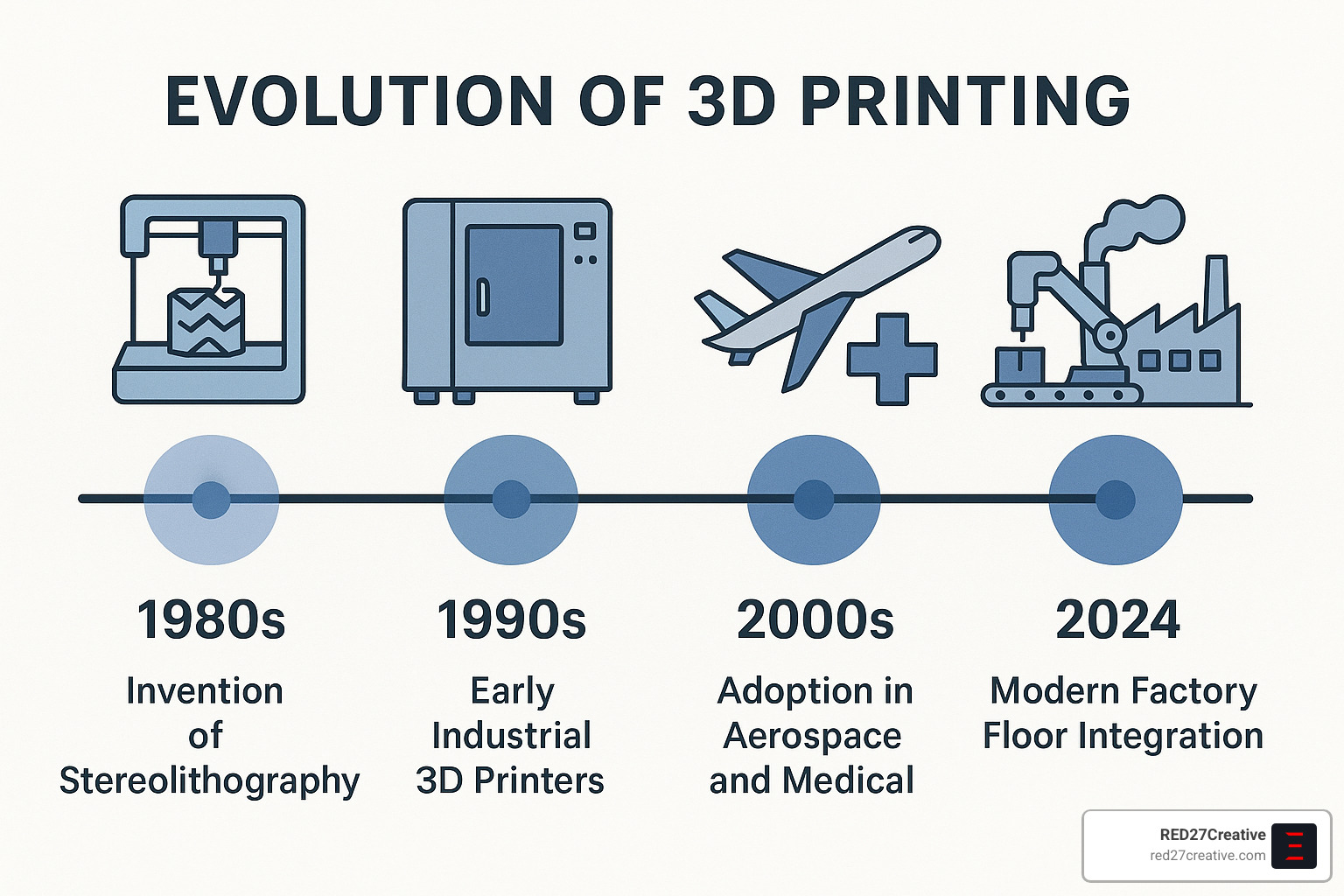
Since Chuck Hull invented stereolithography in the 1980s, the technology has grown up dramatically. What began as a quirky way to create simple prototypes has matured into a sophisticated manufacturing approach that’s creating everything from lightweight aerospace components to custom medical implants.
As one industry veteran put it: “3D printing has come a long way since it was first developed in the 1980s. Once limited to prototyping, it’s now used in the creation of everything from footwear and jewelry to automobile parts and even food.”
How Does It Work?
At its heart, 3D printing in manufacturing builds things layer by layer, but the magic happens in different ways depending on the technology:
Material extrusion (FDM/FFF) works like a precise hot glue gun, melting plastic filament and laying it down in exact patterns. Vat photopolymerization (SLA/DLP) uses light to selectively harden liquid resin, while powder bed fusion (SLS/DMLS/SLM) employs lasers or electron beams to melt powder particles together. Material jetting deposits tiny droplets of build material (think inkjet printer, but with materials instead of ink), and binder jetting sprays adhesive onto powder to create parts.
Most printed parts aren’t ready straight off the printer. They need post-processing—removing supports, curing to strengthen, or finishing techniques like sanding and polishing to achieve the desired look and performance.
The Journey from Prototype to Production
The evolution of 3D printing in manufacturing tells a fascinating story of technological maturation:
In the early days (1980s-2000s), 3D printing was the domain of rapid prototyping. Companies could quickly test designs without expensive tooling, but the parts weren’t durable enough for end use.
As the technology improved through the 2000s-2010s, we entered the bridge manufacturing phase. Manufacturers began using 3D printing for small production runs and to create parts while waiting for traditional tooling to be completed—bridging the gap between prototype and mass production.
Today, we’ve reached the era of direct digital manufacturing. 3D printing in manufacturing now creates end-use parts that go directly into products. Aerospace companies pioneered this shift, with Boeing and Airbus incorporating printed components into their aircraft.
A watershed moment came in 2016 when the FAA certified the first 3D-printed part for a commercial jet engine—proof that the technology had arrived for mission-critical applications. Since then, adoption has accelerated across industries.
As production engineer Brian Konkel explains: “It gives us the ability to quickly adapt to any suggestions and create geometries that we’re not traditionally able to manufacture.”
The journey from novelty to manufacturing necessity hasn’t always been smooth, but it’s been remarkable to witness. And for companies looking to stay competitive in today’s fast-moving marketplace, understanding how to leverage this technology has become essential.
Major 3D Printing Technologies & When to Use Them
The world of 3D printing in manufacturing is like a toolbox with many specialized tools. Each technology has its own magic touch, perfect for specific jobs. Understanding these differences isn’t just technical trivia—it’s the key to open uping the full potential of additive manufacturing for your specific needs.

Plastic Powerhouses (FDM, SLA, SLS)
When it comes to polymer printing, three technologies stand out as the workhorses of the industry.
Fused Deposition Modeling (FDM) is the friendly neighbor of 3D printing—approachable, affordable, and surprisingly capable. It works by melting plastic filament and carefully laying it down layer by layer. I’ve seen small businesses transform their operations with just a few FDM printers, creating custom fixtures that would have cost thousands to machine traditionally.
“FDM is a great option for quickly manufacturing replacement production tools and parts in high-performance thermoplastics that perform in the same way we would expect of a traditionally manufactured equivalent,” as one engineering services lead put it perfectly.
The beauty of Stereolithography (SLA) lies in its incredible detail. Using a laser to cure liquid resin, SLA creates parts with smooth surfaces and fine features that FDM simply can’t match. It’s the go-to for detailed prototypes, dental applications, and jewelry molds. The trade-off? The materials tend to be more brittle and sensitive to UV light.
Then there’s Selective Laser Sintering (SLS), which feels almost magical the first time you see it in action. A laser dances across a bed of powder, fusing particles into solid objects. The unfused powder supports the part during printing, which means you can create complex, interlocking designs without support structures. This makes SLS perfect for functional prototypes and end-use parts with complex geometries.
Metal & High-Performance Processes
When plastic won’t cut it, metal 3D printing steps into the spotlight.
Direct Metal Laser Sintering (DMLS) and Selective Laser Melting (SLM) create fully dense metal parts by fusing powder with a high-powered laser. These technologies have revolutionized industries like aerospace and medical, where complex, lightweight metal parts can justify the higher costs. I’ve held titanium implants and aerospace components that simply couldn’t exist without these processes—the complexity possible is mind-boggling.
Electron Beam Melting (EBM) takes a different approach, using an electron beam in a vacuum to fuse metal powder. It produces less residual stress than laser methods, making it ideal for titanium aerospace and medical parts. The trade-off is slightly lower resolution.
For repairs and large parts, Directed Energy Deposition (DED) shines. Imagine a high-tech welding process that can add material to existing parts or build large structures from scratch. I’ve seen DED save companies millions by repairing expensive components rather than replacing them. One aerospace company restored turbine blades that would have cost $25,000 each to replace for a fraction of that cost.
Picking the Right Process for Your Part
Choosing the right 3D printing in manufacturing technology isn’t just about technical specs—it’s about understanding your unique needs.
Start with your design requirements: How complex is your part? What level of detail do you need? A simple bracket might be perfect for FDM, while an intricate cooling channel might require DMLS.
Material properties matter tremendously. Need heat resistance? Mechanical strength? Biocompatibility? Each technology offers different material options with unique properties. For instance, SLS nylon parts offer excellent durability and chemical resistance, while DMLS can produce parts in medical-grade titanium.
Production volume and timeline will influence your choice too. For a handful of parts needed quickly, SLA might be perfect. For hundreds of end-use parts, SLS could be more cost-effective. For thousands, you might consider 3D printing your tooling rather than the parts themselves.
Budget considerations are always important. FDM offers the lowest entry point, while metal processes require significantly higher investment. However, when you factor in design freedom and part consolidation, more expensive processes might actually save money in the long run.
For regulated industries, certification requirements may narrow your options. Aerospace and medical applications often require extensive documentation and process control that not all technologies can provide.
As scientific research on powder-bed fusion continues to advance, we’re seeing these technologies become even more capable and reliable. The key is matching the right technology to your specific needs—something we’ve helped dozens of manufacturers steer successfully.
The best technology isn’t always the newest or most expensive—it’s the one that solves your specific manufacturing challenge while meeting your budget and timeline.
Benefits That Make 3D Printing the MVP
When it comes to modern manufacturing, 3D printing in manufacturing has truly earned its status as the Most Valuable Player. It’s not just another tool in the toolbox—it’s revolutionizing how we think about production from the ground up.
Speed, Cost & Sustainability Wins
Dramatic Lead Time Reduction
Remember waiting weeks for parts to arrive? Those days are quickly becoming history. 3D printing in manufacturing turns the traditional timeline on its head, compressing what used to take months into mere days or even hours.
I love sharing the story of engineers at the Advanced Manufacturing Research Centre who needed 500 high-precision drilling caps for Airbus. Instead of the usual weeks-long wait, they printed the entire batch in just three days. This kind of speed doesn’t just save time—it transforms how companies can respond to market opportunities and customer demands.
Cost Savings Across the Production Cycle
The financial benefits of 3D printing feel almost too good to be true until you see them in action. By eliminating expensive molds and dies (which can run into tens of thousands of dollars), reducing material waste to nearly zero, lowering labor costs, and shrinking inventory needs, the savings add up quickly.
Take Pankl Racing Systems, for example. By switching from machined jigs and fixtures to 3D printed alternatives, they slashed costs by an incredible 80-90%, putting $150,000 back in their pocket. Even Ford got in on the action, creating assembly lift assists for half the cost of conventional versions. These aren’t small savings—they’re game-changers for production economics.
Environmental Sustainability
In a world increasingly focused on sustainability, 3D printing in manufacturing delivers impressive green credentials. The process typically uses 90-98% of input material (compared to traditional methods that can waste the majority of raw materials), and parts can be designed up to 50% lighter with internal lattice structures. This weight reduction means less fuel consumption when these parts are used in vehicles or aircraft.
I’m particularly impressed by materials like HP’s High Reusability PA12, which achieves up to 80% powder reuse across production cycles. This kind of circular approach to manufacturing resources is exactly what our planet needs.

Supply-Chain Agility Powered by 3D Printing in Manufacturing
If the COVID-19 pandemic taught us anything, it’s that traditional supply chains can be remarkably fragile. 3D printing in manufacturing offers a compelling alternative that’s more resilient and adaptable.
Digital Inventory & On-Demand Production
Imagine replacing your warehouse full of physical parts with digital files that can be printed whenever needed. This isn’t science fiction—it’s happening now. Companies are eliminating storage costs, preventing parts from becoming obsolete, freeing up capital, and enabling true just-in-time production.
As one manufacturing director I spoke with put it: “Our digital inventory has turned our supply chain from a liability into a strategic advantage. We’re no longer guessing what parts we’ll need months in advance—we print exactly what’s needed, when it’s needed.”
Distributed Manufacturing Networks
One of the most exciting developments I’ve seen is the rise of distributed production networks. Instead of centralizing manufacturing in massive factories, 3D printing in manufacturing allows companies to produce parts close to where they’re needed. This cuts shipping costs, reduces carbon footprints, speeds up delivery, and even helps steer tariff barriers.
During the early days of the pandemic, this capability proved invaluable. I watched as local manufacturing hubs rapidly pivoted to produce essential medical supplies when global supply chains faltered. It was a powerful demonstration of how distributed manufacturing creates resilience.
Risk Mitigation
The flexibility of 3D printing provides insurance against a whole host of supply chain nightmares—from supplier disruptions to political instability, natural disasters, and parts obsolescence. When traditional suppliers can’t deliver, in-house printing capabilities can be a lifesaver.
For companies looking to pair their manufacturing innovations with equally forward-thinking marketing approaches, Marketing Automation for Manufacturing offers complementary digital solutions that can help spread the word about these capabilities.
Design Freedom & Part Consolidation
In my mind, the most thrilling aspect of 3D printing in manufacturing is the unprecedented design freedom it gives engineers and designers.
Complex Geometries
Traditional manufacturing methods come with a long list of “can’t do that” limitations. 3D printing tears up that list. Now, designers can create internal channels, organic shapes, and variable wall thicknesses that would be impossible with conventional approaches.
As my colleague in product design often says, “I used to design parts based on what was possible to manufacture. Now I design based on what the part needs to do.” This fundamental shift in thinking is open uping innovations across industries.
Part Consolidation
Perhaps nothing showcases the power of 3D printing in manufacturing better than part consolidation. By combining multiple components into a single printed piece, companies are dramatically simplifying assembly, eliminating potential failure points, reducing inventory complexity, and creating lighter, stronger parts.
My favorite example is a rocket injector head that was transformed from 248 separate machined parts into a single 3D-printed component. Just imagine the assembly time saved, not to mention the improvement in reliability when hundreds of potential failure points are eliminated.
Lightweighting Through Lattice Structures
When designers accept advanced design for additive manufacturing techniques, the results can be truly extraordinary. Internal lattice structures can reduce material usage by 30-70% while maintaining mechanical strength and improving thermal properties and energy absorption.
For aerospace and automotive applications, where every gram matters, these weight savings translate directly into fuel efficiency and performance gains that simply weren’t possible before.
The manufacturing world is changing rapidly, and 3D printing in manufacturing is leading the charge. As these benefits continue to multiply and technology advances, we’re only beginning to see what’s possible when production is reimagined from the ground up.
Applications & Industry Case Studies
3D printing in manufacturing isn’t just a theoretical advancement—it’s making real-world impacts across industries right now. Let’s explore how different sectors are putting this technology to work and the impressive results they’re achieving.
Sector Spotlights
The aerospace industry was among the first to accept this technology, and it’s easy to see why. Currently representing a hefty 16.8% of the $10.4 billion additive manufacturing market, aerospace companies are using 3D printing in manufacturing to revolutionize how aircraft components are made.
Boeing has already incorporated over 60,000 3D-printed parts across their aircraft, while Airbus has implemented more than 1,000 parts just on their A350 XWB. The star of the show? GE’s 3D-printed fuel nozzle for the LEAP engine—25% lighter and consolidated from 20 parts down to just one!
“The ability to create internal cooling channels that would be impossible with traditional manufacturing has been a game-changer for us,” notes an aerospace engineer. “We’re seeing parts that perform better while weighing significantly less.”
Meanwhile, the automotive industry is shifting into high gear with 3D printing in manufacturing. What started as a $1.4 billion segment in 2019 is projected to accelerate to $5.8 billion by 2025. BMW alone has printed over a million parts in the last decade, using the technology for everything from rapid prototyping to production components like the i8 Roadster’s roof bracket.
The medical sector is perhaps where the human impact is most profound. Representing about 11% of the additive manufacturing market, medical applications range from patient-specific implants to surgical guides that improve procedure outcomes. As of 2019, over 600,000 implants have been produced using 3D printing, with projections exceeding 4 million by 2027.
Industrial goods manufacturers aren’t being left behind either. French aerospace manufacturer Latécoère slashed their tooling lead times by an astonishing 95% and cut costs by 40% by adopting 3D printing in manufacturing—numbers that speak for themselves.
Mass Customization & On-Demand Production
Remember when “mass production” and “customization” were opposites? 3D printing in manufacturing is bridging that gap, creating a new paradigm: mass customization.
The dental industry offers the clearest example. Align Technology, maker of those popular clear aligners, reportedly produces over half a million unique 3D-printed aligners every day. Each one is completely customized to an individual patient’s mouth, yet they’re produced at a scale that was previously unimaginable for custom products.
Consumer products are getting the personalization treatment too. Adidas now produces midsoles custom to individual biomechanics, Gillette’s Razor Maker platform offers customized razor handles, and companies are creating everything from personalized eyewear frames to bicycle saddles designed for your unique body.
“Digital design changes alone enable mass customization without new tooling costs,” explains an industry expert. “When you eliminate the need for new molds or dies for each design variation, the economics of customization completely change.”
The on-demand aspect of 3D printing in manufacturing is equally transformative. Companies are replacing physical warehouses full of spare parts with digital warehouses—storing designs instead of products. When a part is needed, it’s printed where and when it’s required. This approach is particularly valuable for maintaining older equipment where traditional spare parts may no longer be available.
Real-World Results
The proof, as they say, is in the printing. Here are some concrete examples of 3D printing in manufacturing delivering remarkable results:
When Airbus needed 500 high-precision drilling caps quickly, engineers at the Advanced Manufacturing Research Centre turned to 3D printing. The result? Lead time slashed from weeks to just three days—keeping production schedules on track that would have otherwise derailed.
Pankl Racing Systems took a different approach, replacing traditionally machined jigs and fixtures with 3D printed alternatives. The payoff was impressive: 80-90% cost reduction, translating to $150,000 in savings. Beyond the financial benefits, they gained the agility to quickly iterate tool designs as needed.
Ford’s experience with a 3D-printed assembly lift assist tells a similar story—50% cost reduction compared to conventional methods, significantly shorter lead times, and a lighter design that improved worker ergonomics. It’s a perfect example of how 3D printing in manufacturing can deliver benefits that extend beyond the balance sheet.
These aren’t isolated success stories. Across industries, companies are finding the competitive advantages that 3D printing in manufacturing brings to the table. From slashing lead times and reducing costs to enabling previously impossible designs, the technology is proving its value day after day in real production environments.
For companies in Asia and other international markets, these benefits translate across languages and borders. Resources are available in multiple languages including 中文(简体) APAC中文(简体)日本語 (日本)한국어(대한민국)English (India) to help global manufacturers implement these solutions.
Challenges, Limitations & Future Outlook
While 3D printing in manufacturing brings exciting possibilities to the production floor, it’s not without its problems. Let’s explore the challenges companies face today and the promising developments on the horizon.
Problems on the Road to Scale
If you’ve ever wondered why all manufacturing hasn’t switched to 3D printing, the answer lies in several practical challenges that teams face when scaling beyond prototyping.
Working with powdered metals requires specialized handling procedures that many traditional manufacturers find daunting. The fine metal powders used in processes like DMLS can be both hazardous and tricky to manage consistently. As one production manager told me, “The first time you see how carefully these materials need to be handled, you understand why this isn’t yet mainstream.”
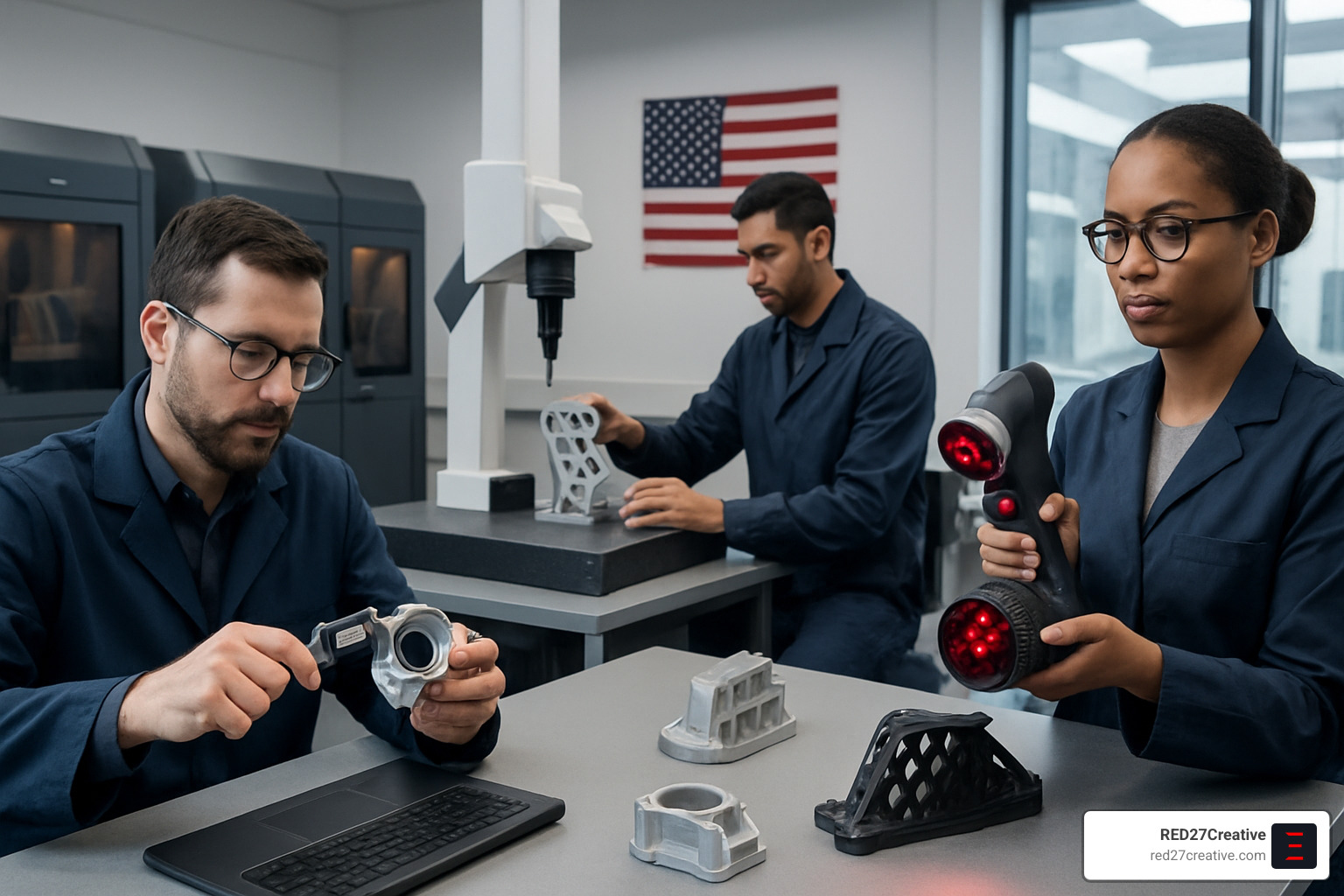
Porosity remains another significant concern, especially in critical applications. Those tiny air pockets that can form during printing might seem insignificant, but in aerospace or medical parts, they can spell disaster. Companies must invest in sophisticated scanning equipment to verify internal structures meet stringent requirements.
The certification journey is perhaps the most time-consuming hurdle of all. Aerospace manufacturers seeking FAA approval or medical device companies pursuing FDA clearance often spend years validating their 3D printing processes. Each material, printer, and part combination essentially needs its own validation pathway.
“The paperwork weighs more than the parts,” joked one aerospace engineer I spoke with about their certification experience.
When it comes to economics, the comparison with traditional manufacturing methods becomes more complex at scale. While a 3D-printed part might cost $50 regardless of whether you make one or one thousand, injection molding might cost $20,000 for tooling but only $1 per part after that. This crossover point means 3D printing in manufacturing makes perfect sense for low to medium volumes but loses its economic advantage in mass production scenarios.
The Future of 3D Printing in Manufacturing
Despite these challenges, the trajectory for additive manufacturing looks remarkably bright. The technology is evolving rapidly, with several game-changing developments on the horizon.

Automation is changing what was once a labor-intensive process. Next-generation systems now incorporate AI-driven monitoring that can detect and correct defects in real-time. This means fewer failed builds and more consistent quality—critical factors for production environments. One manufacturer I visited recently showed me how their system automatically adjusts laser parameters when it detects thermal variations, something that previously required expert intervention.
Bio-printing represents one of the most exciting frontiers, with researchers making remarkable progress in printing living tissues. While fully functional 3D-printed organs remain on the horizon, simpler structures like cartilage are already becoming reality.
Multi-material printing capabilities are expanding rapidly too. Imagine printing a product with rigid structural elements, flexible joints, and conductive circuits all in a single build. This capability is beginning to emerge from research labs into commercial applications, promising to revolutionize electronics manufacturing in particular.
Sustainability is driving material innovation as well. New feedstocks derived from renewable resources are replacing petroleum-based polymers. One company I spoke with has developed a printing material made entirely from agricultural waste that performs comparably to traditional ABS plastic but with a 70% smaller carbon footprint.
The concept of distributed micro-factories is perhaps the most transformative trend. Rather than massive centralized production facilities, 3D printing in manufacturing enables networks of smaller, more flexible production nodes located closer to customers. This approach dramatically reduces shipping costs and carbon emissions while improving responsiveness to local market needs.
From Pilot to Plant-Floor Dominance
The journey from experimental 3D printing projects to mainstream manufacturing adoption requires thoughtful strategy and organizational commitment.
Design for Additive Manufacturing (DfAM) education represents the most critical investment companies can make. Traditional engineers trained in conventional manufacturing methods often design parts that don’t leverage 3D printing’s unique capabilities. As one design engineer told me, “I spent twenty years learning what couldn’t be made. Now I’m relearning everything from scratch.”
Hybrid manufacturing workflows that combine additive and subtractive processes offer a practical transition path. Rather than viewing 3D printing as a replacement for traditional methods, forward-thinking companies integrate it where it adds the most value. For example, complex internal structures might be 3D printed, then finished with high-precision CNC machining for critical mating surfaces.
Strategic partnerships prove invaluable during this transition. Companies rarely succeed in isolation—they need material suppliers, equipment manufacturers, and service providers working together to solve implementation challenges. Industry consortia like America Makes facilitate these connections while advancing standards development.
Government incentives are accelerating adoption in many regions. Countries worldwide recognize 3D printing in manufacturing as a strategic technology and offer tax benefits, grants, and other support to companies investing in these capabilities. Smart manufacturers are leveraging these programs to offset implementation costs.
For companies looking to develop comprehensive marketing strategies alongside their manufacturing innovations, Lead Generation for Manufacturing Companies offers valuable approaches to connect with potential customers while showcasing technological capabilities.
The path forward isn’t about whether 3D printing will transform manufacturing—it’s about how quickly companies can adapt to this new reality. Those who master these capabilities now will find themselves with a substantial competitive advantage as the technology continues its march toward the manufacturing mainstream.
Frequently Asked Questions about 3D Printing in Manufacturing
What is 3D printing and how does it work in manufacturing?
When people ask me about 3D printing in manufacturing, I explain it as a bit like building a layered cake—except instead of flour and sugar, we’re using industrial materials to create physical objects from digital blueprints.
Unlike traditional manufacturing that carves away material (like sculpting from a block of marble), 3D printing adds material only where it’s needed, layer by layer. It all starts with a digital design created in CAD software. This design gets “sliced” into hundreds or thousands of thin horizontal layers—think of it as creating a topographic map of your part.
The printer then follows this digital recipe, either squeezing out melted plastic through a nozzle (FDM), curing liquid resin with light (SLA), or using lasers to fuse powder particles (SLS/DMLS). What makes this approach is how it enables shapes that would be impossible to create any other way, while dramatically reducing material waste and eliminating the need for expensive tooling.
I’ve seen companies transform their production floors with these machines, using them for everything from quick prototypes to custom jigs and fixtures to actual end-use parts that go into products.
How does 3D printing cut costs compared to traditional methods?
The cost savings from 3D printing in manufacturing often surprise people when they see the numbers. I remember visiting a facility where they showed me a part that would have cost $15,000 and taken six weeks to produce traditionally—they printed it for $1,200 in just two days!
These savings come from several directions at once. First, you can skip the expensive tooling—no more waiting months and spending tens of thousands on molds or dies before making a single part. For companies like Pankl Racing Systems, this meant slashing tooling costs by 80-90%, saving them $150,000.
Then there’s the material efficiency. Traditional machining can waste up to 90% of your raw material as chips and scrap, while 3D printing uses just what you need for the part itself. Ford finded this when they 3D printed assembly aids for half the cost of conventional versions.
The savings multiply when you consolidate parts. I’ve seen complex assemblies with dozens of components reimagined as single 3D-printed pieces, eliminating assembly time, reducing inventory, and removing potential failure points at every connection.
Perhaps most valuable is the on-demand production capability—imagine replacing your warehouse of rarely-used spare parts with digital files you can print exactly when needed. No more carrying costs, obsolescence risks, or capital tied up in inventory.
Can 3D printing meet sustainability goals in manufacturing?
When it comes to sustainability, 3D printing in manufacturing feels like it was designed with green principles in mind from the start. I’ve worked with companies whose environmental teams initially skeptical about adding new technology became its biggest champions once they saw the numbers.
The material efficiency alone makes a compelling case—typically using 90-98% of input material compared to traditional methods that might waste more than half. One manufacturer showed me their before-and-after waste bins, and the difference was striking.
Design optimization is another sustainability superpower. By creating lighter parts with internal lattice structures or topology optimization, products require less material and consume less energy throughout their lifecycle. I’ve seen aerospace components redesigned to be 50% lighter while maintaining the same strength.
The distributed production model reduces transportation emissions significantly. Instead of shipping parts around the world, companies can send digital files and produce locally—cutting thousands of miles from their supply chains.
Many 3D printing materials are designed for reusability, with some powder systems achieving up to 80% reuse rates. The development of bio-based and recycled materials is accelerating too, further improving the environmental profile.
Perhaps most impactful is how 3D printing extends product lifecycles. I’ve watched technicians repair high-value components that would have otherwise been scrapped, adding years of service life with minimal material input. For companies balancing business goals with environmental commitments, these capabilities offer a rare win-win.
Conclusion
3D printing in manufacturing has come a long way from its humble beginnings as a quirky prototyping technology. Today, it stands as a genuine game-changer that’s reshaping production landscapes across industries. The benefits we’ve explored throughout this guide aren’t just incremental improvements—they’re transformative advantages that can fundamentally change how companies approach design, production, and delivery.
Think about it: slashing lead times from weeks to days, cutting costs by up to 90% on certain applications, creating previously impossible geometries, and building resilience into vulnerable supply chains. These aren’t just nice-to-haves in today’s competitive manufacturing environment—they’re becoming must-haves.
What’s particularly exciting is seeing how companies across sectors are already putting these advantages to work. Aerospace giants are flying planes with 3D-printed components that are lighter and more efficient. Automotive manufacturers are streamlining production with custom tooling that costs a fraction of traditional methods. Medical device companies are creating personalized implants that fit patients perfectly. And consumer brands are offering mass customization that was economically impossible just a few years ago.
The journey is far from over, though. As automation continues to streamline workflows, as material science open ups new possibilities, and as artificial intelligence optimizes designs and processes, 3D printing in manufacturing will only become more powerful. The smart companies aren’t asking if they should adopt this technology—they’re asking how quickly they can integrate it into their production ecosystem to gain competitive advantages.
At RED27Creative, we see clear parallels between how 3D printing is revolutionizing production and how digital marketing is changing how manufacturers connect with their markets. Both require embracing new technologies and approaches to stay competitive. Both demand strategic implementation rather than blind adoption. And both deliver remarkable results when done right.
If you’re looking to showcase your manufacturing innovations and technological capabilities to potential customers, our social media content creation services can help you tell that story effectively across digital channels.
The future of manufacturing truly is being built layer by layer. The companies that accept this digital change—that learn to leverage its unique capabilities rather than force it into traditional manufacturing paradigms—will be the ones best positioned to thrive in an increasingly competitive global marketplace. The revolution is here, and it’s printing its way to success, one layer at a time.

Kiel Tredrea
https://red27creative.comTop Marketing Agency • Web, SEO & Leads • RED27Creative