Campaign Like a Champ: Google Ads Management Made Easy
Winning Online: Why Google Ads Campaign Management Matters
Have you ever launched a Google Ads campaign with high hopes, only to watch your budget disappear faster than free donuts in an office break room? You’re definitely not alone.
Google Ads campaign management is the art and science of creating, optimizing, and nurturing your paid search campaigns to maximize both visibility and return on investment. It’s like tending a garden – with the right care and attention, your campaigns can flourish and bear fruit in the form of quality leads and sales.
The foundation of effective management starts with understanding the essentials. Your account has a clear hierarchy – campaigns at the top, followed by ad groups, keywords, and finally the ads themselves. Each campaign type (Search, Display, Shopping, Video, or Performance Max) serves a unique purpose in your marketing strategy. Success depends on watching the right metrics: CTR, CPC, conversion rates, Quality Score, and ROAS tell the story of your campaign’s health.
For mid-sized accounts, expect to invest about 4-10 hours weekly on management tasks like monitoring performance, refining negative keywords, and testing different ad variations. This time investment makes all the difference between wasted spend and profitable results.
“If you spend $1 and make $5, it’s worth it every time.” — Jeff Hirz
This simple math explains why proper management matters so much. In fact, businesses with well-optimized Google Ads campaigns can see up to a 600% increase in lead conversions. That’s not just impressive – it’s transformative for your bottom line.
One of the biggest advantages of Google Ads over organic SEO is speed. While organic efforts might take months to show results, a well-managed ads campaign can drive qualified traffic to your website immediately. But here’s the catch – only when managed correctly. The platform’s complexity often leads to costly mistakes: wasted spend, irrelevant clicks, and missed opportunities.
Effective Google Ads campaign management isn’t just about creating clever ads. It’s about:
- Strategic organization of your campaigns
- Continuous optimization based on performance data
- Smart, data-driven decision making
- Selecting the right campaign types for your goals
- Refining audience targeting to reach the right people
Every detail matters when you’re trying to transform your advertising budget into measurable business growth.
Hi there! I’m Kiel Tredrea, founder of RED27Creative. With over 20 years in the trenches implementing high-impact Google Ads campaign management strategies, I’ve helped countless B2B and B2C businesses drive measurable revenue and sustainable growth through strategic paid search.
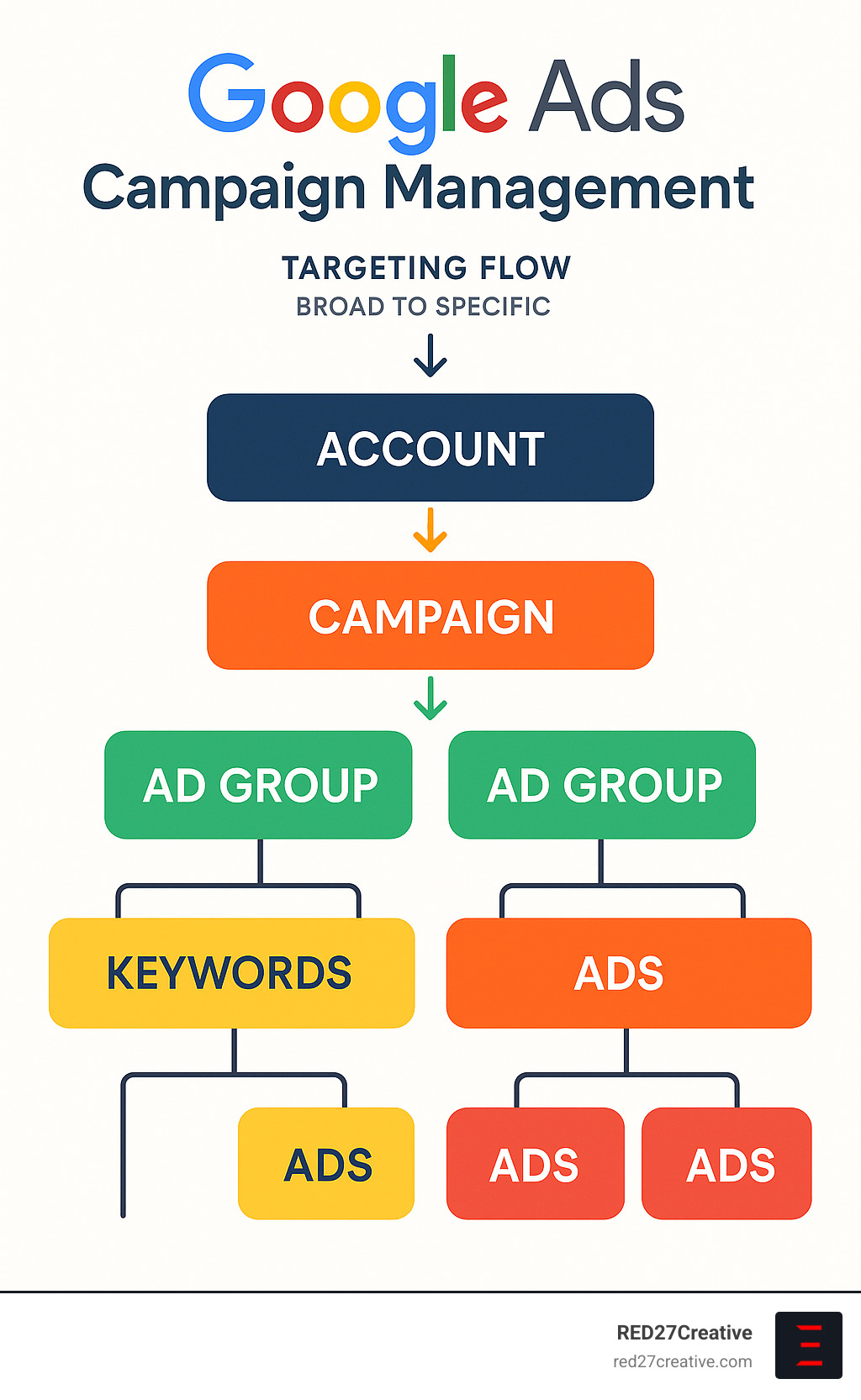
The visual above illustrates how your Google Ads account flows from broad targeting at the campaign level down to specific messaging in your ads. This structured approach is essential for creating campaigns that connect with your audience and deliver measurable results.
Ready to stop watching your ad budget disappear and start seeing real returns? Let’s dig deeper into the strategies that make Google Ads campaign management truly effective for businesses of all sizes.
Google Ads Campaign Management 101
At its core, Google Ads campaign management involves the art and science of organizing, monitoring, and optimizing your paid advertising efforts on Google’s platform. It’s not just setting up ads and forgetting about them—it’s an ongoing process that requires attention and refinement to achieve the best possible results within your budget.
Google Ads operates on a fascinating auction-based model where advertisers bid on keywords relevant to their business. But here’s the interesting part—it’s not just about who throws the most money at Google. The platform also considers the quality and relevance of your ads through a metric called Quality Score, which rewards advertisers who create helpful, relevant ad experiences.
Why It Matters for Every Business
Whether you’re a cozy local shop in Geneva IL or a busy enterprise in Chicago, effective Google Ads campaign management delivers benefits you simply can’t ignore:
Immediate Lead Generation comes first on the list of advantages. Unlike SEO, which often feels like watching paint dry as you wait months for results, Google Ads can drive qualified traffic to your website within hours of launching a campaign. It’s like turning on a faucet of potential customers.
Improved Brand Visibility happens instantly when you appear at the top of search results. Did you know that over 80% of search results now contain Google Ads placements? These can cover up to 85% of the space above the fold—prime real estate that your competitors are probably already occupying.
Speed-to-Market gives you a competitive edge when you need to promote a new service or product quickly. While your competitors are still planning their organic strategy, you’re already connecting with customers.
Precise Targeting lets you zero in on potential customers based on location, device, time of day, and even previous interactions with your brand. It’s like having a heat-seeking missile for finding your ideal customers.
Measurable ROI means every dollar you spend can be tracked and measured, allowing for truly data-driven decisions. No more guessing what’s working!
I remember a client in Naperville IL who came to us after burning through $3,000 monthly with minimal returns. After implementing proper Google Ads campaign management strategies, we increased their conversion rate by 142% while reducing their cost-per-conversion by 48%. That’s the difference professional management makes.
Core Building Blocks
Understanding the structure of Google Ads is like knowing the anatomy of a car before trying to drive it—absolutely crucial for success:
Account sits at the top level, housing all your campaigns, billing information, and access settings. Think of it as your business headquarters in the Google Ads world.
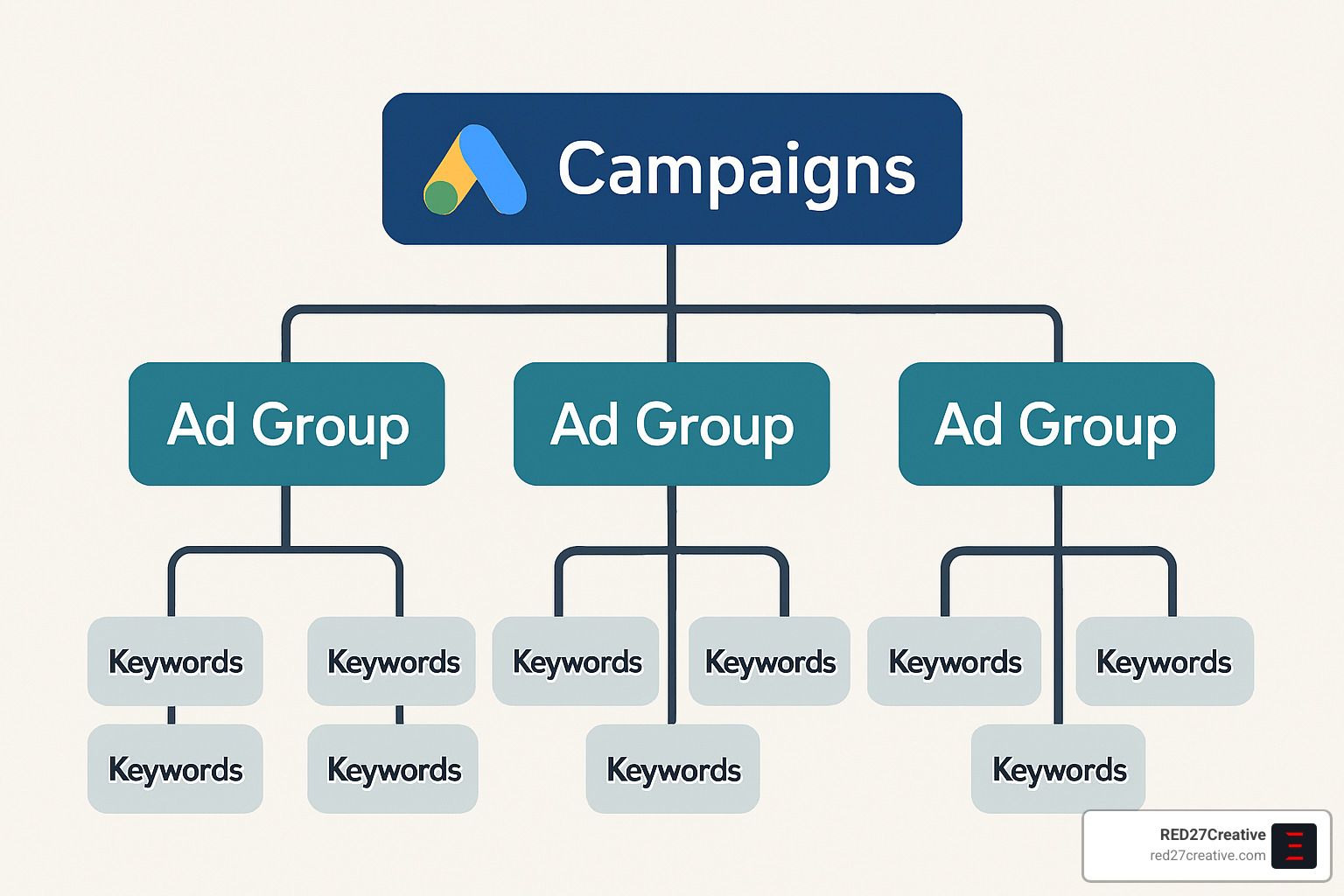
Campaigns are sets of ad groups sharing a budget, location targeting, and other settings. Each campaign should focus on a specific business goal or product/service category. For example, you might have separate campaigns for “Emergency Plumbing Services” and “Bathroom Remodeling.”
Ad Groups collect similar ads and related keywords together. Well-organized ad groups improve Quality Score and campaign performance. It’s like sorting your tools before starting a project—everything works better when properly organized.
Keywords are the search terms you bid on to trigger your ads. Choosing the right keywords connects you with users actively searching for what you offer. They’re the bridges between your customers’ needs and your solutions.
Ads are your actual text, image, or video advertisements shown to users. Compelling ad copy with clear calls-to-action drives clicks and conversions. This is where creativity meets strategy.
When to Use Each Campaign Type
Google offers several campaign types, each designed for specific advertising goals—like having different tools for different jobs:
Search Campaigns display text ads in Google search results. They’re ideal for capturing high-intent users actively searching for your products or services. This is the bread and butter for most businesses in Aurora IL and St. Charles IL looking to generate immediate leads. If someone is searching “emergency plumber near me,” you want to be there!
Display Campaigns show visual ads across Google’s network of partner websites. They’re best for brand awareness, remarketing, and reaching users earlier in the buying cycle. Think of them as billboards on the digital highway.
Shopping Campaigns feature product listings with images, prices, and store information. They’re essential for e-commerce businesses selling physical products, letting customers see what you’re selling before they even click.
Video Campaigns run before or during YouTube videos. They’re excellent for storytelling, demonstrations, and building brand awareness. Nothing beats video for showing how your product works or sharing customer testimonials.
Performance Max is Google’s newest AI-driven campaign type that runs across all Google properties. It’s useful for advertisers seeking to leverage Google’s machine learning to find customers wherever they are—letting the algorithm do the heavy lifting.
For businesses in Plainfield IL and Oswego IL, we typically recommend starting with Search campaigns to capture immediate demand, then expanding to other campaign types as you gather data and grow your advertising efforts.
Managing Google Ads accounts at scale? You might benefit from Manager Accounts (MCC), which allow you to oversee multiple Google Ads accounts from a single dashboard. Learn more about setting these up on the Manager Accounts (MCC): Create a Google Ads manager account page.
Looking to integrate your Google Ads strategy with broader marketing initiatives? Check out our comprehensive guide to Marketing Strategies that can complement and improve your paid search efforts.
Architecting & Launching Your Campaigns
Proper campaign architecture is the foundation of successful Google Ads campaign management. Think of it as building a house – without a solid foundation, everything else will eventually crumble. A well-structured account makes it so much easier to track where your money is going, see what’s working, and make smart decisions based on real data.
When I work with clients, I always recommend organizing campaigns based on your actual business structure. For instance, if you run a home services company in Batavia IL, you might create separate campaigns for your main service categories:
– Campaign 1: Plumbing Services
– Campaign 2: HVAC Services
– Campaign 3: Electrical Services
Then within each campaign, you’ll want to create tightly themed ad groups. For your plumbing campaign, this might look like ad groups for Emergency Plumbing, Bathroom Plumbing, and Kitchen Plumbing. This neat organization isn’t just for show – it actually allows you to create super relevant ads and improves your Quality Score, which can lower what you pay per click while boosting where your ads appear.
“Advice from Google Ads is like advice from a stranger—take it with a grain of salt.”
I can’t stress enough how important consistent naming conventions are, especially as your account grows. Without them, you’ll quickly find yourself lost in a maze of campaigns. We typically recommend using a format like:
[Location] - [Service] - [Campaign Type] - [Targeting Method]
For example: “Chicago IL – Plumbing – Search – Exact Match”
Google Ads Campaign Management in Action: Step-by-Step Setup
Let me walk you through setting up a campaign for a business in Chicago IL – it’s simpler than you might think:
First, set your budget. I usually recommend starting with at least $10-20 per day so you can gather meaningful data. Don’t worry – you can adjust this anytime as you learn what works.
Next, choose your bidding strategy. If you’re just getting started, “Maximize Clicks” is a friendly option to build traffic. If you’ve set up conversion tracking (and you should!), “Maximize Conversions” lets Google do some of the heavy lifting for you. As you gather more data, you can graduate to more sophisticated strategies like Target CPA or ROAS.
For geographic targeting, be thoughtful about where your customers actually are. A neighborhood bakery might focus on specific ZIP codes in Naperville IL, while an online store might target the entire country.
When it comes to ad scheduling, think about when your customers are looking for you. If you’re a B2B company, business hours make sense. But if you’re a restaurant, evenings and weekends might be your sweet spot.
For networks, most local businesses do best starting with Search Network only – it’s more straightforward and typically delivers more immediate results.
When creating ad groups, less is more. Develop tightly themed groups with 15-20 closely related keywords at most. This focus helps your ads stay relevant to what people are searching for.
Don’t skimp on writing compelling ads! Create at least 3 different variations per ad group to see what messaging connects best with your audience. What you think will work isn’t always what actually works – let the data guide you.
Finally, set up conversion tracking from day one. Without it, you’re essentially driving blindfolded. Track those key actions like form submissions, phone calls, or purchases so you can measure your actual return on investment.
Keyword & Match-Type Mastery
Keywords are where the rubber meets the road in Search campaigns. Google’s Keyword Planner is your friend here – use it to find relevant terms and get a sense of traffic and competition.
There are three main match types, and each serves a different purpose:
Broad Match casts the widest net, showing your ads for variations and related searches. It’s like fishing with a wide net – you’ll catch a lot, but not all will be what you’re looking for. Use it cautiously and always pair it with negative keywords to filter out irrelevant searches.
Phrase Match strikes a nice balance, triggering ads when searches include your keyword phrase in the same order, even with additional words before or after. It gives you more control while still reaching a good audience.
Exact Match is your precision tool, showing ads only when someone searches for your exact keyword or very close variations. This typically delivers the highest quality traffic but lower volume.
For most businesses in Geneva IL and surrounding areas, I’ve found a mix of match types works best, with an emphasis on phrase and exact match for better control. Don’t overlook long-tail keywords (those longer, more specific phrases) – they often have less competition and lower cost, while showing higher purchase intent. Someone searching for “emergency plumber in St. Charles IL open now” is clearly ready to hire, compared to someone simply searching “plumber.”
Crafting Compelling Ads & Extensions
Responsive Search Ads (RSAs) have become the standard in Google Ads, and for good reason. They let you create multiple headlines and descriptions that Google mixes and matches to find winning combinations.
For the best RSAs, aim to:
– Write at least 8-10 unique headlines that speak to different selling points
– Include your keywords in at least 2 headlines
– Create 3-4 distinct descriptions that highlight benefits, not just features
– Always include a clear call-to-action that tells people what to do next
Ad extensions are like free real estate – they expand your ads with additional information and links, making your ads more visible and giving people more ways to connect with you. The must-have extensions include:
Sitelink Extensions add extra links to specific pages on your website – perfect for highlighting services, specials, or your “About Us” page. Callout Extensions let you showcase special offers or unique selling points in a concise way. Structured Snippet Extensions highlight specific aspects of your products or services in an organized format.
For local businesses, Call Extensions add your phone number to ads for easy calling (especially important on mobile), while Location Extensions display your business address to help customers find you.
For a local business in Aurora IL, implementing call and location extensions can make a world of difference – they remove friction by making it super easy for potential customers to either call or visit you right from the ad.
More info about Google Paid Search (PPC)
Optimization, Automation & Cost Control
Successful Google Ads campaign management doesn’t end with campaign launch—it’s an ongoing process of testing, learning, and refining. At RED27Creative, we’ve found that the most successful campaigns are those that are actively managed and optimized. Think of your campaign as a garden that needs regular tending, not a “set it and forget it” endeavor.
Lowering CPC & Improving ROI
One of the most common challenges businesses face is high cost-per-click (CPC). I’ve seen the frustration on clients’ faces when they realize they’re paying $10+ per click in competitive industries. The good news? There are proven strategies to reduce costs while maintaining or improving results.
Aggressive Negative Keyword Implementation is like weeding your garden. Regularly review your Search Terms report to identify and exclude irrelevant searches. For a client in Plainfield IL, adding 50+ negative keywords reduced wasted spend by 23% in the first month. It’s oddly satisfying to block those irrelevant clicks!
Bid Adjustments give you surgical precision with your budget. Modify bids based on performance data across devices, locations, time of day, and demographics. For example, if mobile users convert at half the rate of desktop users, consider reducing mobile bids by 50%. One retail client finded their ads performed 40% better on weekends—so we increased weekend bids and decreased weekday bids, resulting in more sales without increasing the budget.
Device Optimization can reveal surprising patterns. Analyze performance across devices and adjust accordingly. For B2B clients in Chicago IL, we often see better conversion rates on desktop, while local service businesses may perform better on mobile. Your audience’s device preferences matter!
Quality Score Improvements often deliver the biggest bang for your buck. Focus on increasing your Quality Score by improving ad relevance, expected CTR, and landing page experience. A one-point improvement in Quality Score can reduce CPC by up to 16%. It’s like getting a permanent discount on every click.
Ad Testing should be ongoing, not a one-time effort. Continuously test different ad variations to improve click-through rates (CTR). Higher CTR generally leads to better Quality Scores and lower costs. One headline change increased a client’s CTR by 27%—sometimes the smallest tweaks yield the biggest results.
A home services client in St. Charles IL saw their average CPC decrease from $7.23 to $4.89 after three months of implementing these optimization strategies, while conversion volume increased by 31%. They were thrilled to get more leads while spending less per acquisition.
Leveraging Automation Safely
Google has invested heavily in automation and machine learning. When used correctly, these tools can improve your Google Ads campaign management efforts—but I always caution clients that automation requires supervision. Think of Google’s automation as a talented but sometimes overeager intern.
Smart Bidding strategies like Target CPA, Target ROAS, and Maximize Conversions use machine learning to optimize bids in real-time. However, they require sufficient conversion data to perform well (typically at least 30 conversions in the past 30 days). I’ve seen Smart Bidding work wonders for established accounts but fall flat for new campaigns with limited data.
Automated Rules are like having a vigilant assistant working 24/7. Set up rules to automatically adjust bids, pause underperforming keywords, or increase budgets for high-performing campaigns based on specific conditions. One client’s weekend emergency service ads automatically increase bids by 20% when temperatures drop below freezing—perfect for a plumbing company!
Google Ads Editor is a desktop application that allows for bulk changes and campaign management, saving significant time for larger accounts. It’s like having power tools instead of manual screwdrivers for your account work.
Budget Alerts keep you informed without requiring constant monitoring. Set up email notifications for significant budget or performance changes. One client avoided a potential $3,000 overspend when they received an alert about unusual spending patterns caused by a competitor repeatedly clicking their ads.
While automation can improve efficiency, it’s important to maintain human oversight. As one client in Naperville IL learned, blindly accepting all of Google’s automated recommendations led to a 40% increase in spend with minimal improvement in results. Google’s suggestions often favor increased spending—remember, they’re in the business of selling clicks!
“There’s no such thing as ‘passive income’ when running and managing Google Ads campaigns.”
When to Scale
Knowing when and how to scale your Google Ads campaigns is crucial for sustainable growth. It’s like knowing when a plant is ready to be moved to a bigger pot—timing matters!
Consistent Conversion Performance is your first green light. Look for stable conversion rates and cost-per-acquisition over at least 2-4 weeks. Fluctuations are normal, but you want to see a reliable pattern before investing more.
Strong ROAS (Return on Ad Spend) is another positive indicator. If your campaigns are consistently achieving or exceeding your target return, it’s a good sign you can scale. One e-commerce client maintained a 400% ROAS even as we doubled their monthly budget—that’s the dream scenario!
Budget Constraints can actually be a positive sign. If your campaigns are limited by budget (spending their full daily budget before the end of the day) and performing well, increasing budget can capture additional conversions. It’s like having a lemonade stand that sells out by noon—time to make more lemonade!
Impression Share Opportunity reveals untapped potential. If your impression share is below 70-80%, there’s room to capture more of your target audience. One B2B client was only showing for 45% of eligible searches—we increased their budget gradually and captured valuable leads they were previously missing.
For a retail client in Chicago IL, we gradually increased daily budget from $100 to $350 over three months as performance data justified the expansion, resulting in a 240% year-over-year revenue increase with maintained ROAS. Their growth was steady and sustainable, not a sudden budget explosion that could have destabilized performance.
The Recommendations page in Google Ads can provide helpful suggestions, but always evaluate them critically. Google’s AI is incredibly smart, but it doesn’t understand your business goals the way you do.
More info about Scoring Traffic Sources for Better ROI
Measuring Success: Tracking, Reporting & FAQ
Effective Google Ads campaign management is a bit like cooking—without tasting as you go, you’ll never know if you’re on the right track. Let’s explore how to properly measure your campaign’s success and avoid common pitfalls that might drain your budget.
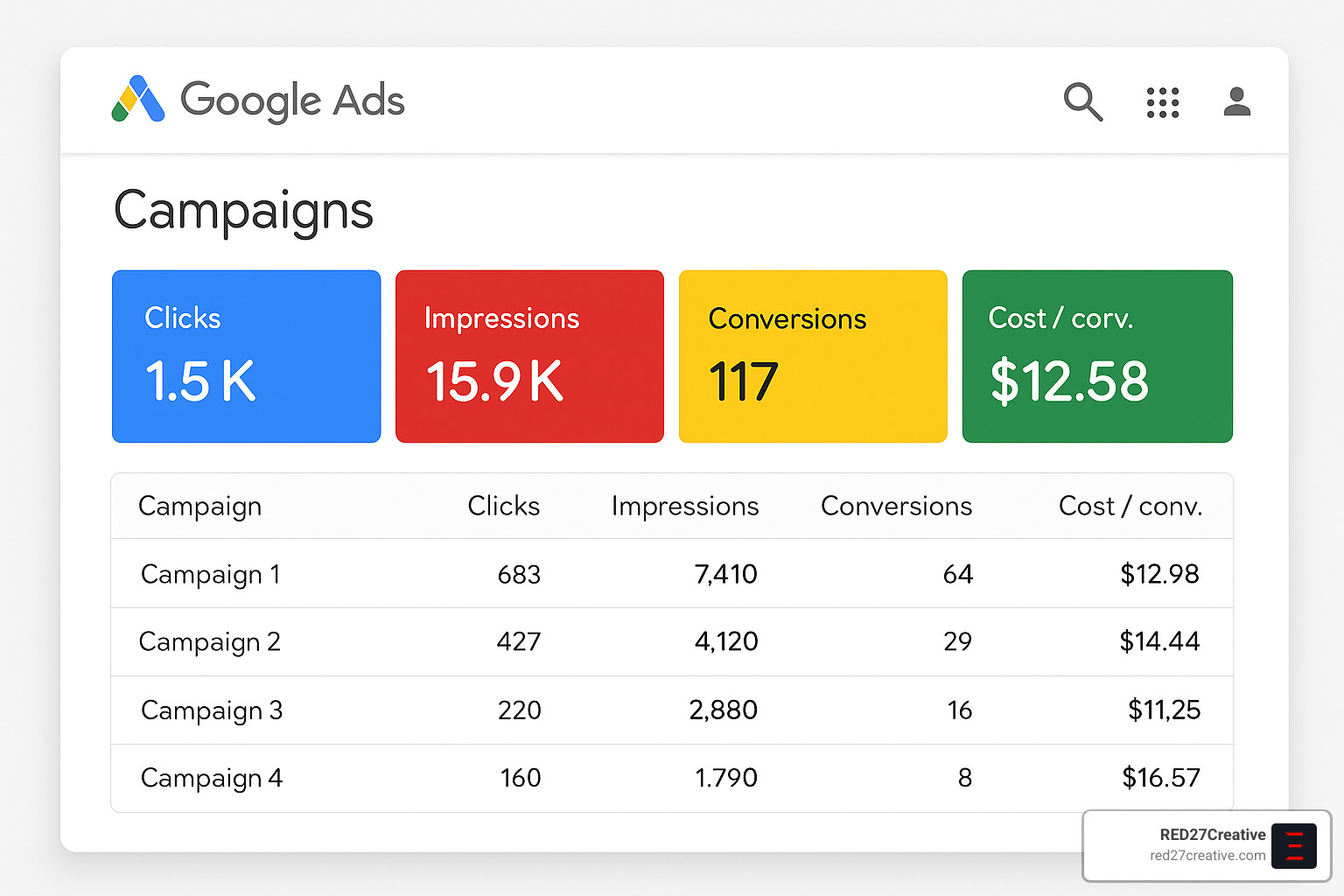
Google Ads Campaign Management KPIs You Must Watch
Think of these key performance indicators as your campaign’s vital signs—they tell you whether your ads are thriving or need immediate attention:
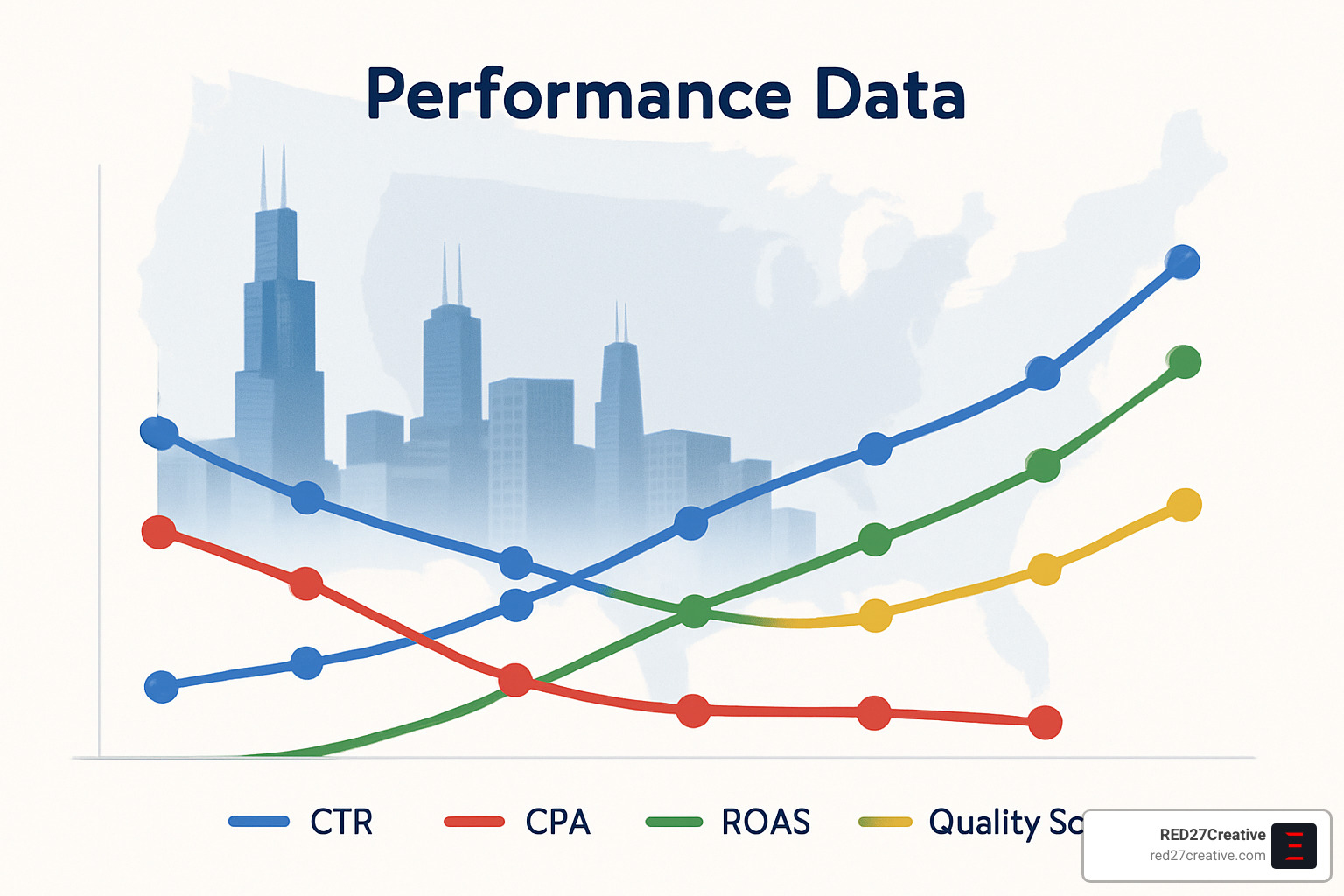
Click-Through Rate (CTR) reveals how compelling your ads are to your audience. When someone sees your ad and thinks “Yes, that’s exactly what I need!”—they click. A healthy CTR typically ranges from 3-5% for Search campaigns, though this varies by industry. I’ve seen local service businesses in Geneva IL achieve CTRs above 7% with highly targeted ads.
Cost Per Click (CPC) is simply what you’re paying for each visitor. Like buying tickets to a party, you want to make sure the experience is worth the admission price. Keep a close eye on how your CPC trends over time—unexpected increases often signal problems that need addressing.
Conversion Rate measures how many visitors take meaningful action on your site. The average across industries hovers around 3.75%, but I’ve seen well-optimized campaigns for businesses in Aurora IL reach 8-10% when everything aligns perfectly.
Cost Per Acquisition (CPA) tells you how much you’re spending to gain a customer or lead. This number should make business sense—if you’re selling a $50 product but spending $75 to acquire each customer, something needs to change quickly!
Return On Ad Spend (ROAS) is the golden metric for many businesses. A 400% ROAS means every dollar you invest returns $4 in revenue—pretty nice math! For most of our clients, we aim for at least 300% ROAS to ensure healthy profitability.
Impression Share reveals missed opportunities. If you’re only capturing 50% of possible impressions, you’re potentially missing half your market. This often happens due to budget constraints or poor ad rank.
Quality Score is Google’s 1-10 rating of your keywords and ads. Think of it as your credit score for Google Ads—higher scores get you better positions at lower prices. For a financial services client in Oswego IL, improving Quality Score from 5/10 to 7/10 cut their CPA nearly in half while maintaining lead volume.
Troubleshooting & Avoiding Pitfalls
Even the best campaigns hit rough patches. Here’s how to steer the most common roadblocks:
When you face ad disapprovals, don’t panic. Review Google’s policies carefully—common triggers include prohibited content, trademark issues, or claims that seem misleading. Sometimes a simple wording change is all you need. If you believe the disapproval was a mistake, don’t hesitate to appeal—I’ve seen many legitimate ads reinstated this way.
Learning phase fluctuations can be frustrating but are completely normal. When you make significant changes to campaigns using automated bidding, Google enters a “learning phase” where performance might swing wildly. Patience is key here—allow 2-4 weeks between major changes for the system to find its footing again.
Budget caps and pacing issues often lurk undetected. If your campaigns consistently exhaust their daily budget by noon, you’re likely missing valuable afternoon and evening conversions. Consider increasing your budget or using shared budgets to let funds flow where they’re most effective throughout the day.
Data delays in Google Ads reporting can lead to hasty decisions. Some metrics, especially conversions, may take 24-48 hours to appear fully in your reports. I’ve seen clients panic over “poor performance” that simply hadn’t finished reporting yet!
Conversion tracking issues are surprisingly common. One manufacturing client in Batavia IL couldn’t understand their fluctuating performance until we finded their tracking was counting both form submissions and thank-you page views—essentially double-counting every conversion. Regular tracking audits are well worth your time.
FAQ Blitz
What is Quality Score and why does it matter?
Quality Score is Google’s 1-10 rating of your keywords, ads, and landing pages. It’s like a report card for your advertising efforts. Higher scores can slash your CPC by up to 50% compared to competitors with lower scores. When we improved a Chicago client’s Quality Score from 4 to 8, their cost-per-lead dropped by 37% overnight—making it one of the most powerful levers in Google Ads campaign management.
How often should I audit my Google Ads campaigns?
For most businesses, a thorough audit quarterly with weekly smaller optimizations strikes the right balance. High-spend accounts (over $10,000/month) benefit from more frequent deep dives. At RED27Creative, we check key metrics daily for our clients, make tactical tweaks weekly, and conduct strategic reviews monthly. This rhythm helps catch issues before they become expensive problems.
Should I use Smart Bidding or manual bidding?
This depends on your specific situation. Smart Bidding shines when you have at least 30 conversions monthly and stable business goals. Manual bidding gives you more control and works better for new campaigns, seasonal businesses, or testing new approaches. For most clients in Geneva IL and Naperville IL, we start with manual bidding to establish baseline performance, then transition to Smart Bidding once we have sufficient data to feed the algorithms.
How can I track phone calls from my Google Ads?
Google’s call extensions and call tracking provide basic measurement of calls generated by your ads. For deeper insights—like call duration and caller information—consider implementing a third-party call tracking solution that integrates with Google Ads. This has been game-changing for service businesses where phone calls are the primary conversion point.
What’s the ideal budget for Google Ads?
There’s no magic number that works for everyone. Start by researching average CPCs in your industry and estimating your conversion rate. If your industry average CPC is $3 and you expect a 5% conversion rate, you’ll spend approximately $60 to acquire one customer (20 clicks × $3). Set your daily budget based on how many conversions you want and adjust as real data comes in. A local retailer might thrive on $500 monthly, while a competitive industry like legal services might require $5,000+ for meaningful results.
How do I know if my campaigns are successful?
Success should always align with your specific business goals. Look for:
– Meeting or exceeding your ROAS or CPA targets
– Improvement in key metrics over time
– Positive impact on overall business revenue
– Favorable comparison to industry benchmarks
For a restaurant client in St. Charles IL, success meant a 5:1 return on ad spend and a steady stream of first-time diners, which we tracked through special offer redemptions. Your definition of success should be as unique as your business.
Google Ads mobile app alert guide
Conclusion
Let’s be honest—Google Ads campaign management isn’t just about clicking buttons and watching leads roll in. It’s a delicate balance of creativity, analysis, and continuous fine-tuning. But when you get it right? The results can be truly game-changing for your business.
Over the years at RED27Creative, we’ve had the privilege of helping businesses throughout Geneva IL, Batavia IL, Aurora IL, St. Charles IL, Plainfield IL, Oswego IL, Naperville IL, and Chicago IL transform their digital advertising efforts. From the local plumber struggling to compete with national chains to e-commerce stores wanting to scale profitably, our approach has always centered on data-driven decisions that deliver real-world results.
I remember working with a small family-owned restaurant in St. Charles that was hesitant about digital advertising. “We’ve always relied on word-of-mouth,” they told me. Six months after implementing a carefully managed Google Ads campaign, they were booked solid on weekends and seeing a 5:1 return on their ad spend. That’s the power of doing this right!
The journey to Google Ads success isn’t complicated, but it does require attention to detail:
Build your campaigns on a solid foundation with logical account structure and tightly themed ad groups. Think of this as the blueprint for your advertising house—get it right from the start, and everything else becomes easier.
Choose keywords that match how your customers actually search, not just how you think about your business. Match types matter—they’re the difference between showing up for “emergency plumber near me” at 2 AM or wasting budget on “plumbing history documentary.”
Your ads should speak directly to what searchers need. Be compelling, be clear, and always include a strong call-to-action that makes the next step obvious. “Furnace broken? We’ll be there in 60 minutes or it’s free” will always outperform “HVAC services available.”
Without proper tracking, you’re essentially driving blindfolded. Set up conversion tracking to measure what actually matters to your business—phone calls, form submissions, or purchases—not just clicks and impressions.
The most successful campaigns we manage aren’t set-it-and-forget-it. They evolve through continuous testing and optimization based on real performance data. Small improvements compound over time into significant competitive advantages.
Use Google’s automation tools as helpful assistants, not replacements for human strategy. Machine learning works best when guided by human insight and business context that algorithms simply don’t have.
When a campaign is working well, resist the urge to dramatically increase budgets overnight. Scale gradually as performance data justifies expansion to maintain profitability while capturing more market share.
Whether you’re just dipping your toes into the Google Ads waters or looking to revitalize campaigns that have lost their spark, these principles will help you maximize results while keeping costs under control.
Ready to stop wondering if your Google Ads could be performing better? We’d love to show you what’s possible. Contact RED27Creative today for a free, no-obligation campaign audit and find how our Google Ads campaign management services can help turn your advertising budget into a reliable growth engine for your business.
More info about Google Paid Search (PPC)
Frequently Asked Questions
Curious about Google Ads but not sure where to start? You’re not alone! Here are the questions I hear most often from business owners in Chicago and the surrounding suburbs.
What makes Google Ads different from other advertising platforms?
Google Ads gives you front-row access to the world’s largest search engine, connecting you with people actively searching for what you offer. That’s the magic difference! While social media ads interrupt someone’s scrolling (think: “Hey, look at me!”), Google Ads campaign management captures high-intent users precisely when they’re looking for solutions.
A plumbing company in Geneva IL once told me: “Facebook ads got us likes, but Google Ads got us emergency calls at 2 AM from people with flooded basements.” That’s the power of intent-based marketing, which typically delivers higher conversion rates and better ROI than platforms where users aren’t actively seeking your services.
How long does it take to see results from Google Ads?
The good news? Traffic can start flowing the same day you launch! Unlike SEO’s slow-and-steady approach (often 3-6 months before seeing significant results), Google Ads delivers immediate visibility.
However, don’t confuse traffic with optimized performance. Most campaigns need 2-4 weeks to gather enough data for meaningful improvements. I’ve found that significant performance breakthroughs typically happen within 1-3 months of professional Google Ads campaign management as we identify what’s working, eliminate what isn’t, and refine your targeting.
How much should I budget for Google Ads?
This question always reminds me of asking “how much does a car cost?” – it depends on what you need! For small local businesses in places like Batavia IL or St. Charles IL, start with at least $500-1,000 per month. More competitive industries or businesses targeting larger areas like Chicago should consider $2,000-5,000+ monthly.
Your ideal budget should reflect three factors: your business goals, industry competition, and customer lifetime value. A home remodeling client in Naperville IL started with $1,500 monthly, proved a 4:1 return on investment within two months, then confidently scaled to $5,000 monthly with continued positive returns.
Do I need a Google Ads expert or can I manage campaigns myself?
While Google’s interface looks deceptively simple (colorful buttons! helpful wizards!), effective Google Ads campaign management requires significant expertise and ongoing attention. I’ve seen too many business owners in Aurora IL and Oswego IL waste thousands by trying the DIY approach.
Think of it this way: you wouldn’t perform your own root canal after watching a YouTube tutorial, right? Google Ads professionals stay current with constant platform changes, understand the nuances of bidding strategies, and know how to interpret data to make profitable adjustments. Most businesses see substantially better results working with experts who do this every day.
What’s the difference between Google Ads and Google AdSense?
This confusion is common! Google Ads is for advertisers (that’s you!) who want to display ads on Google and partner sites. Google AdSense is for website owners who want to earn money by displaying Google Ads on their sites.
As a business looking to attract customers, you’ll use Google Ads, not AdSense. Think of it this way: Google Ads helps you get found, while AdSense helps publishers get paid.
Successful Google Ads campaign management isn’t about overnight success—it’s about consistent optimization and strategic adjustments based on real performance data. The businesses that approach it with patience and commitment are the ones that typically see the most impressive long-term results.

Kiel Tredrea
https://red27creative.comTop Marketing Agency • Web, SEO & Leads • RED27Creative