Google Ads Management Services Explained (Without the Jargon)
Explaining Google Ads Management for Business Success
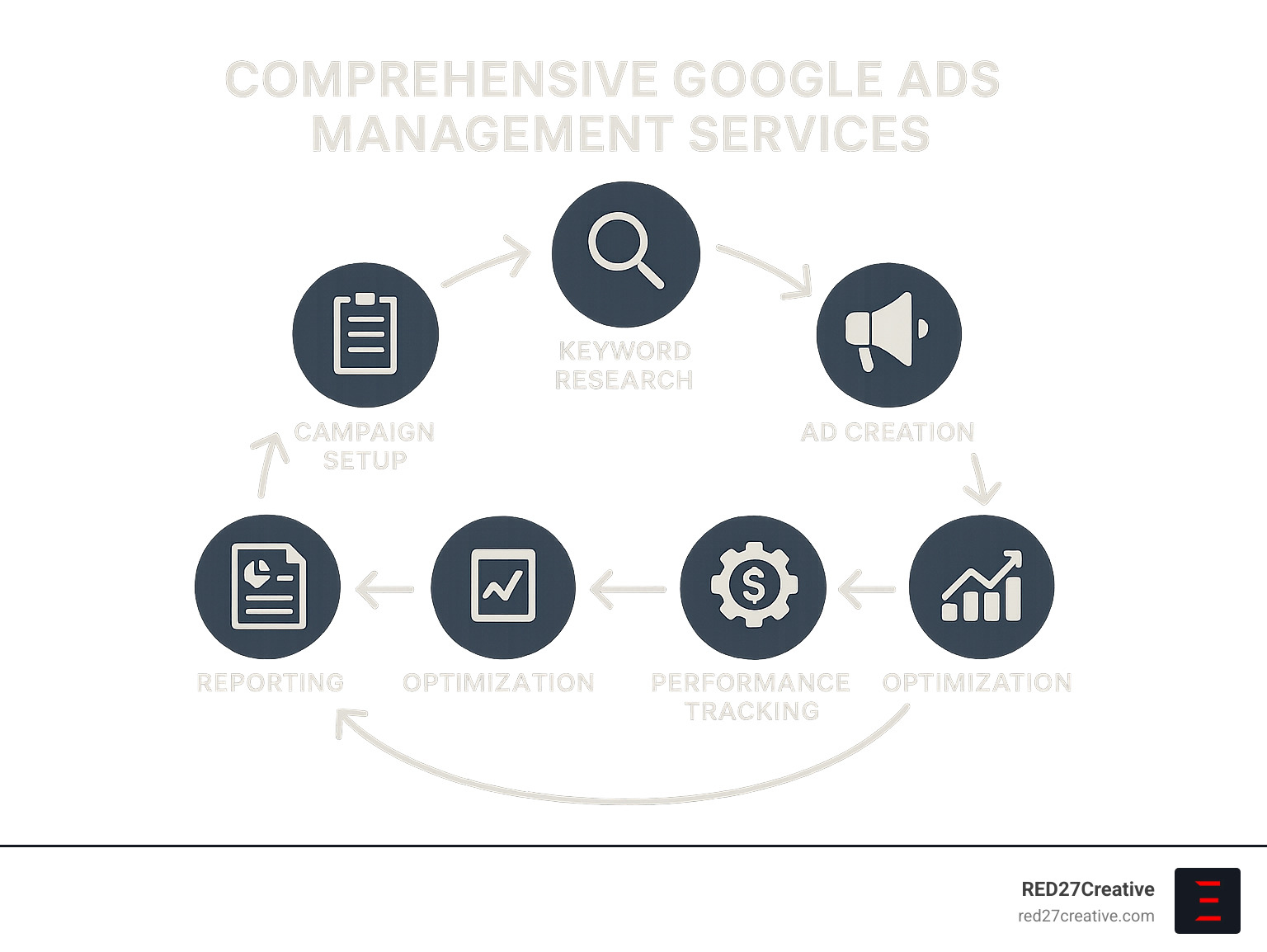
Google Ads management services are professional services that handle the setup, optimization, and ongoing maintenance of Google Ads campaigns to maximize return on investment. These services typically include keyword research, campaign creation, bid management, ad copywriting, performance tracking, and regular reporting.
Here’s what Google Ads management services typically include:
| Service Component | What It Involves |
|---|---|
| Campaign Setup | Account structure, targeting settings, conversion tracking |
| Keyword Research | Identifying profitable search terms and competitor analysis |
| Ad Creation | Writing compelling ad copy and creating extensions |
| Bid Management | Setting and adjusting bids to maximize ROI |
| Ongoing Optimization | Regular adjustments based on performance data |
| Reporting | Regular updates on key metrics and ROI |
Google Ads management services have become essential for businesses of all sizes because they bridge the expertise gap between what Google’s increasingly complex advertising platform offers and what most business owners have time to master.
Since 2004, professional Google Ads management has been shown to boost paid search conversions by more than 485% compared to self-managed campaigns. The difference comes down to specialized knowledge of platform features, testing methodologies, and optimization techniques that take years to develop.
For businesses looking to generate leads or sales through paid search, working with experts can mean the difference between wasting budget on poorly targeted clicks and achieving a sustainable return that fuels business growth.
I’m Kiel Tredrea, founder of RED27Creative with over 20 years of experience implementing successful Google Ads management services for businesses across B2B and B2C industries, helping them develop strategies that drive measurable revenue through optimized paid search campaigns.
Why This Guide Matters
Whether you’re a small business owner in Aurora IL trying to generate local leads, or an enterprise based in Chicago looking to scale nationally, the Google Ads landscape can be overwhelming. With the platform constantly evolving and introducing new features, staying on top of best practices is a full-time job.
This guide cuts through the complexity to help you understand what Google Ads management services actually deliver, how they’re priced, and what results you should expect. We’ve worked with businesses across Geneva, Batavia, St. Charles, and throughout Chicagoland to transform their digital advertising from a cost center to a profit-generating machine.
The PPC landscape has changed dramatically in recent years with the introduction of automation, machine learning, and new campaign types. What worked in 2020 might be costing you money today. This guide will help you steer these changes and make informed decisions about your Google Ads strategy.
What Are Google Ads Management Services?
Google Ads management services are much more than just “running some ads” – they’re a comprehensive approach to planning, executing, and continuously improving your advertising campaigns on Google’s platform. Think of it as having a dedicated team of digital marketing experts whose sole focus is maximizing your advertising dollars while eliminating wasted spend.

At its heart, Google Ads operates on an auction system where businesses bid on keywords relevant to their products or services. But here’s the interesting part – the highest bidder doesn’t automatically win the top spot. Google also evaluates the quality and relevance of your ads and landing pages through what’s called Quality Score. This means a well-crafted campaign can actually outperform competitors who are spending more money.
When you work with professional Google Ads management services, you’re getting a complete package that typically includes:
Campaign setup that thoughtfully organizes your account architecture with campaigns, ad groups, and targeting settings aligned with your specific business goals. Bid management that strategically allocates your budget based on keyword value, competition levels, and real-time performance data. Proper conversion tracking implementation so you can measure exactly which ads are generating leads, sales, or other valuable actions.
Quality Score optimization is another crucial element, where experts work to improve your ad relevance, expected click-through rates, and landing page experience. This can significantly lower your costs while improving results.
Professional management also includes expertise across all campaign types – from traditional Search campaigns that show text ads when someone searches for your keywords, to visually engaging Display campaigns across Google’s partner websites. Video campaigns can put your message in front of YouTube viewers, while Shopping campaigns showcase your products with images and pricing information. The newest option, Performance Max, uses Google’s AI to run your ads across all Google properties automatically.
One of the most valuable aspects of professional management is negative keyword implementation – filtering out irrelevant searches to prevent wasted spending. For example, if you sell luxury watches, you might want to exclude terms like “cheap watches” or “watch repair” to focus your budget on qualified buyers.
Your campaigns can be further improved with ad extensions that provide additional information like phone numbers, site links, and callouts. Remarketing strategies can be implemented to target users who have previously visited your website but didn’t convert.
Google Ads runs off a bidding model where the most common approach is paying when someone clicks your ad (cost-per-click or CPC). However, depending on your goals, other strategies like cost-per-thousand impressions (CPM) or cost-per-acquisition (CPA) might make more sense for your business.
Google Ads Management Services vs DIY
Many business owners start by managing Google Ads themselves, which is understandable – it seems straightforward at first glance. However, the platform’s complexity quickly becomes apparent, and this is where Google Ads management services really prove their value.
The time savings alone can be substantial – professional management typically saves 15-20 hours per week that would otherwise be spent learning, monitoring, and adjusting campaigns. That’s time you can reinvest in other aspects of your business.
There’s also a significant expertise gap to consider. Google made over 3,000 updates to their platform in 2022 alone. Professional managers stay current with these changes and understand how to leverage them to your advantage, while most business owners simply don’t have the bandwidth to keep up.
Risk mitigation is another major benefit. DIY management often leads to costly mistakes like targeting overly broad keywords that drain your budget without bringing qualified traffic. Many self-managed accounts also neglect negative keywords, use poor campaign structures, have inadequate conversion tracking, create ineffective ad copy, or implement suboptimal bidding strategies.
As one of our clients from Naperville told us: “I spent six months trying to manage Google Ads myself. Within two weeks of hiring RED27Creative, my cost per lead dropped by 48% and conversion volume increased by 142%.” Results like these aren’t unusual when proper management replaces a DIY approach.
Google Ads, Google AdSense & Google Ad Manager—Key Differences
These three Google platforms are frequently confused, but they serve entirely different purposes in the digital advertising ecosystem:
| Platform | Primary Users | Purpose | Revenue Model |
|---|---|---|---|
| Google Ads | Advertisers | Run ads to attract customers | Pay per click/impression/conversion |
| Google AdSense | Website owners | Monetize website traffic | Earn revenue by displaying others’ ads |
| Google Ad Manager | Large publishers | Advanced ad inventory management | Comprehensive ad serving platform |
Google Ads is what we’ve been discussing – the platform businesses use to create and run advertisements across Google properties and partner sites. You pay Google when users interact with your ads, making it an advertiser-focused platform.
Google AdSense, on the other hand, is for publishers (website owners) who want to earn money by displaying ads on their sites. Instead of paying Google, Google pays you a portion of what advertisers spend to appear on your site. It’s essentially the flip side of the advertising coin.
Google Ad Manager takes things a step further as an advanced platform for large publishers who need more control over their ad inventory. It allows for direct deals with advertisers, programmatic selling, and sophisticated inventory management. This is typically used by major media companies and websites with millions of monthly visitors.
If you’re looking to promote your business and attract new customers, Google Ads is definitely the platform you want. Support SupportSign inGet started with any of these platforms through Google’s dedicated support resources if you want to learn more about their specific capabilities.
How Professional Google Ads Management Works: From Onboarding to Ongoing Optimization
Professional Google Ads management services aren’t just about clicking a few buttons and watching the leads roll in. It’s more like tending a garden – there’s an art and science to nurturing campaigns that truly bloom. Let me walk you through what this journey actually looks like when you’re working with experts who know their stuff.

Onboarding & Account Setup
Everything starts with what we like to call a “findy call” – a conversation where we get to know your business inside and out. For our clients in Plainfield, Oswego, and throughout Chicagoland, we dig into the local market dynamics that make your business unique.
During this initial phase, we’re building the foundation for your success. If you already have campaigns running, we’ll conduct our comprehensive 82-point audit to find hidden opportunities and plug any money leaks. We’ll work together to define what success actually looks like – whether that’s form submissions, phone calls, or purchases – and then make sure we have the technical infrastructure to track it all properly.
Setting up proper access controls might sound boring, but it’s crucial for maintaining security while allowing collaboration. We’ve had clients who previously gave an agency “the keys to the kingdom,” only to find themselves locked out of their own accounts later!
One healthcare provider we worked with was initially skeptical about switching their Google Ads management service. But after our onboarding process identified critical gaps in their tracking setup, we implemented changes that ultimately led to a 155% increase in patient volume. These changes don’t happen overnight, but they begin with getting these foundational elements right.
Keyword Research & Campaign Build-Out
With the groundwork laid, we roll up our sleeves and dive into the research that will power your campaigns. This is where the magic starts to happen!
We’re not just looking for keywords – we’re analyzing the intent behind searches. Are people looking for information, comparing options, or ready to buy? Each requires a different approach. We’ll also peek over the digital fence to see what your competitors are doing, finding opportunities they’ve missed.
Long-tail keywords are often hidden gems – they’re more specific phrases that might have lower search volume but often convert at much higher rates. For a custom cabinet maker in Geneva, we finded that “craftsman style kitchen cabinets with glass doors” brought in fewer searches than “custom cabinets” but resulted in customers who were ready to make a purchase decision.
Once we’ve gathered our keyword intelligence, we build campaigns with a logical, tightly-themed structure. Your ads need to speak directly to what people are searching for, and your landing pages need to deliver on the promises your ads make. It’s this alignment that leads to higher Quality Scores, lower costs, and better results.
You can Check out keyword planner for yourself to get a taste of this process, though professional services use additional specialized tools to gain deeper insights.
One e-commerce client came to us frustrated after months of DIY efforts. After implementing our more strategic keyword approach, they saw a 479% revenue increase with only a 124% increase in ad spend. That’s the power of professional Google Ads management in action.
Continuous Optimization & Reporting
Once your campaigns are live, the real work begins. This is where amateur efforts often falter, but where professional management truly shines.
We’re constantly fine-tuning your campaigns based on real performance data. This includes adjusting bids, filtering out irrelevant search terms as negative keywords, testing different ad variations, and refining audience targeting. We might find that your ads perform 40% better on mobile devices in certain locations, so we’ll adjust accordingly to capitalize on that insight.
Think of it as having a team of mechanics constantly tuning your car’s engine while you’re driving – making small adjustments that add up to significantly better performance over time.
Transparency is essential in this ongoing process. You’ll receive weekly snapshots so you’re never in the dark about performance, detailed monthly reports that explain what’s working and why, and quarterly strategy reviews to ensure we’re still aligned with your business objectives. Many clients also enjoy access to custom real-time dashboards built in platforms like Looker Studio.
A logistics company we worked with provides a perfect example of this optimization process in action. When they first came to us, they were spending $3,500 monthly on Google Ads with disappointing results. Through our systematic approach to Google Ads management services, we identified that they were targeting the right industry but with messaging that missed the mark. After three months of continuous refinement, they achieved a 1,200% increase in qualified leads – changing their digital marketing from a cost center to their primary growth engine.
The difference between amateur and professional Google Ads management isn’t just knowledge – it’s the commitment to this ongoing cycle of testing, learning, and improving that consistently delivers superior results over time.
More info about Marketing Strategies if you’re looking to integrate Google Ads into a broader marketing approach.
Key Benefits of Outsourcing Google Ads Management vs In-House
So you’re facing the big question: should you hire an agency or build your own in-house team to handle your Google Ads? It’s a decision many businesses across Chicagoland wrestle with, and for good reason.

When we talk to clients about Google Ads management services, they’re often surprised by the depth of expertise required to truly excel on the platform. Think about it – professional Google Ads managers live and breathe the platform every day, working across dozens of accounts and industries. They develop insights and pattern recognition that would take years to build in-house.
As a Google Premier Partner, agencies like ours receive advanced training directly from Google, get early access to beta features, and have dedicated support channels. When Google makes one of their frequent algorithm changes, we’re among the first to know and adapt.
The tool advantage is substantial too. We invest in premium software for keyword research, competitive analysis, and reporting that would be difficult to justify for a single business. One of our manufacturing clients put it perfectly: “It’s like getting access to a Ferrari without having to buy one.”
The scalability factor can’t be overlooked either. As your business grows, we can quickly scale your campaigns without the hiring headaches. One day you might need to triple your ad spend for a seasonal promotion – with an agency, that’s a simple conversation rather than a staffing crisis.
What many business owners don’t initially consider is the cross-channel perspective. Because we work across SEO, social media, and email marketing, we can apply those learnings to improve your Google Ads performance. We recently helped a local Aurora retailer apply insights from their social media engagement patterns to reshape their Google Ads targeting, resulting in a 37% increase in qualified traffic.
Landing page optimization is another significant advantage. The best ads in the world won’t help if your landing pages don’t convert. Most agencies offer conversion rate optimization services that complement their Google Ads management services.
And then there’s the bottom line – cost efficiency. Hiring a full-time Google Ads specialist can run you $60,000-$100,000 annually when you factor in benefits, training, and tools. Agency fees for comparable expertise typically range from $500-$2,000 monthly, depending on campaign complexity and ad spend.
The results speak for themselves. We’ve seen conversion increases of 485% for clients using professional Google Ads management services. In another case, we helped an IT provider achieve a remarkable 600% increase in lead conversions through strategic campaign restructuring and landing page improvements.
Want to understand how these services fit into your broader marketing strategy? More info about Google Paid Search (PPC) is available on our dedicated service page.
When In-House Makes Sense
Despite all these advantages, there are absolutely situations where building an in-house team makes perfect sense.
If you’re spending over $100,000 monthly on Google Ads, the economics might favor dedicated in-house resources. The depth of attention and specialized focus can justify the investment at this scale.
Businesses in highly specialized industries with unique terminology and audience needs might benefit from specialists who are fully immersed in the industry day in and day out. We’ve seen this work well for specialized medical practices and niche B2B manufacturers.
Organizations with strict data governance requirements or those handling sensitive information might prefer keeping all advertising operations in-house for security and compliance reasons.
And of course, if you already have experienced Google Ads professionals on your team, building around that existing expertise often makes sense.
Why Agencies Often Win
For most businesses, however, professional Google Ads management services provide compelling advantages that are hard to match in-house.
The shared learning effect is powerful – we apply insights gained across multiple accounts and industries to your campaigns. When we find a winning approach for a retail client, we can adapt that strategy for your business, giving you the benefit of dozens of simultaneous experiments.
Rather than relying on a single person’s skills and availability, you benefit from a team of specialists in strategy, copywriting, analytics, and technical implementation. This team approach means you’re never left vulnerable when someone takes vacation or calls in sick.
There’s a built-in accountability with agencies that drives performance. We’re incentivized to deliver results to retain your business, often leading to more aggressive optimization and testing than you might see with an in-house team.
Perhaps most importantly, agency teams protect against the knowledge loss that occurs when an in-house employee leaves. As one Batavia business owner shared with us: “We tried hiring a marketing coordinator to manage our Google Ads, but when they left, we lost months rebuilding that knowledge. Switching to RED27Creative gave us a team of experts and eliminated that single point of failure.”
The decision ultimately comes down to your specific business needs, budget, and growth plans. But for most companies looking to maximize their return on ad spend without the overhead of building an internal team, partnering with professionals who live and breathe Google Ads every day is the winning strategy.
Pricing Models & ROI: Understanding Costs & Maximizing Return
Understanding how Google Ads management services are priced helps you budget effectively and evaluate your return on investment. Let’s break down the common pricing structures in a way that makes sense for your business.

When we talk with clients in Aurora or Naperville, they often ask: “How much will this cost me?” The answer depends on several factors, but there are a few standard pricing models in the industry:
A flat fee gives you predictability—you pay the same amount each month regardless of how much you spend on ads. This works well if you’re just starting out and want to keep costs consistent.
The percentage of spend model is exactly what it sounds like—the agency charges 7-15% of your monthly ad budget. As your ad spend grows, so does the management fee, which keeps the agency motivated to scale your campaigns effectively.
Many businesses prefer a hybrid model, which combines a base fee plus a smaller percentage of ad spend. This approach ensures the agency receives fair compensation for their expertise while still aligning their interests with your growth.
Some agencies offer performance-based pricing, where fees are tied directly to results like leads or sales. While less common, this model can be attractive if you’re focused on specific outcomes.
Finally, there’s the hourly rate approach, typically ranging from $100-$200 per hour for US-based professionals. This works well for short-term projects or audits but can become unpredictable for ongoing management.
Each model has its place depending on your business size, goals, and budget comfort level. A small bakery in Geneva might benefit from the predictability of a flat fee, while a growing manufacturing company in Chicago might prefer a percentage model that scales with their expanding market reach.
Typical Cost Ranges for Google Ads Management Services
So what should you expect to pay for Google Ads management services? Here’s a friendly breakdown based on business size:
Small local businesses typically start around $229-$397 per month for management fees (plus your actual ad spend). This tier works well for a family-owned restaurant in St. Charles or a boutique in Batavia looking to drive local traffic.
Mid-sized businesses usually invest $499-$1,500 monthly for more comprehensive management. This might include a car dealership in Aurora or a professional services firm in Naperville that needs more sophisticated campaign structures.
Larger enterprises with substantial ad budgets often pay 7-15% of their ad spend, with minimum fees starting around $2,000 monthly. This tier suits companies with regional or national reach and complex multi-campaign strategies.
These fees don’t include your actual advertising dollars that go to Google. Most agencies recommend minimum monthly ad budgets based on your market reach:
Local businesses: $600-$1,000
Regional businesses: $1,000-$5,000
National campaigns: $5,000+
One of our clients, a home services company in Naperville, initially balked at our $500 monthly management fee on top of their $3,000 ad spend. But after three months of professional management, their lead volume jumped by 142% while their cost per lead dropped by 48%. That $500 monthly investment generated an additional $12,000 in monthly revenue—a return that quickly erased any concerns about the management fee.
Proving ROI & Key Metrics to Track
Any worthwhile Google Ads management service should obsess over metrics that directly impact your bottom line. Here are the key numbers we track for our clients:
Click-Through Rate (CTR) shows the percentage of people who click your ad after seeing it. The industry average hovers between 3-5%, but we aim higher. A strong CTR indicates your ads are resonating with the right audience.
Cost Per Click (CPC) tells you how much you’re paying for each click. This varies dramatically by industry—from $1 for some local services to $50+ for competitive industries like legal or insurance. We work to keep this number as low as possible while maintaining quality traffic.
Conversion Rate measures how many clicks result in meaningful actions like form submissions, calls, or purchases. This metric reveals how well your landing pages connect with visitor needs.
Cost Per Acquisition (CPA) shows what you’re paying to acquire a customer or lead. This is where the rubber meets the road for most businesses—if your CPA is lower than your profit margin, you’re in good shape.
Return On Ad Spend (ROAS) is the holy grail—how much revenue you generate for every dollar spent on ads. We typically target a 3:1 ratio or higher, meaning $3 in revenue for every $1 spent.
Impression Share reveals what percentage of available impressions your ads are capturing. If this number is low, you’re missing opportunities to get in front of potential customers.
Quality Score is Google’s 1-10 rating of your keywords and ads. Higher scores lead to better ad positions and lower costs, creating a virtuous cycle of improvement.
Customer Lifetime Value (LTV) looks beyond the initial transaction to consider how much a customer is worth over their entire relationship with your business. This helps justify higher acquisition costs for valuable long-term customers.
A good agency partner will establish clear KPIs aligned with your specific business goals and report on them regularly in language you can understand. They’ll help you see beyond the numbers to the actual impact on your business growth.
More info about The Secret of Marketing ROI can help you develop a framework for evaluating whether your Google Ads investment is truly paying off.
When we sit down with clients for quarterly reviews, we don’t just show spreadsheets—we translate metrics into business outcomes: “Your Google Ads brought in 43 new customers this quarter, with an average first purchase of $850 and a 65% retention rate, making your actual return much higher than the initial transaction.”
That’s the difference between reporting and insight—and it’s what you should expect from any Google Ads management service worth its fee.
Choosing the Right Google Ads Management Partner
Selecting the right partner for Google Ads management services is like finding a good business partner – it requires careful consideration and due diligence. The choice you make can dramatically impact your marketing success and bottom line.

When we work with clients across Chicagoland – from busy St. Charles to growing Plainfield – we often hear stories of previous partnerships gone wrong. That’s why I recommend focusing on several key factors in your search.
First, check for certifications and credentials. A Google Partner or Premier Partner badge isn’t just a pretty logo – it means the agency has met Google’s stringent requirements for skill and performance. These partners typically get early access to new features and direct support from Google.
Ask to see specific case studies and results relevant to your industry. Any agency worth their salt should be proud to share their success stories (even if they anonymize the client names for privacy). As one of our manufacturing clients in Aurora put it: “Seeing what RED27 had accomplished for similar businesses gave me the confidence to make the switch.”
Transparency should be non-negotiable. Your agency should openly discuss their processes, reporting methods, and how they’ll measure success. If they’re vague or evasive about how they work, consider it a red flag.
The technology stack they use matters too. While Google’s native tools are powerful, professional agencies typically invest in additional software for deeper insights and optimization. Ask what tools they use beyond Google’s platform and how these benefit their clients.
While industry experience can be helpful (especially in specialized fields like healthcare or finance), don’t make it a deal-breaker. Sometimes fresh eyes and cross-industry experience bring innovative approaches that industry veterans might miss.
Pay attention to their communication style during the sales process – it often reflects how they’ll communicate once you’re a client. Some business owners prefer weekly check-ins, while others want monthly emails with minimal interruption. Make sure their approach aligns with your preferences.
Finally, understand the contract terms thoroughly. What’s the commitment period? How easy is it to cancel if needed? Who owns the account and data if you part ways? These details matter when you’re entering a potentially long-term relationship.
Questions to Ask Potential Agencies
Before signing on with any Google Ads management services provider, arm yourself with thoughtful questions that reveal their approach and expertise.
“How will you align Google Ads strategies with my specific business goals?” This question helps determine if they take a cookie-cutter approach or truly customize their strategy to your needs.
“What does your onboarding process look like, and how long until we see results?” A good agency will have a structured onboarding process and set realistic timeline expectations. As a bakery owner in Naperville found out: “RED27Creative told me to expect 3-4 months before seeing optimal results – other agencies promised immediate success, which I knew wasn’t realistic.”
“How frequently will I receive reports, and what metrics will they include?” The answer reveals their commitment to transparency and what they believe constitutes success.
“Who will be my main point of contact, and what is their experience level?” You want to know if you’ll be working with a seasoned professional or being handed off to a junior team member after signing.
Other essential questions include asking about their approach to landing pages, how they stay current with Google’s frequent platform changes, what automation tools they leverage, and whether they can share sample reports.
Don’t forget to ask about what happens to your account and data if you end the relationship. A reputable agency should make this transition smooth and ensure you maintain ownership of your data.
Avoiding Common Google Ads Mistakes
One of the biggest values of professional Google Ads management services is helping you sidestep costly mistakes that plague DIY campaigns.
Broad match misuse is perhaps the most common error we see. Using broad match keywords without proper negative keywords is like fishing with a net full of holes – you’ll catch some good fish, but waste a lot of effort on things you don’t want. A professional team creates a strategic balance of match types with comprehensive negative keyword lists.
Missing conversion tracking is another frequent oversight. Without proper tracking, you’re essentially driving blindfolded – unable to measure ROI or optimize effectively. Your management team should insist on robust tracking from day one.
Many businesses also struggle with weak landing pages that don’t convert visitors effectively. Even the best ads will fail if they lead to pages that don’t fulfill the promise of the ad or make it easy to take action.
The set-and-forget approach dooms many campaigns to mediocrity. Google Ads is not a “launch it and leave it” platform – it requires ongoing testing, learning, and refinement. As one Oswego business owner shared: “Before working with RED27Creative, we’d check our campaigns maybe once a month. Our CPA was three times higher than it is now, and we were ready to give up on Google Ads entirely. Professional management turned it around completely.”
Other common pitfalls include spreading budgets too thin across too many keywords or campaigns, neglecting quality score optimization (which directly impacts your costs), and creating poor account structures that make management and optimization unnecessarily complicated.
Professional management helps you steer these potential pitfalls while implementing proven strategies that drive meaningful results for your business. Whether you’re in Geneva, Batavia, or anywhere in between, the right partner can transform Google Ads from a frustrating expense into a predictable source of growth.
More info about The Secret of Marketing ROI can help you understand how to evaluate potential partners based on their ability to deliver measurable returns.
Frequently Asked Questions about Google Ads Management Services
Curious about how Google Ads management could transform your business? You’re not alone. Here are the questions we hear most often from businesses throughout Chicagoland who are considering professional help with their paid search campaigns.
What are Google Ads management services and why are they important?
Google Ads management services help businesses steer the complex world of paid search advertising by handling everything from account setup to ongoing optimization. Think of it as having a skilled pilot at the controls instead of trying to fly the plane yourself.
These services are crucial because Google’s advertising platform has become incredibly sophisticated. Professional management prevents your budget from disappearing into the digital void by ensuring your campaigns target the right keywords, create compelling ads, and direct traffic to conversion-optimized landing pages.
As one of our clients in Batavia recently told us, “I was spending hours each week trying to figure out Google Ads and seeing mediocre results. Having experts manage it has freed up my time while actually improving our performance.”
How is campaign success measured and reported?
The beauty of digital advertising is its measurability. Your Google Ads management services provider should deliver regular, transparent reporting that connects advertising performance to your business goals.
Key metrics typically include click-through rate (showing ad relevance), conversion rate (how well your website turns visitors into leads or customers), cost per acquisition (what you’re paying for each new customer), and return on ad spend (the revenue generated per dollar spent).
Most agencies provide monthly comprehensive reports with strategic insights and recommendations, but you should also have access to real-time dashboards for keeping an eye on performance between reports. At RED27Creative, we’ve found that our clients appreciate both the detailed monthly analysis and the ability to check key metrics whenever they want.
What budget do I need to get started?
This is like asking how much house you can afford—it depends on your market and goals. For local businesses in smaller communities like Geneva or St. Charles, you can start seeing meaningful results with ad budgets of $600-$1,000 monthly. Regional businesses targeting the broader Chicago area typically invest $1,000-$5,000 monthly, while national campaigns often require $5,000+.
Management fees are separate from your ad spend (which goes directly to Google). Management fees typically range from $229 for starter packages to $2,000+ for enterprise-level service, depending on campaign complexity and the level of support you need.
The good news? A well-managed campaign should generate a positive return on this investment. One of our Naperville clients started with a modest $1,500 monthly ad budget and a $350 management fee. Within three months, they were generating enough new business to increase their budget to $3,000 while still maintaining a healthy 5:1 return.
How long does it take to see results from Google Ads?
Unlike SEO, which can take months to gain traction, Google Ads can begin driving traffic to your website almost immediately. However, there’s a difference between seeing traffic and achieving optimal performance.
You’ll typically see initial data within days of launching your campaign, but meaningful patterns for optimization usually emerge after 2-4 weeks. Significant performance improvements generally develop within 2-3 months as your Google Ads management services team refines your targeting, bidding strategies, and creative elements based on real-world performance data.
More competitive industries may require longer timeframes to achieve peak efficiency. As one of our healthcare clients finded, patience pays off—their cost per patient acquisition decreased by 43% between months three and six as we continuously optimized their campaigns.
Do I need a new website to run Google Ads?
Not necessarily, but your landing pages need to be up to the task. A beautiful ad leading to a frustrating website experience is like a fantastic movie trailer for a terrible film—it creates disappointment and wastes your marketing budget.
Your landing pages should be relevant to your ads, mobile-friendly, fast-loading, and designed to convert visitors into leads or customers. Professional Google Ads management services often include landing page recommendations or creation to ensure your ads and website work together seamlessly.
If your existing website has poor user experience, outdated design, or technical issues, it may limit your campaign performance regardless of how well your ads are managed. Sometimes, creating dedicated landing pages for your campaigns can be a cost-effective alternative to a complete website redesign.
What happens to my Google Ads account if I change agencies?
This is an important question that many businesses forget to ask. Your Google Ads account should always belong to you, not your agency. When changing Google Ads management services providers, you should retain full ownership and access to your account history, data, and assets.
Reputable agencies will facilitate a smooth transition and provide necessary information to your new partner. To protect your business, ensure your contract specifies that you maintain ownership of your Google Ads account and that all campaign data and assets will remain accessible to you.
At RED27Creative, we believe in transparent partnerships. We’ve even helped clients transition smoothly when they’ve outgrown our services or needed specialized expertise in certain industries—because your business success matters more than any single agency relationship.
Conclusion
The digital marketing landscape has transformed Google Ads management services from a nice-to-have into an essential investment for businesses serious about online growth. If you’ve made it this far in our guide, you’ve seen just how sophisticated and nuanced effective Google Ads campaigns have become.
Think about it – Google’s advertising platform undergoes thousands of changes yearly, each adding layers of complexity that even seasoned marketers struggle to keep pace with. For business owners already juggling countless responsibilities, staying on top of these changes while running optimized campaigns is nearly impossible without specialized help.
We’ve seen this at RED27Creative. A local bakery in Geneva came to us after burning through $1,200 in two weeks with zero conversions. Within a month of professional management, they were booking birthday cake consultations at $18 per lead – a complete change that paid for our services many times over.
The right Google Ads management partner doesn’t just run your campaigns – they become a strategic advisor who connects your advertising efforts to real business outcomes. They help you steer algorithm changes, identify new opportunities, and continually refine your approach based on data rather than guesswork.
For businesses throughout Chicagoland – whether you’re a family-owned shop in Batavia or a growing enterprise in downtown Chicago – professional management bridges the expertise gap that often separates successful campaigns from expensive digital experiments.
At RED27Creative, we’ve built our reputation by delivering measurable results for clients across Geneva, Aurora, St. Charles, Plainfield, Oswego, Naperville and beyond. Our approach combines analytical precision with creative excellence – because the most effective campaigns need both.
We understand that entrusting your advertising budget to an outside team isn’t a decision to take lightly. That’s why we focus on transparency, regular communication, and tying every dollar spent to concrete business outcomes. Our clients don’t just see impressions and clicks – they see new customers walking through their doors and reaching out through their websites.
Whether you’re just dipping your toes into Google Ads or looking to revitalize underperforming campaigns, the right management partner can transform your digital advertising from a frustrating expense into a predictable growth engine.
Ready to stop wondering if your Google Ads could perform better? Learn more about our Google Paid Search services and find how we can help you achieve the kind of results that directly impact your bottom line – not just your click reports.

Kiel Tredrea
https://red27creative.comTop Marketing Agency • Web, SEO & Leads • RED27Creative