Chatbot UX: Making Your AI Assistant a Joy to Talk To
Why Great Chatbot Design Transforms Business Results
Chatbot user experience design is the process of creating conversational interfaces that are natural, helpful, and aligned with business goals. While many businesses have adopted AI, only 22% are satisfied with their conversion rates, often because their chatbots frustrate users.
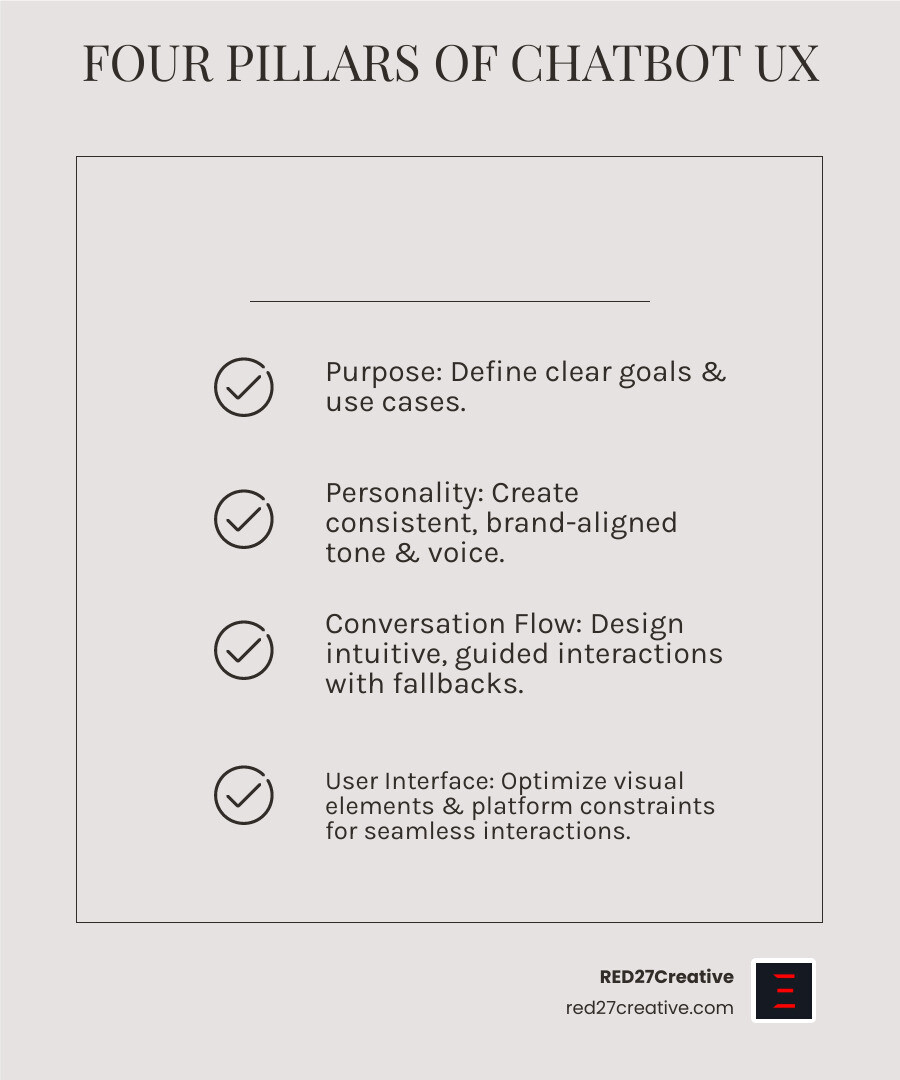
Essential elements of effective chatbot UX design:
- Clear Purpose: Define specific goals like customer support or lead generation.
- Intuitive Personality: Create a consistent tone that reflects your brand.
- Guided Conversations: Use buttons and structured flows.
- Smart Error Handling: Plan fallbacks and escalation paths.
- Platform Optimization: Design for specific channels like your website or Messenger.
- Continuous Improvement: Track user behavior and iterate with real data.
The stakes are high. Most adults use messaging apps daily, yet many chatbots fail when users deviate from scripts. With high visitor acquisition costs, effective chatbot design is a critical conversion tool.
When done right, chatbots can automate 75-90% of customer questions and boost user engagement by up to 70%. The key is treating chatbot design as both a technical and a human experience challenge.
I’m Kiel Tredrea, founder of RED27Creative. With over 20 years of experience, I help businesses create digital experiences that drive growth. My expertise in chatbot user experience design comes from developing conversational interfaces that engage users and convert them into loyal customers.
Explore more about Chatbot user experience design:
The Foundation: Strategy and Purpose
Many businesses build chatbots without a clear strategy, focusing on witty responses instead of the core problem the bot needs to solve. Like a house without a foundation, even the most advanced chatbot will fail if it doesn’t address a real user need.
Defining Your Chatbot’s “Why”: Purpose, Goals, and Use Cases
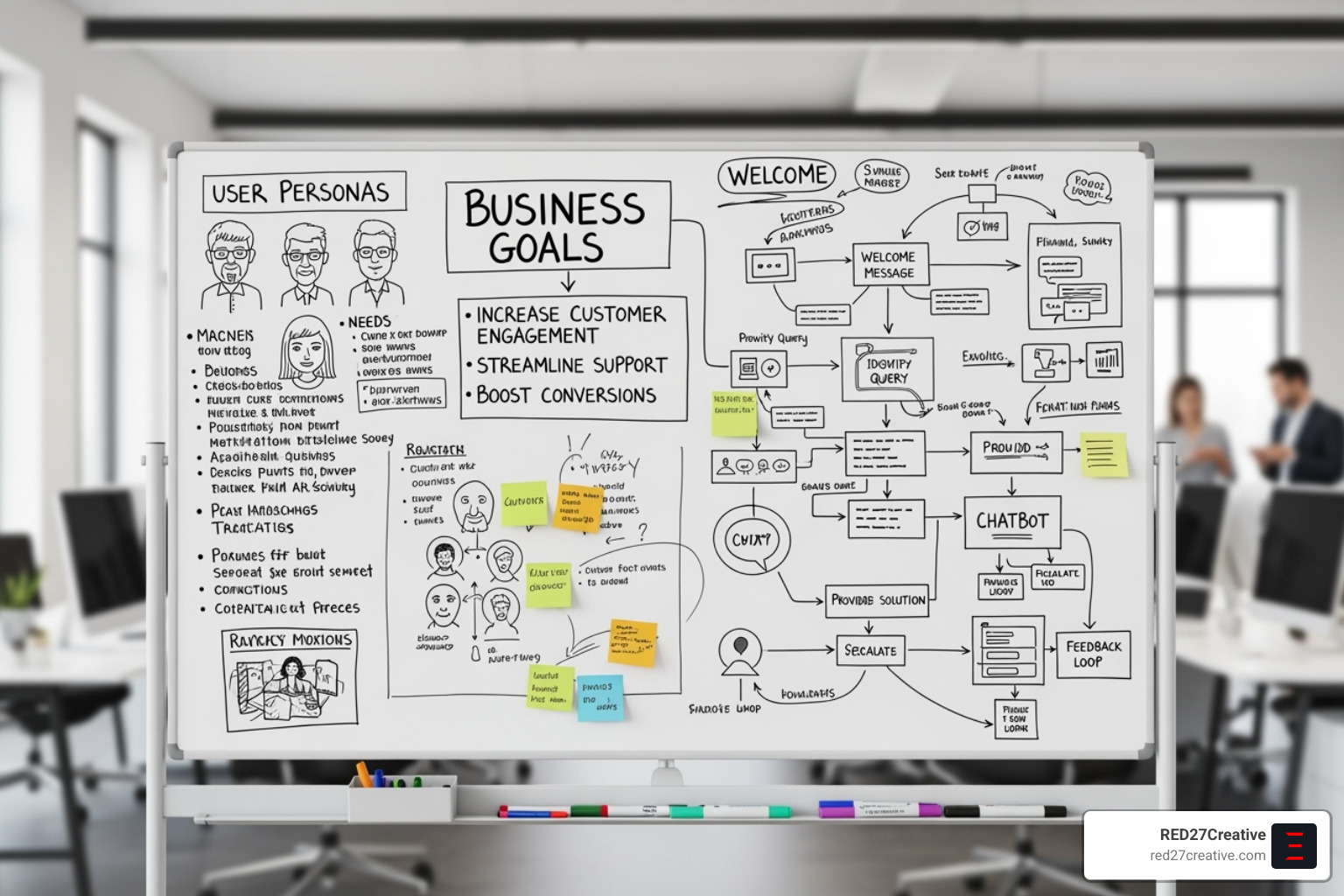
Every successful chatbot starts with a clear purpose aligned with business objectives. Will it handle customer support, generate leads, or automate tasks? For example, 2 out of 3 companies use chatbots for customer support, providing instant answers and freeing up human agents. Other use cases include qualifying leads or handling bookings. The key is to start with one focused goal, master it, and then expand.
Learn more about AI Chatbot Solutions for Businesses and how they can transform your customer interactions.
Choosing Your Bot: Rule-Based vs. AI-Powered
Once you’ve defined your purpose, you’ll face a crucial technical decision: rule-based or AI-powered? This choice shapes your design approach and budget.
| Feature | Rule-Based Chatbots | AI-Powered Chatbots |
|---|---|---|
| Capabilities | Follows predefined scripts and if-then logic | Understands natural language and learns from interactions |
| Complexity | Simpler to build for linear, structured tasks | More complex development requiring training data |
| Cost | Lower upfront investment | Higher initial cost but greater long-term scalability |
| Ideal Use Cases | FAQs, simple forms, guided processes | Customer support, personalized recommendations, complex queries |
Rule-based chatbots are like smart flowcharts, guiding users through predictable paths. They’re perfect for FAQs or lead qualification forms.
AI-powered chatbots use Natural Language Processing (NLP) to understand varied user inputs. They can interpret different phrasings of the same intent and learn from interactions.
Many successful implementations use a hybrid approach, starting with rule-based flows for common tasks and layering in AI for complex interactions. This gives you reliability with flexibility.
Explore Generative AI capabilities and how they’re revolutionizing business automation.
Understanding the Main Types of Chatbots and Their Design Needs
Understanding chatbot types informs your design. Customer-service bots need speed and clear escalation paths for support queries. Interaction bots require guided flows for tasks like booking appointments. Task-oriented bots handle complex processes like travel planning, needing strong context management. Informational bots act as knowledge bases and must have excellent search capabilities. Matching the bot type to its purpose is crucial for building a valuable business asset.
The Blueprint: Core Principles of Chatbot User Experience Design
Once we’ve laid the strategic groundwork, we move to the blueprint. This involves the fundamental principles that guide how users interact with our bot, ensuring every conversation is positive and productive.
UI vs. UX: More Than Just a Pretty Interface
Many businesses focus on making their bot look pretty (UI) but forget to make it work well (UX). It’s like a beautiful car that can’t drive straight.
UI (User Interface) is everything your users see and touch: chat bubble colors, button styles, and fonts. It’s the immediate visual impression.
UX (User Experience) is the invisible magic that makes conversations feel helpful. It covers conversation flow, information architecture, and how easily users accomplish their goals.
A chatbot with basic visuals but a brilliant conversational flow will always outperform a stunning but confusing interface. The best chatbot user experience design happens when UI and UX work together harmoniously.
Crafting a Memorable Chatbot Personality and Tone of Voice
Your chatbot’s personality isn’t about fooling users; it’s about creating a consistent brand experience that feels helpful and engaging.
Brand alignment is crucial. A professional brand needs a professional bot, while a trendy brand can be more casual. The personality should feel authentic.
Empathy and consistency are your secret weapons. Your bot should acknowledge frustrations and maintain the same tone, which builds trust.
Consider these personality dimensions: funny versus serious, formal versus casual, and enthusiastic versus calm. A banking bot might be serious, while a food delivery bot can be playful.
Your welcome message sets the tone. Be clear about what your bot can do and showcase its personality. Instead of a generic “How can I help?” try “Hi there! I’m here to help you find the perfect running shoes. What kind of terrain do you love to explore?”
Key Terms for Effective Chatbot User Experience Design
Understanding the language of chatbot user experience design helps you communicate with developers and make smarter design decisions.
- Intent is what your user wants to accomplish. Utterances are the actual words they use. “Where’s my stuff?” and “I haven’t received my shipment” have the same intent.
- Entities are the specific details that matter, like names, dates, or order numbers.
- Natural Language Processing (NLP) is the technology that helps your bot understand different phrasing for the same meaning.
- Fallback responses and escalation paths are your safety nets for when your bot gets confused.
- User context is the invisible thread that connects different parts of a conversation, allowing the bot to remember previous details.
These concepts work together to create conversations that feel natural and productive. Understanding them helps you design flows that anticipate user needs and guide them smoothly toward their goals. Learn more about the impact of data-driven strategies in creating more effective chatbot experiences.
Crafting the Conversation: Flow, UI, and Error Handling
This is where we translate our strategic blueprint into actual conversational interactions. It’s about guiding users seamlessly, making the interface intuitive, and gracefully handling when things go awry.
Designing Intuitive User Flows and Conversations
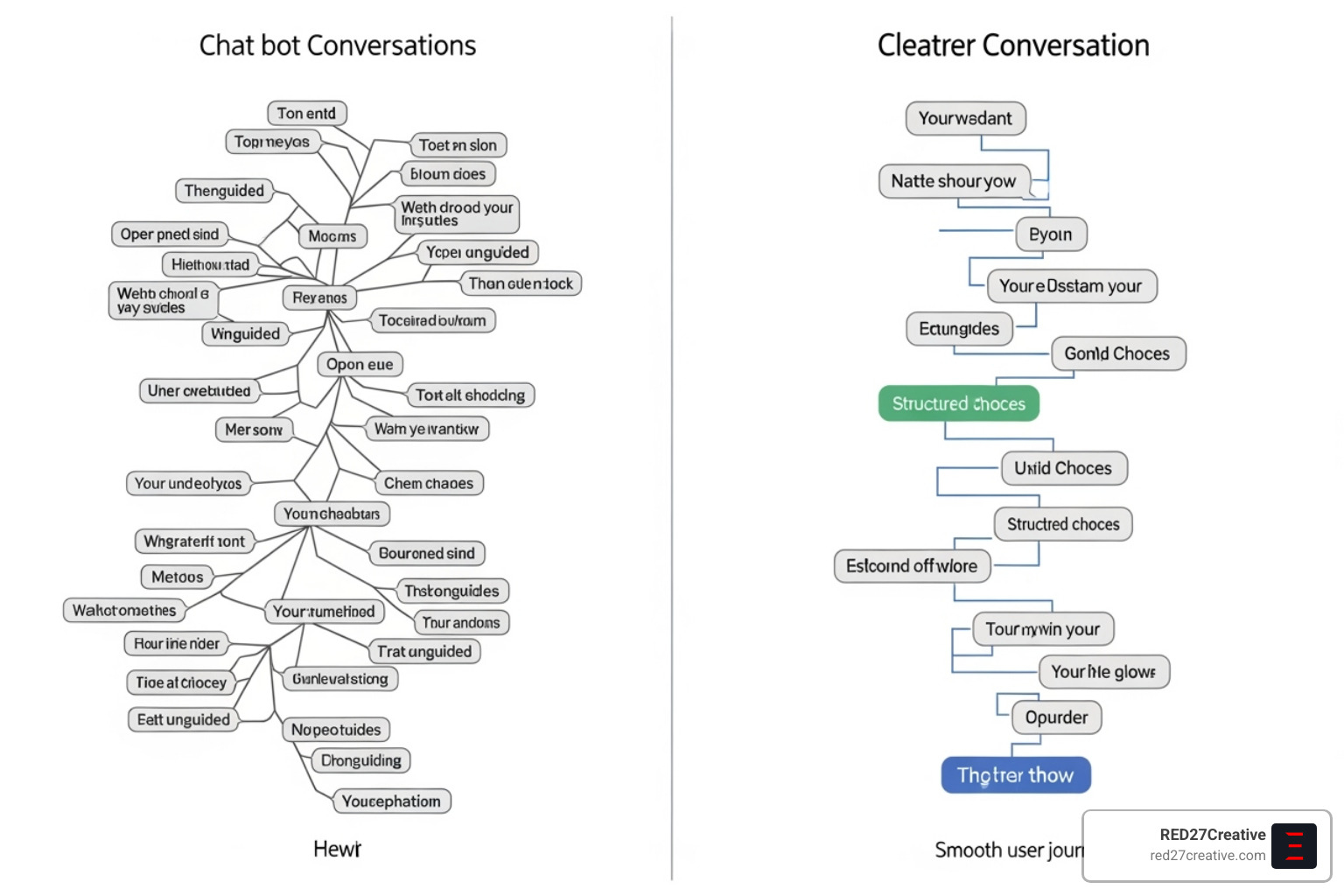
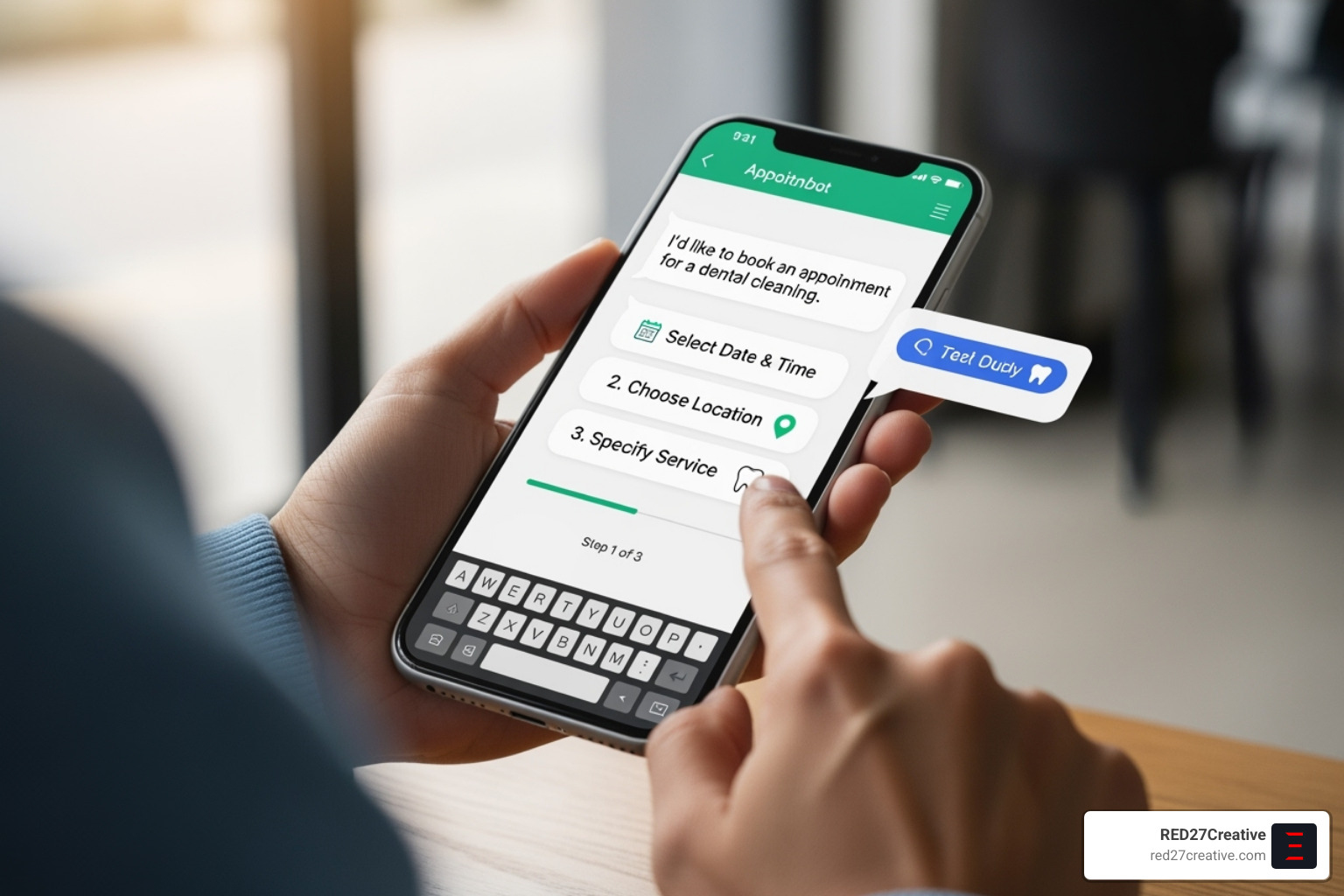
Effective conversation design feels natural yet guided. Start with a welcome message that clearly states the bot’s capabilities. Use guided conversations with buttons and quick replies, as users prefer clicking to typing. Adopt a wizard-like approach by breaking complex tasks into simple, sequential steps. Keep messages short and split long text into multiple bubbles for readability. Ensure users always know their status in a process and have a clear path forward, following established usability principles.
UI Best Practices for Different Platforms (Website, Messenger, etc.)
Each platform brings its own constraints to chatbot user experience design. A chatbot that works on your website might feel clunky in Facebook Messenger.
- Website chatbots offer the most design flexibility. You control the appearance and can incorporate rich media. The challenge is making it a natural part of your site, not an intrusive popup.
- Messaging platforms like Messenger or WhatsApp come with built-in user expectations and UI elements. You work within their visual constraints, but this familiarity is an advantage.
- The secret is leveraging native features like quick reply buttons and carousels. Users already understand them, making the interaction feel intuitive.
- Visual consistency remains crucial. Maintain your brand identity through tone of voice and imagery while respecting the platform’s conventions.
“I Don’t Understand”: Handling Errors and Misunderstandings Gracefully
Even the best AI gets confused. How your bot handles errors determines if users stay. Acknowledge confusion honestly and provide immediate alternatives, such as connecting to a human. An escape hatch to human support is essential. To prevent frustration, the bot must retain context after an error and offer a graceful restart option. Smart error handling should also integrate with your broader support ecosystem, like the marketing automation that ensures smooth handoffs.
The Long Game: Analysis, Integration, and Ethics
Successful chatbot user experience design doesn’t end at launch. The real work begins with measuring performance, integrating with business operations, and maintaining ethical standards that build user trust.
Measure, Analyze, Improve: The Role of User Behavior Tracking
The magic of great chatbot user experience design is in the data. Every conversation is a goldmine of insights.
- Track the right metrics. Your task completion rate shows if users are achieving their goals. It’s often the most revealing metric.
- Identify drop-off points. When users abandon conversations, they’re showing you exactly where your bot is failing.
- Gather user feedback. Simple satisfaction scores (e.g., thumbs up/down) provide immediate feedback on the user experience.
- A/B test conversation flows. Optimize based on real user behavior, not assumptions. Test different welcome messages, button labels, or personality tones.
Platforms like Botanalytics provide specialized analytics that help you understand not just what users do, but why. This data-driven approach gives you a competitive edge. More info about data-driven marketing.
Seamless Integration with Business Processes
A chatbot in isolation has limited value. Its real power emerges when it’s a seamless extension of your business operations.
CRM integration transforms your bot into a personalized service representative. When your bot can access a customer’s history, conversations become infinitely more valuable.
Connecting to your ticketing systems ensures that handoffs to human support are smooth and informed. The bot can create a detailed ticket with full conversation context, so customers don’t have to repeat themselves.
Business process automation is where chatbots truly shine. They can handle scheduling, lead qualification, and basic HR inquiries, freeing up your team for high-value interactions.
Data synchronization across all your systems prevents customers from providing the same information multiple times, creating a connected, professional experience. More info about AI Chatbots for Enterprise.
Ethical Design: Data Privacy and Transparency
In chatbot user experience design, trust is essential. More than half of Americans have decided against using a product due to data privacy concerns.
Data privacy and security must be built-in from day one. Protect all data with secure transmission, encryption, and regular security audits. Compliance with regulations like the General Data Protection Regulation is the baseline.
Transparency about bot identity builds trust. When people know they’re talking to a bot, they adjust their expectations and are more forgiving of its limitations. Pretending it’s human leads to disappointment.
User consent and control should be straightforward. Users need to understand what data you’re collecting, why, and how they can control it.
Ethical data use means collecting only what you need for stated purposes. Respecting user privacy builds trust and turns users into loyal customers.
Frequently Asked Questions about Chatbot UX Design
What is the most important element of chatbot UX?
The most important element of chatbot user experience design is a clearly defined purpose paired with an intuitive, guided conversation flow. A chatbot that knows its goal and can smoothly guide users will always outperform one that is beautifully designed but lacks direction. This clarity ensures every interaction feels intentional and valuable.
Should a chatbot pretend to be human?
No, transparency is key to a positive user experience. While you should give your chatbot a distinct personality, always be upfront that users are interacting with a bot. This manages expectations and makes users more forgiving of limitations. Trying to fool users creates unrealistic expectations that lead to frustration when the bot fails to match human nuance.
How do you measure the success of a chatbot?
Chatbot success is measured using multiple metrics. The task completion rate is your primary indicator—are users achieving their goals? User satisfaction scores (CSAT) provide direct feedback. Other key metrics include retention rate (do users return?), conversation drop-off points (where do they get stuck?), and error rates. Analyzing conversation transcripts helps identify unmet user needs, while A/B testing continuously improves performance.
Conclusion
Exceptional chatbot user experience design bridges technology and human connection. It’s about crafting conversations that feel natural, helpful, and genuinely valuable to your users.
As we’ve explored, strategic design is the foundation. When you start with a clear purpose and understand your users’ needs, you combine this strategy with conversational excellence to design flows that guide users smoothly toward their goals.
The most successful chatbots aren’t trying to be human; they are helpful digital assistants with personalities that reflect your brand. Consistency builds the trust that keeps users coming back.
Launching your chatbot is just the beginning. The real power lies in continuous improvement through data-driven insights. By tracking metrics like task completion rates and conversation drop-off points, you can refine your bot’s performance and create increasingly better experiences.
The future of customer interaction is conversational. Businesses that master chatbot user experience design today will have a significant competitive advantage. When done right, chatbots improve relationships, drive engagement, and turn casual visitors into loyal customers.
At RED27Creative, we understand that effective chatbot user experience design is about creating digital experiences that connect with people and drive measurable growth. From intelligent chatbots to comprehensive marketing strategies, we build solutions that work beautifully. Ready to transform your customer interactions? Find our AI Chatbot solutions and see how the right conversational experience can lift your brand.

Kiel Tredrea
https://red27creative.comTop Marketing Agency • Web, SEO & Leads • RED27Creative