Migrate, Measure, Master: Your Guide to Enterprise SEO Data

Beyond Rankings to Revenue
Enterprise SEO analytics is the framework that transforms organic search from a traffic generator into a measurable revenue engine. It connects SEO performance directly to pipeline, bookings, and customer lifetime value through identity resolution, multi-touch attribution, and CRM integration.
Quick Answer: What Is Enterprise SEO Analytics?
- Definition: A system that ties organic search to business outcomes like MQLs, SQLs, and LTV.
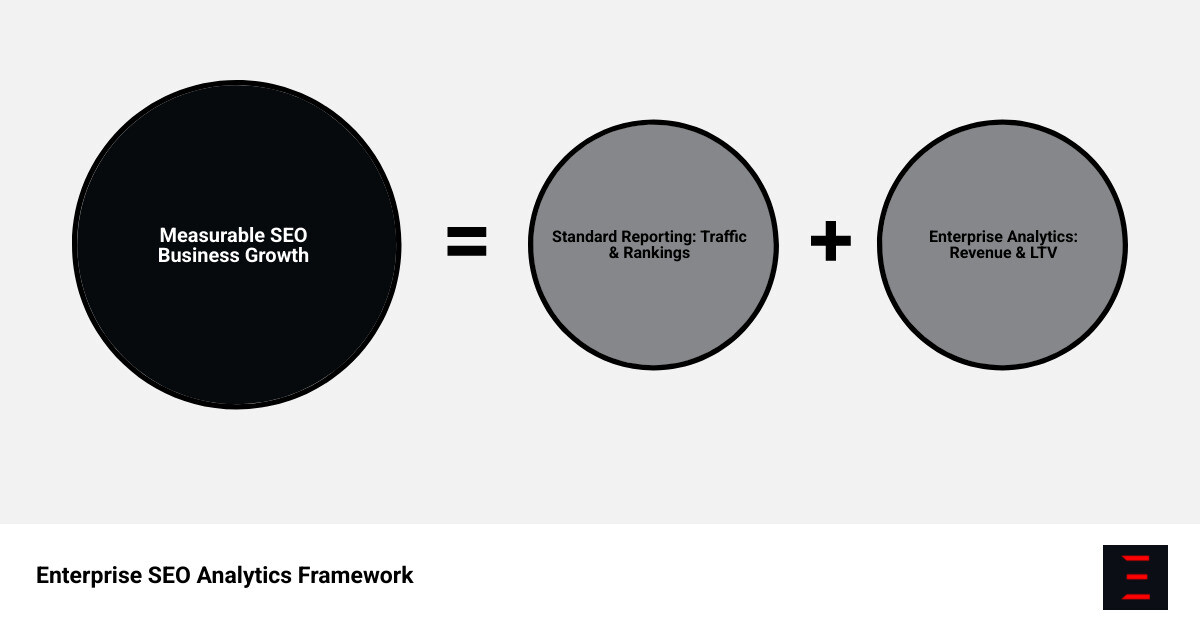
- Key Difference: Standard SEO reports traffic; enterprise analytics reports revenue.
- Components: Multi-touch attribution, identity resolution, CRM integration, BI dashboards.
- Goal: Prove ROI and secure budget by showing SEO’s impact on growth.
Most marketing leaders know SEO matters, as organic searches drive 94% of click-throughs and account for 53% of all website traffic. Yet, many enterprises struggle to connect SEO investments to business results because traditional reporting stops at vanity metrics. It can’t answer the questions your CFO cares about: How much pipeline did organic search generate? What’s our customer acquisition cost from SEO?
Enterprise SEO analytics closes that gap. It moves beyond surface-level metrics to quantify exactly how SEO contributes to your bottom line, helping you win bigger budgets and drive sustainable growth. This is critical, with 57% of enterprises citing limited in-house SEO skills and 43% reporting budget constraints. Proving value isn’t optional—it’s survival.
As Kiel Tredrea, founder of RED27Creative, I’ve spent over 20 years building marketing systems that connect strategy to measurable results. This guide will show you how to build your own revenue-ready analytics system in 90 days.
Enterprise SEO analytics terminology:
What is an Enterprise SEO Analytics Audit and Why Is It Crucial?
An enterprise SEO analytics audit examines how millions of pages and complex systems drive business results. For large organizations, small glitches can cost millions, so this audit connects technical performance, content, and engagement directly to revenue. It moves beyond finding broken links to measure how SEO infrastructure impacts pipeline and ROI, making it a crucial tool for risk management and understanding the advantages of search engine optimization.

The Unique Challenges of Enterprise SEO
Managing SEO at enterprise scale involves navigating a complex operational landscape:
- Organizational silos: Conflicting goals across marketing, IT, and product teams hinder alignment.
- Technical infrastructure: Complex legacy systems and custom CMS platforms are difficult to optimize for SEO.
- Resource allocation: Limited budgets (43% of enterprises) demand data-driven prioritization to justify every dollar.
- Cross-functional collaboration: Aligning developers, content creators, and legal teams on SEO goals is a constant struggle.
- Data management at scale: Handling millions of keywords and pages requires robust systems to avoid noisy, unactionable data.
- Proving value to stakeholders: Translating SEO metrics into revenue and CAC is essential for executive buy-in, a core function of national enterprise SEO services.
The Optimal Timing for an Audit
Knowing when to audit is as strategic as knowing how. Enterprises should use two approaches:
Preventive health checks, performed quarterly or bi-annually, proactively identify issues with technical health, content, and competitive positioning to prevent crises.
Reactive crisis management is an immediate diagnostic audit following a sudden drop in rankings, traffic, or conversions to find and fix the root cause quickly.
Prioritizing regular preventive audits is always more cost-effective and less stressful than emergency fixes.
The Framework: Core Components of a Comprehensive Audit
A comprehensive enterprise SEO analytics audit examines the systems that drive profitability.
- Technical SEO: The foundation. We audit site architecture, crawlability, page speed, and security to ensure search engines can find and understand your content.
- On-page Optimization: We analyze how well pages target user intent through titles, content depth, and internal linking to signal relevance.
- Off-page Authority: We evaluate your backlink profile, brand mentions, and domain authority to measure trust from other credible sites.
- Content Quality: We assess if content is unique, comprehensive, and engaging, identifying thin or duplicate content that harms rankings.
- User Experience: We analyze site navigation, load times, and mobile responsiveness, as poor UX sends negative signals to search engines.
A proper audit combines strategic thinking with advanced analytics, as detailed in our Chicago technical SEO consultant guide.
Essential KPIs for Your Enterprise SEO Analytics
To prove value, we track KPIs that connect directly to business outcomes, which is key for data-driven marketing strategies.
- Organic traffic growth: Indicates improving visibility.
- Non-branded pipeline revenue: Measures revenue from non-branded searches to show true market capture.
- Share of Intent: Gauges visibility across entire topic clusters, not just single keywords.
- Indexation efficiency: The ratio of indexed to valuable pages, critical for large sites.
- Content ROI: Identifies which content drives the most revenue to guide investment.
- Conversion rate by template: Pinpoints high-performing page layouts for optimization.
- Backlink quality: Prioritizes the authority of linking domains over sheer quantity.
Measuring Success Across Key SEO Pillars
We categorize KPIs across three pillars for a complete view, a central part of our advanced SEO services.
- On-page optimization: Click-through rate, bounce rate, and time on page measure content effectiveness.
- Off-page authority: Referring domains, authority score, and referral traffic gauge site credibility.
- Technical SEO: Crawl budget efficiency, Core Web Vitals, and page load time ensure the site’s infrastructure supports growth.
The Process: A 90-Day Blueprint for Actionable Insights
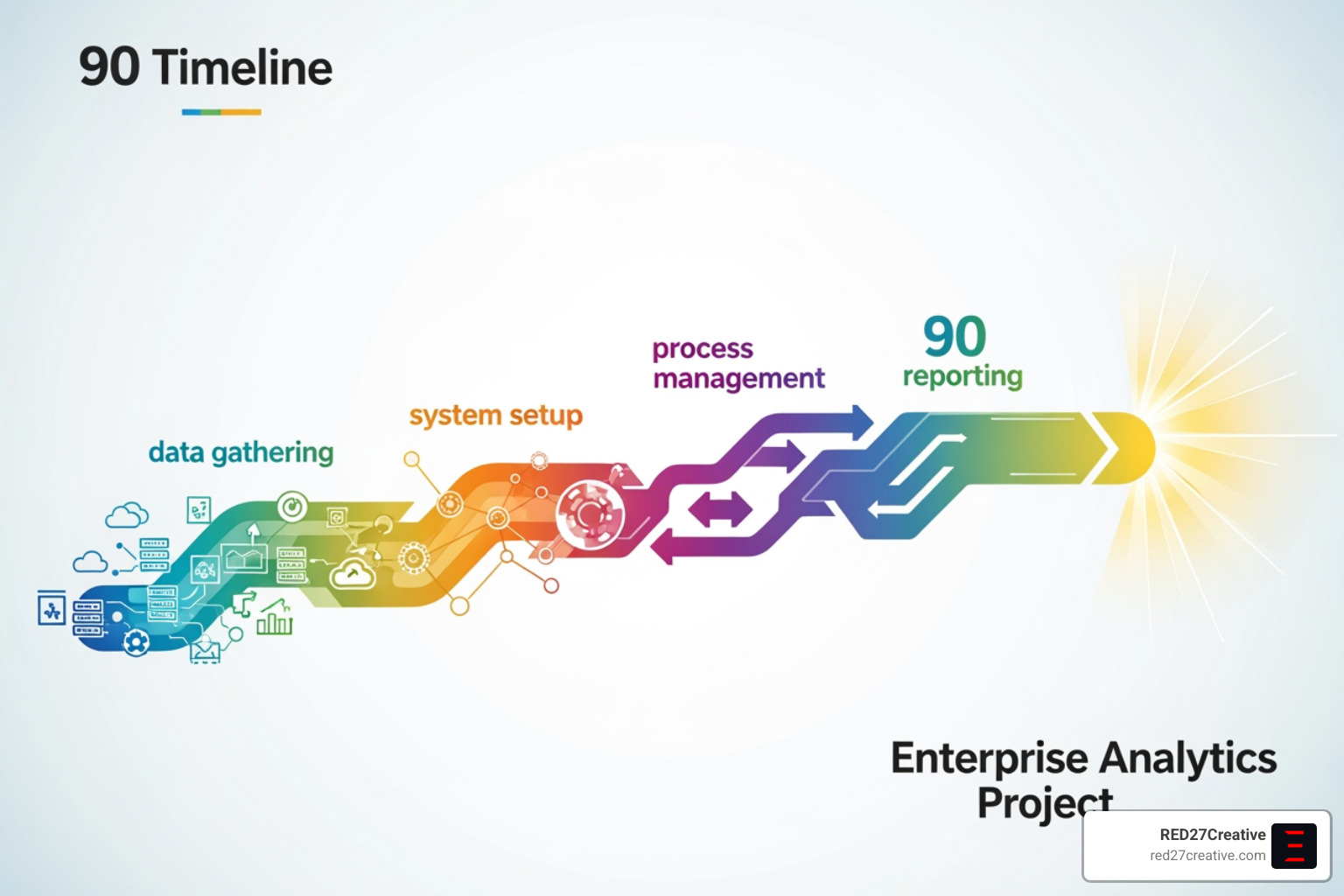
Building a robust enterprise SEO analytics system follows a structured 90-day blueprint that turns raw data into revenue-ready dashboards. This process, key to effective SEO project management, moves from data collection and instrumentation to governance, attribution modeling, and finally, dashboard creation that translates data into clear business outcomes.
Step-by-Step: Conducting an Effective Audit
An effective enterprise SEO analytics audit follows a methodical process:
- Set Objectives and Scope: Define goals, such as recovering from a ranking drop or finding growth opportunities.
- Comprehensive Website Crawl: Use tools to find technical issues like crawl errors and duplicate content.
- Log File Analysis: Examine server logs to understand bot behavior and identify crawl budget waste.
- On-Page and Off-Page Analysis: Evaluate content relevance, meta tags, and backlink profile quality.
- Content and UX Review: Assess content uniqueness and test user experience signals like site navigation.
Tools and Technology: Building Your Analytics Stack
A robust technology stack is essential. Key components include:
- Analytics Platforms (GA4): To understand user behavior.
- SEO Crawlers & Log Analyzers: For technical audits and bot activity insights.
- BI Tools (Looker Studio, Tableau): For custom reporting and dashboards.
- CRM Integration: To connect SEO data to the sales pipeline and prove revenue.
- AI and Automation: To manage complexity by automating site crawls, anomaly detection, and performance forecasting, allowing teams to focus on strategy. This is a key part of how AI in marketing transforms business growth.
Investing in a sophisticated analytics stack is no longer optional, as 55.15% of large enterprises used advanced SEO analytics software in 2023.
The Payoff: Tying Enterprise SEO Analytics to Revenue and ROI
The goal of enterprise SEO analytics is to prove organic search drives business growth—pipeline, revenue, and ROI. Executives want outcomes, not just rankings, which is the secret of marketing ROI.

A proper analytics framework allows you to prove ROI, win budget, and create forecasts by modeling the financial impact of SEO. It’s the difference between saying “traffic is up” and “organic search drove $2.3M in pipeline last quarter at a 40% lower CAC than paid channels.”
Building a Framework for Enterprise SEO Analytics
Connecting organic search to revenue requires a framework that tracks the full customer journey.
- Use Multi-Touch Attribution: Move beyond last-click models to data-driven attribution, accurately crediting SEO’s contribution at every stage.
- Integrate with CRM: Connect organic traffic to MQLs, SQLs, and closed deals to calculate pipeline revenue, bookings, and LTV.
- Tie Technical Health to Business Outcomes: Show how improving Core Web Vitals or page speed directly increases conversions and pipeline.
- Calculate Financial Metrics: Determine the payback period for SEO investments and prove defensibility with metrics like Share of Intent.
Since organic search accounts for 53% of website traffic, attributing its revenue impact is critical.
From Dashboards to Decisions: Communicating Value
Data must drive action. We create role-based Business Intelligence views for different stakeholders:
- CMO Dashboards: Focus on high-level strategy, including organic revenue, market share, and growth contributions.
- Marketing Ops Reports: Detail channel performance and conversion rates for daily execution.
- Finance Narratives: Translate SEO metrics into financial language, focusing on pipeline, payback period, and ROI.
The key is translating metrics into business impact. Crafting clear narratives ensures your enterprise SEO analytics drive strategic decisions and fuel growth for all your B2B SEO strategies.
Frequently Asked Questions about Enterprise SEO Analytics
How does enterprise SEO analytics differ from standard SEO reporting?
Standard SEO reporting tracks surface-level metrics like traffic and rankings. Enterprise SEO analytics is different because it integrates with CRM and BI tools to connect organic search directly to business outcomes like pipeline, revenue, and ROI. It uses advanced attribution models and is built to manage hundreds of thousands of pages, providing the financial context executives require.
How can I prove the ROI of our SEO efforts to the C-suite?
To prove ROI, you must speak the C-suite’s language: revenue and growth. Create dashboards that connect organic traffic to MQLs, SQLs, and closed deals. Use multi-touch attribution to show SEO’s role throughout the buyer journey. Present clear forecasts modeling the financial impact of SEO initiatives, as detailed in our guide on the secret of marketing ROI.
What is the role of AI and automation in enterprise SEO analytics?
AI and automation are essential for managing the scale of enterprise SEO analytics. They automate time-consuming tasks like site crawling, log file analysis, and anomaly detection, freeing your team to focus on strategy. AI-powered tools can also forecast performance and identify content gaps, a key way that AI in marketing transforms business growth. This allows for faster, data-driven decisions.
Master Your Data, Drive Measurable Growth
The journey through enterprise SEO analytics reveals a simple truth: mastering your data is the foundation of sustainable growth. For businesses across Geneva, Batavia, Aurora, St. Charles, Plainfield, Oswego, Naperville, and Chicago, IL, turning data into revenue-driving insights is what separates market leaders from the rest.
We’ve covered how enterprise SEO analytics moves beyond vanity metrics to connect organic search directly to pipeline and revenue. It requires sophisticated attribution, robust tracking, and dashboards that speak the language of business outcomes. As organic search continues to drive 53% of all website traffic, proving its value is a strategic imperative.
At RED27Creative, we build these data-driven systems. Our team of designers, developers, and SEO experts creates unified growth engines that connect your digital presence to measurable results. Led by founder Kiel Tredrea, we focus on what matters most: turning your website into a predictable, defensible revenue generator.
Ready to prove the true value of your organic search efforts? Turn your website into a predictable growth engine with our comprehensive SEO services.

Kiel Tredrea
https://red27creative.comTop Marketing Agency • Web, SEO & Leads • RED27Creative