Finding Your Perfect Match: The Strategic Marketing Partner Playbook

Why Your Next Big Win is a Partnership, Not a Tactic
A strategic marketing partner is a business relationship where two companies collaborate to achieve mutual growth through shared resources, aligned goals, and complementary expertise. The result is increased reach, brand awareness, and revenue that neither could achieve alone.
Key characteristics of a strategic marketing partner:
- Mutual benefit: Both parties gain value and share in the success.
- Long-term focus: The relationship is built for sustained growth, not quick wins.
- Complementary strengths: Partners are non-competing businesses with aligned audiences.
- Shared resources: Expertise, networks, and marketing investments are pooled.
- Strategic alignment: The partnership is deeply integrated into business goals and vision.
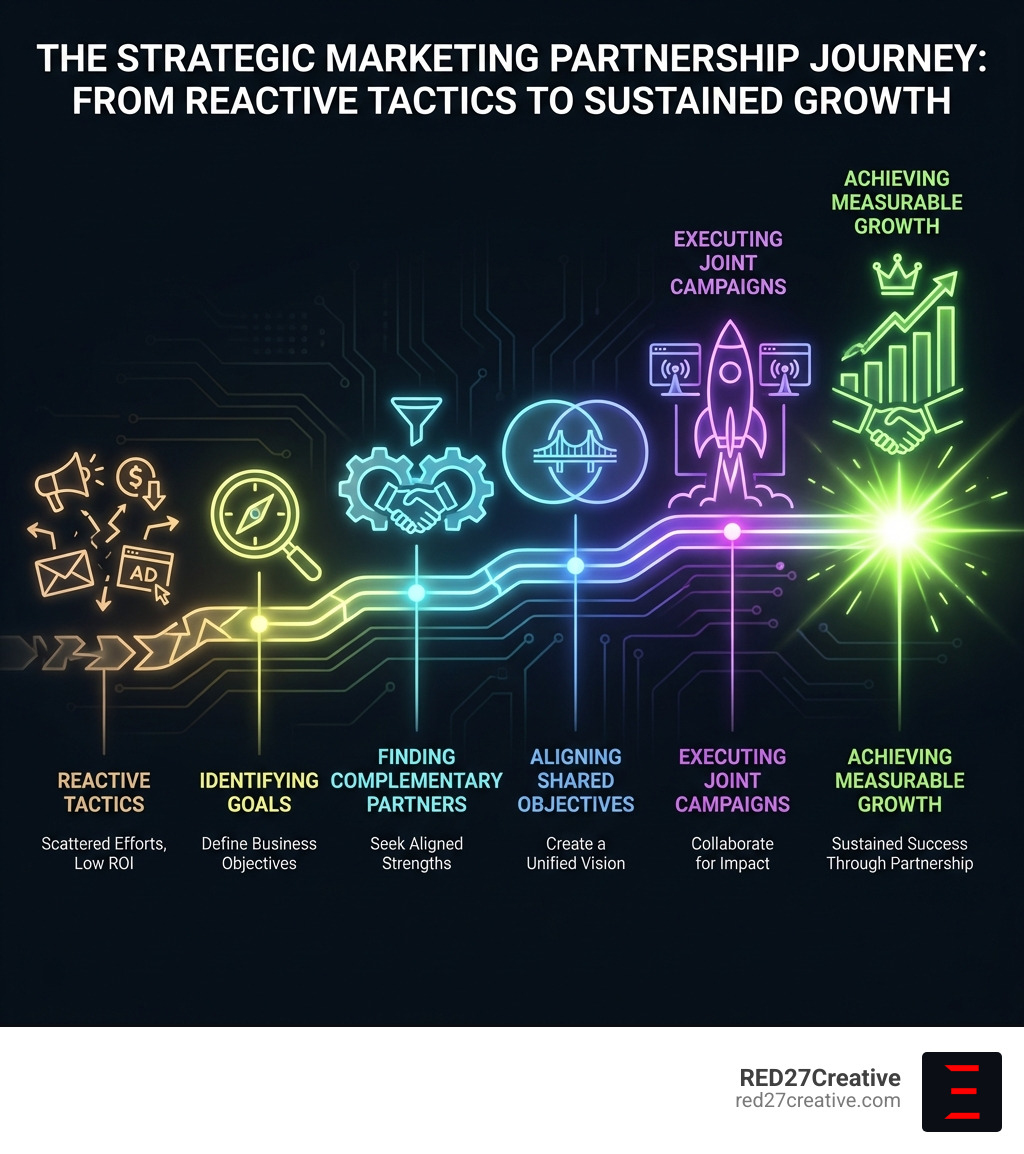
Many businesses waste budgets on scattered marketing tactics—a social campaign here, a paid ad there. This reactive approach feels like throwing spaghetti at the wall. The difference between accidental growth and intentional growth is strategy. The fastest way to build that strategy isn’t by doing more alone, but by finding the right partner.
Strategic marketing partnerships are about forming alliances with businesses that share your vision and multiply your impact. They provide access to new audiences, shared expertise, and cost-effective growth that compounds over time.
The data confirms this: 96% of businesses expect annual revenue increases from their partner networks. Customers from referrals have a 37% higher retention rate and are four times more likely to recommend you. Referral partners can contribute upwards of 20% of annual revenue, and Microsoft reported over $32 billion in partner-sourced revenue in 2019.
The challenge is that most businesses don’t know how to identify, vet, or manage these partnerships. They confuse a vendor relationship with a strategic alliance and wonder why it fizzles out.
This playbook is your roadmap. We’ll cover what makes a true strategic marketing partner, how to find one, what to include in an agreement, and how to measure success.
I’m Kiel Tredrea, founder and president of RED27Creative. With over 20 years of experience, I’ve seen how the right strategic marketing partner can turn scattered efforts into a unified growth engine, expanding market share and creating long-term revenue momentum.
Handy strategic marketing partner terms:
- Marketing Strategy Consulting Complete Guide
- Fractional CMO Services Ultimate Guide
- Digital Marketing Agency Ultimate Guide
Defining the Strategic Marketing Partnership: More Than Just a Collaboration
A strategic marketing partnership is a deliberate, long-term alliance between businesses designed to achieve shared objectives. It’s a relationship built on mutual benefit, where each party contributes unique strengths to create greater value than they could independently. These partnerships involve shared control, with both partners reaping rewards and accepting risks.
Meaningful partnerships require clear expectations and meticulous planning. It’s about finding companies with similar audiences and complementary offerings, ensuring no conflicts of interest, and aligning with firms that share your values.
For us, a strategic marketing partnership is a core part of an overall marketing plan. It’s how we help businesses in Geneva, Batavia, Aurora, St. Charles, and the greater Chicago area amplify their message. Explore how our Marketing Strategy and Consulting Services can help you forge these powerful alliances.
Common Types of Strategic Marketing Partnerships
Strategic marketing partnerships come in many forms, each offering unique advantages.
| Partnership Type | Goals | Commitment Level | Typical Use Cases |
|---|---|---|---|
| Co-branding | Boost brand awareness and reach new markets | High | Nike + Apple, celebrity collaborations |
| Referral Programs | Generate leads and increase customer retention | Medium | Loyalty programs like Marriott Bonvoy |
| Joint Ventures | Enter new markets or share R&D costs | Very High | Hulu (media companies), Amazon/Rivian |
| Distribution Partnerships | Expand market reach and sales channels | Medium to High | Starbucks in Target stores |
| Sponsorships | Increase brand visibility and positive association | Low to Medium | Coca-Cola sponsoring the Olympics |
These partnerships work wonders. For instance, a physical therapy clinic could partner with a health app, or a Chicago ad agency might collaborate with a local hospital on a campaign.
How a Strategic Partner Differs from a Vendor or Agency
A strategic marketing partner is fundamentally different from a vendor or a typical marketing agency. A vendor executes tasks; a strategic partner focuses on the why behind your marketing to drive long-term growth.
Here’s how a strategic marketing partner stands apart:
- Focus on “Why” vs. “How”: A partner focuses on your business goals and overall strategy, while a vendor simply executes tasks.
- Shared Risk and Reward: A partner is invested in your success, sharing in both risks and rewards, unlike a vendor who is paid for services rendered.
- Deep Business Integration: A partner acts as an extension of your team, understanding your business from the inside out.
- Long-Term Vision: A partner focuses on sustainable, long-term growth, whereas vendors are typically hired for short-term projects.
- Strategic Leadership: A partner provides senior-level strategic guidance, much like a Fractional CMO, to shape the bigger picture.
- Relational vs. Transactional: The partnership is built on trust and mutual respect, not just a transaction.
Our strategy-first approach ensures marketing efforts are connected and effective, helping businesses in the Chicago area develop streamlined strategies for measurable results.
The Exponential ROI: Core Benefits of a Strategic Alliance
Engaging a strategic marketing partner open ups exponential growth and a higher return on investment (ROI) than siloed marketing efforts. These alliances transform scattered tactics into a cohesive engine for expansion.
Here are the core benefits of a strategic alliance:
- Increased Reach: Gain immediate access to a partner’s established customer base and networks, expanding your audience without the typical investment.
- Improved Brand Awareness: Exposure to a partner’s audience boosts your brand’s visibility through mutual endorsement, which is impactful in competitive markets like Chicago and Naperville, IL.
- Cost-Effective Marketing: Pool resources to extend your marketing budget. Sharing campaign costs leads to more impactful initiatives for less individual spending.
- Shared Resources and Expertise: Leverage a partner’s specialized skills, technology, or market insights to achieve more sophisticated marketing outcomes.
- Competitive Advantage: Combine forces to offer unique value propositions or enter new markets more effectively. This collaboration creates innovative solutions that differentiate your business.
- Financial Stability: Shared costs and access to a partner’s network can improve financial stability, which is especially valuable for businesses looking to scale.
These benefits deliver tangible results. A DemandGen survey showed that 96% of businesses expected an annual revenue increase from their partner networks. This is about measurable impact, and we help businesses in Geneva, IL, achieve such growth through our Business Growth Consulting Services.

Fueling Business Goals: From Brand Awareness to Revenue Growth
A strategic marketing partner directly helps achieve concrete business goals, from broadening reach to boosting revenue.
Partnering with a complementary business gives you instant access to their audience, allowing you to enter new markets or demographics that would otherwise be costly to penetrate. This expanded reach improves brand awareness and builds credibility.
When customers find you through referrals, their retention rate is 37% higher, and they are four times more likely to recommend your brand. This organic endorsement drives powerful revenue growth.
Referral partners can contribute upwards of 20% of your annual revenue. For large companies, the impact is even greater—Microsoft reported $32 billion in partner-sourced revenue in 2019. The synergy from a strategic partnership creates more leads, higher conversions, and a resilient revenue stream.
The Ultimate Guide to Finding Your Ideal Strategic Marketing Partner
Finding the right strategic marketing partner requires a structured approach. It begins with internal clarity on your goals and needs, then moves to researching and vetting potential partners who can amplify your strengths. Our Business Consulting Solutions Ultimate Guide offers more insight into this process.

Identifying and Vetting Potential Partners
Identifying the right partner requires a keen eye for compatibility. Look for a genuine fit, not just a convenient one. Here’s what to look for:
- Complementary Audiences: Seek a partner who serves a similar audience with a non-competing service.
- Shared Values: Ensure cultural alignment on ethics and customer service for a smooth, long-term relationship.
- No Conflicts of Interest: Verify there are no competing interests that could undermine the collaboration.
- Reputation and Credibility: Research their market standing and customer feedback to reduce risk.
- Strategic Alignment: Ask about their long-term vision and success metrics to gauge commitment.
- Commitment Level: A true partner will be willing to invest significant resources, time, and effort.
- Relationship Building: Focus on building rapport and trust before formalizing any agreement.
- Shared Vision: Articulate a clear vision of how the partnership will create mutual, lasting value.
This rigorous process ensures you find a partner who is aligned with your goals and committed to mutual success.
Crafting a Bulletproof Strategic Marketing Partnership Agreement
Once you’ve found your partner, formalize the relationship with a comprehensive agreement to prevent misunderstandings. Always have legal professionals review it.
A strong agreement should outline:
- Goals and KPIs: Define measurable objectives and tracking methods.
- Roles and Responsibilities: Delineate tasks, contributions, and decision-making authority.
- Resource Contribution: Specify each partner’s financial, staff, and technology contributions.
- Communication Plan: Set a schedule for check-ins and reporting.
- Confidentiality: Include NDAs to protect sensitive information.
- Performance Reviews: Schedule regular reviews to assess progress and adapt strategy.
- Conflict Resolution: Outline a process for handling disagreements.
- Exit Strategy: Include a clear plan for ending the partnership if necessary.
- Legal Review: Ensure the agreement is legally sound and protects your business interests.
This detailed agreement builds a foundation of trust and transparency for the journey ahead.
Measuring Success and Navigating the Partnership Journey
Once a partnership begins, success depends on continuous attention, measurement, and adaptation. Nurturing the relationship with open communication and transparency is key to building a unified growth engine. A data-driven approach, like our Digital Growth Solutions, ensures every effort contributes to measurable growth.
Key Metrics for Tracking Your Strategic Marketing Partner’s ROI
To understand the value a strategic marketing partner brings, you must track specific key performance indicators (KPIs) that show the tangible return on your investment.
Essential metrics to track include:
- Leads Generated: New inquiries from the partnership.
- Conversion Rates: Percentage of partner leads that become customers.
- Customer Acquisition Cost (CAC): Compare the partnership CAC to other channels.
- Return on Ad Spend (ROAS): Revenue from joint advertising.
- Partner-Sourced Traffic: Website traffic from partner platforms.
- Brand Mentions: Increase in brand mentions across all media.
- Social Media Engagement: Growth in engagement from joint campaigns.
- Event Attendance: Attendees at co-hosted events.
Tracking these KPIs is crucial for optimizing strategy and demonstrating the partnership’s value, as success often relies on relationships and influence, not just hard numbers.
Avoiding Pitfalls: The Role of Trust and Communication
Even promising partnerships can falter without careful management. The foundation of any successful partnership is trust and communication. Proactively address common pitfalls:
- Misaligned Goals: Ensure partners are working toward the same objectives.
- Unclear Expectations: Clearly define all responsibilities to avoid frustration.
- Lack of Reciprocity: Ensure the partnership is mutually beneficial to avoid strain.
- Poor Communication: Maintain frequent, clear communication to build trust.
- Insufficient Resources: Allocate adequate time and budget for joint initiatives.
To avoid these issues, build trust through transparency. A critical tool is the “better-together” story—a clear articulation of how your combined offerings create unique value for the customer. As experts note, without this clear story, co-marketing efforts will struggle. This deep collaboration is a hallmark of how How Fractional Marketing Can Help Businesses can foster communication and trust.
Frequently Asked Questions About Strategic Marketing Partnerships
What is the main difference between a strategic marketing partner and a regular marketing agency?
A strategic marketing partner integrates deeply with your business, focusing on long-term growth, shared goals, and mutual success. Unlike a typical agency that executes specific tasks, a partner helps shape the “why” behind your strategy, sharing in both the risks and rewards to drive sustainable results.
How much should a business budget for a strategic marketing partnership?
Budgeting varies, but experts suggest that if you have a clear “better-together” story and defined objectives, partner marketing should account for a significant portion of your marketing budget, with some recommending a minimum of 25%. The investment should reflect the expected ROI in terms of reach, leads, and revenue.
How long does it take to see results from a strategic marketing partnership?
While some quick wins are possible, true strategic partnerships are built for long-term value. You might see initial results like increased brand awareness in the first few months, but significant impacts on revenue and market share typically develop over a 6-12 month period as the collaboration deepens and gains momentum.
Conclusion: Build Your Growth Engine with the Right Partner
In today’s competitive landscape, relying solely on isolated marketing tactics is a recipe for stagnation. The businesses that truly thrive are those that accept collaboration, moving beyond tactical chaos to strategic clarity. A strategic marketing partner is not just an asset; it’s a transformative force that can open up unparalleled growth, expand your reach, and fortify your brand.
We’ve explored what defines a strategic partnership, the diverse forms it can take, and how it fundamentally differs from a vendor relationship. We’ve seen how these alliances can deliver exponential ROI, fueling everything from brand awareness to significant revenue growth by leveraging shared resources and accessing new markets. The playbook for finding your ideal partner involves meticulous identification, thorough vetting, and a robust agreement, all built on a foundation of trust and open communication.
At RED27Creative, based in Geneva, Illinois, we believe in a strategy-first approach to marketing. We understand that your business in Batavia, Aurora, St. Charles, Plainfield, Oswego, Naperville, or Chicago, IL, deserves more than just marketing activity; it deserves a unified engine for growth. Our team of designers, developers, and SEO experts builds data-driven systems that connect every part of your marketing, ensuring that every effort is strategic, purposeful, and delivers measurable results.
Are you ready to stop guessing and start growing with purpose? The transformative power of the right partnership awaits.
Explore our Marketing Strategy and Consulting Services to find how we can help you forge these powerful alliances and build your growth engine.

Kiel Tredrea
https://red27creative.comTop Marketing Agency • Web, SEO & Leads • RED27Creative