Beyond the Buzz: Unpacking B2B Account Based Marketing

Why B2B Account Based Marketing is Changing How Companies Win High-Value Clients
Account based marketing B2B is a strategic approach that flips traditional lead generation on its head by focusing sales and marketing resources on a specific set of high-value accounts rather than casting a wide net. Here’s what makes it different:
- Targets specific accounts first, then personalizes engagement for each
- Aligns sales and marketing teams around shared goals and target lists
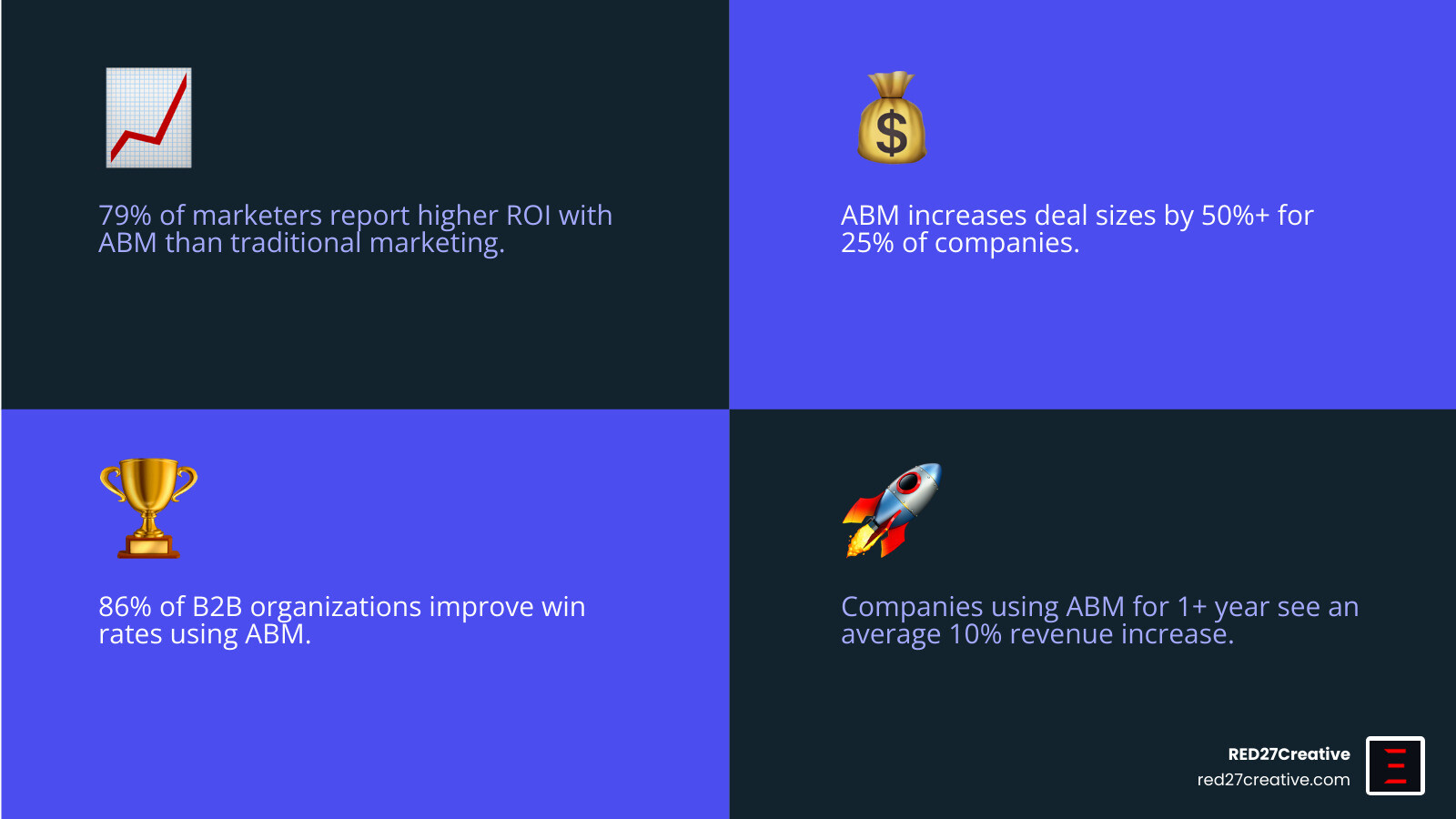
- Delivers higher ROI than traditional marketing (79% of marketers report this)
- Increases deal sizes by 50%+ for 25% of companies using ABM
- Shortens sales cycles by engaging the right stakeholders from the start
- Improves win rates (86% of B2B organizations report this benefit)
If you’ve been frustrated by marketing that generates lots of traffic but few qualified leads, you’re not alone. The traditional B2B playbook—create content, drive traffic, capture leads, qualify later—is increasingly ineffective for complex, high-value sales. Enterprise buying decisions now involve 14 or more stakeholders, and 60-80% of the buyer’s journey happens before a prospect ever contacts you.
That’s why more than 93% of B2B marketers worldwide now consider ABM extremely or very important to their overall marketing efforts. Instead of waiting for prospects to find you, ABM lets you identify your ideal customers, understand their specific challenges, and engage them with personalized experiences across every channel—before they start comparing you to competitors.
The shift from lead-centric to account-centric thinking isn’t just a tactical change. It’s a fundamental reimagining of how B2B companies build relationships, close deals, and grow revenue. Companies using ABM for at least one year see an average 10% revenue increase, with 19% seeing over 30% growth.
But ABM isn’t just about better numbers. It’s about working smarter. By focusing your finite resources on accounts most likely to convert and deliver long-term value, you eliminate wasted effort on unqualified leads, align your entire revenue team around shared targets, and create experiences that actually resonate with decision-makers.
I’m Kiel Tredrea, founder of RED27Creative, and over the past 20 years I’ve helped hundreds of B2B companies transform their marketing from reactive lead chasing to strategic Account based marketing B2B programs that drive predictable, scalable growth. Whether you’re new to ABM or looking to optimize an existing program, this guide will walk you through everything you need to know to make it work for your business.
Essential Account based marketing B2B terms:
- Generate B2B sales leads
- b2b lead generation and appointment setting services
- b2b linkedin lead generation service
The Foundations of ABM: Flipping the Funnel for B2B Success

At its core, Account based marketing B2B represents a fundamental shift in how businesses approach their market. Instead of casting a wide net to capture as many leads as possible, we carefully identify and target specific, high-value accounts. This strategic focus is crucial for B2B companies dealing with long sales cycles and complex buying decisions.
ABM isn’t just a tactic; it’s a strategic mindset that prioritizes quality over quantity, leading to stronger customer relationships and more efficient marketing efforts. We believe this approach is indispensable for B2B success in today’s competitive landscape. For more insights into evolving B2B strategies, check out our thoughts on B2B marketing trends.
What is Account-Based Marketing and How is it Different?
Account based marketing B2B is a focused approach where marketing and sales teams collaborate to identify, engage, and convert best-fit accounts into customers. Think of it as “flipping the funnel.” Traditional B2B marketing starts broad, trying to attract a large audience and then qualifying leads down the funnel. ABM, however, starts with a carefully selected list of target accounts, treating each as a “market of one.”
This “market of one” philosophy means we tailor our marketing and sales efforts specifically to the unique needs, challenges, and goals of each high-value account. Unlike traditional content marketing, which aims for broad relevance, ABM creates content and experiences designed exclusively for these chosen few. This targeted precision helps us engage prospects earlier in their buying process, often before they even begin searching for solutions. While ABM isn’t new—it’s been around for well over a decade—advances in data and technology have made it more accessible and powerful than ever.
The Core Benefits of an ABM Strategy
Implementing an Account based marketing B2B strategy open ups a cascade of benefits that directly impact a company’s bottom line and long-term growth. We’ve seen how this focused approach transforms B2B operations:
- Higher ROI: This is a compelling benefit, with over 79% of marketers reporting higher ROI from ABM than other marketing efforts. Studies show that a vast majority of organizations (89%) achieve a higher ROI with ABM accounts, and 40% see at least double the ROI compared to other methods.
- Increased Deal Sizes: ABM helps us go after bigger fish. 91% of B2B marketers activating ABM campaigns report larger deal sizes for ABM accounts, with 25% seeing deals over 50% larger.
- Improved Win Rates: By focusing on best-fit accounts and delivering personalized experiences, we significantly increase our chances of closing deals. 86% of B2B organizations attribute improved win rates to ABM.
- Shorter Sales Cycles: Engaging the right stakeholders with relevant information from the outset helps us accelerate the buying process, shortening traditionally long B2B sales cycles.
- Stronger Customer Relationships and Loyalty: ABM fosters deeper connections. 84% of B2B marketers using ABM report significant benefits in retaining and expanding existing client relationships, while 80% say ABM improves customer lifetime value. This personalized approach positions us as indispensable partners.
- Maximized Marketing Efficiency: By concentrating resources on high-potential accounts, we eliminate wasted effort on unqualified leads. This focus improves personalization, which is proven to drive growth, and saves resources by growing existing accounts, which is more cost-effective.
These quantifiable benefits demonstrate why ABM isn’t just a trend; it’s a strategic imperative for businesses aiming for sustainable growth. To understand how we measure the impact of these strategies, explore our insights on marketing ROI.
Building Your B2B Account Based Marketing Playbook
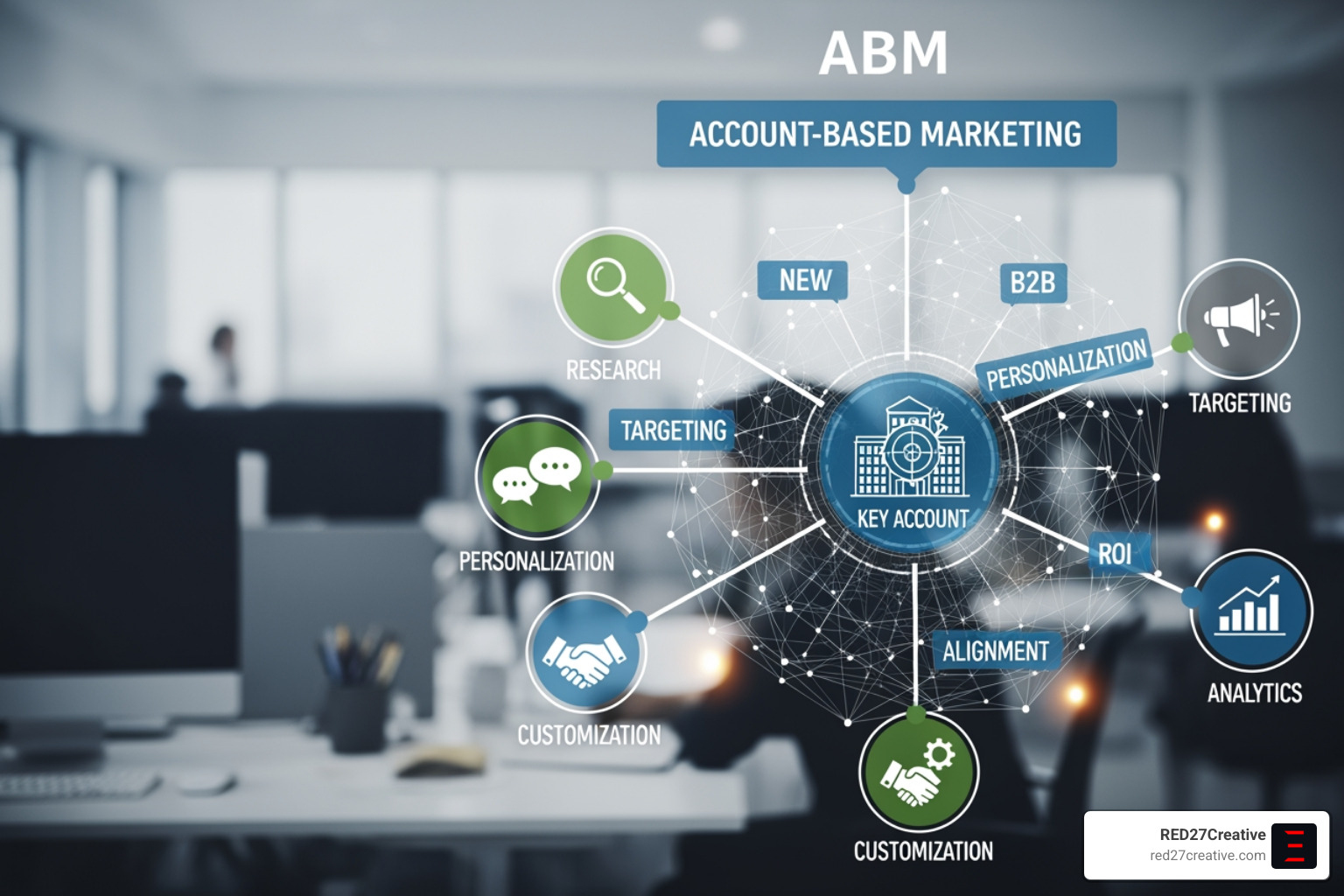
Successfully implementing Account based marketing B2B requires more than just knowing its benefits; it demands a practical, step-by-step approach. At RED27Creative, we guide our clients through building a robust ABM playbook that integrates key components, ensures sales and marketing alignment, and leverages data and personalization to drive results. Let’s explore the essential steps.
Step 1: Identifying and Selecting Your Ideal Target Accounts
The foundation of any successful ABM strategy is the meticulous identification of your ideal target accounts. This isn’t guesswork; it’s a data-informed research phase. We start by developing a comprehensive Ideal Customer Profile (ICP). An ICP defines the characteristics of companies that would derive the most value from your products or services and, in turn, provide the most value to you.
Key criteria for account selection include:
- Firmographics: Company attributes like industry, size, revenue, and growth rate.
- Technographics: The current technology stack an account uses, indicating compatibility or need.
- Intent Data: Crucial signals (e.g., web searches, content downloads) that indicate an account is actively “in market” for a solution. This helps rank accounts with high buying propensity.
- Predictive Analytics: Using models to evaluate potential accounts based on factors like past purchase history and existing relationships.
- Account Scoring: Combining these data points to score and prioritize accounts, focusing resources on the highest-potential targets.
This rigorous selection process ensures that every effort we make is directed toward accounts that are truly the best fit for our clients, maximizing the chances of conversion and long-term partnership.
Step 2: Choosing Your Targeting Strategy (1-to-1, 1-to-Few, 1-to-Many)
Once your ideal target accounts are identified, the next step in Account based marketing B2B is to determine the most effective targeting strategy. The Information Technology Services Marketing Association (Momentum ITSMA) outlines three main types of ABM, each suited for different scenarios and resource allocations:
- 1-to-1 (Strategic ABM): A highly personalized, resource-intensive approach treating each high-value account as a “market of one.” It involves creating bespoke programs and content for individual accounts, ideal for enterprise-level clients.
- 1-to-Few (ABM Lite): This strategy targets small clusters of accounts (e.g., 5-10) with similar needs. It balances deep personalization with scalability by developing campaigns that resonate with the group’s common challenges.
- 1-to-Many (Programmatic ABM): This approach uses technology to deliver personalized messages to hundreds or thousands of accounts. It scales personalization by using data to tailor content programmatically.
The choice among these strategies depends on the value of the accounts, available resources, and desired level of personalization. Here’s a quick comparison:
| ABM Type | Account Value | Personalization Level | Typical Channels Used |
|---|---|---|---|
| 1-to-1 | Very High | Extremely High | Direct Mail, Custom Content, Executive Events |
| 1-to-Few | High | High | Custom Webinars, Niche Campaigns, ABM Ads |
| 1-to-Many | Moderate to High | Moderate | Programmatic Ads, Personalized Email, Web |
By strategically choosing the right ABM type, we can optimize resource allocation and ensure that campaigns are both impactful and efficient.
Step 3: Aligning Sales and Marketing for Unified Execution
The success of any Account based marketing B2B initiative hinges on the seamless alignment and collaboration between sales and marketing teams. This isn’t just about “getting along”; it’s about marching in lockstep towards shared revenue goals. Research shows that 67% of businesses are better at closing deals when sales and marketing are aligned.
Key components of effective sales and marketing alignment in ABM include:
- Shared Goals and Metrics: Both teams agree on target accounts, success definitions, and KPIs to work toward the same objectives (e.g., increased engagement, pipeline velocity).
- Understanding the Buying Committee: Marketing and sales must understand the roles and pain points of all stakeholders (often 14+) within a target account to tailor outreach.
- Open Communication Workflows: Regular meetings, shared platforms, and a continuous exchange of insights keep both teams on the same page.
- Service Level Agreements (SLAs): Formalizing expectations through SLAs clarifies responsibilities, handover processes, and response times.
- Joint Planning and Execution: Collaborative planning for campaigns, content, and outreach ensures a unified approach and consistent messaging.
- Consistent Messaging: Training all teams on the same messaging maintains brand integrity across all touchpoints.
This level of collaboration moves beyond traditional lead handoffs to a truly integrated revenue team. For more strategies on optimizing your sales process, explore our sales strategies.
Step 4: Creating Personalized Campaigns and Content
In Account based marketing B2B, personalization is not a luxury; it’s a necessity. With 71% of consumers expecting personalized interactions, generic campaigns simply won’t cut it for high-value accounts. Our goal is to create campaigns and content that resonate deeply with each target account and the individuals within its buying committee.
Here’s how we approach personalized campaigns and content:
- Deep Account Research: We conduct in-depth research into each account’s challenges, industry, and decision-makers to create hyper-relevant content.
- Custom Content Creation: We develop content (e.g., case studies, reports, webinars) tailored to an account’s unique needs and buyer’s journey stage. Original research is particularly effective.
- Omnichannel Orchestration: We deliver a cohesive, personalized experience across all channels, including email, web, social media, and direct mail.
- Buyer’s Journey Mapping: Content is mapped to individuals based on their role and stage in the buying process, ensuring relevance for everyone from C-suite executives to technical managers.
- Dynamic Messaging: Using technology, we adjust CTAs and offers based on engagement and intent signals to make every interaction timely.
Effective content is the cheese to your mousetrap, as Barry Feldman once said. We ensure our professional content writing services are geared towards creating this highly engaging, personalized content that speaks directly to your target accounts.
Measuring, Scaling, and Optimizing Your ABM Efforts
Implementing Account based marketing B2B is an iterative process that requires continuous measurement, strategic scaling, and ongoing optimization. We believe in a data-driven approach to ensure that our ABM initiatives are not only effective but also demonstrate clear ROI.
Essential Tools and Technologies for Account based marketing B2B
To execute a successful Account based marketing B2B strategy, a robust technology stack is essential. These tools help automate processes, centralize data, and enable personalized outreach at scale.
Here are the key technologies we leverage:
- CRM Platforms: The cornerstone of ABM, serving as the single source of truth for all account and contact data (e.g., Salesforce, Microsoft Dynamics). It provides a unified view of every interaction.
- Marketing Automation Platforms (MAPs): Critical for engaging accounts at scale by automating personalized email campaigns, nurture flows, and ad targeting based on account-level data.
- Predictive Analytics and AI Tools: Use AI to analyze data, identify in-market accounts, predict conversion likelihood, and recommend engagement strategies.
- Data Enrichment Services: Enrich existing account data with firmographic, technographic, and intent data for a more complete picture and precise targeting.
- Ad Targeting Platforms: Vital for programmatic ABM, these platforms serve targeted ads to individuals within specific accounts across digital channels like LinkedIn and display networks.
The right combination of these tools ensures that our ABM programs are efficient, scalable, and highly effective.
Measuring Success: How to Prove ABM ROI
Proving the return on investment (ROI) for Account based marketing B2B is paramount, especially when justifying resource allocation. Unlike traditional marketing, ABM metrics focus on account-level engagement and revenue impact, not just individual leads.
Key metrics we track to measure ABM success include:
- Account Engagement: Measures how actively the entire buying committee within a target account interacts with content across all channels (e.g., site visits, downloads, ad clicks).
- Pipeline Velocity: The speed at which target accounts move through the sales pipeline. ABM aims to accelerate this.
- Deal Size: The average deal size of ABM-influenced accounts compared to non-ABM accounts.
- Win Rate: The percentage of target accounts that become paying customers.
- Customer Lifetime Value (CLV): The total value of an ABM-acquired account over the long term.
- Attribution Models: Multi-touch models that show which touchpoints contributed to closing a deal.
- Funnel Diagnostics: Regular analysis to identify and fix conversion gaps in the ABM journey.
By focusing on these account-centric metrics, we can clearly demonstrate the impact of ABM on revenue generation and business growth. This data-driven approach is a cornerstone of our philosophy at RED27Creative, enabling us to continuously refine our strategies. Learn more about data-driven marketing and its impact.
Overcoming Common Challenges and Scaling Your Program
While the benefits of Account based marketing B2B are clear, implementing and scaling an ABM program comes with its own set of challenges. We help our clients steer these problems to ensure long-term success.
Common challenges include:
- Sales and Marketing Alignment: Achieving true alignment is a common hurdle. Overcoming misaligned goals and fragmented tools requires ongoing communication, shared KPIs, and joint planning.
- Data Quality and Integration: ABM depends on accurate, integrated data. Siloed systems and inconsistent data can hinder personalization and must be addressed with robust platforms.
- Resource Allocation and Buy-in: Securing dedicated resources (time, budget, personnel) and leadership buy-in can be challenging. A pilot program can help demonstrate early wins and justify investment.
- Personalization at Scale: Scaling personalization from 1-to-1 to 1-to-many requires sophisticated technology and a well-defined content strategy.
- Measuring Impact: Attributing revenue accurately can be complex due to long sales cycles. Clear metrics and advanced attribution models are essential to prove ROI.
Scaling ABM for Different Business Sizes:
- SMBs: Small businesses can succeed with ABM by using a focused “1-to-1” or “1-to-few” approach. Concentrating limited resources on a few high-value accounts allows SMBs to achieve significant ROI without a large budget.
- Enterprises: Scaling ABM in large organizations involves using advanced AI and automation, establishing clear governance, and ensuring consistent execution across teams while maintaining personalization.
Ethical Considerations and Privacy Implications:
The data-heavy nature of ABM makes privacy paramount. Compliance with regulations like GDPR and CCPA is essential. Key principles include:
- Transparency: Be open about data collection and use.
- Consent: Obtain consent for communications where required.
- Data Security: Implement robust security to protect account information.
- Relevance: Ensure personalization is valuable, not intrusive.
By addressing these challenges proactively and adhering to ethical data practices, we can build trust and ensure the long-term success of our ABM programs. For guidance on navigating complex business growth strategies, refer to our business growth consulting services.
Frequently Asked Questions about B2B Account Based Marketing
How long does it take to see results from ABM?
ABM is a long-term strategy, not a quick fix. While some early indicators like account engagement can appear within weeks, significant results such as increased revenue and shorter sales cycles typically take 6-12 months to materialize as relationships with high-value accounts are nurtured and deals progress.
Can small businesses use account based marketing B2B?
Absolutely. Small businesses can benefit by starting with a “1-to-Few” or a highly focused “1-to-1” approach. By concentrating limited resources on a handful of best-fit, high-value accounts, SMBs can achieve significant ROI and compete effectively without needing a large budget or enterprise-level tools.
What’s the difference between ABM and demand generation?
Demand generation casts a wide net to attract a large volume of individual leads at the top of the funnel. In contrast, ABM flips the funnel, starting with a specific list of high-value accounts and using personalized campaigns to engage multiple stakeholders within them, focusing on quality over quantity.
Conclusion: Is ABM the Right Move for Your Business?
Account based marketing B2B is more than just a marketing strategy; it’s a fundamental shift in how B2B companies identify, engage, and grow their most valuable customer relationships. We’ve explored how ABM flips the traditional funnel, focusing resources on high-potential accounts to deliver higher ROI, increase deal sizes, shorten sales cycles, and build lasting customer loyalty.
The key to successful ABM lies in meticulous account identification, strategic targeting (1-to-1, 1-to-few, 1-to-many), deep alignment between sales and marketing, and the creation of highly personalized campaigns. While challenges like data integration and scaling exist, they are surmountable with the right tools, processes, and a commitment to a data-driven approach.
In an increasingly competitive landscape, where enterprise buying decisions involve numerous stakeholders and customer experience is paramount, ABM positions your business as an indispensable partner rather than just another vendor. It’s about building stronger customer relationships and increasing customer lifetime value by demonstrating a deep understanding of their unique needs and delivering consistent, relevant experiences.
At RED27Creative, we build data-driven systems that turn marketing efforts into measurable growth for businesses across Geneva, Batavia, Aurora, St. Charles, Plainfield, Oswego, Naperville, and Chicago. If you’re ready to move beyond generic lead generation and focus on the accounts that will truly drive your business forward, Account based marketing B2B is definitely the right move. Find how our B2B Lead Generation Services can help you implement a powerful ABM strategy.

Kiel Tredrea
https://red27creative.comTop Marketing Agency • Web, SEO & Leads • RED27Creative