Beyond the Horizon: Crafting Winning Business Growth Strategies

Why Business Growth Strategies Matter More Than Ever
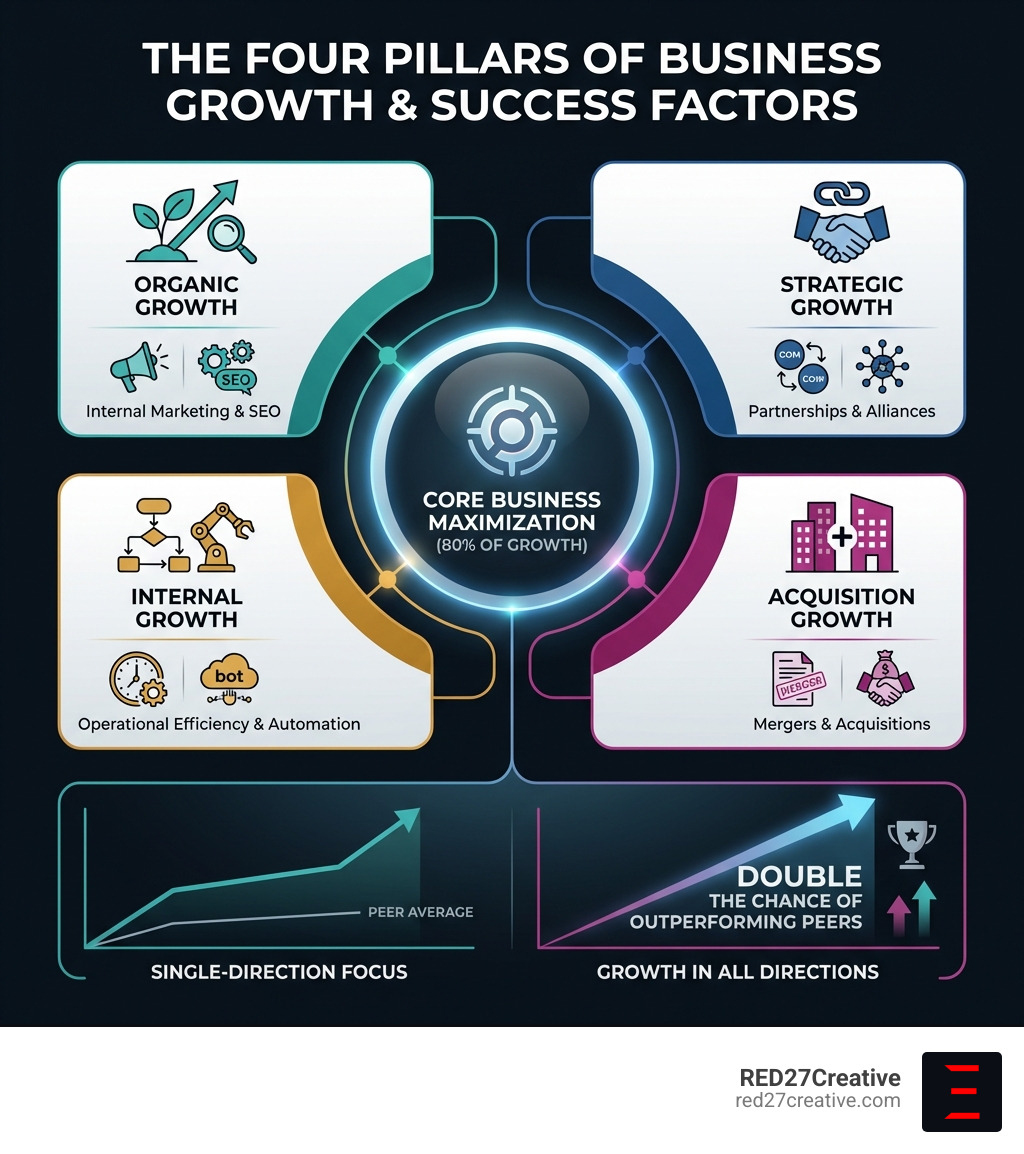
Business growth strategies are the roadmap companies use to expand revenue, increase market share, and build long-term competitive advantage. These strategies fall into four primary categories:
- Organic Growth – Expanding through internal marketing and sales of existing products
- Strategic Growth – Building partnerships and alliances to expand reach
- Internal Growth – Improving operational efficiency to boost profitability
- Acquisition Growth – Merging with or acquiring other businesses to accelerate expansion
The numbers tell a compelling story. Research shows that companies growing faster and more profitably than their peers generate shareholder returns six percentage points above industry averages. Yet only one in eight companies recorded growth rates above 10% per year in the decade before COVID-19, and just 25% of companies grow sustainably over time.
Growth isn’t just about scale. It’s about building momentum through the right combination of strategies. Companies that grow in all directions over a ten-year period have double the chance of outperforming their peers. The most successful organizations understand that 80% of growth comes from maximizing their core business, while the remaining 20% comes from strategic expansion into adjacent markets where they have a “right-to-win.”
What separates growth outperformers from everyone else? Courage. Companies that courageously pursued and stuck with through-cycle growth strategies during recent turbulent shifts led their organizations to growth outperformance. They didn’t hunker down during uncertainty—they leaned into strategic investments, digital change, and customer-centric innovation.
I’m Kiel Tredrea, founder and president of RED27Creative, and over the past 20 years I’ve guided hundreds of businesses through transformative marketing initiatives that strengthen brand positioning and drive consistent revenue using proven business growth strategies. My team and I have helped companies across industries build integrated marketing systems that combine SEO, web design, lead generation, and strategic consulting into measurable, sustainable growth.
Handy business growth strategies terms:
The Four Pillars of Business Growth Strategies
When we talk about business growth, we often think of it as a single objective. However, it’s more accurate to view it as a multi-faceted process built upon four distinct pillars: organic growth, strategic growth, internal growth, and acquisition growth. Each offers unique pathways to expansion and plays a crucial role in a well-rounded growth blueprint.
| Growth Strategy | Description | Key Characteristic | Typical Timeframe | Risk Level |
|---|---|---|---|---|
| Organic Growth | Expanding through internal efforts like increased sales, marketing, and product development within existing markets. | Relies on internal capabilities and market penetration. | Medium to Long | Low to Medium |
| Strategic Growth | Expanding through partnerships, alliances, or joint ventures. | Leverages external relationships and shared resources. | Medium | Medium |
| Internal Growth | Improving operational efficiency, cost reduction, and process optimization. | Focuses on maximizing existing resources and profitability. | Short to Medium | Low |
| Acquisition Growth | Expanding by merging with or acquiring other businesses. | Involves external entities for rapid market entry or diversification. | Short | High |
For businesses looking to formulate their growth plans, understanding these pillars is the first step. If you’re seeking a custom approach, exploring business growth consulting can provide the clarity you need.
Defining Organic and Internal Growth
Organic growth is often seen as the purest form of expansion, relying on a business’s own efforts to increase sales and market share. This can involve enhancing existing products, improving customer service, or expanding marketing efforts. For example, a company like Zapier saw 72% of its organic website traffic generated from SEO-focused blogs in 2023. This highlights the power of content marketing and SEO in attracting new customers and driving sales for existing offerings without external mergers or partnerships. It’s about making your current offerings irresistible and highly visible.
Internal growth, while sometimes overlapping with organic growth, specifically zeroes in on optimizing a business’s internal operations. This means improving efficiency, reducing costs, and streamlining processes to boost profitability. Think about refining supply chains, automating repetitive tasks, or enhancing employee productivity. These improvements can free up resources, allowing us to reinvest in other growth initiatives or simply increase our bottom line. Both organic and internal growth strategies focus on strengthening the business from within, building a robust foundation for future expansion.
Strategic Alliances and Acquisitions
Sometimes, to grow faster or enter new markets, we look beyond our own four walls. This is where strategic alliances and acquisitions come into play. Strategic alliances involve partnering with other businesses to leverage complementary strengths, resources, and customer bases. This could be anything from co-marketing campaigns to joint ventures. These partnerships can help us reach new audiences and expand our capabilities without the full commitment of an acquisition. According to research on strategic partnerships, they are a powerful way to increase market reach and customer potential.
Acquisition growth, on the other hand, involves buying other businesses. This is a faster way to gain market share, acquire new technology, or diversify product lines. Mergers and acquisitions (M&A) are significant drivers of revenue growth, accounting for approximately one-third of the revenue growth among companies in our data set. Programmatic M&A, where companies make at least two small or medium-sized deals a year along a consistent theme, has been shown to outperform other M&A approaches and even organic growth. It’s a bold move, but when executed strategically, it can open up substantial value and accelerate our journey toward becoming a market leader.
Maximizing the Core: Market Penetration and Product Development
At the heart of any successful business growth strategy lies the core business. Eighty percent of growth comes from maximizing the value of your core. This means we must continuously strive to deepen our presence in existing markets (market penetration) and evolve our offerings (product development) to meet changing customer needs.
Market penetration involves increasing sales of our current products or services to our existing customer base. This can be achieved through aggressive marketing and sales tactics, special promotions, expanding distribution channels, or simply improving customer service. The goal is to capture a larger share of the market we already serve.
Product development focuses on creating new, innovative products or significantly enhancing existing ones. This requires investment in research and development, keen market research, and actively listening to customer feedback. By doing so, we ensure our offerings remain relevant and compelling, driving sustained interest and sales.
Both market penetration and product development are intrinsically linked to customer retention. Keeping our current customers happy and engaged is crucial for long-term success. If you’re looking to refine your approach, exploring marketing strategies can provide valuable insights.

Driving Value through Product Diversification
Sometimes, maximizing the core means looking at how we can diversify within our existing product categories or offer complementary services. A fantastic example of this is the Stanley brand. Their sales increased from a typical $70 million a year to $750 million after adding a water bottle product line in various colors. This wasn’t a radical departure from their core business of insulated containers; it was a smart diversification that met a new customer need and significantly expanded their market reach.
Product or service diversification isn’t just about offering more; it’s about mitigating risk by creating broader revenue streams. By carefully introducing complementary offerings, we can tap into new segments or markets that align with our existing strengths, reducing dependency on a single product or service and boosting overall revenue growth. It’s about finding those adjacent opportunities that make sense for our brand and our customers.
The Critical Role of Client Retention
We all know the excitement of acquiring a new customer. But what about keeping the ones we already have? Client retention is not just important; it’s a critical business growth strategy. Retaining existing consumers is simpler than finding new ones and expedites growth because clients already trust our brand. On average, repeat customers spend 33% more on subsequent purchases. A meager five percent increase in retention can increase profits by 25% to 95%.
This is why we invest heavily in customer experience and building long-term relationships. By providing exceptional value and personalized communication, we foster loyalty. Leveraging integrated CRM and marketing automation systems helps us maintain engagement, offer relevant promotions, and ensure a memorable customer experience. For businesses in our service areas like Chicago, Naperville, or Aurora, focusing on local client retention can be a powerful driver of sustained growth. If you’re looking to turn leads into loyal customers, our B2B lead generation services are designed to help you not just acquire, but also retain valuable clients.
Expanding Horizons through Market Expansion and Strategic Partnerships
While maximizing the core is essential, sustained growth often requires looking beyond our current boundaries. Market expansion, whether into new geographic areas or new customer segments, is a powerful way to tap into untapped markets, diversify our customer base, and reduce dependency on a single market. This often involves thorough market analysis and localization strategies to adapt our offerings to new cultural nuances and preferences. For businesses in St. Charles or Geneva, this could mean expanding services to neighboring towns or even exploring national opportunities.
Another key aspect of expanding horizons is forming strategic partnerships. These collaborations allow us to leverage each other’s strengths and resources, reaching new customers and enhancing our capabilities. The ‘ten rules of value-creating growth’ from McKinsey highlight the importance of not just growing, but growing profitably. These rules include:
- Put competitive advantage first: Focus on what makes you uniquely strong.
- Make the trend your friend: Prioritize fast-growing, profitable markets.
- Don’t be a laggard: Outgrow your peers to gain market share.
- Turbocharge your core: Focus on growth in your largest industry segments.
- Look beyond the core: Nurture growth in adjacent business areas.
- Grow where you know: Expand where you have an ownership advantage.
- Be a local hero: Win convincingly in your home market first.
- Go global if you can beat local: Expand internationally with a transferable advantage.
- Acquire programmatically: Combine organic growth with serial acquisitions.
- It’s OK to ‘shrink to grow’: Periodically prune slow-growing parts of your portfolio.
For companies ready to explore exporting, resources like those from the SBA can provide guidance on increasing profits and stabilizing seasonal sales by reaching international markets.
Identifying Right-to-Win Adjacencies
Expanding into adjacent markets or “right-to-win” businesses is about smart growth. It’s not just about jumping into any new area, but rather those where we possess a clear ownership advantage. This could stem from our existing customer relationships, unique capabilities we can leverage, or a strategic position within the value chain. Companies pursuing adjacent businesses where they have a ‘right-to-win’ delivered 12 percentage points higher excess Total Shareholder Return (TSR) growth versus their peers.
This requires dynamic portfolio management—constantly assessing our strengths and opportunities to ensure we’re making the best strategic moves. It’s about asking: “Where can we truly excel and create lasting value?”
When to Shrink to Grow
It may seem counterintuitive, but sometimes the path to greater growth involves getting smaller first. This is the ‘shrink to grow’ strategy. It means periodically pruning back parts of our business portfolio that are underperforming or no longer align with our core strengths. By divesting these slow-growth assets, we can free up capital and resources to reinvest in more promising areas.
Companies in our sample that used shrink-to-grow strategies, divesting assets in one or two years but growing consistently during the other years, generated five percentage points more annual excess TSR than inconsistent growers and large-deal acquirers. This disciplined approach ensures that our resources are always allocated to where they can generate the most value, making our overall growth more robust and sustainable.
Leveraging Technology and Data for Modern Growth
In today’s digital landscape, technology and data are no longer just tools; they are fundamental drivers of business growth strategies. From automating mundane tasks to uncovering deep customer insights, digital change is reshaping how we operate and compete.
This means embracing innovations like Generative AI (GenAI) and advanced automation to improve productivity and efficiency across the board. If you’re looking to streamline your operations, exploring marketing automation can offer significant advantages.
Digital Change and AI-Driven Business Growth Strategies
Digital change is the process of adopting new technologies for better business operations, integrating cutting-edge technology throughout. This aims for long-term improvement and survival. The economic potential of Generative AI (GenAI) is immense, offering unprecedented opportunities for efficiency and innovation. GenAI can help teams focus on what matters most, such as delivering strategic advice and insights, by automating certain tasks that previously consumed valuable time. We’re focused on learning how new AI tools can help our team focus on delivering strategic advice, insights, and results for our clients.
AI-driven business growth strategies leverage machine learning and artificial intelligence to analyze vast amounts of data, predict market trends, personalize customer experiences, and even generate creative content. These tools allow businesses to make faster, more informed decisions and adapt quickly to market shifts. For example, AI analysis helped one software company identify more than 500 growth ideas. For companies in Oswego or Plainfield, integrating AI into local marketing efforts can provide a significant competitive edge. Learn more about how AI in marketing transforms business growth.
Data-Driven Decision Making for Business Growth Strategies
In today’s connected world, businesses automatically create and collect mountains of data. The challenge and opportunity lie in leveraging this data for informed decision-making. Data-driven decision making is about using analytics to spot market trends, identify opportunities, and understand customer behavior. This insight informs both short-term tactics and long-term strategic planning, helping us increase sales, reduce costs, or find new markets.
By analyzing the success of our marketing initiatives, for instance, we can adapt our strategies based on ROI, shifting resources from less effective channels to those that deliver the best results. This continuous optimization is crucial for efficient growth. Implementing robust data analytics frameworks allows us to measure everything from website traffic and conversion rates to content performance, ensuring our business growth strategies are always backed by solid evidence. For a deeper dive into how we use data to drive results, check out the impact of data-driven marketing strategies.
Operational Excellence and Talent Mobilization
True business growth isn’t just about external factors; it’s deeply rooted in our internal capabilities and the strength of our team. Achieving operational excellence and mobilizing our talent are essential for sustained expansion. This involves cultivating agile business models that can adapt quickly to market shifts, investing in talent development, and building scalable internal systems.
Agile business models are characterized by flexibility, shared responsibility, and action-oriented goals, focusing on experimentation and continuous improvement. We also know that businesses thrive when their people thrive. Investing in our employees fosters a culture of innovation and accountability. Engaged employees are more productive, leading to higher product quality, profitability, and customer loyalty. Scientific research on employee engagement consistently shows its positive impact on business outcomes. Furthermore, creating scalable internal systems, often by leveraging software, can significantly increase efficiency without necessarily increasing payroll, making growth more manageable.
Building an Innovation Mindset
An innovation mindset is not just about creating new products; it’s about fostering a culture where new ideas are encouraged, risks are taken, and continuous improvement is the norm. Companies that outperform their peers often talk about innovation on earnings calls at twice the rate of others. This involves investing in R&D, digital capabilities, and analytics, and cultivating an environment where employees feel empowered to experiment and learn from failures.
Mobilizing people to capture value quickly means envisioning ambitious growth changes and equipping our teams with the skills and capabilities to execute them. By fostering bold mindsets and creating rigorous performance management, we ensure that everyone, from the C-suite to the front lines, is aligned with our growth aspirations and actively contributing to our expansion efforts.
Sustainable and Ethical Growth Practices
How we grow is just as important as the growth itself. Sustainable and ethical practices are increasingly becoming integral to business growth strategies. Corporate responsibility builds brand loyalty and creates a positive reputation, as customers are willing to spend more with socially responsible businesses that align with their values. This isn’t just about good PR; it’s about building a resilient, future-proof business.
Companies that commit to sustainable, inclusive growth, often by integrating ESG (Environmental, Social, and Governance) factors into their strategy, are known as ‘triple outperformers.’ These companies grow revenues and profits while simultaneously improving their sustainability and ESG scores. Between 2017 and 2021, half of these triple outperformers reached or exceeded 10 percent annual revenue growth. This demonstrates that doing well by doing good can lead to superior financial performance and stronger brand positioning.
Frequently Asked Questions about Business Growth Strategies
What are the primary types of business growth strategies?
The four primary types include organic growth through internal marketing, strategic growth via partnerships, internal growth by improving operational efficiency, and acquisition growth through mergers. Successful companies often combine these methods, focusing on their core business while selectively expanding into adjacent markets where they have a clear competitive advantage.
How does digital change drive business growth?
Digital change drives growth by integrating cutting-edge technology across all operations to improve customer experience and internal efficiency. By leveraging tools like Generative AI and data analytics, businesses can automate repetitive tasks, gain deeper customer insights, and adapt quickly to market shifts, resulting in higher profitability and sustainable expansion.
Why is client retention a critical growth strategy?
Client retention is critical because retaining existing customers is significantly more cost-effective than acquiring new ones. Repeat customers already trust your brand and spend an average of 33% more on subsequent purchases. Focusing on retention through exceptional service and personalized engagement provides a stable foundation for long-term, profitable growth.
Conclusion
Navigating the complexities of business growth requires more than just ambition; it demands a strategic, adaptable, and data-driven approach. From maximizing your core business through market penetration and product development to expanding horizons via strategic partnerships and targeted acquisitions, each pillar of growth plays a vital role. Leveraging technology and data, embracing operational excellence, and fostering an innovative, ethical culture are no longer optional—they are imperatives for sustained success.
At RED27Creative, we understand these dynamics intimately. As a modern marketing and web agency based in Geneva, Illinois, we specialize in building data-driven systems that connect every part of your marketing—website, SEO, local presence, and lead generation—into one unified engine for growth. Our expertise in advanced SEO, web design, and lead generation ensures that our clients, from Batavia to Chicago, achieve measurable ROI and consistent, qualified opportunities.
We’re here to partner with businesses ready to grow. Let us help you craft winning marketing strategy and consulting services that not only meet your current goals but also position you for long-term success beyond the horizon.

Kiel Tredrea
https://red27creative.comTop Marketing Agency • Web, SEO & Leads • RED27Creative