Stop Wasting Traffic and Start Generating B2B Leads with Technical SEO

Why Most B2B Tech Companies Are Losing Leads They Should Already Have
B2B lead tech SEO is one of the most powerful — and most misunderstood — growth levers available to technology companies today.
Here is the core problem: most B2B companies invest in SEO and watch their traffic climb, only to have their CEO ask the question that nobody wants to answer — “So how many of these visitors actually became customers?”
Traffic without pipeline is just a vanity metric. And for B2B tech companies, where a single contract can be worth hundreds of thousands of dollars, that gap is expensive.
Here is what B2B lead tech SEO actually does when it works:
- Attracts high-intent buyers — people actively searching for solutions you sell
- Builds compounding organic visibility — unlike paid ads, it keeps working after you stop spending
- Shortens the trust gap — buyers find you during their research phase, before they even talk to sales
- Generates qualified pipeline — not just clicks, but demos, form fills, and closed-won revenue
B2B purchases typically involve 266 touchpoints across 11.5 months before a contract is signed. That means your SEO content needs to show up consistently — not just once.
The difference between SEO that drives traffic and SEO that drives revenue comes down to strategy. And that is exactly what this guide covers.
I’m Kiel Tredrea, founder of RED27Creative, and over the past 20+ years I’ve helped B2B companies build SEO systems that connect organic search directly to pipeline growth — the kind of B2B lead tech SEO that turns a website into a consistent source of qualified opportunities. Let’s get into what actually works.
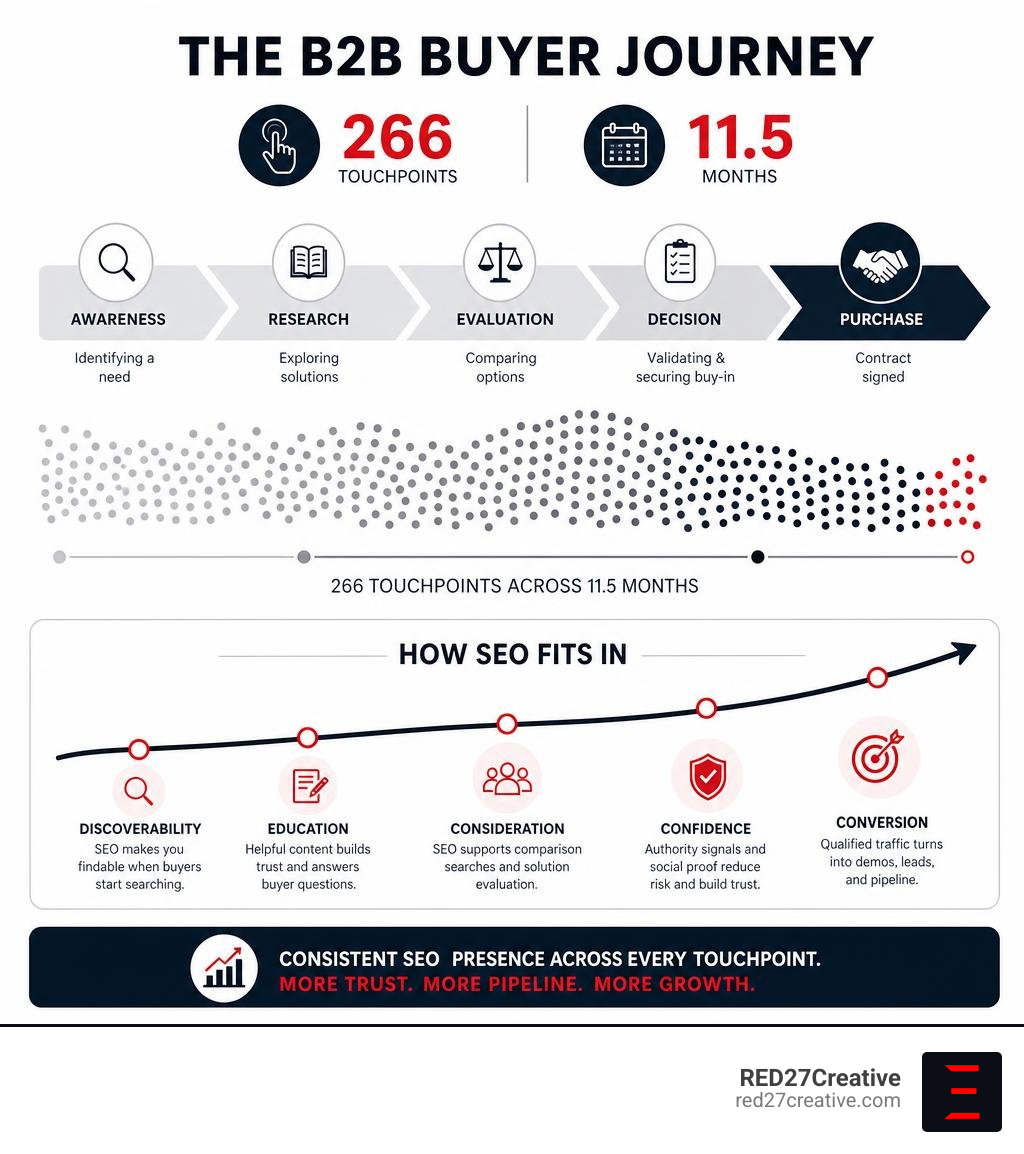
Similar topics to B2B lead tech SEO:
What is B2B lead tech SEO and Why Does It Matter?
At its core, B2B lead tech SEO is the strategic process of aligning your technical website infrastructure, search engine optimization, and conversion pathways to attract professional decision-makers. It is not just about getting more eyes on your website. It is about getting the right eyes on your site when they are actively looking to solve a complex business problem.
In the B2B tech sector, buyers do not make impulse decisions. They research, compare, read technical specifications, and consult multiple stakeholders before requesting a demo. If your website is invisible during this research phase, you lose the deal before you even know it exists.
Implementing a modern, revenue-first strategy ensures that your platform is easily crawlable by search engines and structured to convert high-value traffic. To build a solid foundation, check out our comprehensive guide on B2B SEO Strategies to see how we align search intent with business outcomes. For companies looking to scale their pipeline, focusing on technical search optimization that targets high-intent buyers is the first step toward turning search visibility into actual revenue.
The Core Differences Between B2C and B2B lead tech SEO
Many generic marketing agencies treat B2B SEO exactly like B2C SEO, which is a recipe for wasted ad spend and empty pipelines. B2C SEO typically focuses on high-volume, transactional keywords with short sales cycles. In contrast, B2B search intent is highly specific, operationally complex, and involves multiple decision-makers.
A B2C buyer might search for “best running shoes” and make a purchase within five minutes. A B2B buyer searching for enterprise software is looking for integration capabilities, security compliance, and long-term scalability.
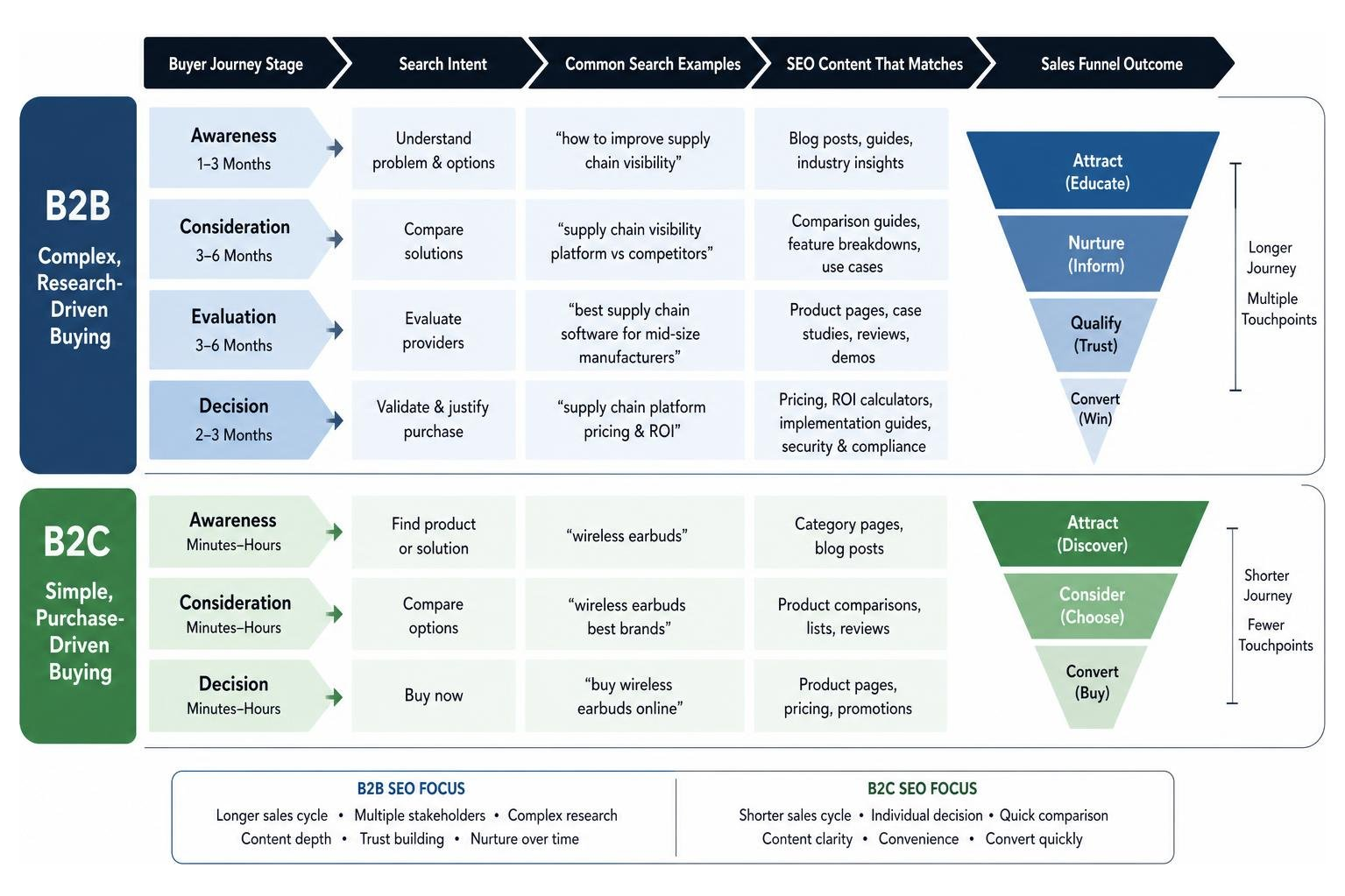
Because B2B purchases are operationally expensive, buyers use complex industry jargon and highly specific search queries. Your content must speak directly to these technical needs while maintaining a flawless user experience.
SEO vs. PPC: Cost, Sustainability, and Lead Quality
While Pay-Per-Click (PPC) advertising can drive immediate traffic, it is a pay-to-play model. The moment you stop funding your ad campaigns, your lead flow drops to zero.
Organic SEO, on the other hand, acts as a compounding asset. The work you do today continues to attract passive, high-quality traffic for years to come. Furthermore, organic search results are often perceived as more trustworthy and authoritative than paid advertisements.
| Feature | Organic B2B SEO | Paid Search (PPC) |
|---|---|---|
| Upfront Cost | Moderate to High (Strategic Setup) | High (Ad Spend + Setup) |
| Long-Term Cost | Low (Compounding Returns) | Continuous (Increases with Competition) |
| Lead Quality | Very High (Intent-Driven) | Variable (Requires constant tweaking) |
| Sustainability | High (Passive traffic continues 24/7) | Low (Stops when budget runs out) |
| Trust Factor | High (Viewed as organic authority) | Moderate (Marked as sponsored) |
When you combine organic search optimization with a targeted outreach strategy, you build a resilient pipeline. For example, using specialized platforms like IntelLeads.ai | AI-Powered B2B Lead Generation & Email Outreach Platform can complement your organic efforts by helping you target and nurture high-intent accounts directly.
High-Intent Keyword Strategies for B2B Buyers
To generate qualified leads, you must prioritize commercial intent over raw search volume. Targeting broad, informational keywords like “what is cloud computing” will bring in plenty of traffic, but very few buyers.
Instead, we focus on identifying keywords that indicate a buyer is ready to evaluate solutions. Our B2B Lead Generation Services are built around mapping these high-intent queries to your core business offerings, ensuring your content meets the buyer exactly where they are in their decision-making journey.
Targeting Bottom-of-Funnel (BOFU) Search Queries
Bottom-of-Funnel (BOFU) keywords are the goldmine of B2B lead tech SEO. These search terms are used by prospects who already understand their problem and are actively comparing vendors.
Some of the most lucrative BOFU keyword patterns include:
- Alternative Pages: Targeting search terms like “Competitor Alternatives” or “Apps like Competitor.”
- Comparison Pages: Creating objective head-to-head reviews, such as “Product A vs. Product B.”
- Pricing Queries: Capturing buyers researching “Competitor Pricing” or “Enterprise Software Cost.”
These keywords might have lower monthly search volumes, but their conversion rates are often 20x higher than top-of-funnel informational terms. When a buyer searches for a comparison page, they have their credit card or budget approval within arm’s reach.
Leveraging Jobs-to-be-Done (JTBD) Keywords for B2B lead tech SEO
The Jobs-to-be-Done (JTBD) framework focuses on the specific “job” a customer is trying to accomplish when they use your product. Instead of targeting generic product categories, you target the exact operational pain point your software or service solves.
For example, instead of targeting “marketing automation software,” a JTBD keyword strategy might target “how to track email marketing ROI automatically.”
By aligning your content with highly specific use cases, you build immediate authority. This approach allows you to target thousands of long-tail JTBD keywords efficiently, ensuring your solutions are visible to buyers searching for very specific operational answers.
Technical SEO Foundations That Drive Pipeline
No matter how great your content is, it won’t rank — or convert — if your website is slow, broken, or difficult for search engines to crawl. Technical SEO is the engine under the hood of your digital marketing strategy.
For businesses in competitive regions, local technical execution is critical. If you are operating in the Chicago area, partnering with a specialized team is essential. You can learn more about our local expertise through our Chicago Technical SEO services, or browse our comprehensive Chicago Technical SEO Consultant Guide to learn how we optimize complex enterprise websites.
Core Web Vitals and User Experience (UX)
Google places massive importance on user experience metrics, known as Core Web Vitals. If your site takes too long to load, or if elements shift unexpectedly while loading, users will bounce back to the search results.
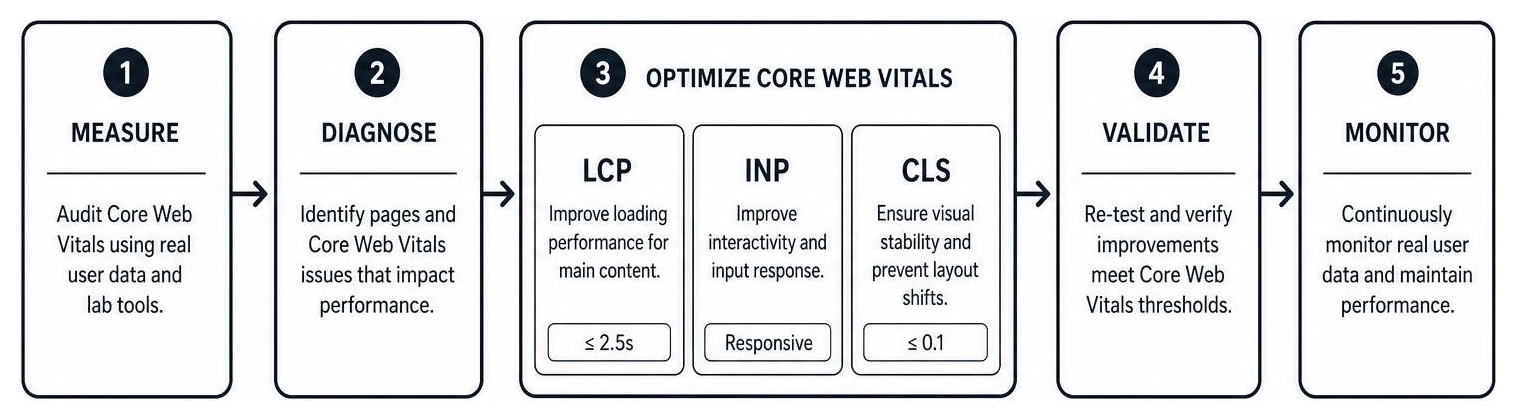
To optimize your user experience:
- Improve Largest Contentful Paint (LCP): Ensure your main page elements load in under 2.5 seconds.
- Minimize Interaction to Next Paint (INP): Keep your site highly responsive to user clicks and inputs.
- Prevent Cumulative Layout Shift (CLS): Ensure your page layout remains stable as assets load.
A fast, responsive website keeps prospects engaged and reduces friction in the lead generation funnel.
Structured Data and Schema Markup for B2B Tech
Structured data (Schema markup) is code that you add to your website to help search engines understand your content. By implementing detailed JSON-LD schema, you make it easier for search engines to display rich snippets, such as product ratings, pricing, and FAQ dropdowns directly in the search results.
For B2B tech companies, the most critical schema types include:
- Organization Schema: Establishes your brand identity, locations, and social profiles.
- Product Schema: Highlights specific software features, pricing models, and user reviews.
- FAQ Schema: Displays common questions and answers directly on the SERP, capturing more visual real estate.
Using clean, validated schema ensures that both search engine crawlers and modern AI search engines can easily parse your business data.
Optimizing for the AI Search Era (ChatGPT, Perplexity, and GEO)
The search landscape in July 2026 has fundamentally shifted. Traditional search engines are no longer the only way buyers find solutions; generative AI engines like ChatGPT, Claude, and Perplexity are actively shaping purchasing decisions.
In fact, recent data shows that 90% of B2B buyers use ChatGPT during their vendor research, and 38% of B2B buyers have made purchasing decisions based partly on AI-generated recommendations. If your brand isn’t cited by these LLMs, you are missing out on a massive, fast-growing segment of high-intent traffic.
The Rise of Generative Engine Optimization (GEO)
Generative Engine Optimization (GEO) is the practice of optimizing your digital footprint so that AI models retrieve and recommend your brand. These AI tools use Retrieval-Augmented Generation (RAG) and semantic vector matching to synthesize answers for users.
Unlike traditional SEO, which focuses on exact-match keywords, GEO focuses on semantic relevance, brand authority, and clear entity relationships. To stay ahead, you must align your technical structure with the exact data points that generative engines look for, ensuring your brand is recognized as a trusted authority in your niche.
Aligning Content with AI Search Preferences
AI search engines prefer structured, authoritative, and easily digestible information. To optimize your content for AI citation:
- Use Structured Summaries: Lead your articles with a concise, factual summary (40-60 words) that directly answers the core query.
- Leverage Expert Validation: Ensure your content is backed by real subject matter experts (SMEs) to satisfy search engine E-E-A-T guidelines.
- Provide Multimodal Context: Use custom diagrams, tables, and structured data to make your content easy for AI models to parse.
By structuring your pages as “citation-ready units,” you increase the likelihood of being featured as a primary source in AI-generated answers.
Measuring SEO Success: From Traffic to Revenue
Many marketing agencies will show you beautiful charts of rising keyword rankings and monthly traffic. But if that traffic doesn’t turn into qualified pipeline, it is completely meaningless.
At RED27Creative, we measure success by business outcomes — marketing qualified leads (MQLs), opportunities, and closed-won revenue. If you want to build a system that prioritizes actual business growth, our B2B Lead Generation Agency services are designed to connect your organic search strategy directly to your sales pipeline.
Setting Up GA4 and CRM Attribution
To prove the ROI of your B2B lead tech SEO efforts, you must connect your website analytics directly to your Customer Relationship Management (CRM) platform.
Standard Google Analytics 4 (GA4) setups often miscategorize organic traffic or fail to track complex, multi-touch journeys. We recommend implementing custom channel groupings in GA4 to isolate AI search traffic and traditional organic traffic.
Additionally, you should implement self-reported attribution on your high-intent form fills. Adding a simple, mandatory field like “How did you first hear about us?” often captures the “dark funnel” touchpoints that standard tracking software misses.
Integrating SEO with Multi-Channel Marketing
Organic SEO does not operate in a vacuum. It works best when integrated with your paid ads, email marketing, and social media outreach.
For example, when a prospect lands on a BOFU comparison page via organic search but doesn’t immediately book a demo, you should immediately place them into a highly targeted LinkedIn retargeting campaign. By combining organic authority with multi-channel nurturing, you create a safety net that guides prospective buyers through the entire 11.5-month sales cycle.
Frequently Asked Questions about B2B Lead Tech SEO
What is B2B lead tech SEO?
B2B lead tech SEO is the process of optimizing a technology company’s website infrastructure, search visibility, and conversion design to attract professional decision-makers. Unlike traditional SEO, it focuses strictly on commercial-intent keywords, technical site health, and aligning content with complex B2B buyer journeys to generate qualified pipeline.
How long does it take to see results from B2B tech SEO?
Typically, it takes 3 to 6 months to see meaningful organic search rankings and lead generation. Because search engines require time to crawl, index, and establish authority for new content, SEO is a compounding investment that delivers accelerating returns over time.
How does AI search affect B2B SEO strategy?
AI search tools like ChatGPT and Perplexity pull information from highly authoritative, structured, and technically sound websites. To rank in AI search results, B2B companies must optimize for Generative Engine Optimization (GEO) by providing clear entity definitions, structured summaries, and robust schema markup.
Conclusion: Build a Revenue-First SEO Engine with RED27Creative
Generating high-quality B2B leads is not about chasing vanity traffic metrics or relying on outdated keyword stuffing tactics. It requires a modern, technical, and revenue-first approach that aligns your website structure with actual buyer intent.
At RED27Creative, we are built for real, measurable growth. Based in Geneva, Illinois, we serve businesses locally across Batavia IL, Aurora IL, St. Charles IL, Plainfield IL, Oswego IL, Naperville IL, and the greater Chicago IL area, as well as national brands ready to scale.
With over 20 years of experience, we build data-driven marketing systems that connect your technical SEO, custom web design, and conversion rate optimization into one unified engine for growth.
Ready to stop wasting traffic and start driving qualified pipeline? Schedule a consultation with RED27Creative today, and let’s discuss how we can turn your website into your most valuable sales asset.

Kiel Tredrea
https://red27creative.comTop Marketing Agency • Web, SEO & Leads • RED27Creative