Stop Chasing Clients: A Proactive Guide to Agency Business Development

Why Most Agencies Are Stuck in a Referral Loop — And How to Break Out
Advertising agency new business development is the structured process of identifying, attracting, engaging, and closing new client accounts through proactive strategy — not luck, charm, or waiting for the phone to ring.
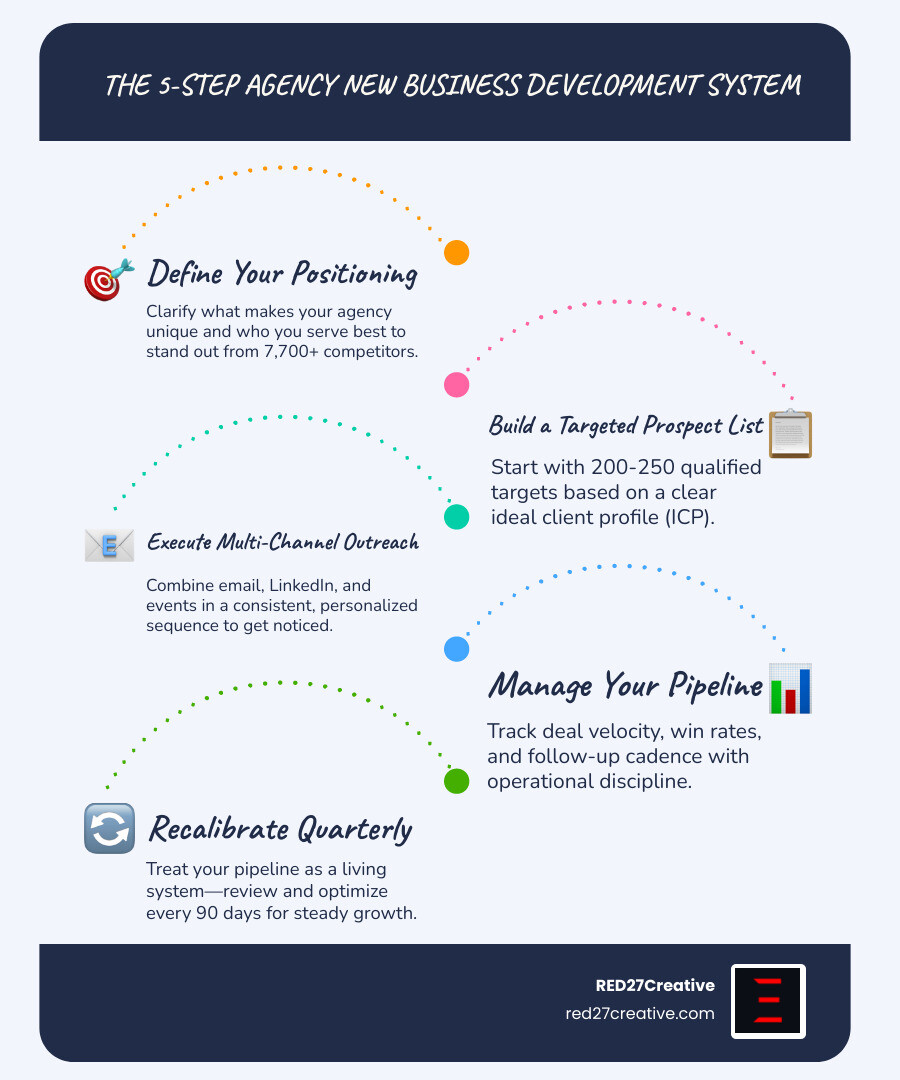
Here is a fast overview of what it involves:
- Define your positioning — Clarify what makes your agency different and who you serve best.
- Build a targeted prospect list — Start with 200-250 qualified targets based on a clear ideal client profile.
- Execute multi-channel outreach — Combine email, LinkedIn, and events in a consistent, personalized sequence.
- Manage your pipeline — Track deal velocity, win rates, and follow-up cadence with discipline.
- Optimize the pitch process — Qualify RFPs carefully and run pitches with operational precision.
- Recalibrate quarterly — Treat your pipeline as a living system, not a set-it-and-forget-it tool.
Most agencies know they need new clients. The problem is they have no real system to find them consistently.
Instead, they rely on referrals, wait on inbound RFPs, or leave business development to founders who are already stretched thin. It works — until it doesn’t. One lost client, one slow quarter, and suddenly the pipeline is empty.
The numbers back this up. Nearly 70% of agencies say new business development is their single biggest challenge — ranking it above client retention and upselling combined. And with more than 7,700 U.S. marketing agencies competing for the same clients, standing out without a deliberate strategy is nearly impossible.
The agencies that grow predictably are not the ones with the most charismatic founders or the biggest contact lists. They are the ones that treat business development as an operational discipline — with clear positioning, structured outreach, and consistent follow-through.
This guide walks you through how to build exactly that.
I’m Kiel Tredrea, founder and president of RED27Creative, and I’ve spent over 20 years helping businesses build marketing systems that generate real, measurable growth — including guiding agencies and B2B organizations through the full landscape of advertising agency new business development. The framework I share here is grounded in what actually works, not theory.
What is Advertising Agency New Business Development?
In the fast-moving marketing world of 2026, advertising agency new business development is the operational engine that drives sustainable new business growth. Far too many agency owners confuse “business development” with transactional sales or charismatic networking.
True business development is a strategic, repeatable process. It is how an agency systematically aligns its unique expertise with the exact brands that need it most.
Instead of waiting for opportunities to fall into our laps, we design systems that actively attract them. When we treat growth as a product that requires constant optimization, we protect our agencies from the feast-or-famine cycle that sinks so many creative shops.
Why Proactive Advertising Agency New Business Development is Critical
Relying on word-of-mouth is a dangerous way to run a business. While referrals are wonderful, they are inherently unpredictable and impossible to scale.
According to recent industry data, 69.6% of agencies rank new business development as their most difficult challenge, outpacing both client retention and upselling. Without a proactive strategy, you are always one client departure away from a financial emergency.
A proactive pipeline gives us the power to say “no” to bad-fit clients who drain our resources. By investing in dedicated business growth consulting services, agencies can design predictable outreach engines that keep their pipelines healthy and their teams focused on high-value work.
The Role of Specialization in Advertising Agency New Business Development
In a crowded market of over 7,700 U.S. agencies, being a “full-service” generalist is a fast track to invisibility. Clients do not want generalists; they want specialists who understand their exact industry, challenges, and customers.
Specialization gives you immediate pricing power. When you possess deep, niche expertise—such as localized performance marketing for mid-sized enterprises—you can command premium rates because the client sees you as a low-risk partner.
To win better clients, we must first build a tight, strategic framework. This starts with defining your ideal client profile (ICP) and learning how to position your agency as the obvious choice. For a step-by-step approach to this process, check out our guide on finding your perfect match the strategic marketing partner playbook.
The Three Key Stages of Agency Growth
Building a scalable pipeline requires a logical progression from planning to execution. We break this down into three distinct operational stages that turn cold prospects into long-term partners.
To build a system that works, we must align our internal goals with external market realities. For a deeper look at high-level planning, explore our guide on beyond the horizon crafting winning business growth strategies.
Stage 1: Foundation and Strategic Positioning
Your positioning is the foundation of all your marketing and sales efforts. If your team cannot explain what makes your agency different in a single sentence, your prospects certainly won’t grasp it either.
We must define our core differentiators, map our target market segmentation, and craft a compelling value proposition. This is not about bragging about our creative awards; it is about proving how we solve specific business problems.
If you want to understand how clients evaluate potential agency partners, read our advice on how to pick a marketing firm without losing your mind.
Stage 2: Building an Intelligent Prospect Database
Once our positioning is locked in, we need to build a highly targeted prospect list. A healthy initial list should contain at least 200-250 targets that perfectly match our ICP.
We do not just look at company size and industry. We also monitor “trigger events” like leadership changes, new funding rounds, or brand expansions.
These indicators tell us when a company is actively looking for a new strategic partner. For agencies looking to accelerate this phase, partnering with a specialized b2b lead generation agency is an excellent way to secure high-quality data without draining internal resources.
Stage 3: Multi-Channel Outreach and Execution
With our database built, we execute highly personalized, multi-channel outreach campaigns. A single cold email is no longer enough to get a busy CMO’s attention.
We combine targeted emails, professional LinkedIn interaction, and event networking into a structured sequence of 8 to 10 touchpoints over several weeks.
The secret is to lead with value—sharing industry-specific insights and proof of results rather than a generic sales pitch. Utilizing professional lead generation services can help you systematize this outreach, ensuring no prospect falls through the cracks.
Overcoming Modern Challenges in Agency Pipeline Building
The agency landscape of 2026 presents unique hurdles that require modern solutions. Legacy sales tactics simply do not work anymore.
| Challenge | In-House Business Development | Outsourced Business Development |
|---|---|---|
| Cost | High ($150K+ base salary plus benefits & tech) | Predictable monthly retainer with lower overhead |
| Speed to Market | Slow (requires recruiting, hiring, and ramp-up time) | Fast (can launch targeted campaigns in 30 days) |
| Tech Stack | Agency must purchase and manage multiple tools | Included in the partner’s existing infrastructure |
| Best For | Large enterprise agencies with stable long-term budgets | Growing agencies needing immediate pipeline support |
Agencies must carefully weigh these options to build a sustainable growth engine. To scale your brand effectively, we often recommend blending internal strategy with specialized digital growth solutions.
Navigating the Rise of In-House Agencies
The in-housing trend continues to accelerate. According to the Association of National Advertisers (ANA), 82% of member organizations now have in-house agencies, up from 78% just a few years ago.
This means brands are pulling basic creative execution and day-to-day media management in-house. To win in this environment, agencies must pivot to a hybrid model.
Instead of fighting the in-house team, position your agency as a specialized partner that handles high-level strategy, advanced technical execution, or objective auditing. Learn how to present this collaborative value by reading from strategy to success partnering with a performance focused agency.
Combating AI Commoditization with Strategic Value
AI tools have commoditized basic content execution, design, and code. If your agency sells deliverables by the hour, you are competing in a race to the bottom.
To protect your margins, you must shift your positioning from execution to strategic consulting. Clients do not pay for the hours we spend writing copy; they pay for our ability to solve complex business problems and drive measurable ROI.
We must anchor our value proposition in business outcomes, using advanced data, consumer psychology, and creative problem solving that AI cannot replicate.
Optimizing the Pitch-to-Close Process and Deal Velocity
Securing the initial meeting is only half the battle. To scale, agencies must optimize their pitch-to-close process and accelerate deal velocity.
One of the biggest mistakes agencies make is chasing every RFP that comes their way. This leads to pitch fatigue and wasted creative resources.
Instead, we must implement a strict qualification process. We should only pitch when we have a clear, demonstrable “right to win” and the opportunity aligns perfectly with our strategic goals.

Managing High-Stakes Pitches Without Chaos
When a major opportunity arises, it is easy for the agency to descend into chaos. Creative teams pull all-nighters, account managers get stressed, and daily client work suffers.
To avoid this, treat every pitch as a structured, operational project. Assign a clear RACI framework (Responsible, Accountable, Consulted, Informed) so everyone knows their exact role.
Leading agency growth experts like Alice Lindsay emphasize that running tight, disciplined pitch sprints—with daily momentum meetings and standardized templates—ensures a polished, stress-free submission that stands out to brand decision-makers.
Tracking Metrics to Measure Pipeline Health
You cannot manage what you do not measure. To build a predictable growth engine, we must track key metrics that go beyond simple revenue targets.
- Win Rate by Vertical: Which industries do we close most successfully?
- Deal Velocity: How many days does it take to move a prospect from first contact to a signed contract?
- Pitch ROI: Are we spending more on spec creative and travel than the account is actually worth?
By analyzing these metrics, we can refine our targeting and focus our energy on high-probability opportunities. For a deeper look at managing enterprise-level pipelines, explore our insights on enterprise marketing agencies your path to strategic growth.
Frequently Asked Questions about Agency Growth
What is the average sales cycle for an advertising agency?
The average sales cycle for an advertising agency typically ranges from 3 to 9 months. Enterprise-level accounts and complex RFPs often sit on the longer end of this spectrum due to procurement reviews and multiple decision-makers. Consistent, value-first lead nurturing is required to keep these prospects engaged throughout the process.
Should agencies outsource their business development?
Outsourcing business development is highly effective for agencies that want to scale outreach quickly without the high overhead of an in-house Director of New Business, which often costs over $150,000 annually. Outsourcing grants immediate access to specialized sales tech stacks and proven prospecting databases, bypassing lengthy recruitment and ramp-up times.
How many prospects should be on an initial agency lead list?
An initial agency lead list should contain between 200 and 250 highly qualified prospects. We strongly advocate for quality over quantity; blasting thousands of generic contacts yields poor conversion rates and can damage your brand’s reputation. A smaller, highly curated list allows for deep personalization and more meaningful conversations.
Conclusion: Building a Predictable Growth Engine
Stop relying on inconsistent referrals. By treating advertising agency new business development as a disciplined, proactive system, you can build a stable pipeline of high-value brands that respect your expertise.
At RED27Creative, we build data-driven marketing, advanced SEO, and robust lead generation engines that help businesses across Chicago, Naperville, Geneva, and beyond turn digital visibility into consistent growth.
Ready to start growing? Partner with RED27Creative today, and let’s build a pipeline that works as hard as you do.
FAQ Schema Markup

Kiel Tredrea
https://red27creative.comTop Marketing Agency • Web, SEO & Leads • RED27Creative