A – Z Guide to Content Marketing Copywriting
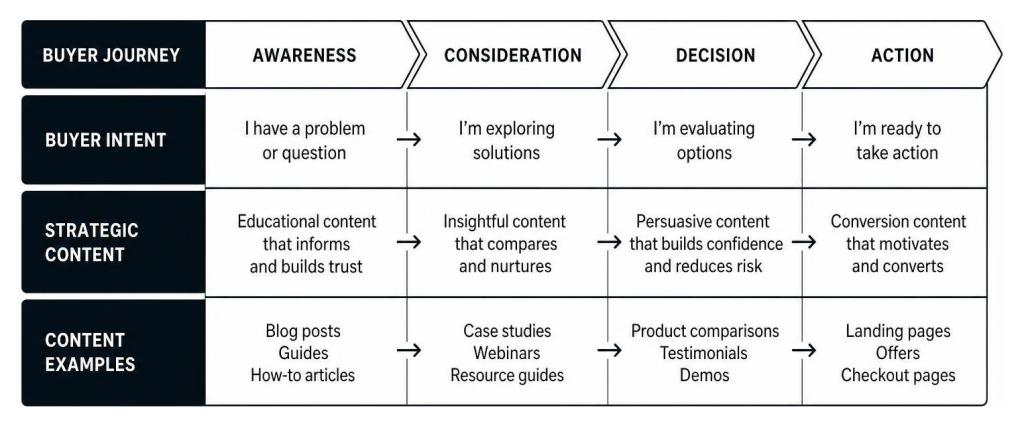
Every successful marketing engine relies on clear strategic alignment. Without a framework, your content risks becoming a collection of random words that fail to drive real business results.
When we design content marketing copywriting strategies for our clients, we align every asset directly with the customer journey. Buyers do not move from stranger to client overnight. They move through distinct mental phases, and your copy must match their exact mindset at every stage.
To build a reliable marketing machine, you need to understand how informational assets and direct-response text complement each other.
| Marketing Dimension | Content Marketing | Copywriting |
|---|---|---|
| Primary Goal | Build authority, educate, and cultivate long-term trust. | Drive immediate direct action and sales conversions. |
| Funnel Stage | Top of Funnel (Awareness & Interest). | Bottom of Funnel (Decision & Action). |
| Format Examples | Detailed guides, industry articles, educational blog posts. | Landing pages, ad headlines, promotional emails, sales letters. |
| Success Metrics | Organic search traffic, dwell time, social shares, brand recall. | Conversion rates, sales volume, form submissions, cost per lead. |
Content Marketing vs. Copywriting: Core Differences

Content marketing focuses on long-term relationships. It delivers educational value that keeps your brand top of mind when a prospect reaches the awareness stage.
Copywriting focuses on direct conversion. It uses psychological triggers and clear offers to guide prospects through the decision stage when they are ready to act.
Research shows that 70% of business decision-makers feel closer to a company after consuming its content. However, without persuasive copy elements embedded within that content, those warm leads will leave without taking action.
When you combine both disciplines, your educational content builds the authority required for your sales copy to succeed. You can study classic frameworks through WordStream’s copywriting 101 guide to see how top brands blend information with persuasion.
How Copywriting Fits Into Content Strategy
Copywriting gives your high-level content strategy its voice and power. While an editorial plan decides what topics to cover, copywriting determines how those topics resonate with real human beings.
Every piece of content requires high-performing conversion assets to capture qualified leads. A comprehensive guide builds trust, but inline calls to action, lead-magnet forms, and compelling headers turn readers into active sales pipeline opportunities.
When we help mid-market businesses scale, we audit their existing content assets to ensure every piece has a clear purpose. If you want to refine your high-level approach, read our practical breakdown on how to build a content marketing strategy that actually converts.
Persuasive copy is grounded in human psychology. To move readers to take action, you must understand their core motivations, hidden fears, and strategic goals.
Applying Cialdini’s Persuasion Principles
Dr. Robert Cialdini identified core psychological triggers that influence human choices. We integrate these principles directly into our content marketing copywriting frameworks:
- Social Proof: People look to others when making decisions. Case studies and verified customer reviews build immediate trust. Data indicates that 41% of consumers always read reviews when browsing for businesses.
- Reciprocity: Give real value before asking for anything in return. Detailed guides and free tools create positive goodwill.
- Authority: Demonstrate domain expertise through original research, industry awards, and verified results.
- Scarcity: Highlight limited opportunities, exclusive spots, or time-sensitive benefits to prompt immediate choices.
- Commitment & Consistency: Encourage small initial actions, such as subscribing to a newsletter, before asking for a major contract commitment.
- Sympathy & Likability: Write with genuine warmth, empathy, and conversational language that builds an authentic human bond.
Storytelling and Emotional Triggers
Data shows that emotional campaigns generate nearly double the profitability of purely rational content. Readers retain narrative structures far better than lists of technical specifications.
To build emotional resonance, position your customer as the hero of the story. Your business acts as the trusted guide who equips them with the tools needed to overcome their operational pain points.
Focusing on emotional benefits rather than technical features leads to significantly higher conversion rates across landing pages and email workflows.
Great content marketing copywriting adapts smoothly to different marketing channels. The message remains consistent, but the delivery changes to fit how users read on each platform.
Writing for Social Media, Ads, and Email Copy
Different channels require specific formatting and structural rules to maintain high audience engagement:
- Paid Ad Copy: Focus on ultra-concise ad headlines that call out a specific problem. Use active voice, lead with the primary benefit, and stick strict platform character limits.
- Email Marketing: Focus heavily on the subject line. Email marketing generates an impressive average ROI between $10 and $36 for every $1 spent. Personalize the body text and incorporate custom CTAs; research reveals personalized CTAs perform 202% better than generic copy.
- Social Media Copy: Stop the scroll with a strong opening line, break up blocks of text, and spark user engagement through direct questions. Discover more actionable techniques in our guide to social media copy writing secrets.
Enhancing Skills in Content Marketing Copywriting
Improving your craft requires disciplined habits. Here are actionable daily practices we use within our own team:
- Build Operational Buyer Personas: Base your writing on actual customer survey feedback, support tickets, and sales calls rather than guesswork.
- Maintain a Swipe File: Collect high-converting headlines, email openers, and ad frameworks from successful campaigns for daily creative inspiration.
- Practice Ruthless Editing: Cut unnecessary filler words, clear out corporate jargon, and shorten long paragraphs.
- Draft Headlines Daily: Write 10 to 15 alternative headline variations for every single article to find the most compelling angle.
To deepen your understanding of foundational techniques, explore Neil Patel’s guide to copywriting for additional skill-building exercises.

Modern content marketing copywriting must satisfy both search engine discovery algorithms and human readers. Writing useful text is only half the battle; people must be able to find it when searching online.
SEO Best Practices for Content Marketing Copywriting
Search engine algorithms reward deep expertise and user-focused clarity. Google’s E-E-A-T guidelines (Experience, Expertise, Authoritativeness, and Trustworthiness) prioritize content created by knowledgeable professionals.
To rank effectively in modern organic search results:
- Match Search Intent First: Determine whether searchers want quick answers, deep educational guides, or transactional service pages before you begin writing.
- Strategic Keyword Placement: Place primary search terms naturally in your title tag, meta description, H1, H2 headers, and first 50 words without keyword stuffing.
- Format for Skimmers: Use 1- to 3-line paragraphs, clear subheadings, and bulleted lists.
- Optimize for AI Overviews: Provide clear, concise 1- to 3-sentence answers beneath headers to earn citations in AI search summaries.
Learn more about evolving search requirements in TechCognate’s guide to SEO copywriting or explore WordStream’s top SEO copywriting tips for on-page optimization ideas.
Testing, Analytics, and Common Mistakes to Avoid
Never assume your first draft is perfect. Use data to evaluate your copy and refine your approach based on real user interactions.
- A/B Testing: Systematically test headline variations, CTA button text, and hero imagery on landing pages to optimize conversion rates.
- Monitor Dwell Time and Bounce Rates: If readers leave quickly, your opening lines failed to hook them, or your content missed their search intent.
- Eliminate Passive Voice: Replace weak passive phrasing with strong active verbs that drive reader momentum.
- Avoid Feature Dumping: Never list product specs without clearly explaining the direct personal benefit to the buyer.
If you want an experienced team to handle your campaigns, explore our professional content writing services to see how we build high-converting content engines.
AI Integration Without Losing the Human Touch
AI tools can assist with research, outlining, and brainstorming, but relying entirely on automated output carries significant risks.
Data shows human-generated content pulls 5.44 times more search traffic than pure AI-generated text. Additionally, 36% of consumers can spot AI-generated copy and actively avoid doing business with brands that use it. Furthermore, only 4% of B2B marketers report high trust in generative AI content output.
Use AI as a research assistant, but rely on human copywriters to provide strategy, brand authenticity, and emotional depth.
What is the main difference between content marketing and copywriting?
Content marketing focuses on long-term relationships through educational assets like blog posts, articles, and white papers. Copywriting focuses on driving direct sales actions through persuasive elements like landing page text, ad campaigns, email sequences, and calls to action.
How do I use AI writing tools effectively without hurting search rankings?
Use AI tools to generate topic outlines, brainstorm headline ideas, and organize raw research. Always have human writers rewrite the text, add verifiable industry experience, weave in brand messaging, and ensure the content answers user search intent.
What are the most critical copywriting mistakes to avoid?
The most damaging copywriting mistakes include writing generic headlines, overusing complex corporate jargon, listing technical features instead of practical customer benefits, omitting clear calls to action, and publishing dense, hard-to-read text blocks.

Creating high-converting content marketing copywriting requires a balance of strategy, creative writing, and ongoing performance optimization. When educational content and persuasive copy work together, your website becomes an engine for reliable lead generation and business growth.
At RED27Creative, we help businesses across Chicago, Naperville, Geneva, Batavia, Aurora, St. Charles, Plainfield, and Oswego build custom digital marketing engines that convert traffic into revenue.
Ready to transform your brand messaging and expand your digital reach? Explore our content writing services illinois or schedule a strategy consultation with our agency team today.

Kiel Tredrea
https://red27creative.comTop Marketing Agency • Web, SEO & Leads • RED27Creative