Manufacturing Smarter, Not Harder – Advanced Tech You Need

The Future of Manufacturing is Here
Advanced manufacturing technologies are revolutionizing production across industries, combining cutting-edge digital tools with physical processes to create smarter, more efficient operations. For executives seeking to understand this change, here’s what you need to know:
- Additive Manufacturing (3D Printing): Creates complex parts layer-by-layer with minimal waste
- Industrial IoT: Connects machines and systems for real-time monitoring and optimization
- AI & Machine Vision: Enables predictive quality control and zero-defect production
- Digital Twins: Virtual replicas of physical assets for simulation and optimization
- Advanced Robotics & Cobots: Collaborative robots that work alongside humans safely
The manufacturing landscape is undergoing a fundamental shift. No longer is it enough to simply produce goods efficiently – today’s competitive advantage comes from the ability to adapt quickly, customize products at scale, and leverage data throughout the production process.
“Advanced manufacturing is revolutionising the way products and processes are being created and implemented across various industries.” – TWI Global
Manufacturing companies that accept these technologies report up to 30% increases in production efficiency compared to traditional methods. Beyond efficiency, these innovations enable unprecedented levels of customization, improve quality control, reduce time-to-market, and build resilience into supply chains.
Continuous manufacturing technology, a cornerstone of advanced manufacturing, has demonstrated remarkable potential to improve product quality and reliability while simultaneously lowering costs, reducing waste, and increasing agility in response to market demands.
I’m Kiel Tredrea, founder of RED27Creative with over 20 years of experience helping manufacturing businesses steer digital change, including implementing advanced manufacturing technologies to drive growth and operational excellence.
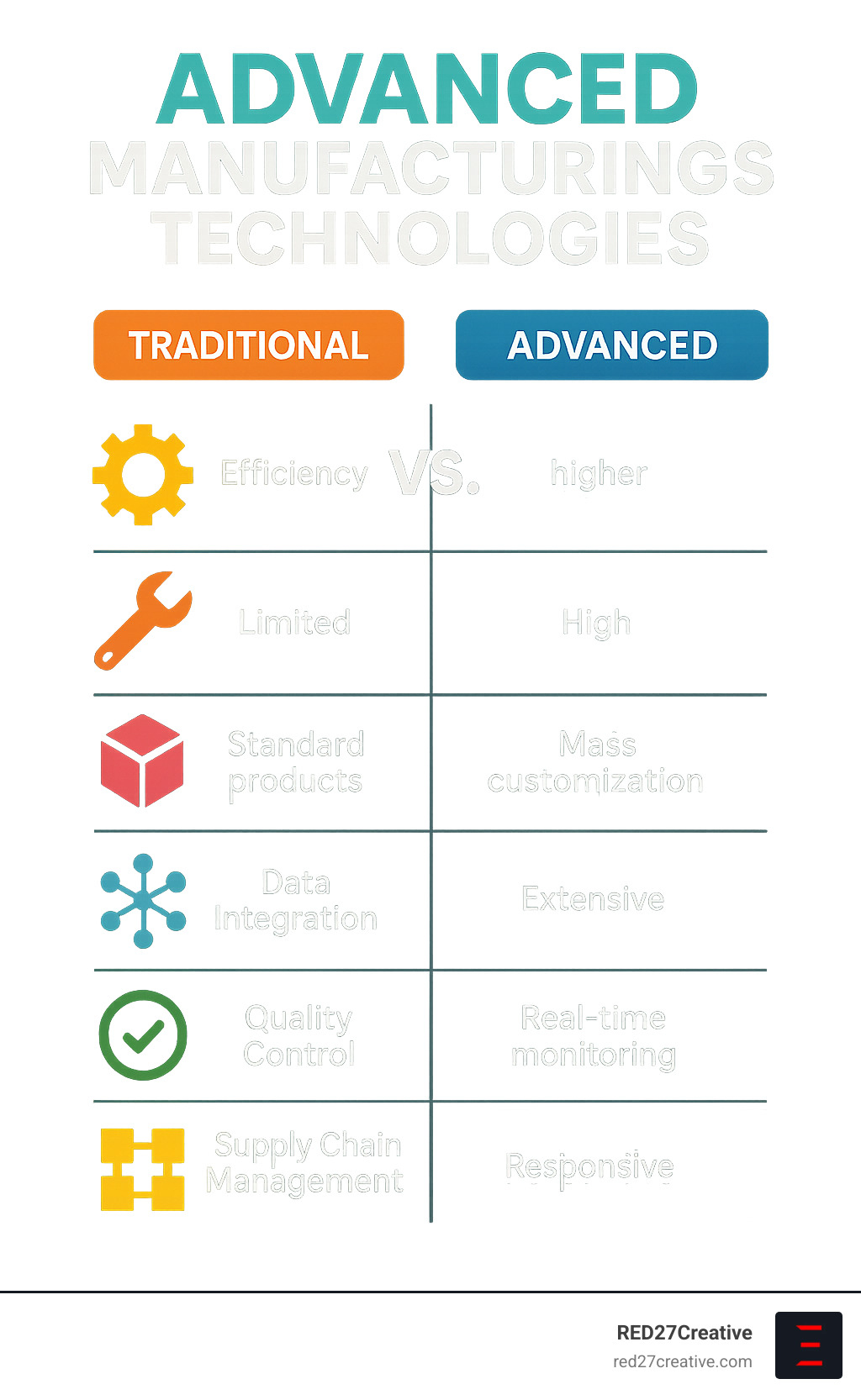
Know your Advanced manufacturing technologies terms:
– Innovative manufacturing processes
– 3D printing in manufacturing
– Manufacturing industry benchmarks
Why Manufacturers Can’t Ignore the Shift
The momentum toward advanced manufacturing technologies isn’t just another industry trend—it’s becoming the dividing line between tomorrow’s success stories and those left behind. For manufacturers across Illinois and beyond, this technological evolution represents both opportunity and necessity.
Efficiency That Transforms the Bottom Line
Remember when a 5% productivity improvement was considered remarkable? Those days are gone. Today’s manufacturing facilities implementing advanced manufacturing technologies are experiencing efficiency gains that completely transform their financial outlook.
The FDA has documented how continuous manufacturing technology significantly reduces production costs while simultaneously decreasing inventory requirements. For a medium-sized manufacturer in Schaumburg, this translated to a 27% reduction in operating expenses within just 18 months of implementation.
When margins are tight and competition is fierce, these efficiency improvements aren’t just nice-to-have—they’re survival tools in an increasingly challenging marketplace.
Customization at Scale
“We want it our way” isn’t just a consumer mindset anymore—it’s infiltrated B2B relationships too. The ability to deliver customized solutions without sacrificing efficiency has become a powerful competitive advantage.
Advanced manufacturing technologies make mass customization economically viable in ways traditional manufacturing simply cannot match. Take the example of a forward-thinking manufacturer in Aurora who implemented flexible automation systems that allowed them to offer custom configurations while maintaining production efficiency. The result? A remarkable 22% increase in high-margin orders from clients who previously sourced from overseas suppliers.
This shift from standardized production to agile customization is redefining what’s possible in manufacturing—and reshaping customer expectations along the way.
Supply Chain Resilience
If there’s one lesson the past few years have hammered home, it’s that supply chain vulnerability can threaten even the most successful operations. The pandemic, geopolitical tensions, and extreme weather events have all exposed weaknesses in traditional supply models.
Advanced manufacturing technologies provide the agility to weather these storms. As an FDA report noted:
“During the COVID-19 pandemic, additive manufacturing enabled the rapid production of critical medical supplies, demonstrating how advanced technologies can improve public health preparedness and supply chain resilience.”
Manufacturers throughout the Chicago area, including Naperville and St. Charles, are increasingly investing in distributed manufacturing capabilities. These technologies allow production to continue—or even pivot to new products—when traditional supply chains falter.
The ability to adapt quickly isn’t just about surviving disruption; it’s about capitalizing on new opportunities when competitors cannot. This resilience is becoming a key differentiator for manufacturers who accept the technological shift, allowing them to maintain operations and customer relationships through challenges that might otherwise prove devastating.
What Makes Manufacturing “Advanced”?
When we talk about advanced manufacturing technologies, we’re not just referring to any tech upgrade on the factory floor. There’s a meaningful distinction between simply adding computers to old processes and truly changing how manufacturing works.
Think of advanced manufacturing as a complete reimagining of production—where digital brains meet physical muscle in ways that weren’t possible before. Let me walk you through what makes manufacturing truly “advanced” in today’s world:
From Batch to Continuous
Traditional manufacturing has long relied on batch processing—making products in separate groups or lots. But advanced manufacturing technologies often enable a continuous flow where production never stops. This shift is like comparing stop-and-go traffic to a smooth-flowing highway.
The benefits are significant: your inventory levels drop, quality becomes more consistent (no more variations between batches), products reach market faster, and you can monitor quality in real-time rather than finding issues after a full batch is complete.
Cyber-Physical Integration
The magic of modern manufacturing happens at the intersection of digital systems and physical production. Imagine your production line not just operating but constantly learning and improving itself. Sensors collect data, analytics platforms interpret it, and systems automatically adjust—creating a continuous feedback loop that traditional manufacturing simply can’t match.
Smart Materials and Processes
Advanced manufacturing technologies open doors to working with materials that traditional methods struggle with:
Composite materials with remarkable strength-to-weight ratios are revolutionizing aerospace and automotive industries. Nanomaterials bring properties at microscopic scales that transform everything from electronics to medicine. Biomaterials create new possibilities for medical devices and sustainable products. Even metamaterials with properties not found naturally are becoming manufacturing realities.
Agility and Responsiveness
While traditional manufacturing excels at making thousands of identical widgets, it struggles with variety. Advanced manufacturing flips this equation—allowing you to switch products quickly or even customize each item without the usual efficiency penalties. This agility means you can respond to market changes in days rather than months.
Sustainability by Design
Today’s advanced processes aren’t just more efficient—they’re fundamentally more sustainable. They typically generate less waste, use fewer resources, and enable circular economy principles where yesterday’s products become tomorrow’s raw materials. As environmental regulations tighten and consumers demand greener products, this advantage becomes increasingly valuable.
Workforce Change
Perhaps the most profound shift is happening with the people who make manufacturing possible. Advanced manufacturing transforms work itself—requiring higher-skilled employees who manage complex systems rather than performing repetitive manual tasks. The factory worker of tomorrow is part technologist, part problem-solver, and part systems thinker.
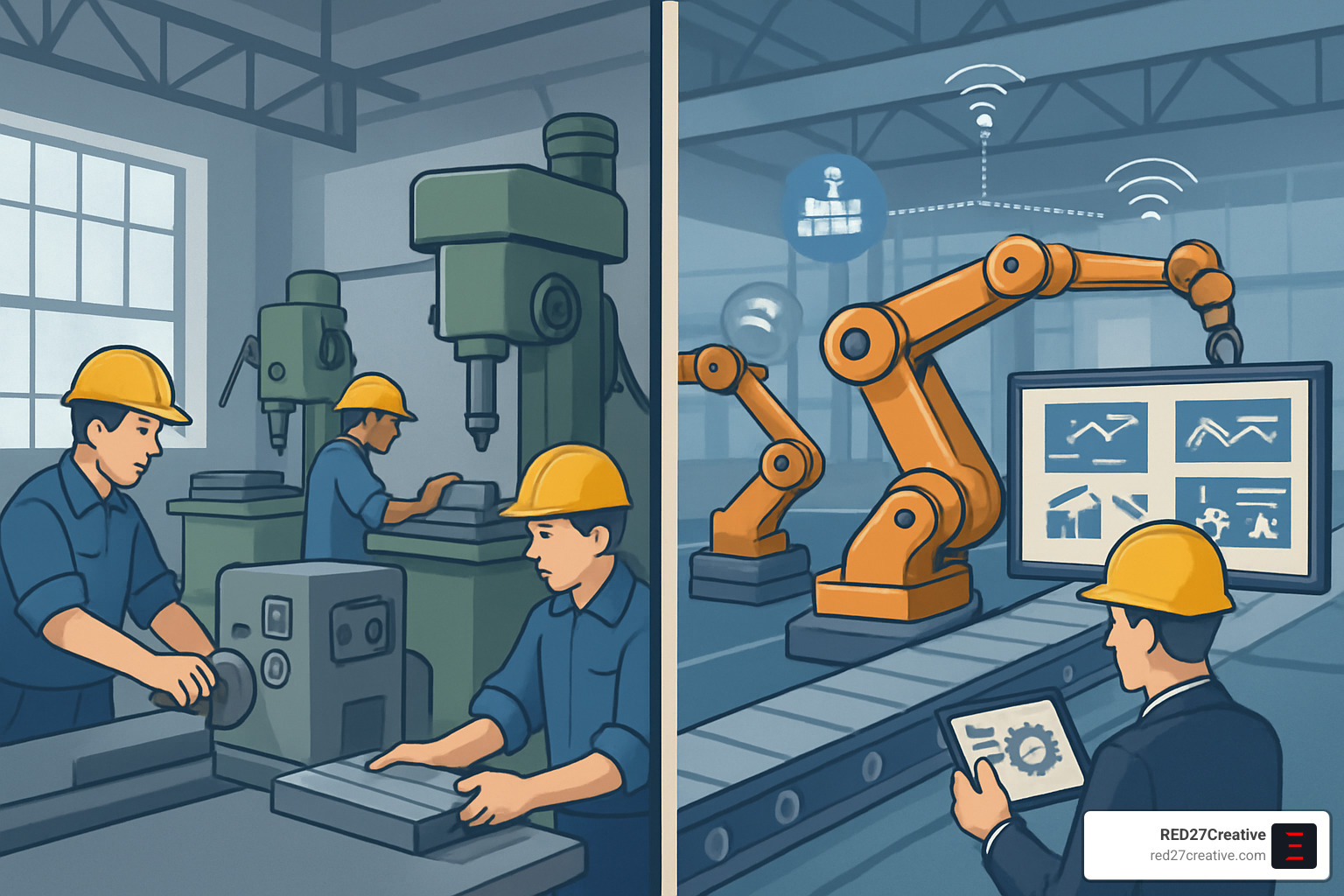
Traditional vs. Advanced Manufacturing Methods
| Aspect | Traditional Manufacturing | Advanced Manufacturing |
|---|---|---|
| Production Mode | Primarily batch processing | Continuous flow or flexible batch |
| Design Process | Sequential, separate from production | Integrated, digital thread from design to production |
| Quality Control | Sample inspection, post-production | Real-time monitoring, predictive quality |
| Customization | Limited, high cost for variations | Mass customization at minimal cost premium |
| Data Utilization | Limited, often siloed | Comprehensive, integrated across systems |
| Workforce Skills | Task-specific, manual operation | System management, digital literacy |
| Supply Chain | Linear, inventory-based | Networked, information-driven |
| Sustainability | Often resource-intensive | Resource-efficient, circular principles |
| Flexibility | Rigid, long changeover times | Agile, rapid reconfiguration |
The change to advanced manufacturing isn’t just about adopting new technologies—it’s about embracing a fundamentally different approach to creating products. For manufacturers looking to stay competitive, understanding these distinctions is the first step toward meaningful innovation and lasting success.
Additive Manufacturing (3D Printing) — The Gateway Tech
Among advanced manufacturing technologies, additive manufacturing (AM) or 3D printing often serves as the entry point for many manufacturers. There’s something almost magical about watching a complex part materialize layer by layer from seemingly nothing—and this accessibility is precisely why so many companies start their digital change journey here.

Unlike traditional manufacturing methods that carve away material from a larger block, additive manufacturing builds parts by adding material only where it’s needed. This fundamental shift in approach is opening doors to possibilities that were once considered impossible.
I’ve seen how this technology transforms businesses across Illinois. Just last month, I visited a client in Chicago who reduced their product development timeline by a remarkable 65% after bringing 3D printing in-house. The excitement on their team was palpable—they weren’t just saving time; they were releaseing creativity.
Lightweight Parts with Complex Geometries
Aerospace manufacturers are now creating intricate lattice structures within components that traditional manufacturing simply couldn’t produce. These innovative designs maintain strength while dramatically reducing weight—a game-changer when every ounce saved translates to significant fuel economy over an aircraft’s lifetime.
Rapid Prototyping and Iteration
Remember when product development took months? Those days are rapidly disappearing. Today, ideas can move from concept to physical prototype in hours or days rather than weeks. This speed doesn’t just save time—it encourages experimentation and innovation that might otherwise be deemed too risky or expensive.
Distributed Production Networks
Perhaps one of the most aspects of additive manufacturing is how it’s reshaping supply chains. Instead of shipping physical products across the country (or globe), companies can now send digital files to be printed closer to where they’re needed.
This capability proved invaluable during the COVID-19 pandemic. As research published in the New England Journal of Medicine noted, “Additive manufacturing (3D printing) has enabled the rapid production of critical medical supplies during public health emergencies, such as the COVID-19 pandemic.” When traditional supply chains faltered, 3D printing stepped in to produce everything from ventilator parts to testing swabs.
Materials Revolution
The early days of 3D printing were mostly limited to basic plastics, but today’s systems are incredibly versatile. Modern printers work with high-performance polymers, metals like titanium and aluminum, ceramics, composites, and even biocompatible materials for medical applications. This expanding material palette is opening new possibilities every day.
Why Additive Leads Advanced Manufacturing Technologies
Tool-less Production
Traditional manufacturing often requires expensive tooling and molds before production can begin. With AM, parts come directly from digital files—no tooling required. This eliminates significant upfront costs and lead times, making small production runs economically viable for the first time.
Dramatic Waste Reduction
I love explaining this benefit to clients because it’s so intuitive: traditional machining can waste up to 90% of the starting material, while additive approaches use only what’s needed for the final part. In an era of rising material costs and environmental consciousness, this efficiency is increasingly valuable.
Design Freedom
Perhaps the most exciting aspect of additive manufacturing is how it liberates designers from traditional constraints. Parts that once required assembly from multiple components can now be printed as a single piece. Organic shapes optimized for performance—not manufacturing convenience—become possible. Internal features that would be impossible to create conventionally can now be incorporated with ease.
Regulatory Support
Even regulatory bodies are recognizing the potential of these technologies. The FDA has established guidance for 3D-printed medical devices, and in 2022 supported the approval of three applications using emerging technologies like continuous manufacturing.
Getting Started
For manufacturers in Geneva, Batavia, and surrounding Illinois communities looking to begin their additive manufacturing journey, several approachable options exist:
Desktop Printers for Concept Validation can be an excellent starting point. With entry-level systems starting around $3,000-$5,000, teams can validate concepts quickly before committing to production tooling. I’ve seen companies transform their innovation process with just this simple first step.
Service Bureaus for Advanced Materials offer access to industrial-grade systems without the capital investment. Many Chicago-area providers specialize in metal AM for aerospace, medical, and industrial applications, making this a flexible option for exploring the technology.
Metal AM Production Cells represent a more significant investment (typically $500,000+) for manufacturers ready to bring metal AM in-house. These turnkey systems combine printing, post-processing, and quality control in an integrated workflow, enabling production of end-use metal parts with consistency and traceability.
As the American Society of Mechanical Engineers (ASME) observed, “Aerospace was quick to recognize the huge potential of additive manufacturing for advanced geometries.” Other industries are quickly following suit, recognizing that this technology isn’t just about making parts differently—it’s about reimagining what’s possible.
More info about lead generation for manufacturing companies
AI & Machine Vision for Zero-Defect Production
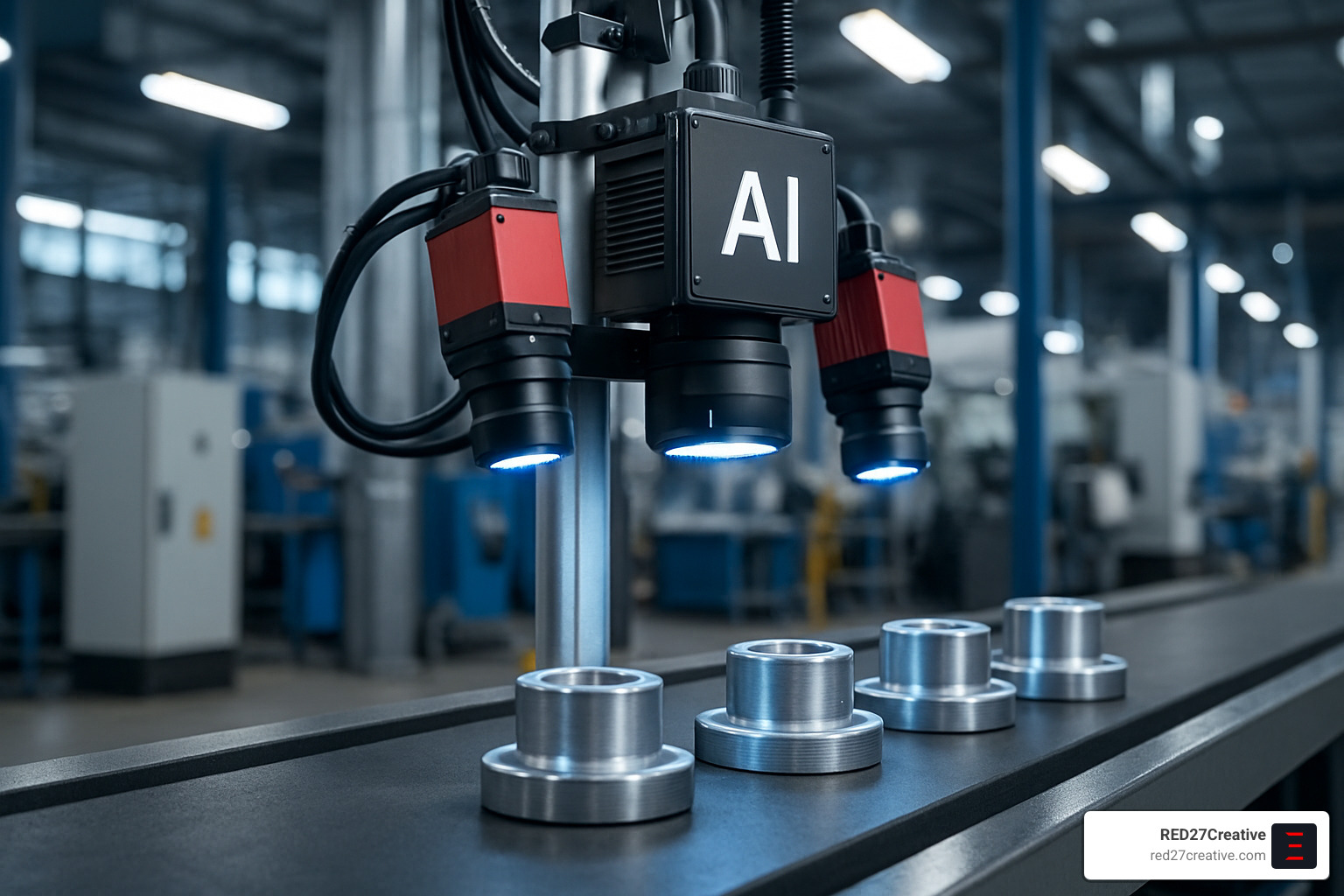
In advanced manufacturing technologies, AI and machine vision systems are like the watchful eyes and brilliant minds of the factory floor. They’re changing quality control from random spot-checks into comprehensive, 100% verification that catches things even the most eagle-eyed human inspector would miss.
Predictive Quality Through Data Analytics
Today’s smart factories don’t just fix problems—they see them coming. AI systems are constantly analyzing patterns in manufacturing data, identifying subtle warning signs before they become costly defects:
“I remember visiting a manufacturer in Plainfield who was struggling with unpredictable quality issues,” says Kiel Tredrea, founder of RED27Creative. “After implementing an AI-based predictive system, they saw defect rates drop by 37% in just six months. The system was catching tiny temperature fluctuations and tool wear patterns that humans simply couldn’t spot.”
These systems monitor everything from the subtle vibration changes that signal a tool is wearing out to minute material property variations that could affect your final product quality. It’s like having a quality expert watching every millisecond of your production process.
Big Data Analytics for Process Optimization
Modern manufacturing generates mountains of data—far more than any human team could meaningfully analyze. AI systems thrive on this data abundance, uncovering hidden optimization opportunities that translate directly to your bottom line.
“Advanced manufacturing uses robotics, 3D printing, AI, and computer programming to improve efficiency and customization.”
A well-implemented AI system doesn’t just improve quality; it helps you optimize energy consumption, production scheduling, maintenance timing, and even supply chain synchronization. One Chicago-area manufacturer finded they could reduce energy costs by 18% simply by adjusting production schedules based on AI recommendations—savings they never would have identified through traditional analysis.
Edge Computing Enables Real-Time Decisions
When milliseconds matter, even cloud computing can be too slow. That’s where edge computing comes in—processing data right on or near your production equipment for truly real-time decision making.
This capability is game-changing for manufacturers who need immediate responses to critical situations. Imagine a high-speed production line that can detect a potential problem and make micro-adjustments before a single defective part is produced. Or a system that can perform an emergency shutdown the instant it detects conditions that could damage expensive equipment.
Defect Detection Beyond Human Capabilities
The limitations of human vision are no longer your quality ceiling. Today’s machine vision systems can detect:
Microscopic surface flaws invisible to the naked eye, internal defects using X-ray or ultrasonic imaging without destroying parts, color variations too subtle for human perception, and dimensional variations down to a few microns—thinner than a human hair.
Continuous Improvement Through Learning Systems
Unlike traditional inspection systems that need manual reprogramming for every new product or defect type, AI-based systems get smarter over time. They’re constantly learning and improving:
“What amazes our clients most,” notes Tredrea, “is how these systems adapt. They’re self-optimizing inspection parameters based on results, adjusting to new product variations without reprogramming, and even identifying new defect types nobody programmed them to look for.”
Key Sensors Enabling Advanced Manufacturing Intelligence
The intelligence of your manufacturing system is only as good as the sensors feeding it information. Today’s advanced manufacturing technologies rely on a sophisticated array of sensors working together:
| Sensor Type | Application | Benefit |
|---|---|---|
| High-speed cameras | Surface inspection, assembly verification | Detects visual defects at production speeds |
| Infrared cameras | Temperature monitoring, stress analysis | Identifies thermal issues before failure |
| 3D scanners | Dimensional verification | Compares parts to CAD models with micron precision |
| Acoustic sensors | Vibration analysis, leak detection | Detects abnormal equipment operation |
| Force sensors | Assembly verification, material testing | Ensures proper component seating and operation |
| Chemical sensors | Material verification, contamination detection | Validates material composition |
| X-ray/CT scanners | Internal feature inspection | Verifies internal structures non-destructively |
For manufacturers looking to take their first steps into AI-powered quality control, the journey typically begins with a focused application addressing your most costly quality challenges. Starting small allows you to build expertise while demonstrating clear ROI before expanding to more comprehensive implementations.
Ready to explore how AI and machine vision could transform your quality processes? The team at RED27Creative has helped manufacturers across Illinois implement these technologies with remarkable results.
Industrial IoT, Digital Twins & Cloud Platforms
The backbone of advanced manufacturing technologies isn’t just about machines—it’s the invisible web of connectivity that brings them to life. Industrial Internet of Things (IIoT), digital twins, and cloud platforms work together like a manufacturing nervous system, turning physical operations into smart, data-driven powerhouses.
Real-Time Monitoring Transforms Decision Making
Remember when manufacturing decisions were made based on last month’s reports? Those days are fading fast. Today’s factory floor is alive with IIoT sensors that constantly capture what’s happening:
Temperature spikes in that injection molding machine? You’ll know immediately. Energy consumption suddenly increasing on the assembly line? It’s flagged in real-time.
A food manufacturer I worked with in Oswego, IL installed an IIoT monitoring system throughout their facility and cut unplanned downtime by 42%. Their maintenance team now responds to developing issues before they become costly breakdowns—it’s like having a crystal ball for your equipment.
The Digital Thread Connects Design to Production
Think of the digital thread as manufacturing’s version of DNA—a continuous stream of data that flows from initial concept through production and beyond. This unbroken connection ensures everyone’s working from the same playbook.
“The U.S. National Strategy for Advanced Manufacturing aims to develop and implement advanced manufacturing technologies, grow the advanced manufacturing workforce, and build resilience into manufacturing supply chains and ecosystems.”
When a design change happens, it ripples through the entire system automatically. When quality issues arise, you can trace them back to their source with precision. This connectivity isn’t just convenient—it’s changing how products move from imagination to reality.
Predictive Maintenance Prevents Costly Downtime
The old approach to maintenance was simple: fix it when it breaks. But in today’s competitive landscape, that’s like waiting for a heart attack instead of monitoring your health.
Modern advanced manufacturing technologies use AI to analyze equipment performance patterns and spot trouble brewing weeks or even months before failure occurs. A slight change in vibration patterns might signal bearing wear. Unusual temperature fluctuations could indicate cooling system issues.
I recently helped a manufacturing client in Naperville implement predictive maintenance for their critical equipment. The result? They slashed unplanned downtime by 73% in just one year, saving over $425,000 in lost production time. That’s the difference between reactive and proactive approaches.
Data Lakes Enable Cross-Functional Insights
The modern factory generates mountains of data—but its true value emerges when you break down the silos between departments. Cloud-based data lakes are like vast reservoirs where all this information can flow together:
Production metrics, quality data, supply chain information, and customer feedback all mingle in one place. This creates opportunities to find connections you never knew existed. Perhaps weather patterns are subtly affecting your material properties? Or slight variations in supplier components correlate with customer returns? These insights remain hidden unless your data can talk to each other.
Cybersecurity Becomes Mission-Critical
As manufacturing becomes more connected, cybersecurity isn’t just IT’s problem anymore—it’s everyone’s concern. When your production equipment is networked, a security breach could mean physical safety risks, not just data loss.
Advanced manufacturing technologies require protection for both information systems and operational technology. Your intellectual property, stored in digital designs, needs safeguarding. And as supply chains become digitally connected, they create new potential vulnerabilities that need addressing.
How Digital Twins Drive Advanced Manufacturing Technologies
Digital twins might sound like science fiction, but they’re revolutionizing manufacturing today. These virtual replicas of your physical assets act like a risk-free sandbox where you can test ideas before committing resources.
Simulation Before Implementation
Why guess how a new production line will perform when you can know in advance? Digital twins let you test changes virtually:
A manufacturer in St. Charles used digital twin simulation to reimagine their production cell layout. The virtual testing revealed bottlenecks nobody had anticipated, allowing them to redesign before installation. The result? Their actual implementation achieved 28% higher throughput than their original design would have delivered.
Virtual Commissioning Accelerates Deployment
Traditional equipment commissioning is often a lengthy, frustrating process of integration and debugging. Virtual commissioning through digital twins changes the game entirely.
By connecting control systems to virtual equipment models, teams identify integration issues while physical equipment is still being built. Operators can train on virtual systems, and programmers can debug control logic before installation. This approach typically reduces physical commissioning time by up to 75%—getting production online faster.
Faster Scale-Up from Pilot to Production
The leap from successful pilot to full-scale production is where many great manufacturing ideas stumble. Digital twins bridge this gap by revealing how systems will behave at scale.
They allow testing of control strategies at full production rates, validate material handling systems under maximum load, and optimize staffing and workflow—all before committing to full deployment.
“Advanced manufacturing allows for improved competitiveness in the manufacturing sectors through improved outputs as well as increased value, quality, market responsiveness and flexibility.”
The integration of these digital systems isn’t just adding technology to manufacturing—it’s fundamentally changing how we think about production, enabling levels of efficiency, quality, and customization that were previously impossible. For more in-depth research on how these technologies are reshaping American manufacturing, check out the National Strategy for Advanced Manufacturing published by the White House.
Advanced Robotics & Cobots on the Shop Floor
Remember when robots were confined to cages, performing the same repetitive tasks day after day? Those days are rapidly fading into manufacturing history. Today’s robots and collaborative robots (cobots) bring advanced manufacturing technologies within reach of companies of all sizes—including smaller operations that previously couldn’t justify the investment.
Flexible Automation Redefines Possibilities
Modern robotics systems are breaking free from the limitations of their predecessors. Unlike the single-purpose industrial robots of yesterday, today’s advanced systems can switch gears as quickly as your production needs change.
A furniture manufacturer in Chicago recently showed me their flexible robotic cells that transition between different product lines in under 15 minutes. This capability has transformed their business, allowing them to economically produce custom orders alongside their standard product lines—something that would have been financially impossible just a few years ago.
These systems excel at:
- Quickly switching between different tasks with minimal downtime
- Adapting to product variations without complex reprogramming
- Learning new tasks through simple demonstration rather than coding
- Working safely in human environments without extensive safety barriers
Human-Robot Collaboration Changes the Workforce
Perhaps the most exciting development is how collaborative robots—or cobots—are changing the relationship between people and machines on the factory floor.
“There will be a lot more robotics and automation to get rid of labor-intensive processes.”
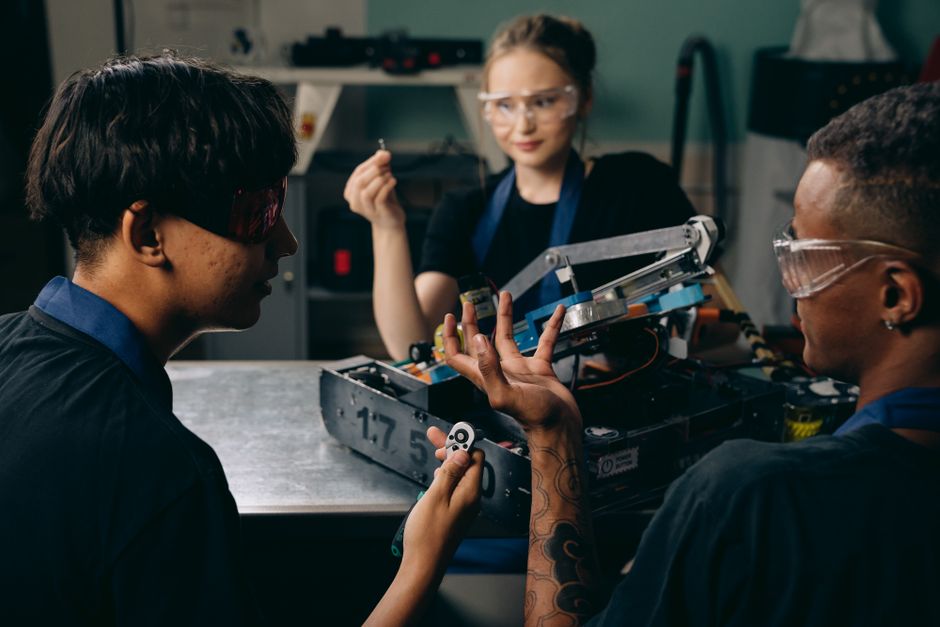
But this isn’t about replacing workers—it’s about enhancing their capabilities. Cobots handle the physically demanding, repetitive tasks that lead to injuries and burnout, while humans focus on the creative problem-solving and decision-making that machines can’t match.
I’ve seen how this partnership works in manufacturing facilities across Illinois. Humans and cobots working side-by-side, each bringing their unique strengths to the production process. The robots maintain superhuman precision without fatigue, while their human counterparts provide the adaptability and judgment that automation still can’t replicate.
Autonomous Mobile Robots Transform Material Movement
Walk into an advanced manufacturing facility today, and you might be surprised to see robots freely navigating the floor without fixed tracks or guides. These autonomous mobile robots (AMRs) are revolutionizing internal logistics by:
Delivering components to workstations exactly when needed, reducing inventory at each station while ensuring production never stops for lack of parts. Retrieving finished goods for packaging without human intervention. Transporting tools and equipment between areas, saving valuable worker time. Adapting their routes on the fly based on obstacles, congestion, or changing facility conditions.
A manufacturer in Geneva, IL shared with me how their AMR deployment reduced manual material handling by an impressive 62% while simultaneously improving on-time delivery of components to production cells. The workers who previously pushed carts around the facility now focus on higher-value activities.
Kitting and Assembly Applications Expand
One area where advanced manufacturing technologies like robotics truly shine is in kitting operations—the gathering and organizing of components for assembly. Vision-guided systems can now:
Pick varied components with remarkable accuracy, handling different shapes, sizes, and materials. Place items precisely in custom packaging configurations. Verify kit completeness before sending to assembly. Track everything through barcode or RFID scanning for complete traceability.
These capabilities ensure assembly operations receive complete, accurate kits every time, dramatically reducing delays and errors that plague manual kitting processes.
SME Adoption Accelerates Through New Models
“But we’re too small for robotics” is a statement I hear less and less these days. Small and medium enterprises (SMEs) are finding innovative approaches that make robotics accessible without breaking the bank:
Robots-as-a-Service (RaaS) models eliminate heavy upfront capital investment, turning automation into a predictable operating expense. Modular systems can be reconfigured as needs change, protecting the initial investment. User-friendly interfaces now allow workers without programming backgrounds to “teach” robots new tasks. Pre-configured applications for common manufacturing tasks reduce implementation time and complexity.
I recently visited a small manufacturer in Batavia with just 27 employees who implemented a cobot cell through a RaaS model. They achieved payback in less than 8 months while maintaining the flexibility to adapt as their product mix evolves—proving that advanced manufacturing technologies are no longer just for the manufacturing giants.
ROI Calculations Demonstrate Value
The return on investment for advanced robotics continues to improve year after year. System costs have decreased while capabilities have increased dramatically. Implementation timelines that once stretched for months can now often be completed in weeks.
The flexibility of modern systems allows redeployment as needs change, protecting your investment. And the benefits extend far beyond simple labor savings to include quality improvements, reduced training needs, and increased production capacity.
“An entire welding project can be completed with only a small fraction of the usual waste using robots.”
Advanced robotic welding systems, for example, can reduce material waste by up to 60% compared to manual processes while simultaneously improving weld quality and consistency. These “hidden” benefits often don’t show up in initial ROI calculations but can significantly impact the bottom line.
Looking to automate your marketing alongside your production? More info about marketing automation for manufacturing is just a click away.
Conclusion & Next Steps
The journey toward implementing advanced manufacturing technologies isn’t a final destination—it’s an ongoing evolution. Throughout this guide, we’ve explored how these innovations can transform operations for manufacturers of all sizes, whether you’re based in Chicago’s busy industrial corridors or the manufacturing hubs of Aurora and Naperville.
The Path Forward
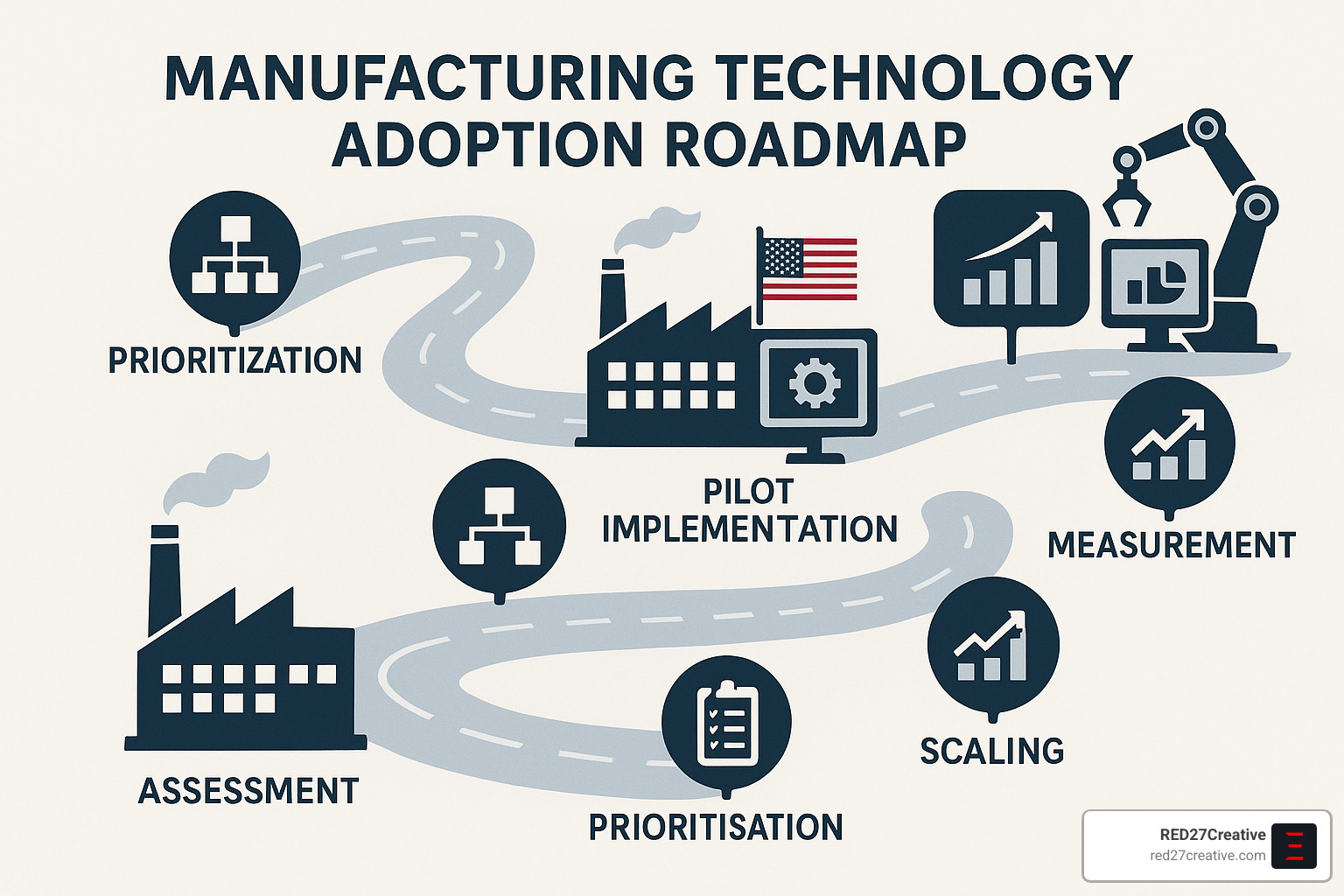
Ready to take the plunge? Here’s a practical roadmap that has worked for our clients:
- Assessment: Take a good look at your current operations to spot those high-impact opportunities—the places where technology could really move the needle.
- Prioritization: Choose your first projects carefully based on potential ROI and alignment with your business strategy. Not every shiny new technology deserves your immediate attention!
- Pilot Implementation: Start small with controlled projects. Think of it as dipping your toes in the water before diving in headfirst.
- Measurement: Set up clear metrics from day one. What gets measured gets improved, and you’ll need this data to justify further investments.
- Scaling: Once you’ve proven success, roll out your winning approaches across more of your operations.
At RED27Creative, we’ve guided manufacturers throughout the Chicago suburbs through this journey. Our team understands both the technical aspects and the human side of change—because implementing new technology is as much about people as it is about machines.
Funding Sources to Accelerate Adoption
Don’t let budget constraints hold you back. Several resources can help offset your investment:
The Manufacturing USA Institutes offer 16 public-private partnerships focused on specific technology areas, providing both funding and expertise. For smaller projects, Small Business Innovation Research (SBIR) grants provide federal funding specifically for R&D initiatives.
The Manufacturing Extension Partnership (MEP) offers technical assistance custom for smaller manufacturers. And don’t overlook what’s in your own backyard—many Illinois communities offer incentives for manufacturing technology investments that create jobs or improve sustainability.
Skills Development for the Future Workforce
Let’s be honest—the shiniest technology in the world won’t help if your team doesn’t know how to use it. As one manufacturing client told me, “Advanced manufacturing represents a dynamic, transformative process that all stakeholders must accept to stay competitive.”
That means investing in your people alongside your technology:
Partner with local community colleges like College of DuPage or Waubonsee Community College, which offer specialized manufacturing training. Develop internal training programs that build on your employees’ existing knowledge. Consider creating apprenticeship programs to build your talent pipeline for the future. And don’t forget to engage with Illinois manufacturing workforce development initiatives that can provide both resources and funding.
Sustainability Wins Through Advanced Manufacturing
Beyond operational benefits, advanced manufacturing technologies deliver impressive sustainability advantages that are increasingly important to customers and regulators alike.
A perfect example comes from one of our clients in Aurora who implemented advanced process controls that slashed energy consumption by 32% while simultaneously improving product quality. They reduced material waste through precision manufacturing techniques, lowered their carbon footprint with optimized processes, and decreased transportation emissions by producing more components locally.
These aren’t just environmental wins—they translate directly to cost savings and competitive advantage in markets where sustainability increasingly matters.
The Time to Act Is Now
The manufacturing landscape is shifting beneath our feet. Those who accept advanced manufacturing technologies today will be the market leaders tomorrow, while those who delay risk watching more agile competitors race ahead.
What we’ve seen throughout this guide is that these technologies are more accessible than ever before, regardless of your company’s size. The real question isn’t whether your organization should adopt advanced manufacturing, but how quickly you can begin the journey and how strategically you implement these powerful tools.
More info about social media content creation services
Frequently Asked Questions
What is the biggest benefit of adopting advanced manufacturing?
While efficiency gains often drive initial interest, the most significant long-term benefit is typically increased agility and responsiveness. Advanced manufacturing technologies enable you to pivot quickly when customer demands shift, supply chains hiccup, or competitors make unexpected moves. This strategic flexibility provides a sustainable advantage that goes far beyond simple cost reduction. One client described it as “having superpowers” when market conditions changed suddenly during the pandemic.
How do I choose which technology to pilot first?
Start with your pain points, not the technology. Conduct a value stream analysis to identify where you’re bleeding money, time, or quality. Technologies that address these high-impact areas typically provide the fastest ROI and build momentum for broader adoption. For many of our clients, technologies that address quality issues deliver quick wins through reduced scrap, rework, and warranty costs—sometimes paying for themselves in months rather than years.
Are there government incentives for advanced manufacturing technologies?
Absolutely! Multiple programs at federal, state, and local levels can help fund your technology journey. The U.S. National Strategy for Advanced Manufacturing coordinates federal efforts, offering R&D tax credits and accelerated depreciation for equipment investments. Workforce development grants can help train your team on new systems. Many economic development agencies in Illinois communities offer incentives for manufacturing technology investments that preserve or create jobs—we’ve helped clients secure matching funds that effectively cut their implementation costs in half.

Kiel Tredrea
https://red27creative.comTop Marketing Agency • Web, SEO & Leads • RED27Creative