Beyond the Build: Finding Your Ideal B2B Web Development Partner

The B2B Website Platform Landscape Has Changed — Here’s What You Need to Know
A B2B website platform is no longer just a digital storefront. It is the operational backbone of how modern businesses buy and sell at scale.
The global B2B e-commerce market is projected to surpass $36 trillion by 2026. That number alone tells you how much is at stake when choosing the wrong platform.
Here is a quick overview of the top B2B website platforms in 2025:
| Platform | Best For | Standout Feature |
|---|---|---|
| Salesforce Commerce Cloud | Enterprise, global brands | Native CRM + AI (Agentforce), 99.99% uptime |
| BigCommerce B2B Edition | Mid-market to enterprise | 391% 3-year ROI, headless, MACH-certified |
| Shopify Plus | Unified B2B + DTC | Single platform, 8,000+ app ecosystem |
| Adobe Commerce (Magento) | Custom, open-source builds | Deep flexibility, developer control |
| OroCommerce | B2B-first operations | Built-in CPQ, account hierarchies |
| commercetools | Composable/headless | Modular, API-first architecture |
| SAP Commerce Cloud | Large enterprise, ERP-heavy | Deep SAP ERP integration |
Today’s B2B buyers are not patient. 64% prefer digital channels and 80% use mobile throughout their buying journey. Nearly nine in ten millennial buyers say they will pay more for a seamless purchasing experience.
That means your platform choice is not just a technology decision. It is a revenue decision.
Yet many B2B companies are still running on legacy systems that cannot keep pace with buyer expectations, integrations, or growth demands. The result? Lost deals, frustrated customers, and mounting technical debt.
This guide cuts through the noise. Whether you are evaluating platforms for the first time or considering a migration, you will find a clear, honest comparison of the top options — and what actually matters when making your choice.
I’m Kiel Tredrea, founder of RED27Creative, and over 20 years of working with B2B and service-based brands I have seen how the right B2B website platform can transform a company’s lead flow and revenue trajectory. Let’s walk through what you need to know before making this critical decision.
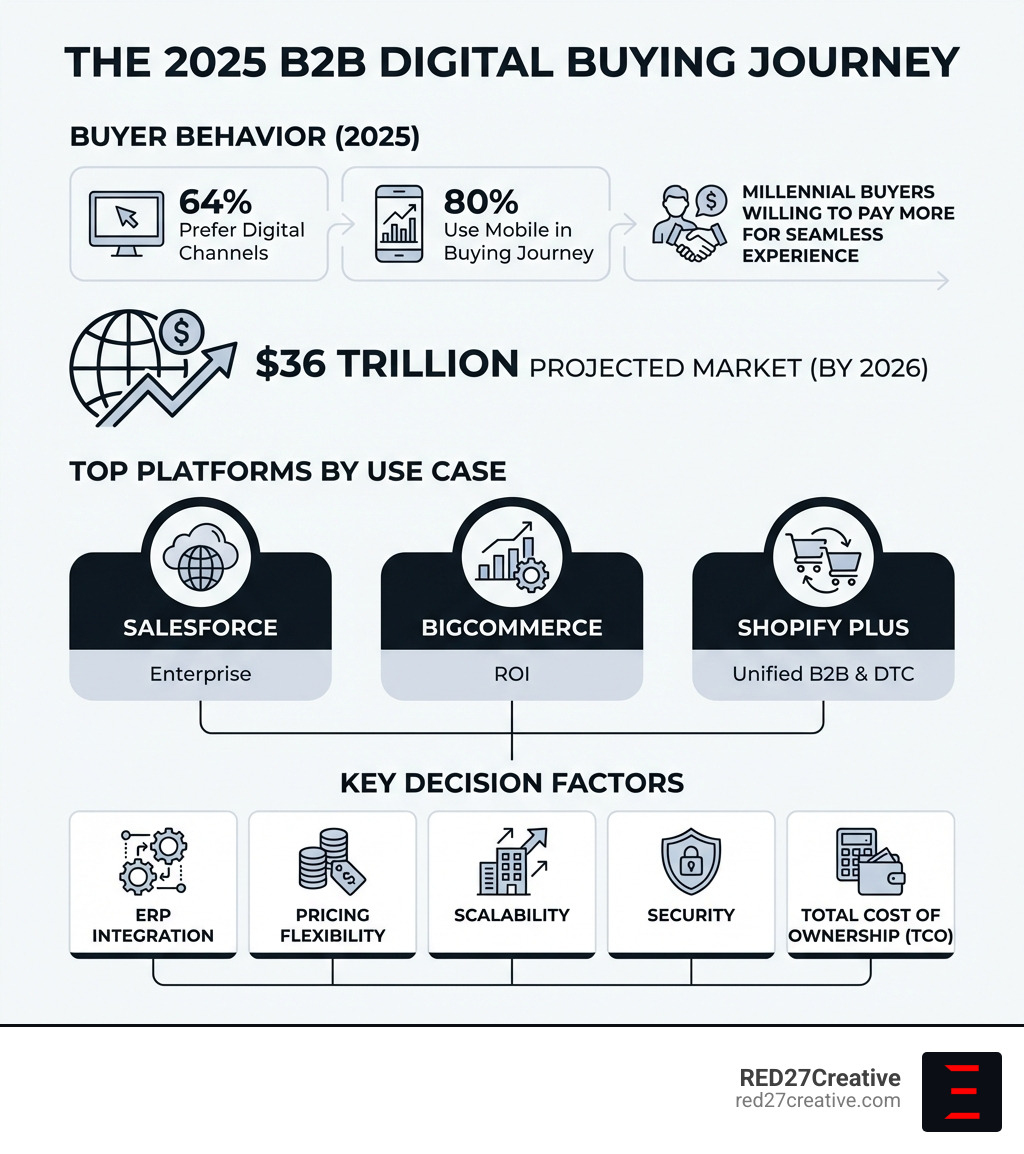
B2B website platform terms at a glance:
Key Considerations for Selecting a B2B website platform
Choosing the right technology stack is a balancing act between current needs and future ambitions. We often see businesses get dazzled by “flashy” features while ignoring the structural integrity of the software. To avoid these pitfalls, we focus on a few non-negotiable pillars.

Total Cost of Ownership (TCO)
The price tag on the website is just the tip of the iceberg. You must account for implementation, monthly licensing, hosting, security updates, and third-party app fees. For instance, while an open-source platform might have no “sticker price” for the software, the costs of custom development and specialized hosting can quickly outpace a SaaS subscription.
SaaS vs. Open-Source: Finding Your Fit
This is the “Build vs. Buy” debate of the modern era. SaaS (Software as a Service) platforms like BigCommerce and Salesforce handle the infrastructure, security, and updates for you. Open-source options like Adobe Commerce (Magento) or WordPress with WooCommerce offer total code control but require you to manage the “plumbing.”
| Feature | SaaS (e.g., BigCommerce, Salesforce) | Open-Source (e.g., Adobe Commerce) |
|---|---|---|
| Speed to Market | High (Days or weeks) | Moderate to Low (Months) |
| Security/PCI | Included & Managed | Merchant’s Responsibility |
| Customization | High (via APIs) | Limitless (Core access) |
| Maintenance | Automatic Updates | Manual Patches & Upgrades |
User Experience and Mobile Optimization
In the $36 trillion global B2B market, friction is a deal-killer. Modern buyers expect a “B2C-like” experience. This means fast load times, intuitive navigation, and a mobile-first design. Research shows that nine in ten millennial buyers are willing to pay more for a seamless experience. If your site feels like a clunky 1990s database on a smartphone, you are handing customers to your competitors.
At RED27Creative, we emphasize that E-commerce Website Solutions must prioritize the human on the other side of the screen, not just the data in the backend.
Essential Features for Complex B2B Operations
B2B commerce is inherently more complex than B2C. You aren’t just selling a pair of shoes to an individual; you are selling 500 industrial valves to a procurement manager who needs departmental approval and a net-30 payment term. Your B2B website platform must handle these nuances natively.
Personalized Pricing and Customer-Specific Catalogs
No two B2B customers are identical. Your platform needs to support “Price Lists” that automatically show Buyer A their negotiated rate while showing Buyer B a different one. Similarly, “Customer-Specific Catalogs” ensure that distributors only see the products they are authorized to sell, reducing confusion and ordering errors.
Quote Management and Approval Workflows
The “Add to Cart” button isn’t always the end of the journey. Many high-value transactions start with a “Request a Quote” (RFQ). Leading platforms like BigCommerce B2B Edition or OroCommerce allow buyers to submit quotes directly through the portal. Internally, your platform should support approval workflows, where a junior buyer can build an order that a manager must sign off on before it is finalized.
Bulk Ordering and Volume Discounts
Wholesalers and manufacturers live and die by volume. Features like “Quick Order Pads” (where buyers can upload a CSV or type in SKUs) and “Quantity Breaks” (discounts that kick in at 10, 50, or 100 units) are essential for driving larger average order values. For those with highly specific requirements, Custom Web Applications can bridge the gap between standard commerce features and unique business logic.
Evaluating Scalability in a B2B website platform
Growth shouldn’t break your website. Scalability means the ability to handle a 10x spike in traffic during peak seasons and the flexibility to expand into new markets.
Modern architectures like Headless Commerce and Composable Commerce are the gold standard here. By decoupling the frontend (what the user sees) from the backend (the commerce logic), you can change your site’s look and feel without touching the complex data underneath. This is vital for global expansion, allowing you to run multiple localized sites across different currencies and languages from a single administrative hub. Read the research on the age of intelligent buying to see how brands are using these “intelligent” setups to stay agile.
Security Standards for Your B2B website platform
In B2B, a security breach isn’t just a PR nightmare; it’s a threat to your partners’ supply chains. Every platform we recommend meets rigorous standards:
- PCI Compliance: Essential for handling credit card data securely.
- SOC II & GDPR: Critical for data privacy and operational security, especially for global enterprises.
- SSO (Single Sign-On): Allows your customers to use their existing corporate credentials to log in, improving security and UX simultaneously.
High historical uptime (like Salesforce’s 99.99%) ensures your “digital branch” never closes. For businesses in regulated industries, IT Consulting Website Design ensures that compliance is baked into the code from day one.
Maximizing ROI Through ERP Integration and Scalability
The true power of a B2B website platform is unlocked when it talks to your other systems. If your website is an island, your team is likely wasting hours on manual data entry, leading to the inevitable “Oops, that’s actually out of stock” phone call.
The Critical Role of Real-Time Data
A seamless ERP (Enterprise Resource Planning) integration ensures that your inventory, pricing, and order status are synchronized in real-time. When a customer places an order on your site, it should instantly appear in your ERP for fulfillment. Conversely, when your warehouse receives new stock, your website should reflect that availability immediately.
Measurable Business Benefits
According to IDC research, brands using modern B2B editions see significant returns:
- 391% Three-Year ROI: Driven by increased sales and reduced operational costs.
- 24% Increase in Sales Productivity: Sales reps spend less time taking orders and more time acting as consultants.
- $10,536 Annual IT Cost Savings: Per year, by moving away from high-maintenance legacy systems.
By automating workflows, you reduce the “cost per order” and free your team to focus on high-value growth initiatives. Our Website Design and Development Services are designed to build these integrated engines, ensuring your tech stack works as hard as your sales team.
Frequently Asked Questions about B2B Website Platforms
What are the key factors to consider when selecting a B2B ecommerce platform?
When choosing a platform, prioritize integration capabilities with your existing ERP and CRM systems to ensure data accuracy. Evaluate the total cost of ownership, including licensing and maintenance. Additionally, ensure the platform supports B2B-specific needs like personalized pricing, bulk ordering, and complex account hierarchies to meet modern buyer expectations.
How does ERP integration impact B2B ecommerce success?
ERP integration is critical because it synchronizes inventory, pricing, and customer data in real-time. This automation reduces manual entry errors, improves order fulfillment speed, and provides buyers with accurate stock levels. Seamless integration leads to higher customer trust, increased operational efficiency, and a significantly better return on investment for the business.
Why is headless commerce beneficial for B2B businesses?
Headless commerce decouples the frontend presentation layer from the backend commerce engine, allowing for ultimate design flexibility. This architecture enables B2B companies to deliver highly customized, lightning-fast user experiences across multiple devices and regions. It also allows businesses to update their digital storefronts without disrupting core backend operations or complex integrations.
Which platform is best for small B2B businesses vs. large enterprises?
Small businesses often thrive on platforms like B2B Wave or Shopify Plus due to their speed of setup and lower initial complexity. Large enterprises with global footprints and heavy ERP requirements typically lean toward Salesforce Commerce Cloud or SAP Commerce Cloud for their robust multi-site management and deep integration capabilities.
How can we avoid common replatforming pitfalls?
The biggest mistake is a “big bang” rollout. We recommend a phased approach: start with a pilot group of customers, gather feedback, and iterate. Also, never underestimate the importance of clean data. Investing in data quality before you migrate will save months of troubleshooting post-launch.
Conclusion
The journey to finding the right B2B website platform is not just about checking boxes on a feature list. It is about choosing a foundation that allows your business to scale without limits. Whether you are a manufacturer in Aurora, a distributor in Naperville, or a global enterprise based in Chicago, your digital presence is now your most important salesperson.
At RED27Creative, we don’t just build websites; we build growth engines. Led by Kiel Tredrea, our team brings over 20 years of experience to the table, helping businesses in Geneva, Illinois, and across the nation turn digital visibility into measurable ROI. We specialize in B2B Enterprise Web Design that bridges the gap between complex backend requirements and the seamless frontend experiences your buyers demand.
Ready to move beyond the build and start growing? Let’s talk about how we can align your technology with your long-term business goals.

Kiel Tredrea
https://red27creative.comTop Marketing Agency • Web, SEO & Leads • RED27Creative