Beyond the Hype: Finding Your Ideal Full-Service Data Agency Partner

Why the Right Data-Driven Marketing Agency Changes Everything
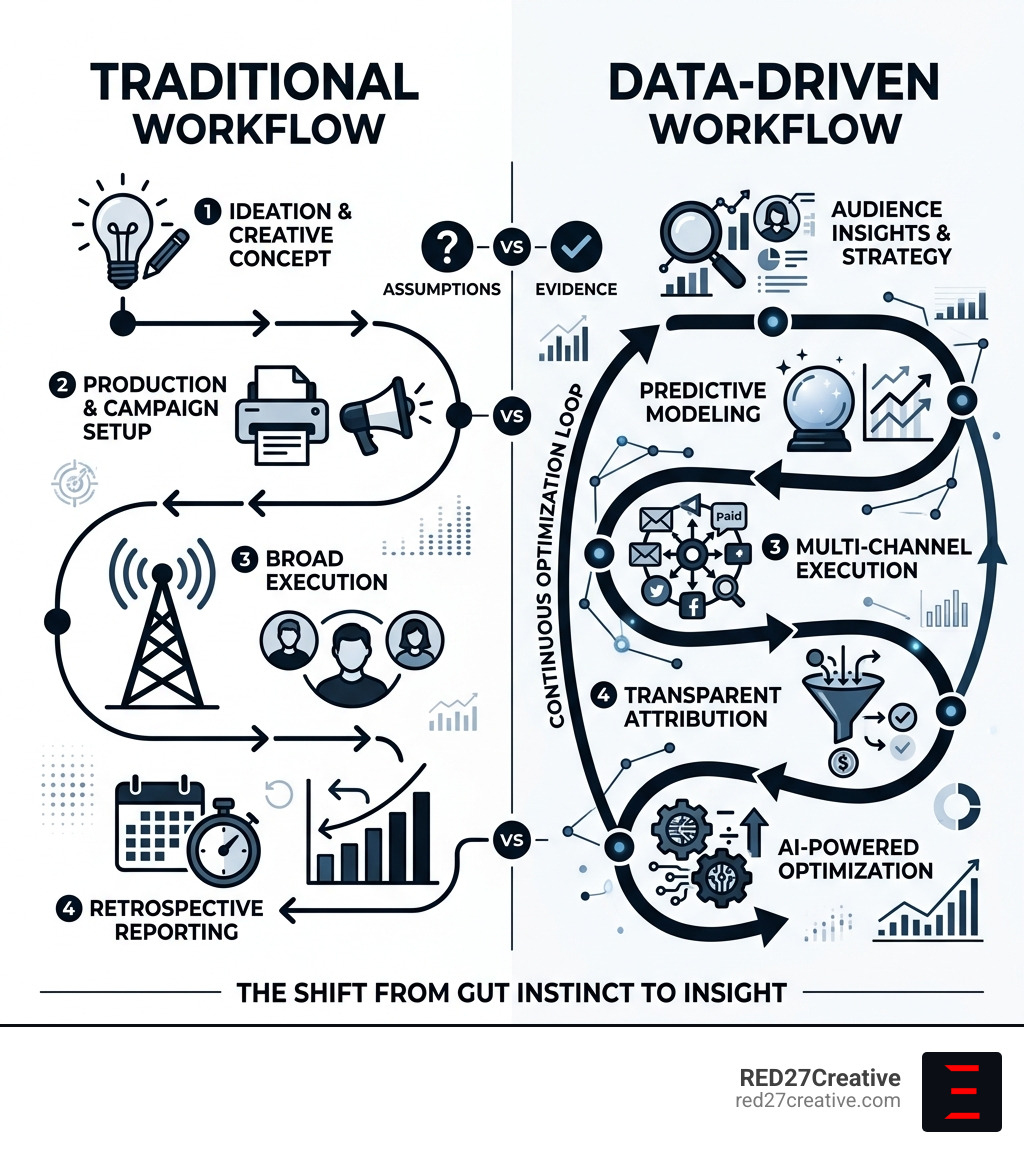
A data-driven marketing agency uses real customer data — not gut instinct — to plan, execute, and optimize every campaign. If you’re looking for the right partner, here’s a quick breakdown of what separates the best from the rest:
| What to Look For | Why It Matters |
|---|---|
| First-party data activation | More accurate targeting without relying on third-party cookies |
| Predictive analytics and modeling | Anticipate customer behavior before it happens |
| Multi-channel execution | Consistent messaging across email, paid, social, and search |
| Transparent attribution reporting | Know exactly what’s driving revenue |
| AI-powered campaign optimization | Faster decisions, less wasted spend |
Marketing has changed. The old model — broad creative campaigns aimed at demographic buckets — is being replaced by something far more precise. Gartner defines data-driven marketing as using data from customer interactions and third parties to understand motivations, preferences, and behaviors. The goal is simple: reach the right person, at the right time, with the right message.
But here’s the problem most executives run into.
A lot of agencies claim to be data-driven. They show you dashboards. They talk about metrics. But there’s a big difference between being data-aware and being truly data-driven. One decorates reports with numbers. The other uses those numbers to make better decisions — and prove it.
The results when you get it right are hard to ignore. Some agencies report helping clients achieve average revenue growth of nearly 5x. Others have cut customer acquisition costs in half. One campaign exceeded its enrollment goal by over 163%. These aren’t flukes — they’re what happens when strategy is built on evidence, not assumptions.
The challenge is knowing which agencies can actually deliver, and which ones are just good at selling themselves.
I’m Kiel Tredrea, founder of RED27Creative, and over more than 20 years of building marketing systems for businesses ranging from local service companies to national B2B brands, I’ve seen how a truly data-driven marketing agency partnership transforms growth — and how the wrong one wastes both time and budget. In this guide, I’ll walk you through exactly what to look for, what to avoid, and how to find a partner built for long-term results.
Simple Data-driven marketing agency glossary:
What Defines a Truly Data-driven Marketing Agency?
At its core, a truly data-driven marketing agency doesn’t just collect information; it transforms that information into a competitive advantage. We believe that every organization has a hidden story within its data. Our job is to uncover that story to fuel predictable growth.
This starts with a shift in mindset. Instead of seeing data as an obstacle or a monthly chore, elite agencies treat it as a high-value asset. This involves using Audience Science to identify your highest-value customers and predictive modeling to understand their future needs.
A hallmark of a sophisticated partner is their approach to data-driven web design. Your website shouldn’t just look good; it should be built on user behavior data to ensure every button and page layout is optimized for conversion.
The Difference Between Data-Aware and Data-Driven
Many agencies are “data-aware.” They can tell you how many clicks you got or what your bounce rate was last month. However, a data-driven marketing agency goes much deeper. They focus on actionable insights that answer the question, “What do we do next?”
True data-driven partners set quantitative goals based on historical benchmarks rather than arbitrary guesses. If a client wants to grow leads by 20%, we look at past performance to see if that’s realistic and what specific levers need to be pulled to get there. It’s about moving from “I think” to “The data shows.”
Hallmarks of Technical Precision
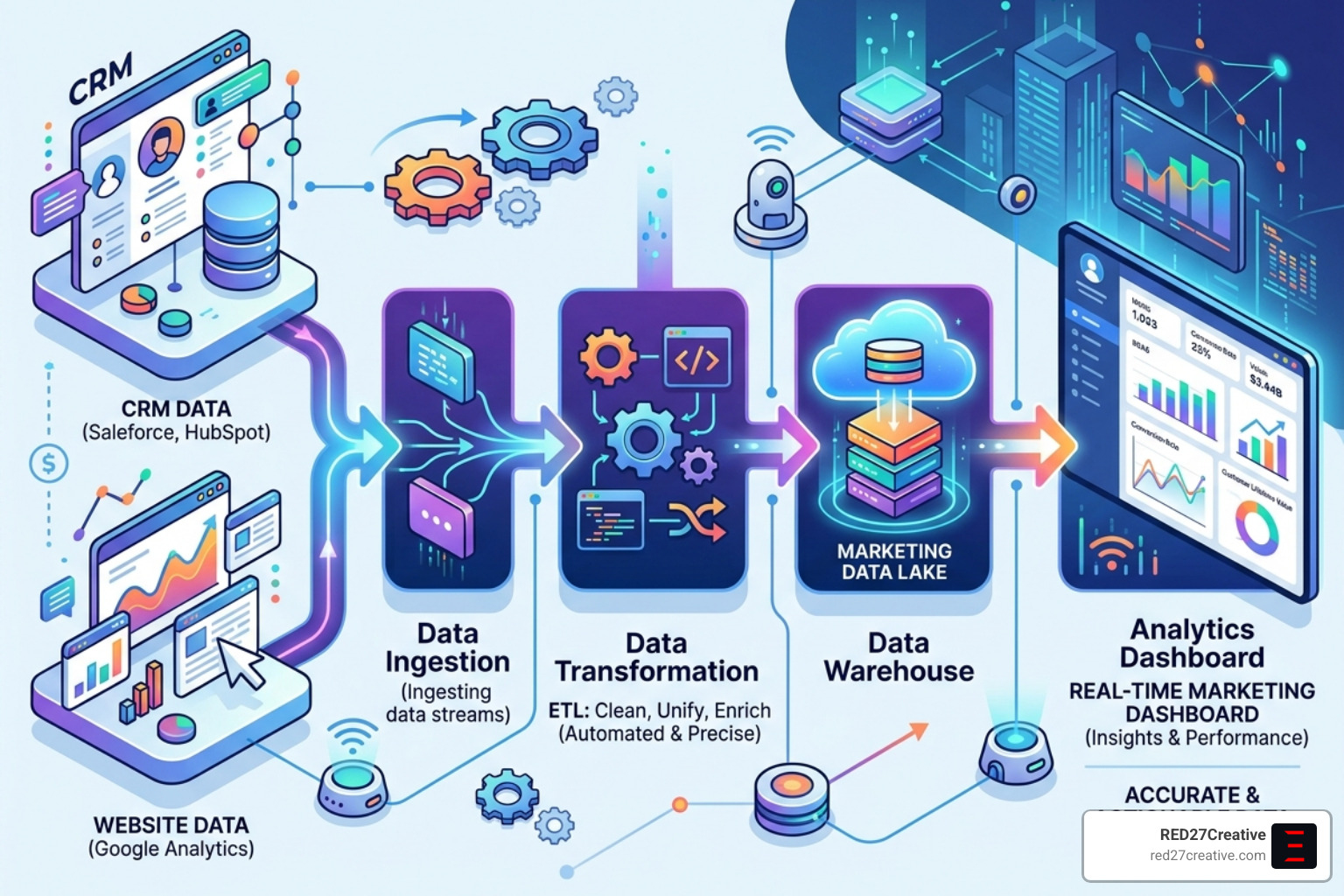
Technical precision is what keeps the engine running. This includes building clean data pipelines that automate the flow of information from your CRM to your marketing platforms. Without this, you’re stuck with manual CSV exports that are outdated the moment they’re downloaded.
According to research by McKinsey & Company, companies that excel at data-driven personalization generate 40% more revenue from those activities than average players. Data governance and UTM consistency are also non-negotiable. If your tracking links aren’t standardized, your attribution data becomes a mess. A professional agency ensures that every touchpoint is tracked accurately so you can see exactly where your revenue is coming from.
Core Services and Technologies Powering Modern Growth
The modern marketing landscape is powered by a sophisticated tech stack. A data-driven marketing agency utilizes tools like Customer Data Platforms (CDPs) to unify fragmented data into a single view of the customer. This allows us to identify anonymous website visitors and tailor messaging specifically to their interests.
We also leverage AI-powered decisioning for programmatic advertising. Instead of buying ad space blindly, AI analyzes thousands of variables in real-time to place your ads where they will have the most impact. This reduces waste and ensures your budget is working as hard as possible.
Activating First-Party Data through a Data-driven Marketing Agency
With the decline of third-party cookies, first-party data has become the “holy grail” of marketing. This is data you own—collected directly from your customers through your website, email signups, and sales.
A data-driven marketing agency helps you activate this data across multiple channels. By integrating CDPs like Tealium or Bloomreach, we can create hyper-targeted audiences for social media and search campaigns. This ensures your marketing is privacy-safe, reliable, and incredibly effective.
Advanced Analytics and Attribution Models
Understanding the secret of marketing ROI requires moving beyond “last-click” attribution. Most customers interact with your brand multiple times before buying.
We use multi-touch attribution and incrementality testing—such as geo-holdout experiments—to measure the true impact of each channel. This helps us understand the Lifetime Value (LTV) of your customers and identify where a dollar spent today will yield the highest return tomorrow.
The Tangible ROI of Data-Led Strategies
The reason businesses switch to a data-driven marketing agency is simple: the results are measurable and often much higher than traditional methods. When you stop guessing, you stop wasting money.
| Metric | Traditional Agency (Est.) | Data-Driven Agency (Proven) |
|---|---|---|
| Revenue Growth | Linear / Unpredictable | Up to 4.8x Average |
| Lead Quality | High Volume, Low Intent | Targeted, High Intent |
| CAC (Acquisition Cost) | Static or Rising | Often Reduced by 50% |
| Decision Making | Monthly / Reactive | Real-time / Proactive |
Measurable Impact and Industry Statistics
The numbers speak for themselves. In data-driven strategy, we’ve seen clients achieve a 224% increase in recurring revenue within months. Others have seen a 163% achievement of enrollment goals by using precise audience targeting.
For many, the biggest win is the reduction in Customer Acquisition Cost (CAC). By using PPC ROI optimization, one insurance firm was able to cut their CAC by 50% simply by using better data to target their direct mail and digital campaigns.
Scaling Beyond the Initial Launch
Data-driven marketing isn’t a “one and done” project. It’s a rolling engagement of testing and iteration. We use performance forecasting and diminished returns modeling to figure out exactly when to scale a campaign and when to pivot.
This proactive leadership ensures that your growth is sustainable. We don’t just look for a quick win; we build a unified engine for growth that continues to deliver results as your business expands.
How to Evaluate and Select Your Strategic Partner
Choosing a data-driven marketing agency is a big decision. You aren’t just hiring a vendor; you’re choosing a strategic partner who will have access to your most valuable business intelligence.
Transparency is key. You should look for an agency that is willing to show you their work, explain their attribution methodology, and give you full ownership of your data. If they try to keep their “secret sauce” in a black box, it’s time to look elsewhere.
Key Questions to Ask a Potential Data-driven Marketing Agency
When interviewing a potential partner, don’t be afraid to get technical. Ask them:
- What does your internal data stack look like?
- How do you handle first-party data activation in a cookieless world?
- Can you explain your enterprise SEO analytics process?
- How often will we receive reports, and will they include actionable insights or just raw numbers?
Red Flags and Common Challenges to Avoid
Watch out for agencies that still rely on manual CSV pulls or provide vague benchmarks. A lack of data ownership is a major red flag—you should always own your accounts and your data.
Another common pitfall is siloed reporting. If your SEO team isn’t talking to your paid media team, you’re missing out on cross-channel insights that could improve your scoring of traffic sources for better ROI.
Emerging Trends: AI, Privacy, and the Cookieless Future
The future of marketing is privacy-first. With increasing regulations and the deprecation of third-party cookies, a data-driven marketing agency must be an expert in compliance.
We are seeing a massive shift toward data lakehouses—modern architectures that combine the best of data warehouses and data lakes. These allow for secure, scalable AI execution while keeping consumer data safe. This infrastructure is what allows brands to remain competitive in a data-driven world.
AI is also moving from a “cool tool” to a core necessity. From generating creative variations to predicting which anonymous website visitors are most likely to buy, AI is making marketing faster and more efficient than ever before.
Frequently Asked Questions about Data-Driven Marketing
What is the difference between a traditional and a data-driven agency?
A traditional agency often relies on creative intuition and broad demographic targeting. In contrast, a data-driven agency uses real-time customer interactions, first-party data, and predictive analytics to make evidence-based decisions. This approach ensures every marketing dollar is spent on high-value opportunities with measurable ROI.
How does a data-driven approach improve marketing ROI?
By utilizing advanced attribution and propensity-to-buy analysis, agencies can identify which channels and tactics actually drive conversions. This eliminates wasteful spending on underperforming campaigns and allows for the continuous optimization of the sales funnel, often resulting in a significant reduction in customer acquisition costs.
What technologies are essential for data-driven marketing?
Key technologies include Customer Data Platforms (CDPs) for unifying user data, AI-powered decisioning engines for programmatic ads, and robust data warehouses for storage. These tools allow agencies to track the entire customer journey, from anonymous website visitors to loyal advocates, ensuring personalized and effective communication.
Conclusion: Building Your Unified Engine for Growth
In today’s market, you can’t afford to guess. Whether you are a local business in Geneva, IL, or a national brand, your growth depends on how well you use the information available to you.
At RED27Creative, we don’t just provide services; we partner with you to build a unified engine for growth. From technical SEO to custom web design and lead generation systems, everything we do is designed to turn visibility into measurable ROI.
We lead with strategy, drive with purpose, and focus on results that last. If you are ready to stop chasing “hype” and start building a data-backed future for your business, we are ready to help.

Kiel Tredrea
https://red27creative.comTop Marketing Agency • Web, SEO & Leads • RED27Creative