Marketing Funnels Explained: From Awareness to Conversion

Understanding the Digital Marketing Funnel Framework
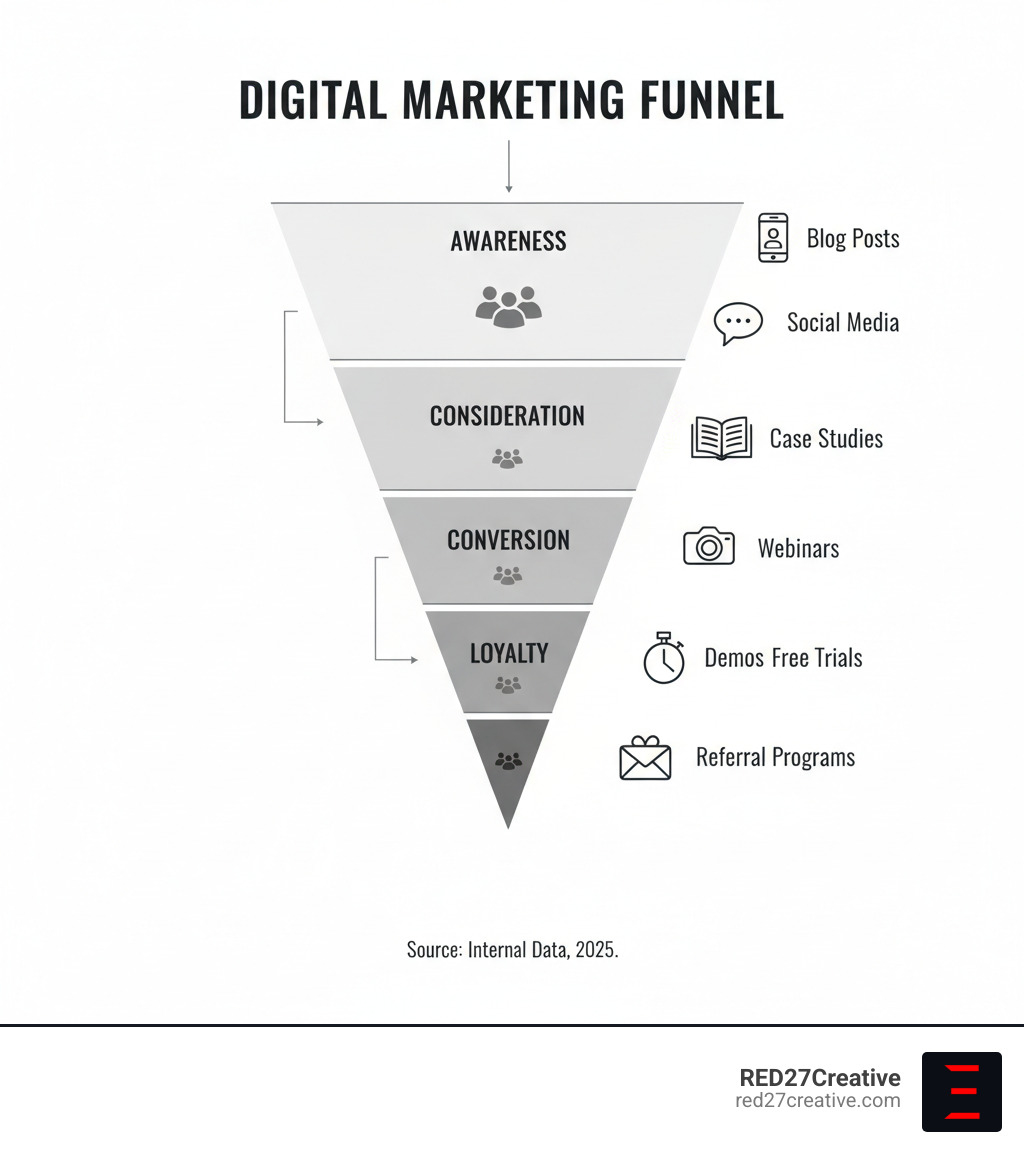
Digital marketing funnels are the strategic backbone of online business growth. A digital marketing funnel is a model that maps the journey a potential customer takes, from first finding your brand to making a purchase and becoming a loyal advocate. It’s a roadmap that guides prospects through awareness, consideration, and decision stages using targeted digital tactics.
What is a Digital Marketing Funnel?
- A model showing how prospects become customers.
- Maps the customer journey across online channels.
- Includes stages: Awareness, Consideration, Conversion, and Loyalty.
- Uses targeted content for each stage (TOFU, MOFU, BOFU).
- Helps businesses improve marketing ROI.
Why it matters: Industry data shows 68% of companies haven’t identified their funnel, missing huge growth opportunities. A well-defined funnel is crucial because today’s customer journey isn’t linear. People bounce between stages and interact with brands across multiple touchpoints before buying.
I’m Kiel Tredrea, founder of RED27Creative, and I’ve spent over 20 years building and optimizing digital marketing funnels that drive measurable revenue for B2B and B2C companies. My approach combines conversion-focused web design, advanced SEO, and data-driven marketing to turn strangers into loyal customers.
Why a Digital Marketing Funnel is Essential
Without a defined funnel, marketing becomes expensive guesswork. A well-structured digital marketing funnel creates a predictable, scalable system for business growth. It helps you attract the right people, engage them with valuable content, convert them into customers, and keep them coming back.
The Value of a Structured Funnel
A structured funnel transforms how your business connects with customers by turning the complex, multi-channel customer journey into an actionable plan.
- Maps the Customer Journey: It provides a clear visual of how people interact with your brand online at every touchpoint.
- Improves Segmentation: By tracking user engagement, you can send targeted messages based on their stage in the funnel.
- Drives Efficient Lead Generation: It shows which content and channels bring in the best prospects, so you can focus on what works.
- Supports Smarter Resource Allocation: Invest your budget and team efforts where they will have the greatest impact, eliminating waste.
- Delivers Higher ROI: A refined funnel leads to more qualified leads, higher conversion rates, and better customer retention.
This strategic approach is central to our marketing strategy and consulting services, where we build campaigns that move the needle.
Digital Funnels vs. Traditional Sales Funnels
While related, digital marketing funnels differ from traditional sales funnels. The classic sales funnel (AIDA model) was linear and relied on a salesperson guiding the customer. Digital funnels are content-driven and non-linear.
In the digital world, customers interact with content like blog posts, videos, and ads long before speaking to a person. This allows businesses to engage thousands of people at once, building trust at scale.
| Feature | Digital Marketing Funnel | Traditional Sales Funnel |
|---|---|---|
| Primary Interaction | Content (blogs, videos, social media, ads) | Salesperson, direct communication |
| Customer Journey | Often non-linear, multi-touchpoint, self-directed | More linear, guided by sales process |
| Key Channels | Websites, social media, email, search engines, apps | Phone calls, in-person meetings, brochures |
| Scalability | Highly scalable through automation and content | Limited by sales team capacity |
| Focus | Building relationships, educating, nurturing leads | Closing deals, direct persuasion |
When marketing and sales funnels work together, the customer experience is seamless, and conversion rates increase.
The Core Stages of a Digital Marketing Funnel
A high-performing digital marketing funnel delivers the right message at the right time, guiding users from awareness to loyalty. The funnel is typically organized into four stages: Top of Funnel (TOFU), Middle of Funnel (MOFU), Bottom of Funnel (BOFU), and post-purchase.
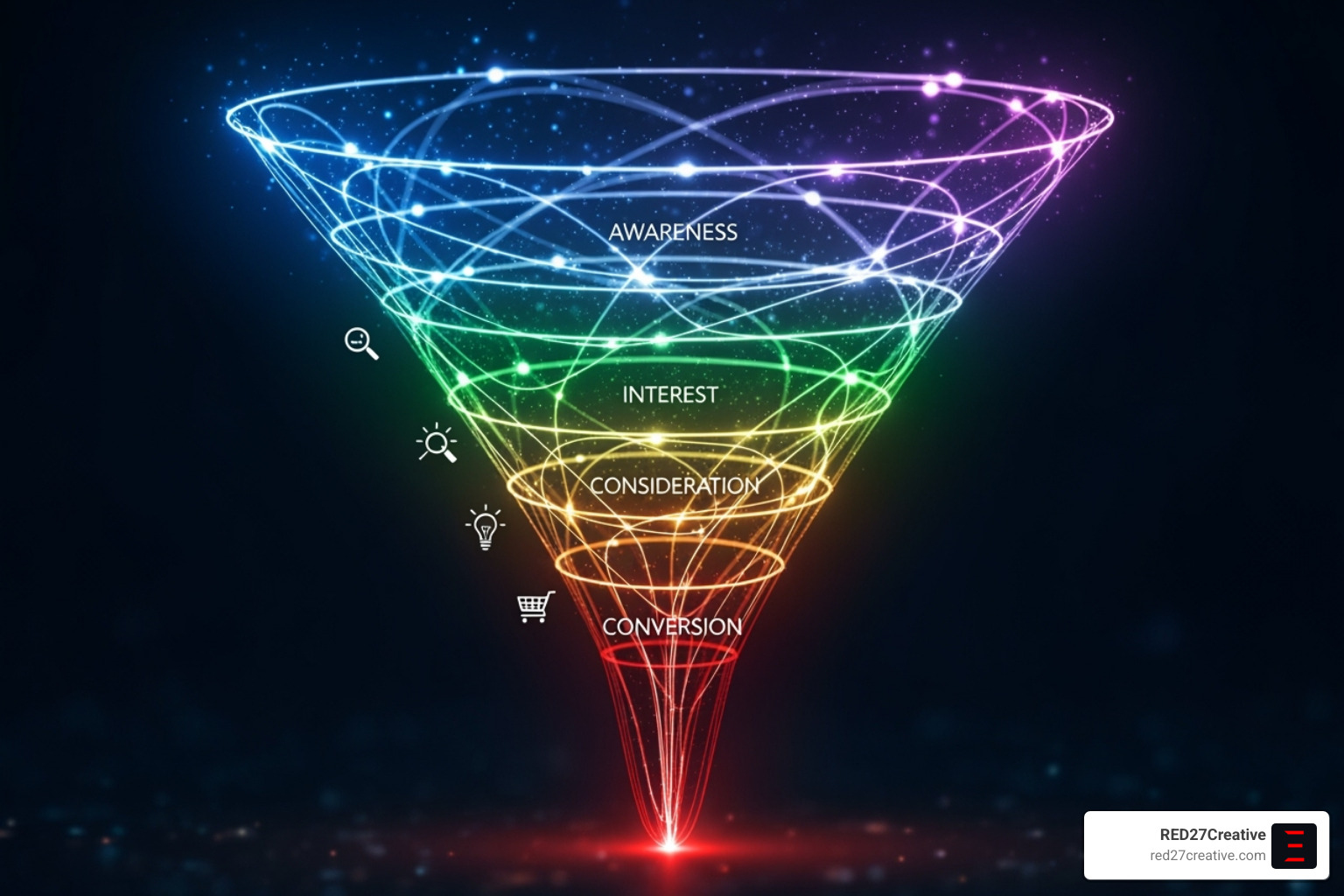
Stage 1: Awareness (Top of the Funnel – TOFU)
This is where the customer relationship begins. Potential customers are just starting to research a problem or are browsing for information.
Goal: Attract a wide audience and introduce your brand.
Customer Mindset: “I have a problem, but I don’t know the solution yet.”
Tactics: We cast a wide net with content designed to generate traffic to your website. This includes blog posts that answer common questions, engaging social media content, and educational infographics and videos. Our SEO services ensure your brand appears when people search for solutions.
Stage 2: Consideration (Middle of the Funnel – MOFU)
Prospects in this stage are actively researching and comparing options to solve their problem. They know your brand and are evaluating if you’re the right fit.
Goal: Nurture leads and position your brand as the best choice.
Customer Mindset: “I’m comparing my options. What makes this solution different?”
Tactics: We shift to deeper engagement with case studies, whitepapers, and webinars that demonstrate expertise. Our lead generation services use valuable resources like ebooks and checklists to convert visitors into qualified leads. Our custom content writing services help craft these compelling narratives.
Stage 3: Conversion (Bottom of the Funnel – BOFU)
At this stage, prospects are ready to make a decision. They are highly engaged and are actively looking to buy.
Goal: Convert qualified leads into paying customers.
Customer Mindset: “I’m ready to buy. Why should I choose you?”
Tactics: We use high-intent tactics like personalized demos, free trials, and consultations to address final questions. Testimonials and reviews provide social proof, while strong calls-to-action (CTAs) and special offers encourage immediate action. For B2B clients, our B2B lead generation and appointment setting services help close the deal.
Stage 4: Loyalty & Advocacy
The journey doesn’t end at the sale. This stage focuses on turning customers into repeat buyers and brand advocates.
Goal: Retain customers and turn them into brand advocates.
Customer Mindset: “I made a great choice and want to share my experience.”
Tactics: We nurture the relationship with onboarding emails, exceptional customer support, and loyalty programs. Referral incentives and exclusive content make customers feel valued. This is critical, as acquiring a new customer can be 5 to 25 times more expensive than retaining an existing one.
How to Build and Optimize Your Funnel for Maximum ROI
Building a digital marketing funnel is an ongoing process of testing, measuring, and optimizing to improve performance and maximize ROI. Successful funnels are constantly evolving based on user interactions and data.
The Power of Landing Pages
Landing pages are essential for funnel conversions. These standalone pages are designed with a single objective: to guide a visitor toward one specific action, like downloading a resource or booking a demo.
- Single Call-to-Action (CTA): Landing pages eliminate distractions and focus the user on one goal, increasing conversion rates.
- Message Matching: The content on the landing page should directly match the ad or link the user clicked, creating a seamless experience.
- A/B Testing: Test different headlines, images, and CTAs to see what resonates most with your audience and continuously improve results.
- Mobile Optimization & Fast Load Times: With over half of traffic coming from mobile, pages must be fast and responsive on any device to avoid losing impatient visitors.
Our website design and development services create landing pages optimized for conversion.
Using Data to Measure and Improve Your Funnel
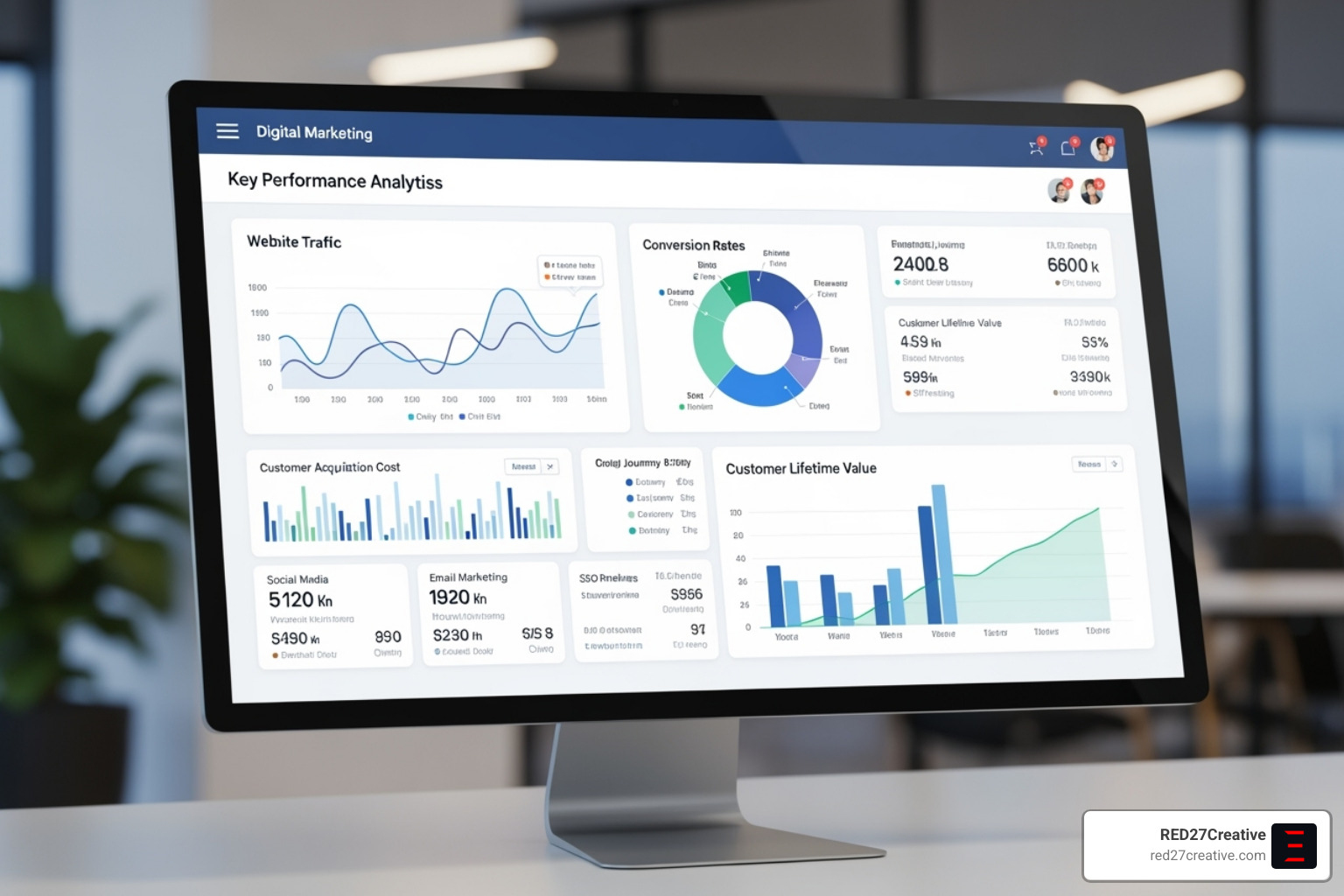
Without data, you’re just guessing. Data-driven marketing is key to identifying funnel leaks and opportunities for improvement. We rely on hard numbers to guide our decisions.
- Track Key Metrics (KPIs): Monitor conversion rates per stage to see where users drop off. A large drop-off signals a problem that needs fixing.
- Analyze CAC and CLV: Customer Acquisition Cost (CAC) measures spending per new customer, while Customer Lifetime Value (CLV) shows the total revenue a customer generates. A healthy funnel has a CLV that significantly exceeds its CAC.
- Use Analytics Tools: Google Analytics helps understand traffic sources and user behavior. Heatmaps and session recordings show how users interact with your pages, revealing what they click, scroll past, or miss.
This commitment to measurement is central to the competitive edge of data-driven marketing, leading to higher conversions and a stronger ROI.
Common Funnel Types and Modern Alternatives
While the classic funnel provides a solid foundation, today’s customer journey is rarely a straight line. Marketers often use specialized funnels and alternative models to reflect this complex, real-world behavior.
Common Types of Digital Marketing Funnels
Different goals require different funnels. Here are a few common types:
- Lead Magnet Funnel: Offers a free resource (e.g., ebook, checklist) in exchange for an email address to build your list and nurture leads.
- Webinar Funnel: Uses a live or automated online presentation to educate prospects, build authority, and convert attendees for high-value offerings.
- Tripwire Funnel: Presents a low-cost initial offer to convert prospects into customers quickly, making them more likely to buy higher-priced products later.
- Product Launch Funnel: Builds anticipation for a new product through a timed series of content, creating urgency and driving sales.
Beyond the Funnel: The Flywheel and Hourglass Models
Traditional funnels are sometimes criticized for being too linear and ignoring the post-purchase journey. In reality, the customer journey is non-linear and cyclical, with customers re-engaging at various points.
- The Flywheel Model: This model is a circular process where happy customers fuel growth by becoming promoters. It focuses on attracting, engaging, and delighting customers to create a self-reinforcing cycle.
- The Hourglass Model: This model expands the traditional funnel by adding post-purchase stages like loyalty and advocacy. It highlights the importance of retaining customers and turning them into your best marketers.
These models remind us to focus on the entire customer lifecycle, not just the initial conversion, to build lasting, profitable relationships.
Frequently Asked Questions about Digital Marketing Funnels
Here are answers to some common questions about digital marketing funnels to help clarify the essentials.
What is a full-funnel marketing approach?
A full-funnel approach means engaging customers at every stage of their journey, from awareness to loyalty. Instead of focusing on a single phase, this holistic strategy creates a seamless experience that builds trust. Brands using this approach see up to twice as many purchases compared to single-stage tactics.
How do you measure the success of a marketing funnel?
Success is measured by tracking Key Performance Indicators (KPIs) at each stage. For Awareness, track traffic and reach. For Consideration, monitor lead generation and engagement. For Conversion, measure conversion rate and cost per acquisition (CPA). Post-purchase, focus on customer retention rate and lifetime value (CLV).
What is the main difference between a B2B and B2C funnel?
B2B funnels are typically longer and more complex, involving multiple decision-makers and focusing on education and ROI. B2C funnels are shorter and more emotional, targeting a single buyer making a faster, often impulse-driven decision. The content and tactics for each must be custom to these different buying cycles.
Transform Your Strategy with a High-Converting Funnel
Mastering digital marketing funnels is essential for sustainable growth. A well-designed funnel creates a predictable system for attracting customers, building genuine connections, and turning them into loyal advocates. It’s the engine that powers your marketing, ensuring every dollar you spend works harder to deliver measurable results.
Without a clear framework, marketing efforts often fail to deliver predictable results. A data-driven funnel provides the structure needed to scale your success and build a business that thrives in any market.
Ready to build a funnel that converts? At RED27Creative, we specialize in creating data-driven marketing funnels that deliver measurable growth. We combine strategic planning, expert SEO, and conversion-focused design to guide your customers from curiosity to commitment.
Explore our lead generation services to see how we can help you turn more prospects into loyal customers and achieve your business goals. Let’s build a system that lasts.

Kiel Tredrea
https://red27creative.comTop Marketing Agency • Web, SEO & Leads • RED27Creative