Building Beyond the Box: A Guide to Custom Web Applications

Why Custom Web Applications Are Your Competitive Advantage
Custom web applications are browser-based software tools built specifically for your business needs, enabling users to complete tasks, process data, and interact with dynamic features—unlike standard websites that simply display information.
Key Characteristics of Custom Web Applications:
- User Interaction: Users log in, input data, and complete specific tasks
- Data Processing: Information is created, read, updated, and deleted (CRUD operations)
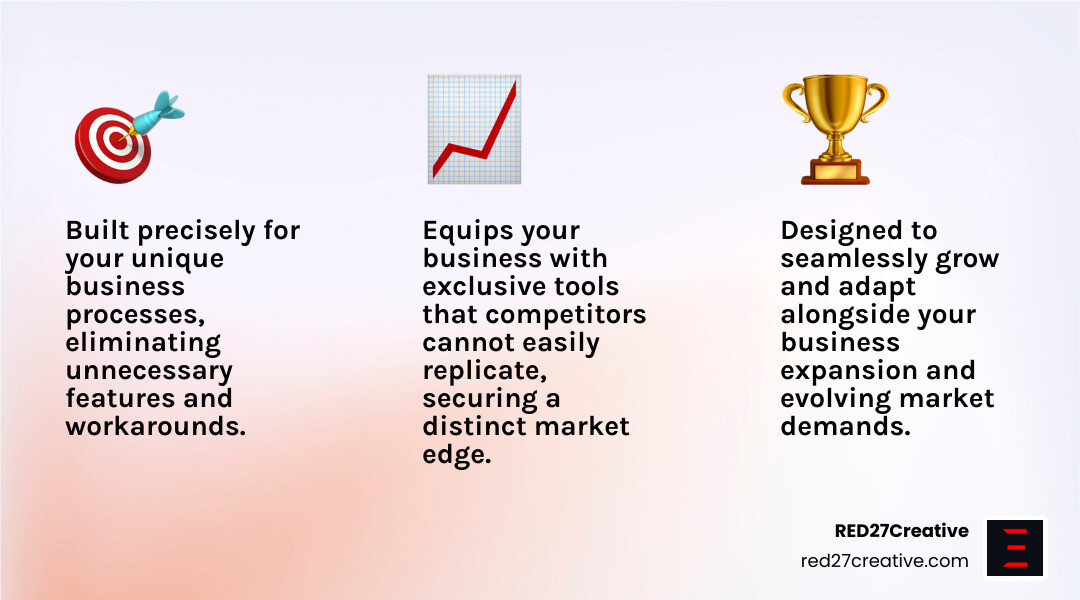
- Business Alignment: Built to match your exact workflows, not generic processes
- Scalability: Grows with your business without vendor limitations
- Accessibility: Works from any device with a browser and internet connection
The custom web app development market is projected to grow at a 22.5% CAGR through 2030, signaling a clear industry shift away from one-size-fits-all software. Businesses are realizing that forcing operations to fit generic tools costs more in lost productivity than building the right solution from the start.
Think about it this way: off-the-shelf software is like buying a suit off the rack. It might fit reasonably well, but there will always be compromises. A custom web application is custom precisely to your measurements—no excess fabric, no uncomfortable seams, just exactly what you need to perform at your best.
The core problem? Most businesses rely on pre-built software that includes features they’ll never use while missing the critical functions they actually need. This creates workarounds, inefficiencies, and frustration across your team. Custom web applications solve this by putting control back in your hands.
I’m Kiel Tredrea, founder and president of RED27Creative, where I’ve spent over 20 years helping businesses transform their operations through strategic web design, development, and custom web applications that drive measurable growth. My team and I specialize in building digital systems that align perfectly with business objectives, creating tools that don’t just look good—they convert, scale, and deliver ROI.
Simple guide to Custom web applications:
What is a Custom Web Application and Why Choose It?
When most people think about building something online, they picture a website—a digital space where visitors can learn about your company, read your content, or browse your services. And while websites are important, they’re only part of the story. Custom web applications take things several steps further, changing your digital presence from a static information source into an active business tool.
Understanding the difference between a website and a web application isn’t just technical jargon—it’s the foundation for making smart decisions about where to invest your resources. And once you see how generic, off-the-shelf software can hold your business back, the case for building something custom becomes crystal clear.
| Feature | Custom Web Application | Off-the-Shelf Software |
|---|---|---|
| Flexibility | Custom to exact business needs, highly adaptable | Limited customization, often requires workarounds |
| Scalability | Built for future growth, easily expands functionality | May hit limits, difficult to adapt to unique demands |
| Cost (Upfront) | Higher initial investment | Lower initial cost (license fees) |
| Cost (TCO) | Lower long-term cost, no recurring license fees | Higher long-term cost (licenses, unnecessary features) |
| Feature Set | Only necessary features, precise functionality | Feature bloat, missing critical functions |
| Competitive Advantage | Unique, proprietary tools, market differentiation | Generic, accessible to competitors |
Defining the Difference: Web App vs. Website
A website is like a digital brochure—it’s there to inform and showcase your business. Its main job is information delivery. A custom web application, on the other hand, is built for action. It’s interactive software in a browser that lets users accomplish specific tasks like logging in, processing data, or managing workflows. Think of the difference between reading about your bank (website) versus logging into your online banking portal to transfer funds (web application). One delivers static content; the other enables task completion.
If you’re curious about how these concepts apply to building a complete digital presence, we cover more info about custom web design and development that bridges both worlds.
The Problem with Pre-Built Solutions
Off-the-shelf software seems convenient and cheaper upfront, but this often leads to serious long-term costs. Generic solutions are packed with features you don’t need (feature bloat) while missing critical functions you do, forcing your team into awkward workarounds. This means adapting your workflows to the software’s limitations, not the other way around.
Another issue is vendor lock-in. Once you’ve invested in a platform, switching is difficult, leaving you at the mercy of the vendor’s pricing and updates. Recurring license fees add up, and pre-built solutions rarely scale with your unique business needs. As you grow, the software stays rigid, becoming a barrier instead of a tool.
This is why businesses are choosing custom web applications. They match exact requirements, eliminate waste, and provide complete control, delivering ROI through efficiency gains and a competitive edge that off-the-shelf products can’t offer.
The Strategic Benefits of Investing in Custom Web Applications
When you invest in custom web applications, you’re making a strategic decision that reaches far beyond technology. You’re building a proprietary asset that can fundamentally reshape how your business operates, competes, and grows. The numbers tell the story: the custom software development market is projected to grow at a 22.5% CAGR through 2030. That’s not just a trend—it’s a clear signal that businesses are moving away from generic solutions and toward tools built for their exact needs.
The real question isn’t whether custom applications deliver value. It’s whether your business can afford to keep operating with software that wasn’t designed for you.

Boost Business Efficiency and Productivity
A custom web application automates repetitive tasks and centralizes data, eliminating manual errors and freeing your team to focus on revenue-generating work. Instead of forcing your processes into a generic tool, the technology adapts to your team’s natural workflows. For businesses across Geneva, Batavia, Aurora, St. Charles, Plainfield, Oswego, Naperville, and Chicago, IL, this means intuitive tools that boost productivity from day one. By centralizing information and automating workflows, you gain measurable efficiency that improves your bottom line.
Achieve Best Scalability and Flexibility
Your business evolves, and your software should too. Off-the-shelf solutions have limits, but custom web applications are built to grow with you. We architect systems for the future, making it easy to add new functionality or integrate with other platforms. You’re not constrained by a third-party vendor’s roadmap; you have complete control to adapt quickly to market changes. This agility keeps you competitive, turning technology into an enabler of growth, not a barrier.
Fortify Your Security and Data Integrity
Security must be built-in, not bolted on. Custom web applications offer a significant advantage by including only the code you need, which minimizes the attack surface compared to bloated generic software. We build security protocols tailored to your specific risks and data requirements, giving you full control over access, storage, and encryption. By following best practices from trusted sources like OWASP, we build systems that meet compliance standards and protect your sensitive data, building trust with your customers.
The Development Lifecycle: From Idea to Launch
Building a custom web application is a collaborative partnership to turn your vision into a tangible business asset. Our refined website design and development process breaks the project into clear, manageable stages. A typical project takes four to six months, focusing on building a flawless solution that delivers long-term ROI. The process moves through five key stages: discovery, design, development, testing, and deployment, followed by ongoing maintenance.

Stage 1: Discovery and UI/UX Design
Every successful project starts with a deep discovery phase where we understand your business, workflows, and goals. We define clear objectives and map user journeys to reflect how your team actually works. This groundwork informs the UI/UX design, where we create wireframes and interactive prototypes using tools like Figma and Adobe XD. This allows you to test the application’s flow and feel before development begins, ensuring the final product is both functional and intuitive.
Stage 2: Choosing the Right Technology Stack
The right technology stack impacts performance, scalability, and long-term cost. We choose technologies based on your specific needs, not trends. For the frontend, we may use frameworks like React or Vue for dynamic interfaces. The backend might be built with Node.js for speed or Python for complex data operations. For databases, we choose between SQL (PostgreSQL, MySQL) for structured data or NoSQL (MongoDB) for flexibility. Our team serving Geneva, Batavia, Aurora, St. Charles, Plainfield, Oswego, Naperville, and Chicago, IL, has the experience to select the optimal stack for your project.
Stage 3: Development, Testing, and Deployment
Using an agile methodology, we build your application in two-week sprints, delivering working features incrementally for regular feedback. We write clean, maintainable code and integrate quality assurance throughout the process, including unit, integration, and User Acceptance Testing (UAT). For deployment, we use reliable cloud platforms like AWS or Microsoft Azure to ensure security and scalability. Our CI/CD pipeline allows for smooth, non-disruptive updates. Launch isn’t the end; ongoing maintenance ensures your application remains a valuable, high-performing asset.
Frequently Asked Questions about Custom Web Applications
When businesses start exploring custom web applications, they naturally have questions about how these tools differ from traditional websites, what kind of investment they require, and how long the process takes. We’ve answered the most common questions we hear from business owners in Geneva, Batavia, Aurora, St. Charles, Plainfield, Oswego, Naperville, and Chicago, IL—and beyond.
What is the main difference between a website and a web application?
A website is primarily informational, like a digital brochure. Visitors consume content. A custom web application is interactive software in a browser that lets users perform tasks. Think of the difference between reading a restaurant’s menu online (website) and ordering delivery through their portal (web app). One displays information; the other enables action.
How long does it take to build a custom web application?
The timeline depends on complexity. A straightforward application might take three to four months, while complex enterprise solutions can take six to twelve months or more. Our process includes detailed planning, design, development, and thorough testing to ensure a high-quality result that saves you time and money in the long run.
Are custom web applications more expensive than off-the-shelf software?
Custom web applications have a higher upfront investment, with projects ranging from $10,000 to $250,000+ depending on complexity. However, off-the-shelf software comes with hidden costs: recurring license fees, lost productivity from workarounds, and the inability to scale. When you consider the total cost of ownership, a custom solution often delivers a higher ROI. You own a proprietary asset that provides a unique competitive advantage, which is something a subscription can’t offer.
Build Your Business’s Digital Growth Engine
Here’s the truth: choosing to invest in a custom web application isn’t just about software. It’s about building a proprietary asset that becomes the foundation for everything your business wants to achieve. When you move beyond forcing your operations into generic tools, you’re making a strategic decision that pays dividends for years to come.
Think about what happens when your technology actually fits your business. Your team stops wasting time on workarounds and starts focusing on what they do best. Your customers experience a seamless, branded interaction that builds trust and loyalty. Your operations become more efficient, more secure, and more scalable. This isn’t theoretical—it’s what happens when your digital tools are built specifically for your unique workflows and goals.
The competitive advantage here is real. While your competitors are stuck with the same off-the-shelf solutions everyone else uses, you’ve got something they can’t replicate. Custom web applications become your secret weapon, turning your digital presence into a true engine for growth that scales with your ambition.
Ready to build something that actually fits your business? The team at RED27Creative specializes in creating data-driven web design services and applications that deliver measurable results. We’re not just developers—we’re strategic partners who understand that great technology should drive real business outcomes.
Based in Geneva, Batavia, Aurora, St. Charles, Plainfield, Oswego, Naperville, and Chicago, IL, our designers, developers, and SEO experts work together to build complete solutions. We help you establish a strong online foundation and turn visibility into consistent, qualified opportunities. Because at the end of the day, that’s what matters: results that move your business forward.
Let’s talk about what’s possible when your technology is built for you, not for everyone.

Kiel Tredrea
https://red27creative.comTop Marketing Agency • Web, SEO & Leads • RED27Creative