Future-Proof Your Store: Top E-commerce Solutions for a Modern Online Presence
Why E-commerce Website Solutions Matter More Than Ever
E-commerce website solutions are the platforms and services that let you build, manage, and grow an online store. They handle everything from web design and payment processing to inventory and marketing. Choosing the right one depends on your business model, budget, and growth goals.
Quick overview of top e-commerce solutions:
- Shopify – Best for fast setup and all-in-one functionality
- WooCommerce – Best for WordPress users who want full control
- BigCommerce – Best for high-volume sellers with complex needs
- Square Online – Best for businesses selling both online and in-person
- Wix – Best for small businesses prioritizing design and ease of use
- Magento (Adobe Commerce) – Best for enterprise-level customization
Global retail e-commerce sales surpassed $6.3 trillion in 2023 and continue to climb, showing that the opportunity for online growth is massive. Success isn’t just about having a store—it’s about choosing the right platform to create a seamless experience that converts visitors into customers.
A poor platform can cost you revenue through slow speeds, a clunky checkout, or weak SEO. In contrast, a great e-commerce system becomes a unified engine for growth, connecting your website, inventory, marketing, and sales into one scalable operation.
As Kiel Tredrea, founder of RED27Creative, I’ve spent over 20 years helping businesses build high-performing e-commerce website solutions that drive real revenue. Our approach focuses on strategy, conversion, and long-term scalability—not just a pretty website.
Choosing the Right E-commerce Platform: A Strategic Decision
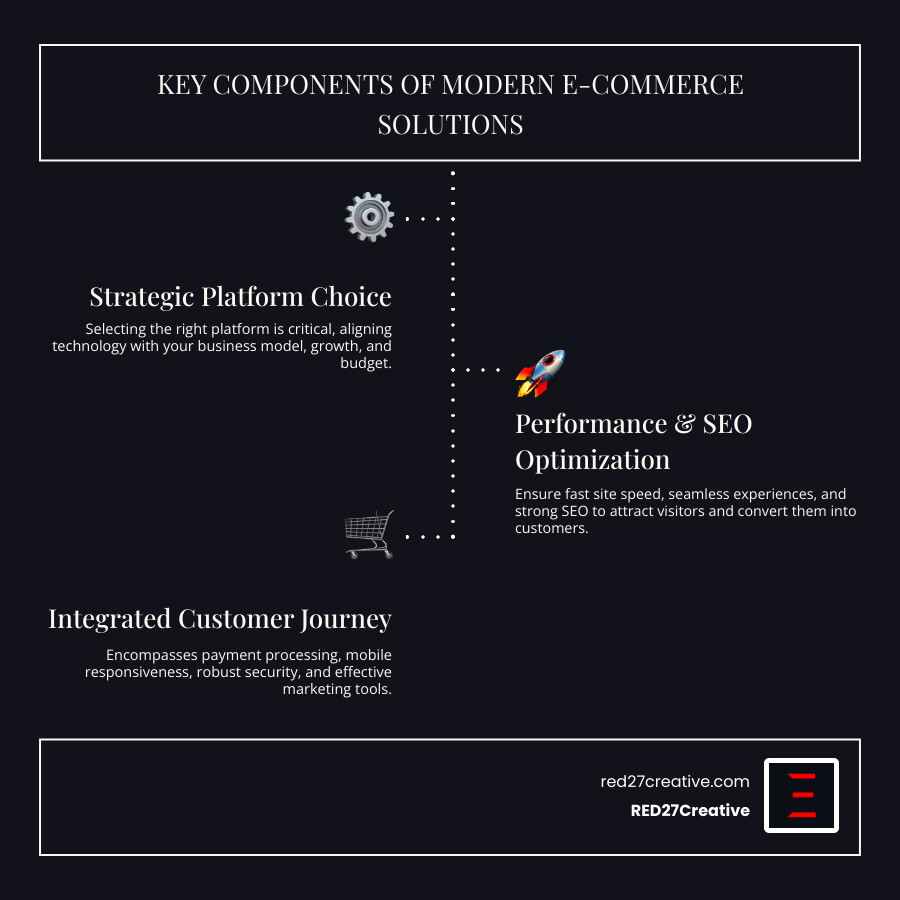
Picking the right e-commerce website solution is a critical decision that matches technology to your needs, budget, and growth plans. The right choice accelerates growth, while the wrong one creates headaches and limits potential.
Key Features to Consider
When evaluating platforms, look beyond the surface to ensure the backend can handle your operations.
- Ease of Use: An intuitive platform saves time on daily tasks. Look for clear navigation and drag-and-drop editors.
- Customization: Reflect your brand with flexible themes and the ability to add apps or custom code.
- Scalability: Ensure the platform can handle growth in traffic and orders to avoid a costly future migration.
- Pricing Structure: Understand the total cost, including monthly fees, transaction costs, and app prices.
- Built-in Marketing & SEO: A strong SEO foundation is crucial. Look for customizable meta tags, clean URLs, and a built-in blog.
- Integrations: Connect seamlessly with your CRM, email marketing, and accounting software to automate workflows.
Catering to Diverse Business Needs
Your product type should guide your choice. Most platforms handle physical products well. For digital products, ensure secure delivery. For subscriptions, look for strong recurring billing features. For services, find a platform that integrates with scheduling tools.
Pricing Structures: Understanding the True Cost
The advertised monthly fee is just the start. A Total Cost of Ownership analysis should include:
- Monthly Subscription Fees
- Payment Gateway Fees (typically 2.9% + $0.30 per transaction)
- Platform Transaction Fees
- App and Extension Costs
- Premium Themes and Design
- Hosting and Security (for self-hosted solutions like WooCommerce)
Small Business vs. Enterprise Solutions
- Small and Medium Businesses (SMBs): Need ease of use, affordability, and quick setup. Platforms like Shopify, Wix, Square Online, and WooCommerce are ideal.
- Enterprise Businesses: Require deep customization, complex integrations (e.g., ERP), and advanced B2B features. Adobe Commerce (Magento), Shopify Plus, and BigCommerce Enterprise are built for these demands.
Options for Limited Budgets or Startups
- Free Plans: Platforms like Square Online and Ecwid let you start selling with no monthly fees.
- Marketplace Selling: Using Etsy or Gumroad gives you access to an existing audience but they take a larger cut of each sale.
- Open-Source Solutions: WooCommerce is a free plugin for WordPress, offering maximum control for those with technical skills.
Top E-commerce Website Builders for Small and Medium Businesses
For small and medium businesses, the right platform balances power with simplicity. Here are the top e-commerce website solutions that consistently deliver results.
Shopify: The All-in-One Powerhouse
Shopify is an all-in-one platform designed to get you selling fast. Its intuitive interface, massive app store, and high-converting checkout make it a powerhouse for businesses of all sizes. It offers a clear path from launch to scale, with pricing starting at $39 per month.
WooCommerce: Flexibility for WordPress Users
For WordPress users wanting complete control, WooCommerce is the perfect fit. This open-source plugin transforms any WordPress site into a full-featured store with endless customization via extensions. While the plugin is free, you are responsible for your own hosting and security.
Wix: Design-Driven Simplicity
Wix excels for those who prioritize visual appeal without coding. Its intuitive drag-and-drop editor, professional templates, and built-in marketing tools make it easy to create a stunning store. It’s ideal for small businesses wanting great design without technical hassle.
Square Online: Seamless In-Person and Online Sales
For businesses selling both online and in-person, Square Online offers seamless integration with Square’s POS system. It syncs inventory, sales, and customer data, unifying your operations and creating a cohesive customer experience.
BigCommerce: Scaling for Growth
BigCommerce is designed for scaling businesses that need more power. It offers robust native features, reducing reliance on paid apps, and its open architecture allows deep customization. It’s an excellent choice for high-volume sellers with complex catalogs.
Ecwid by Lightspeed: The Free Starter
Ecwid offers a useful free plan for those starting with zero upfront investment. It lets you sell up to 5 physical products and can be embedded into any existing website or social page, making it a low-risk entry into e-commerce.
Other Notable Mentions
- PrestaShop: A flexible, open-source solution that gives you full data ownership and extensive customization options.
- Odoo: A unique platform that combines e-commerce with a full suite of business management apps like CRM and inventory.
- Shopware: An API-first, open-source platform known for creating rich, content-driven shopping experiences.
- Adobe Commerce (Magento): The enterprise-level standard for large businesses needing unparalleled customization and power.
Beyond the Build: Essential Aspects of E-commerce Success
Launching your store is just the beginning. True success comes from optimizing every aspect of your business, from customer acquisition to retention. Your e-commerce website solution is the foundation, but these key areas build a thriving business upon it.
Integrating with Other Sales Channels
An omnichannel strategy is essential to reach customers everywhere.
- Physical Retail: Integrate your online store with a Point of Sale (POS) system to sync inventory and customer data.
- Marketplaces: Expand your reach by selling on Amazon, eBay, and Etsy, often managed from a single dashboard.
- Social Commerce: Sell directly on Instagram and Facebook by integrating your store to turn engagement into revenue.
The Role of AI in Modern E-commerce
AI improves efficiency and customer experience by powering personalization (product suggestions), content generation (product descriptions), and customer support (24/7 chatbots).
Marketing, SEO, and Customer Engagement
Effective marketing is crucial to drive traffic to your store.
- SEO: Built-in SEO tools (meta tags, clean URLs, mobile design) are vital for organic traffic. For a comprehensive strategy, consider expert seo-services.
- Content Marketing: Use an integrated blog to attract visitors, build authority, and position your brand as a trusted resource.
- Paid Advertising: Ad integrations for Google and Facebook simplify campaign management and drive targeted traffic.
- Email Marketing: Automated campaigns (abandoned carts, welcome series) are high-ROI tactics for nurturing leads and encouraging repeat sales.
International Selling
To sell globally, your platform needs multilingual and multi-currency support, local payment gateway integrations, and tools to manage international shipping and taxes.
Hosting, Security, and Maintenance
- SaaS Platforms (e.g., Shopify, Wix): These are fully managed, with the provider handling hosting, security, and maintenance—a hands-off approach ideal for most businesses.
- Open-Source Platforms (e.g., WooCommerce): These offer more control but require you to manage hosting, security, and maintenance, demanding more technical oversight.
Ensure your platform is PCI compliant and has an SSL certificate to protect customer data and build trust.
All-in-One vs. Specialized Tools
- All-in-One Solutions (e.g., Shopify): Offer a streamlined, integrated experience that is simpler to manage.
- Specialized Tools (e.g., WooCommerce + plugins): Provide greater flexibility to build a custom stack but require more effort to manage integrations.
Leveraging Customer Data and Analytics
Use your platform’s analytics to make data-driven decisions. Track sales, customer behavior, and marketing performance to identify trends, refine your strategy, and increase profitability.
Support and Resources
When issues arise, good support is critical. Evaluate the availability of customer support (live chat, phone), knowledge bases, and community forums. For strategic guidance, expert partners like RED27Creative can help optimize your platform.
Frequently Asked Questions About E-commerce Website Solutions
What is the best e-commerce platform for a small business?
The “best” platform depends on your needs. Shopify is excellent for a fast, all-in-one setup. Wix excels in design flexibility and ease of use. If you’re on WordPress, WooCommerce offers maximum control. For businesses with physical locations, Square Online provides seamless integration between in-person and online sales.
How much does it cost to build an e-commerce website?
Costs vary widely. You can start for free with Square Online or Ecwid (paying only transaction fees). Paid plans from Shopify or Wix start around $30-$40/month. Remember to budget for payment processing fees (around 2.9% + $0.30), a premium theme ($100+), and any necessary monthly apps.
Can I sell digital products or subscriptions with these solutions?
Yes. Most modern e-commerce website solutions support more than just physical goods. Platforms like Shopify, WooCommerce, and Wix have built-in features or app integrations to handle digital downloads, online courses, and recurring subscription billing, allowing you to automate delivery and customer management.
How do e-commerce platforms help with marketing and SEO?
Top platforms include foundational SEO tools for customizable meta tags, clean URLs, and mobile-responsive designs. They also integrate with marketing channels like email, social media, and paid ads. Many feature built-in blogging tools, which are powerful for attracting organic traffic and establishing your brand as an authority.
What are the benefits of integrating online and in-person sales?
Integrating online and in-person sales creates a unified system. This prevents overselling by syncing inventory in real-time across all channels. It also provides a single view of customer data and sales reports, giving you a complete picture of your business and creating a seamless shopping experience for your customers.
Ready to Build Your Future-Proof Online Store?
The e-commerce landscape is always evolving, but the opportunity for growth is enormous. Choosing the right e-commerce website solution is your first step, but sustained success depends on a continuous strategy of optimization, marketing, and expert support.
Building a website is one thing. Creating a digital ecosystem where your platform, SEO, and marketing all work together to drive revenue is the real challenge.
That’s where RED27Creative comes in. We don’t just build websites; we craft comprehensive digital strategies designed for measurable results. We connect every part of your online presence—from web design and SEO to lead generation—into a unified engine for growth.
Whether you’re launching your first store or scaling an established business, our team is here to help you steer the complexities of e-commerce. We build digital presences that don’t just look good—they convert.
Your business deserves more than a cookie-cutter solution. You need a strategy built around your unique goals and a partner who understands how to turn digital efforts into real ROI. Let’s build an online store that’s ready for today and future-proof for tomorrow.
Contact us today for a consultation.
Explore our services:
Web Design Services | SEO Services | Lead Generation Services | Marketing Strategy and Consulting

Kiel Tredrea
https://red27creative.comTop Marketing Agency • Web, SEO & Leads • RED27Creative