From Click to Commerce: Crafting Your Custom B2B Website

Why B2B E-commerce Development Is Now a Business Imperative
B2B e-commerce development is the process of designing, building, and integrating online platforms that allow businesses to sell products or services to other businesses — with all the complexity that entails.
Here’s what that typically includes:
- Custom pricing and contract management — different prices for different customers, negotiated terms, volume discounts
- Account hierarchies and role-based access — multiple buyers, approvers, and administrators under one company account
- ERP and CRM integration — real-time sync between your storefront and backend business systems
- Bulk ordering and quick reorder tools — built for procurement workflows, not individual shoppers
- Self-service portals — so buyers can track orders, pull invoices, and reorder without calling your team
This is fundamentally different from building a consumer shopping site.
The numbers make the case clearly. The global B2B e-commerce market was valued at roughly $18.67 trillion in 2023 and is projected to grow at an 18.2% CAGR through 2030. More telling: over three-quarters of B2B buyers now prefer digital self-service over speaking with a sales rep — and 35% are willing to spend $500,000 or more in a single online transaction.
That’s not a trend. That’s a structural shift in how business gets done.
Yet most B2B companies are still running their sales through phone calls, email threads, and PDF catalogs. The gap between what buyers expect and what sellers offer is widening — and it’s costing revenue every day.
The good news? Getting this right is entirely achievable with the right strategy, platform, and development partner.
I’m Kiel Tredrea, founder of RED27Creative and a marketing strategist with over 20 years of experience helping B2B companies build digital systems that drive measurable growth — including B2B e-commerce development projects that connect complex backend operations with the seamless buyer experiences modern procurement teams demand. In this guide, I’ll walk you through everything you need to know to build a platform that actually performs.
Easy B2B e-commerce development word list:
The Strategic Shift in B2B E-commerce Development
The landscape of business-to-business sales has undergone a permanent transformation. We are seeing a massive move toward digital-first procurement, driven largely by a new generation of decision-makers. In fact, roughly 44% of Millennials now prefer a “seller-free” experience when researching and purchasing. They want the same convenience they get from Amazon, but with the industrial-grade features required for their professional roles.
In 2024, B2B ecommerce site sales surged to $2.3 trillion, marking a 10% year-over-year increase. This trajectory is expected to surpass $3 trillion by 2028. For businesses in the Chicago area—from the industrial hubs of Aurora and Batavia to the corporate corridors of Naperville—this means your website is no longer just a digital brochure. It is your most important sales representative.
At RED27Creative, we believe that e-commerce website solutions must be built as unified growth engines. This requires an omnichannel strategy where your customer data is integrated across every touchpoint, whether they are browsing on a mobile device at a job site in Plainfield or placing a bulk order from an office in downtown Chicago.
Why B2B E-commerce Development Differs from B2C
If B2C e-commerce is a sprint, B2B is a marathon with obstacles. The buying complexity is significantly higher. While a B2C customer might buy a pair of shoes in three clicks, B2B buyers use an average of 10 channels in their buying journeys before making a final purchase.
Key differences we address during B2B e-commerce development include:
- Multiple Stakeholders: A single purchase often requires approval from procurement, finance, and department heads.
- Account Hierarchies: Your platform must allow a “Parent” company to manage multiple “Child” locations or departments, each with its own budget and permissions.
- Negotiated Pricing: Unlike the static prices seen in B2C, B2B often involves contract-based pricing that varies by customer.
- Longer Sales Cycles: Decisions are rational and ROI-based, requiring detailed technical documentation and “Request for Quote” (RFQ) workflows.
Maximizing ROI through Advanced B2B E-commerce Development
To see a real return on investment, your platform needs to do more than just take orders; it needs to save time and reduce errors. This is where advanced integrations come into play. By connecting your e-commerce site to your ERP (Enterprise Resource Planning) and CRM (Customer Relationship Management) systems, you create a seamless flow of data.
According to Shopify’s 2025 B2B commerce research, companies that implement advanced personalization strategies see an average revenue uplift of 15%. This isn’t just about “recommended products.” It’s about showing a buyer in St. Charles their specific contract pricing, their past order history for easy reordering, and real-time inventory levels across your warehouses.
Automation is the secret sauce here. Features like automated reordering and punchout catalogs—which allow your catalog to appear directly within your customer’s procurement software—make you the easiest vendor to work with. When you reduce the friction of buying, loyalty follows naturally.
Essential Features for a High-Performance B2B Platform
A successful B2B e-commerce development project must balance user-facing features with powerful backend functionality. We often see businesses make the mistake of focusing only on the “look” while neglecting the “logic.”
Modern buyers expect a mobile-responsive experience. With 80% of B2B buyers using mobile devices at work, your catalog needs to be as easy to navigate on a phone in Geneva as it is on a desktop in Chicago.
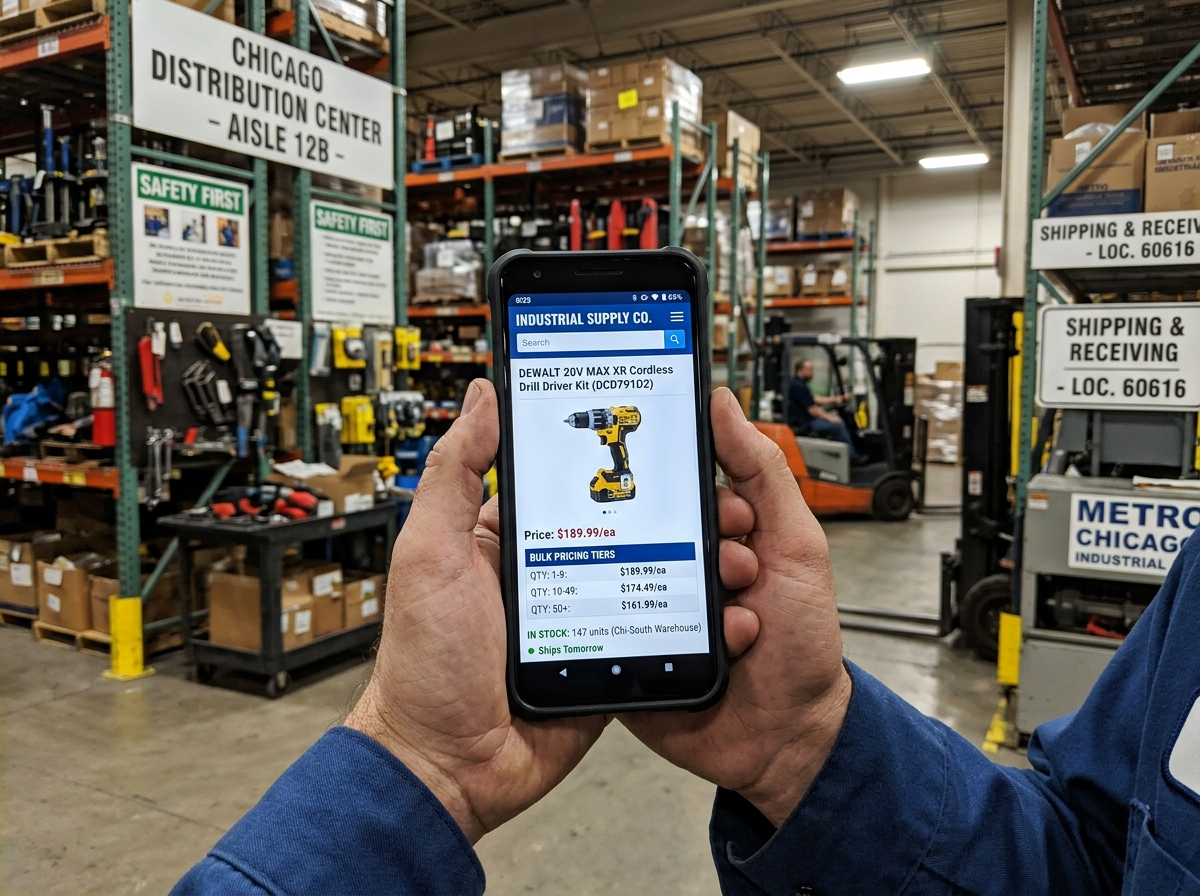
Foundational vs. Advanced Features
| Feature Category | Foundational Features | Advanced B2B Features |
|---|---|---|
| Ordering | Basic Shopping Cart | Quick Order by SKU / CSV Upload |
| Pricing | List Pricing | Contract/Tiered Pricing & RFQ Tools |
| Access | Single User Login | Role-Based Permissions & Approvals |
| Inventory | “In Stock” Labels | Real-Time Sync & Multi-Warehouse View |
| Payments | Credit Card | Net Terms, ACH, & Purchase Orders |
To truly stand out, we recommend implementing custom web applications that handle complex product configurations. If you sell machinery with thousands of parts, a high-performance search engine with attribute filtering is non-negotiable. Buyers should be able to find exactly what they need in seconds, not minutes.
Best Practices for Security, Scalability, and Performance
Performance is a silent killer of conversions. Research shows that the highest e-commerce conversion rates happen on pages with load times of 0-2 seconds. In fact, 70% of online users admit that page speed influences their likelihood to buy. For a busy procurement manager in Naperville, a slow site is a reason to switch to a competitor.
Security and Compliance
Because B2B transactions often involve sensitive data and high-value orders (with 77% of buyers willing to spend $50,000+ online), security is paramount. We implement robust PCI compliance, data encryption, and regular security audits. If you are using enterprise WordPress solutions, we ensure the architecture is hardened against vulnerabilities while maintaining the flexibility your marketing team needs.
Headless Architecture
For businesses looking to future-proof their operations, we often suggest a headless architecture. This decouples the “head” (the frontend your customers see) from the “body” (the backend commerce engine). This allows you to push your product data to multiple channels—like a mobile app, a web portal, or even IoT devices—without rebuilding your entire system every time technology shifts.
The Roadmap to Launching a Successful B2B Website
Building a world-class B2B site is a marathon, not a sprint. We follow a structured, data-driven process to ensure every dollar of your budget is working toward your growth.
- Discovery Phase: We start by mapping your buyer journeys and identifying your internal bottlenecks. We look at your existing ERP data, your pricing logic, and your customer service workflows.
- Platform Selection: Not every business needs a multi-million dollar enterprise build. We help you choose the platform—whether it’s Shopify Plus, BigCommerce, or a custom build—that fits your specific needs.
- Integration Architecture: This is the most critical step. We design the “pipes” that connect your website to your warehouse, your accounting software, and your sales team’s CRM.
- UX & Design: We build a b2b-enterprise-web-design that feels like a B2C site but functions like a professional tool.
- User Acceptance Testing (UAT): Before launching, we have real buyers and internal staff test the system to ensure every edge case is covered.
- Launch & Optimization: Launching is just the beginning. We use real-world data to tweak navigation, speed up checkout, and improve SEO.
Frequently Asked Questions about B2B E-commerce
What is the primary difference between B2B and B2C e-commerce development?
B2B development focuses on complex organizational needs like multi-user account hierarchies, negotiated contract pricing, and bulk ordering workflows. Unlike B2C, which prioritizes emotional triggers and fast individual checkouts, B2B platforms must facilitate rational, multi-step decision-making processes and integrate deeply with backend systems like ERPs and CRMs for operational efficiency.
How much does it cost to develop a custom B2B e-commerce website?
The cost of B2B e-commerce development typically ranges from $20,000 for basic SaaS-based setups to over $250,000 for enterprise-level custom builds. Key price drivers include the complexity of ERP integrations, the number of custom product configurations required, and the need for advanced features like AI-driven personalization or multi-regional support.
Why is ERP integration critical for B2B e-commerce success?
ERP integration ensures that your website displays real-time data regarding inventory levels, customer-specific pricing, and order statuses. By automating the flow of information between your storefront and backend systems, you eliminate manual data entry errors, reduce administrative overhead, and provide the transparent, self-service experience that modern business buyers demand.
How does mobile responsiveness impact B2B sales?
With 80% of B2B buyers using mobile devices at work, a non-responsive site directly hinders sales. Mobile-optimized sites often see a 20% shorter buying cycle because they allow procurement managers and field technicians to research and place orders instantly from any location, rather than waiting until they are back at a desk.
Can B2B e-commerce platforms handle large transactions?
Absolutely. Modern B2B buyers are increasingly comfortable with high-value digital transactions. Statistics show that 35% of buyers are willing to spend $500,000 or more in a single online transaction. To support this, platforms must offer secure payment methods like ACH, wire transfers, and purchase orders (PO) with built-in approval workflows.
Conclusion
At RED27Creative, we don’t just build websites; we build unified engines for growth. Based in Geneva, Illinois, we serve businesses across the Chicago area—from St. Charles and Batavia to Naperville and Plainfield—helping them turn digital visibility into consistent, qualified opportunities.
With over 20 years of experience in B2B e-commerce development, we understand that your online presence must be backed by a rock-solid strategy and seamless backend integrations. Whether you are a manufacturer in Aurora looking to automate your quoting process or a distributor in Chicago needing a high-performance catalog, we are ready to partner with you.
Our data-driven systems connect every part of your marketing—web design, advanced SEO, and lead generation—into one powerful platform that delivers measurable ROI. If you are ready to stop losing revenue to manual processes and outdated systems, it’s time to build a platform that works as hard as you do.
Start your project with RED27Creative today and let’s craft a custom B2B solution that drives real results.

Kiel Tredrea
https://red27creative.comTop Marketing Agency • Web, SEO & Leads • RED27Creative