From Clicks to Customers: Unlocking Conversions with Smart Web Design

Why Your Website’s Success Depends on More Than Just Good Looks
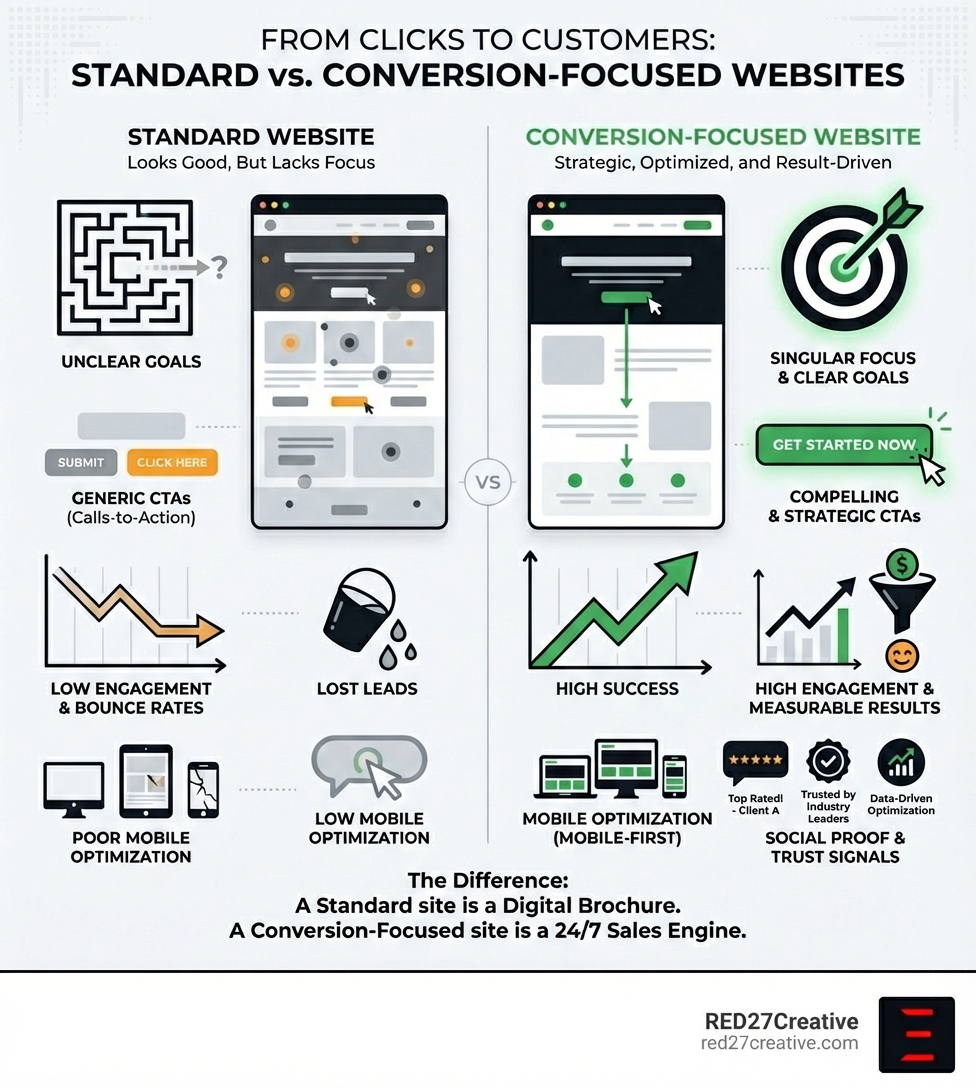
Conversion focused web design is a strategic, data-driven approach to building websites that turn visitors into leads, customers, and revenue. It goes beyond surface-level aesthetics to align every page with clear business objectives and measurable outcomes.
A conversion-focused website is built around how real people search, decide, and take action online. When designed correctly, your site becomes a predictable growth engine that supports SEO, paid traffic, and long-term ROI.
What makes a website conversion-focused?
- Clear, singular goals on every page (one primary action, not ten competing options)
- Strategic layout and visual hierarchy that guides the eye toward key actions and content
- Compelling calls-to-action (CTAs) that use specific, action-oriented language and stand out visually
- Mobile-first design optimized for the 50%+ of users browsing on phones and tablets
- Social proof and trust signals like testimonials, reviews, and recognizable client logos
- Fast load times and frictionless user experience across devices and browsers
- Data-driven optimization through A/B testing, analytics, and continuous improvement
Your website is more than a digital brochure. For businesses across Chicago, Geneva, Naperville, and the Fox Valley, it should be the most reliable sales tool in your marketing stack.
Yet industry benchmarks show that the average website conversion rate is just 2.35%. Out of 100 visitors, fewer than three take meaningful action. The rest bounce, often within seconds, and rarely come back.
A beautiful website that does not convert is a liability. It quietly drains ad budgets, wastes hard-earned traffic, and hides missed revenue opportunities every day.
The difference between a site that simply looks good and one that consistently performs comes down to conversion focused web design: a psychology-informed, user-centered framework that moves people from curiosity to commitment.
It is not about flashy graphics or trendy animations. It is about clarity, relevance, trust, and removing every barrier between your visitor and their next logical step.
I am Kiel Tredrea, founder of RED27Creative. For more than 20 years, I have helped businesses turn underperforming websites into high-converting lead-generation systems using conversion focused web design, advanced SEO, and data-driven marketing strategy.
If you want to understand how this approach can impact traffic quality, lead volume, and ROI, explore how we give clients a competitive edge in data-driven marketing.
Simple conversion focused web design glossary:
The High Cost of a “Good-Looking” but Ineffective Website
Many businesses in Chicago, Naperville, Aurora, and across the Fox Valley invest significantly in a visually appealing website, only to find it underperforms. While stunning graphics and smooth navigation are attractive, they don’t automatically translate to sales or leads. We’ve seen that a website designed purely for aesthetics, without a focus on its users, will likely fail to generate revenue. It becomes a digital brochure that looks nice but doesn’t work for your business.
This oversight leads to several critical issues: lost revenue from missed opportunities, high bounce rates as visitors leave without taking action, wasted ad spend driving traffic to an unoptimized site, and ultimately, a lack of measurable return on investment. The internet is increasingly crowded, and a website that doesn’t actively guide visitors toward conversion is a significant liability, not an asset. We believe in building websites that are not just beautiful but are engineered for performance, ensuring your investment truly drives growth. This strategic approach gives our clients a competitive edge in data-driven marketing.
Defining Your Conversion Goals
Before we even begin designing, a critical first step in conversion focused web design is clearly defining what a “conversion” means for your business. It’s not always about a direct sale; a conversion is any action a site visitor takes that moves them closer to becoming a customer.
We categorize conversions into two main types:
- Macro-conversions: These are the primary goals, such as making a purchase, filling out a detailed quote request, or signing up for a service. For a B2B company in St. Charles, this might be a demo request; for an e-commerce store in Plainfield, it’s a completed transaction.
- Micro-conversions: These are smaller, interim steps that indicate engagement and move users further down the sales funnel. Examples include signing up for a newsletter, downloading an eBook, watching a product video, or clicking a “learn more” button. These actions build trust and nurture leads over time.
By defining these goals explicitly, we align every design choice with your business objectives. This ensures that every element, from content to layout, works in harmony to guide visitors toward your desired outcomes. This foundational work is part of our comprehensive marketing strategy and consulting services.
The Core Principles of Conversion-Centered Design (CCD)
At RED27Creative, we use Conversion-Centered Design (CCD) as our framework for conversion focused web design. Articulated by Oli Gardner of Unbounce, CCD combines design, copywriting, and behavioral psychology to create persuasive, intuitive experiences. It uses psychology-based techniques and user research to optimize the user journey, moving visitors smoothly toward a conversion—be it a sale, consultation, or sign-up.

Principle 1: Create a Singular Focus
This principle dictates a singular focus for each page. Research shows that too many options lead to “analysis paralysis,” where users choose nothing. On high-intent pages, we aim for a 1:1 attention ratio: one page, one goal. We make the primary action prominent and unmistakable by reducing or hiding competing elements like non-essential navigation or unrelated links. The result is a clear, frictionless path for the visitor.
Principle 2: Build a Clear Visual Hierarchy
A strong visual hierarchy guides a visitor’s eyes through the page in a persuasive sequence. Since users scan pages in predictable F- or Z-patterns, we use these models to position key information. Elements like size, color, spacing, and contrast signal what matters most, making headlines, value propositions, and CTAs prominent. Our expertise in visual branding solutions ensures this hierarchy is both functional and on-brand.
Principle 3: Stay Consistent and Build Trust
Consistency builds trust, which is essential for conversions. Visitors should immediately recognize your brand and feel confident they’re in the right place. We achieve this by aligning all visual and verbal elements—from colors and fonts to tone of voice—with your brand standards. Equally important is message matching: the promise made in an ad or search result must be reinforced on the landing page. This seamless experience reduces confusion and builds credibility. We can follow your brand guidelines or help you establish them.
Principle 4: Design for Mobile-First Conversions
With over half of web traffic coming from mobile, a mobile-first design is non-negotiable. We go beyond a simple responsive layout to optimize the entire experience for smaller screens and touch interactions. This involves simplifying layouts, prioritizing key content, and ensuring copy is concise and scannable. CTAs must be thumb-friendly—large, well-spaced, and easy to tap. Forms are streamlined to include only essential fields. Crucially, we prioritize page speed, as slow mobile sites kill conversions. Our responsive website development combines these elements to effectively capture and convert mobile traffic for businesses across the Chicago area.
Designing for Action: Layout, Content, and Calls-to-Action
Once the core principles are in place, conversion focused web design turns them into concrete choices about layout, content, and calls-to-action. These elements work together to create a clear path from first impression to final click.
Every section, headline, and button should exist for a reason tied to your conversion goals. If a block does not educate, build trust, or move people forward, it is a candidate to simplify or remove.
How to Use Layout and Visual Cues to Guide Users
Effective page layout is a visual roadmap that makes the desired action feel obvious. We use several techniques to guide users:
- White Space: Creates separation, making important elements like headlines and CTAs stand out.
- Color and Contrast: High-contrast CTAs using a dedicated “action color” are easier to spot and click.
- Directional Cues: Subtle arrows, lines, or even the gaze of people in photos can direct attention toward a CTA or form. Eye-tracking studies confirm users follow the gaze in images.
- Authentic Photography: We use real photos of your team or customers, as studies show users ignore generic stock photos. This builds trust and authenticity.
These strategies are integral to our custom web design and development process.
The Power of Compelling Copy and Social Proof
Compelling copy is as crucial as visuals. It must clearly explain your value proposition: what you offer, who it’s for, and why it’s better. We use plain language, short paragraphs, and bullet points to make content easy to scan and understand, which improves engagement.
Social proof is a powerful trust signal that can lift conversion rates significantly. We integrate various forms of it near key decision points:
- Testimonials: Specific quotes highlighting positive results.
- Reviews: Star ratings and links to third-party platforms.
- Case Studies: Brief success stories.
- Client Logos: Recognizable brands you’ve worked with.
Our custom content writing services focus on crafting this type of persuasive, trust-building copy.
Crafting Irresistible Calls-to-Action (CTAs)
A CTA is where interest becomes action. High-performing CTAs are clear, specific, and benefit-driven. We avoid generic labels like “Submit,” opting for action-oriented language that clarifies the outcome, such as “Get My Free Quote.”
Design and placement are critical. CTA buttons must:
- Stand out with strong color contrast.
- Be large enough for easy clicking or tapping.
- Be placed near motivating content like benefits or social proof.
We place a primary CTA above the fold for ready buyers and secondary CTAs lower on the page. When used honestly, psychological triggers like urgency (“Limited spots available”) can also boost engagement. Well-designed CTAs can dramatically improve conversion rates.
Here are 5 strong CTA examples relevant to RED27Creative’s services:
- “Get Your Free SEO Audit”
- “Schedule My Web Design Consultation”
- “Download Our Lead Generation Guide”
- “Request a Digital Marketing Proposal”
- “See Our Portfolio”
Measurement and Optimization: The Key to Sustainable Growth
A conversion-focused website is not a one-time project; it’s an ongoing process of refinement. The digital landscape is always changing, so continuous measurement and optimization are crucial for sustainable growth. We use a data-driven, scientific approach—making educated hypotheses and testing them rigorously—to identify what truly resonates with your audience and drives results.
Leveraging User Research and A/B Testing
User research and A/B testing are central to our optimization process. We start by understanding your audience through user personas and analyzing their behavior with tools like HotJar and CrazyEgg, which provide heatmaps and session recordings.
With these insights, we form a hypothesis and use A/B testing to validate it. By testing one variable at a time—such as a headline or CTA button—we can measure its direct impact on performance. This methodical process turns assumptions into data-backed decisions and is a core part of our website conversion rate optimization services.
Key Metrics to Track in Google Analytics
We track key metrics in Google Analytics to measure success and identify areas for improvement. The most critical metrics include:
- Conversion Rate: The percentage of visitors who complete a desired action (the ultimate success metric).
- Bounce Rate: The percentage of visitors who leave after viewing only one page, often signaling a poor user experience.
- Time on Page: How long users spend on a page, which can indicate engagement.
- Exit Pages: The last pages users view before leaving, which can reveal friction points.
By setting up specific goals tied to your macro and micro-conversions, we can accurately measure performance and use that data to continuously optimize your site.
Common Pitfalls in Conversion-Focused Web Design
Even with the best intentions, several common pitfalls can derail conversion efforts. Avoiding these mistakes is crucial for maximizing your website’s potential:
- Too many CTAs: Overwhelming visitors with competing calls-to-action leads to inaction. Focus on one primary goal per page.
- Unclear value proposition: If visitors can’t quickly understand what you offer, they will leave.
- Slow page speed: Slow sites frustrate users, hurt SEO, and kill conversion rates.
- Not designing for mobile: Ignoring the 50%+ of users on mobile alienates a huge part of your audience.
- Ignoring data: Design decisions should be based on user behavior and testing, not personal opinions.
- Forgetting to test: Without A/B testing, you’re just guessing. Optimization requires a continuous cycle of testing and refinement.
Frequently Asked Questions about Conversion-Focused Web Design
What is the difference between UX design and conversion-focused web design?
UX (User Experience) design focuses on making a website easy and enjoyable to use, while conversion focused web design is a specialized discipline within UX that specifically aims to guide users toward completing a business goal. A great conversion-focused site always has excellent UX, but a site with good UX doesn’t always convert well.
How long does it take to see results from a conversion-focused redesign?
Results can vary, but you can often see initial impacts within weeks of launching changes, especially when tracking metrics with tools like Google Analytics. Significant, stable improvements typically emerge over 1-3 months as you gather more data and run A/B tests to validate which changes are most effective for your audience.
Can I apply conversion-focused principles to my existing website?
Absolutely. You don’t always need a full redesign. You can start by optimizing key pages like your homepage, service pages, and landing pages. Simple changes to your headlines, calls-to-action, and page layout can often lead to significant increases in conversion rates. This iterative approach is central to website conversion rate optimization.
Conclusion: Turn Your Website into a Growth Engine
In the competitive digital landscape of Chicago, Plainfield, and beyond, a website is no longer just an online brochure. It must be a powerful, strategic tool designed to convert visitors into valuable business opportunities. Conversion focused web design is the methodology that makes this happen.
We’ve explored the core principles, from creating a singular focus and clear visual hierarchy to maintaining brand consistency and designing mobile-first. We’ve also dug into actionable strategies for optimizing layout, crafting compelling content with social proof, and creating irresistible calls-to-action. Most importantly, we’ve emphasized that this is an ongoing, data-driven process of measurement and optimization, leveraging user research and A/B testing to continuously refine your site.
At RED27Creative, we don’t just build websites; we build data-driven systems that connect every part of your marketing—website, SEO, local presence, and lead generation—into one unified engine for growth. Our team of designers, developers, and SEO experts in Geneva, IL, specializes in turning traffic into measurable results for businesses ready to thrive.
Ready to transform your website into a lead generation machine? Explore our web design services and let us help you open up conversions with smart web design.

Kiel Tredrea
https://red27creative.comTop Marketing Agency • Web, SEO & Leads • RED27Creative