Optimizing for Velocity: The Essentials of High-Performance Web Development

Why High-Performance Web Development Is a Business-Critical Decision
High performance web development is the practice of building websites that load fast, respond instantly, and deliver a seamless user experience across all devices. It combines smart technology choices, optimized code, efficient asset delivery, and continuous measurement to create digital experiences that keep users engaged and drive conversions.
Core elements of high-performance web development include:
- Speed: Pages load in under 3 seconds to prevent user abandonment
- Efficiency: Minimal server response times and optimized critical rendering paths
- Scalability: Architecture that handles traffic spikes without slowdowns
- Modern tech stacks: Frameworks and languages designed for performance (React, ASP.NET Core, Node.js)
- Asset optimization: Compressed images, lazy loading, and efficient code delivery
- Continuous monitoring: Regular performance audits and real-time user metrics
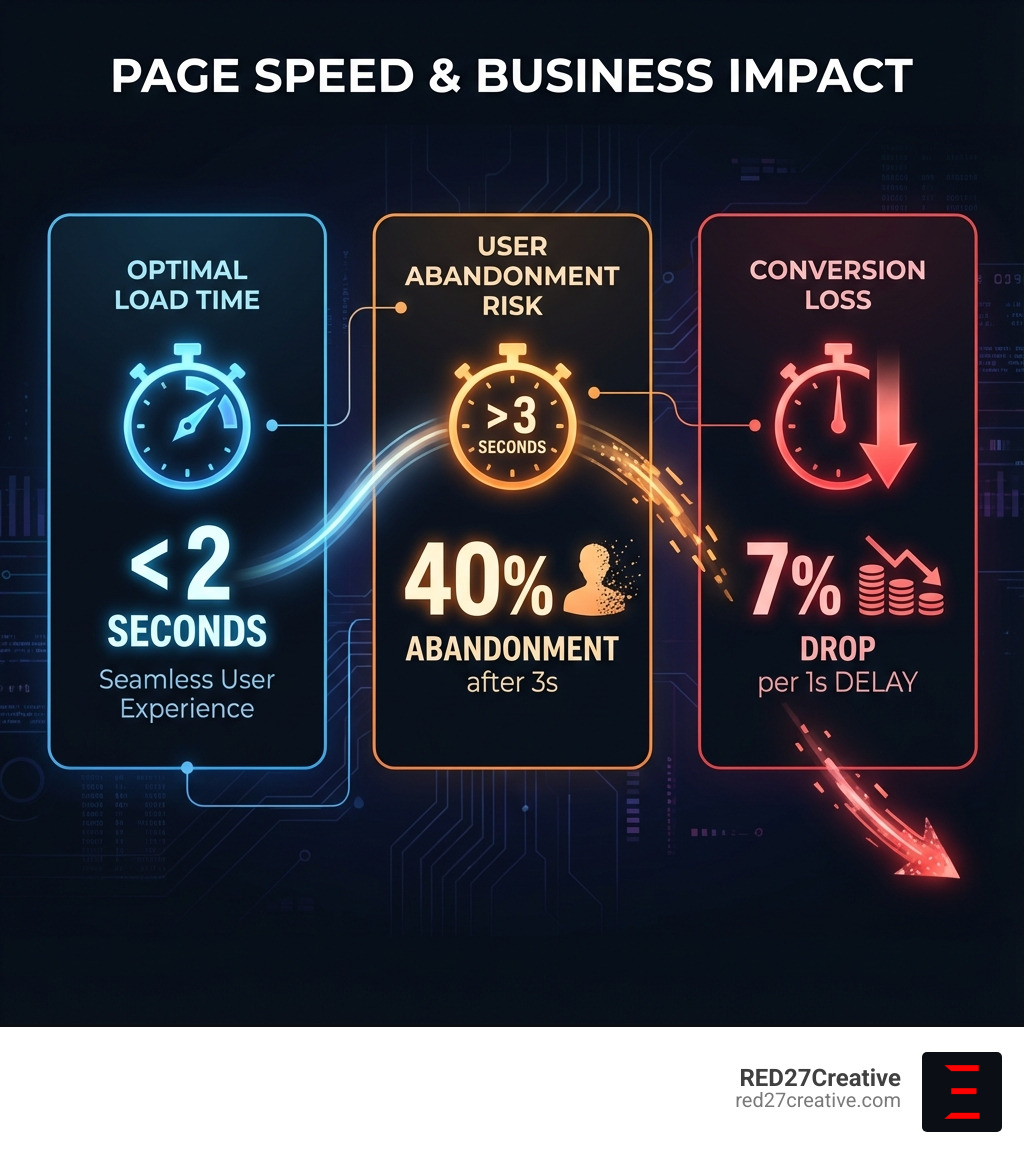
The stakes are real. 40% of users abandon a website that takes more than 3 seconds to load. Even a 1-second delay in load time can drop conversions by 7%. For businesses generating millions in revenue, these delays translate directly into lost opportunities and revenue.
But high-performance web development isn’t just about raw speed. It’s about creating a system where every component—frontend, backend, database, and supporting infrastructure—works together efficiently. It’s about choosing the right technology stack for your business needs, not just following trends. And it’s about building a foundation that scales as your business grows.
Modern high-performance websites leverage techniques like Server-Side Rendering (SSR), Static Site Generation (SSG), code splitting, and edge caching. They use Content Delivery Networks (CDNs) to serve assets globally with minimal latency. They implement lazy loading for images and JavaScript to prioritize critical content. And they continuously measure performance using tools like Lighthouse and PageSpeed Insights to prevent regressions.
The best part? Most of these optimizations don’t require a complete rebuild. Strategic improvements to your existing site can deliver measurable results. However, if your website is built on outdated technology or a flawed architecture, a modern rebuild might be the most cost-effective path to high performance.
I’m Kiel Tredrea, founder and president of RED27Creative, where I’ve spent over 20 years helping businesses build high-performance web systems that drive measurable growth. High performance web development is at the core of every project we take on—because we know that speed, user experience, and technical excellence are the foundation of any successful digital strategy.
Must-know High performance web development terms:
The Anatomy of a High-Performance Website: Core Principles & Tech Stack
Building a truly high-performing website means understanding its fundamental components and how they interact. It’s like assembling a precision machine where every part contributes to overall efficiency and speed. We focus on three pillars: speed, scalability, and reliability, knowing that a great tech stack influences all three.

Core Performance Principles
At the heart of high performance web development are several key principles. First, we aim to minimize requests to the server, as each request adds latency. Reducing the total payload size – the amount of data transferred – is equally critical, directly impacting load times. This includes everything from images to scripts and stylesheets.
Optimizing the critical rendering path ensures that users see meaningful content as quickly as possible. This involves delivering essential HTML, CSS, and JavaScript first, while deferring non-critical resources. Our goal is to improve perceived performance, making the site feel fast, even if the absolute load time isn’t always instantaneous. Users often value a smooth, responsive experience over raw millisecond timings. For more insights into crafting exceptional digital experiences, explore our services in custom web design and development.
Choosing Your Technology Stack
The choice of tech stack profoundly impacts a website’s performance, scalability, and maintainability. There’s no one-size-fits-all solution; each project brings unique challenges and performance goals. A slow frontend can increase load time, while an inefficient backend can struggle under heavy traffic. A poorly chosen database, on the other hand, can bottleneck data-heavy operations.
When selecting a stack, we consider non-functional requirements like expected traffic volume, user location, interaction types, and scalability needs. We also evaluate our team’s expertise, long-term maintenance costs, and the overall total cost of ownership. It’s often wiser to use a slightly less trendy stack that your team deeply understands and can optimize effectively. Whether it’s the frontend framework, backend language, or database (SQL vs. NoSQL), each decision is critical. The choice between SQL and NoSQL databases, for instance, significantly impacts performance based on data structure and read/write patterns, a critical consideration for web design for tech companies.
Popular High-Performance Stacks & Trade-offs
The web development landscape offers a rich variety of stacks, each with its strengths for performance-critical applications. Here are some popular choices:
- MERN Stack: (MongoDB, Express, React, Node.js) Known for its flexibility and scalability, MERN is excellent for single-page applications and real-time tools.
- PERN Stack: (PostgreSQL, Express, React, Node.js) By using PostgreSQL, PERN adds strong relational data handling and ACID compliance, making it ideal for complex data.
- Jamstack: This modern architecture serves pre-rendered pages from a CDN, offering improved speed and security. It’s ideal for static sites, blogs, and e-commerce with dynamic features handled by APIs.
- ASP.NET Core: Microsoft’s framework is a top performer in benchmarks, with features like Native AOT (Ahead-of-Time) compilation ensuring fast startup times. This makes ASP.NET an excellent choice for enterprise-grade, high-performance applications.
- Other notable stacks include MEAN for large-scale applications, MEVN as a lightweight alternative, the traditional LAMP/LEMP, and frameworks like Python/Django or Ruby on Rails for rapid development.
Each stack brings trade-offs. For example, while MERN offers flexibility, Jamstack might deliver faster load times for static content. ASP.NET Core excels in raw performance benchmarks, but its ecosystem might be different from a JavaScript-centric stack. We carefully weigh these factors, including language and framework trade-offs, to ensure the chosen stack aligns perfectly with your project’s performance and scalability needs.
Building for Speed: High-Performance Web Development in Practice
Building a high-performing website is a structured journey, not a sprint. We approach web development with a meticulous, step-by-step process, ensuring that performance is baked in from the very beginning. Skipping steps can lead to costly delays and a product that falls short of expectations.

Our process typically spans 12 to 20 weeks, depending on complexity, covering everything from initial information gathering to ongoing maintenance. This structured approach helps us mitigate risks, prevent delays, and deliver a product that truly serves both your business and your users. Our commitment to best practices is reflected in resources like the Web performance guides from MDN.
Frontend Strategies for High-Performance Web Development
The frontend is where users directly interact with your site, making its performance crucial for user experience. We employ various rendering strategies to ensure speed:
- Server-Side Rendering (SSR): Generates HTML on the server for each request, reducing initial load times and improving SEO.
- Static Site Generation (SSG): Builds HTML files at deploy time, delivering incredibly fast, pre-rendered pages via a CDN.
- Incremental Static Regeneration (ISR): A hybrid approach that allows static pages to be rebuilt in the background as data changes, offering the best of both SSR and SSG.
Modern frameworks like React, Vue, and Angular provide powerful tools for implementing these strategies. We also heavily use code splitting and lazy loading for JavaScript and other resources. Code splitting breaks down large JavaScript bundles into smaller, on-demand chunks, reducing initial load times and CPU contention. Lazy loading defers the loading of non-critical images and iframes until they enter the user’s viewport, saving bandwidth and processing power. This approach is fundamental to responsive website development, ensuring optimal performance across all devices.
Backend Architecture for High-Performance Web Development
An efficient backend is the engine of a high-performing website. It handles data processing, business logic, and server responses, all of which directly impact speed and scalability. Our choice of backend language and framework depends on project needs. Languages like Node.js, Go, and PHP (especially with frameworks like Laravel) offer distinct advantages in terms of performance and development speed. ASP.NET Core, as mentioned, is a powerhouse for performance-critical applications.
We carefully design APIs to be efficient and lean, minimizing unnecessary data transfer. Depending on the project’s scale, we might opt for a microservices architecture for improved scalability and resilience, or a well-optimized monolith for simpler applications. Database optimization is also paramount, focusing on efficient query writing, proper indexing, and strategic caching to prevent data retrieval from becoming a bottleneck. The choice between SQL and NoSQL databases is carefully made, considering data structure, scalability, and specific read/write patterns. For complex systems, particularly those built on WordPress, our enterprise WordPress solutions ensure robust and scalable backend performance.
Supporting Technologies for Maximum Velocity
Beyond the core tech stack, several supporting technologies are essential for achieving and maintaining maximum website velocity:
- Content Delivery Networks (CDNs): CDNs store static files (images, videos, CSS, JS) at edge locations globally, reducing latency by serving content from servers geographically closer to the user.
- Caching: Implementing comprehensive caching strategies (browser caching, server-side caching, edge caching) is one of the most efficient ways to improve load speed by serving pre-generated content.
- Load Balancing: Distributes incoming traffic across multiple servers, preventing any single server from becoming overloaded and ensuring high availability and fault tolerance.
- Serverless Architecture: Allows applications to scale automatically based on demand, abstracting away server management and often leading to cost efficiencies and improved performance for event-driven workloads.
- HTTP/2: This modern protocol introduces multiplexing, stream prioritization, and header compression, significantly improving how browsers and servers communicate compared to its predecessor.
- Resource Compression: Technologies like Gzip, Brotli, and Zopfli compress text-based assets (HTML, CSS, JavaScript), drastically reducing file sizes and speeding up transfer times.
These supporting technologies are integral to our web design and development process, ensuring that every website we build is fast, reliable, and ready to scale.
Fine-Tuning the Engine: Advanced Optimization & Measurement
Once the foundational architecture is in place, we move to fine-tuning, focusing on advanced optimizations and rigorous performance measurement. This phase ensures that the website isn’t just fast, but consistently fast, and that any regressions are caught and addressed promptly.
Performance budgeting is a key strategy here. We define clear performance targets (e.g., initial load time, interactivity) and ensure that all new features or content additions stay within these limits. This acts as a preventative measure against performance regressions. Continuous monitoring post-launch is crucial, allowing us to react to issues instantly and maintain peak performance.
Optimizing Critical Assets
Optimizing specific assets is often the “lowest hanging fruit” for significant performance gains:
- Image Optimization: Images often represent a large portion of a page’s data. We use next-gen formats like WebP and AVIF, which offer superior compression without sacrificing quality. Implementing responsive images ensures that users receive appropriately sized images for their device, further reducing payload.
- Video Optimization: Videos can be bandwidth-heavy. We recommend hosting videos on third-party services and, for background videos, removing audio tracks if they aren’t essential, saving significant bandwidth.
- Web Font Optimization: While web fonts improve design, they come with a performance cost. We prioritize WOFF and WOFF2 formats due to their built-in compression. Implementing
font-display: swapallows the browser to use a system font while the web font loads, preventing a “Flash of Unstyled Text” (FOUT) and improving perceived performance. For icons, using compressed SVGs is often more efficient than icon web fonts.
Integrating these asset optimization techniques is a core part of our SEO website design approach, ensuring that visual appeal doesn’t come at the cost of speed or search engine visibility.
Measuring and Testing Performance
“What gets measured, gets improved.” This adage holds especially true for high performance web development. We rely on a suite of metrics and tools to accurately assess and continuously improve website speed and responsiveness:
- Performance Metrics: We track key metrics like Time to First Byte (TTFB), which measures server responsiveness. First Contentful Paint (FCP) indicates when the first piece of content appears, while Largest Contentful Paint (LCP) measures when the main content of the page is visible. Interaction to Next Paint (INP) assesses a page’s responsiveness to user interactions. These metrics, alongside others like Cumulative Layout Shift (CLS), form the Core Web Vitals, crucial for both user experience and SEO.
- Performance Auditing Tools: Tools like Lighthouse and PageSpeed Insights provide comprehensive reports and actionable recommendations. For more in-depth analysis, WebPageTest.org offers detailed waterfall charts and global testing locations.
- Synthetic vs. Real User Monitoring (RUM): Synthetic monitoring simulates user visits to test performance under controlled conditions, ideal for regression testing. RUM, on the other hand, collects data from actual user interactions, providing insights into real-world performance trends and user perception. We use both to get a complete picture of your site’s performance.
The Future of Web Performance: Emerging Technologies
The landscape of web development is changing, and emerging technologies continue to push the boundaries of performance. We keep a close eye on these innovations to ensure our clients benefit from the latest advancements.
WebAssembly (Wasm): Wasm is a low-level, binary instruction format that runs in modern web browsers at near-native speed. It’s designed to complement JavaScript, not replace it, by handling CPU-intensive tasks. Wasm allows developers to compile code written in languages like C, C++, or Rust to run directly in the browser. This opens doors for high-performance applications like in-browser gaming, 3D rendering, video editing, and complex data processing that were previously challenging for JavaScript alone. Its portability means code can be compiled once and run anywhere, including server-side with Node.js. Learn more about this transformative technology at The official WebAssembly.org site.
AI and Machine Learning Integration: AI is increasingly being integrated into high performance web development. This includes AI-driven asset optimization, where machine learning algorithms automatically select the best image formats and compression levels. Predictive prefetching uses AI to anticipate user behavior and preload resources before they are requested, dramatically improving perceived speed. AI-assisted development tools are also emerging, helping developers write more efficient code and identify performance bottlenecks.
Edge Computing: Moving computational power and data storage closer to the end-users, rather than relying on a centralized server, is the core of edge computing. This significantly reduces latency and improves responsiveness, especially for global applications. By processing data at the “edge” of the network, websites can deliver faster, more personalized experiences.
These technologies promise even faster, more dynamic, and more powerful web applications in the years to come, further cementing the importance of continuous innovation in high performance web development.
Frequently Asked Questions about High-Performance Web Development
What is the single most important factor for website performance?
The most critical factor is optimizing the critical rendering path. This involves minimizing the size and number of resources—like CSS and JavaScript—that block the initial display of your page. A well-optimized path ensures users see meaningful content as quickly as possible, dramatically improving perceived speed and user experience.
How much does the tech stack really impact website speed?
The tech stack has a massive impact. A high-performance backend like ASP.NET Core or Go can handle more requests per second, while a modern frontend framework with Server-Side Rendering (SSR) can deliver a faster Time to First Byte (TTFB). The right database and caching strategy also prevent bottlenecks, ensuring the entire system is fast and scalable.
Can a slow website be fixed, or does it need a rebuild?
Most slow websites can be significantly improved through targeted optimization. This includes compressing images, implementing caching, minifying code, and upgrading server infrastructure. However, if the site is built on a fundamentally flawed architecture or outdated technology, a custom website rebuild may be the most effective long-term solution for achieving high performance.
Conclusion: Build a Foundation for Growth with a High-Performance Website
Prioritizing high performance web development is not just a technical choice; it’s a strategic business decision that directly impacts user experience, conversions, and your bottom line. By focusing on a fast, efficient, and scalable technology stack, optimizing every asset, and continuously measuring performance, you create a powerful digital asset that drives growth. The experts at RED27Creative build data-driven systems that turn visibility into measurable results. Ready to build a website that performs? Explore our web design services to get started.

Kiel Tredrea
https://red27creative.comTop Marketing Agency • Web, SEO & Leads • RED27Creative