Cool Strategies to Grow Your Heating and Air Conditioning Business

The Proven Path to HVAC Business Growth in 2024
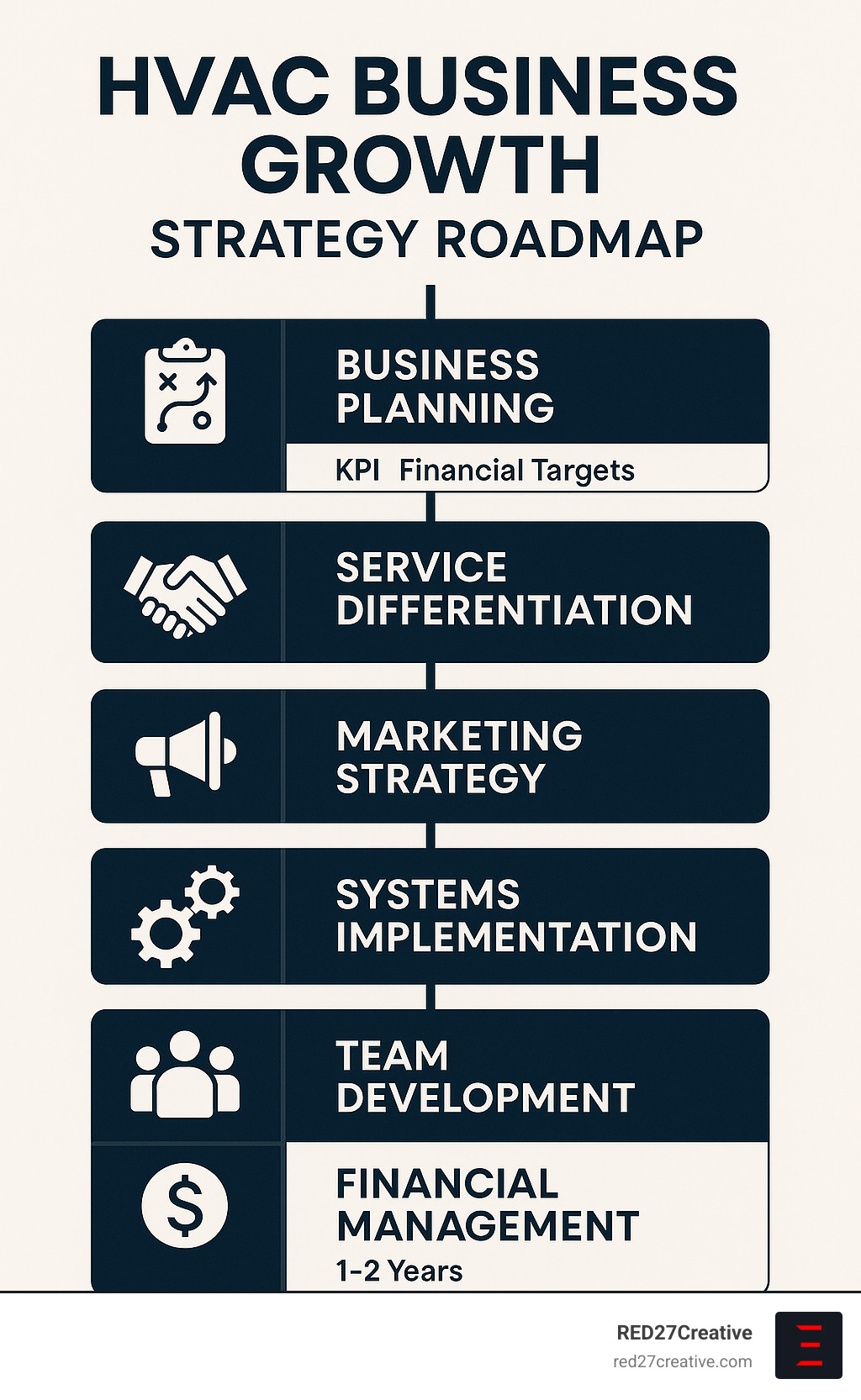
If you’re searching for how to grow a heating and air conditioning business, here are the essential steps:
- Develop a clear business plan with specific financial targets
- Define your unique service offering to stand out from competitors
- Implement strategic marketing focused on local SEO and Google Business Profile
- Build efficient business systems and documented processes
- Train technicians in sales techniques to increase average ticket size
- Maintain a profit margin of 10-20% through smart pricing strategies
The HVAC industry is ready for massive growth, with over 46,000 new technician positions needed by 2028. With average profit margins hovering under 2% industry-wide, but potential to reach 10-20% with proper planning, the opportunity to build a thriving HVAC business has never been greater. Yet approximately 20% of HVAC businesses fail yearly, and a staggering 70% of new owners don’t survive their first year of operation.
What separates the struggling HVAC companies from those generating millions in revenue? It’s rarely about technical expertise alone. The real difference lies in implementing proven business growth strategies, systematic marketing approaches, and operational excellence.
I’m Kiel Tredrea, founder of RED27Creative, and I’ve spent over 20 years helping HVAC businesses implement strategic marketing plans and operational systems that drive sustainable growth, combining my expertise in digital marketing with field-tested strategies on how to grow a heating and air conditioning business.
Why HVAC Businesses Stall—And the Numbers You Must Know
Let’s have an honest conversation about why so many HVAC businesses struggle to thrive. The statistics might be a bit tough to swallow, but understanding them is the first step toward avoiding the same fate.
Cash flow problems are the silent killer in this industry. More than 80% of businesses that close their doors do so because they simply ran out of money. And in the HVAC world specifically, about 20% of companies fail each year across the country. Even more sobering? A whopping 70% of enthusiastic new HVAC business owners don’t make it past their first birthday.

When we look at profitability, the picture doesn’t get much prettier. The average HVAC company limps along with razor-thin profit margins of less than 2%, and most never break the $1 million revenue mark.
But here’s the good news – it doesn’t have to be this way for your business. The potential upside is tremendous:
- The average HVAC owner takes home about $131,000 annually according to industry salary data
- Top performers can earn close to $300,000 each year
- With smart business planning, your profit margins can soar to 10-20%
- A well-trained technician isn’t just a service provider – they can generate over $1 million in annual revenue
The gap between struggling and thriving isn’t about luck or location. It’s about avoiding common pitfalls and implementing proven strategies for how to grow a heating and air conditioning business.
Common Pitfalls That Cripple Growth
Cash-flow missteps catch even experienced owners off guard. Our industry’s seasonal nature creates feast-or-famine cycles that can be devastating without proper financial planning. Those summer heat waves and winter freezes bring floods of calls, but what about those shoulder seasons? Without cash reserves, these natural fluctuations can sink an otherwise solid business.
Under-pricing services is perhaps the most common self-inflicted wound I see. “We can’t charge that much in our area” is something I hear all the time, but it’s usually not true. As respected HVAC business coach Dave Miller puts it: “Lower pricing strategies often hurt profitability more than they win customers.” When you compete solely on price, you’re in a race to the bottom – and nobody wins that race.
Weak lead flow leaves too many companies vulnerable to market swings. Relying on word-of-mouth or seasonal advertising creates an unpredictable revenue stream. Without a systematic approach to marketing, you’re essentially gambling with your business’s future.
No unique selling proposition (USP) means customers see you as just another van with a logo. When your company appears identical to every other HVAC business in town, you become a commodity – and commodities compete only on price, not value. Your business deserves better than that.
The good news? Each of these pitfalls has a solution. In the following sections, we’ll explore exactly how to grow a heating and air conditioning business by implementing systems and strategies that can transform your company from struggling to thriving. The roadmap is clear – you just need to follow it.
Build a Bulletproof HVAC Business Plan
The foundation of sustainable growth is a solid business plan. Whether you’re just starting out or looking to scale your existing HVAC business, a well-crafted plan provides direction and accountability.
“If you don’t know where you’re going, any road will get you there,” goes the old saying. For HVAC businesses, this couldn’t be more true. A proper business plan should include:
-
Executive Summary: A brief overview of your business, including your mission statement, company values, and growth objectives.
-
Market Analysis: Research on your service area, including demographics, competition, and market trends.
-
Service Offerings: Detailed descriptions of your HVAC services, including your unique selling proposition.
-
Marketing Strategy: How you’ll attract and retain customers, including digital and traditional marketing channels.
-
Financial Projections: Revenue targets, expense forecasts, and profit margin goals.
-
Operational Plan: Systems, processes, and resources needed to deliver your services efficiently.
-
Team Structure: Organizational chart, hiring plans, and training protocols.
For those who prefer a more streamlined approach, a lean canvas model can be effective. This one-page document focuses on key elements like value proposition, customer segments, revenue streams, and cost structure.
Regardless of format, your business plan should incorporate SMART goals (Specific, Measurable, Achievable, Relevant, Time-bound). For example, instead of simply aiming to “grow revenue,” set a goal to “increase residential service revenue by 25% within 12 months through targeted marketing and technician sales training.”
Financial Benchmarks Every Owner Should Track
To achieve healthy growth, HVAC business owners must monitor key financial metrics and aim for industry-leading benchmarks:
- Gross Profit Margin: Aim for a minimum of 40%
- Net Profit Margin: Target 10-20% (compared to the industry average of under 2%)
- Overhead Expenses: Keep between 25-35% of revenue
- Total Business Expenses: Maintain under 60% of gross revenue
- Marketing Budget: Allocate 10-20% of revenue for growth (anything under 5% is considered maintenance-level)
One HVAC business owner shared: “When I started tracking these numbers religiously and making decisions based on them rather than gut feeling, our profitability increased from 3% to 14% within 18 months—without raising prices dramatically.”
How to Grow a Heating and Air Conditioning Business: Marketing & Branding Playbook
Now that you’ve got your business plan locked in, it’s time to turn up the heat on your marketing efforts. The HVAC companies that thrive don’t just wait for the phone to ring – they build marketing machines that generate consistent leads year-round.
Think of marketing as the engine that powers your growth. When done right, it keeps your technicians busy even during those notorious shoulder seasons when many competitors are scrambling for work.
How to Grow a Heating and Air Conditioning Business with Local SEO
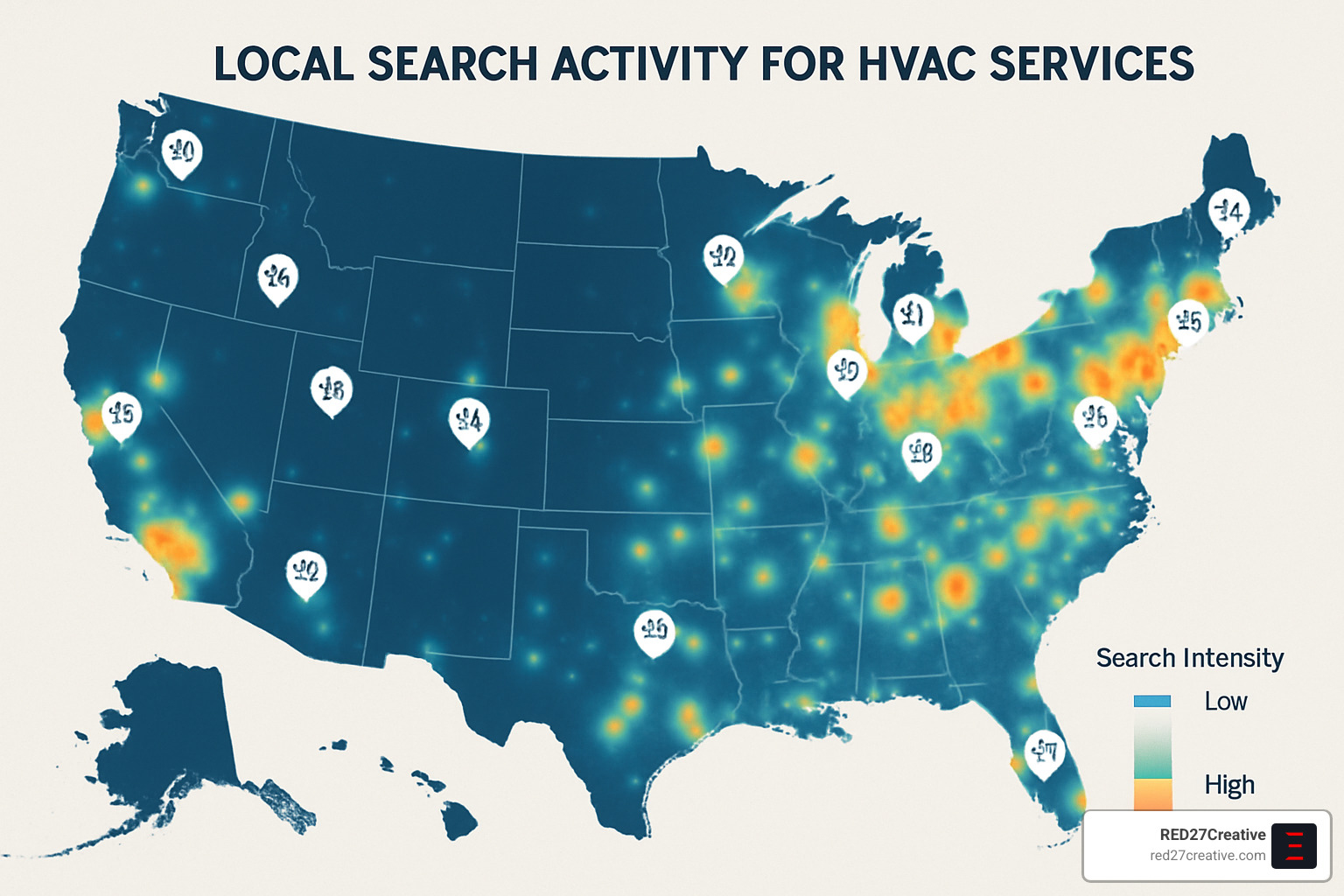
When someone’s AC dies on a sweltering summer day, what’s the first thing they do? About 90% of the time, they grab their phone and search online. That’s why dominating local search results is absolutely critical for how to grow a heating and air conditioning business.
Your local SEO strategy needs to be comprehensive but doesn’t have to be complicated. Start with claiming and optimizing your Google Business Profile – this free tool is arguably the most powerful weapon in your local marketing arsenal. Add high-quality photos, update your hours regularly, and make sure your service areas are accurately listed.
NAP consistency might sound like sleep advice, but it’s actually about keeping your Name, Address, and Phone number identical across every online directory. Even small inconsistencies can confuse Google and hurt your rankings.
One strategy that works wonders is creating city-specific landing pages for each neighborhood you serve. A page dedicated to “AC Repair in Westlake” will outperform a generic service page when someone searches for help in that specific area.
Don’t forget about local link building – connections with chambers of commerce, business associations, and even sponsorships for local events can boost your search visibility tremendously.
Technical elements matter too. Implementing schema markup helps search engines understand exactly what your business offers, while ensuring your site is mobile-first is non-negotiable in today’s smartphone-dominated world.
I’ve seen the power of these strategies at RED27Creative. One of our Chicago-area HVAC clients saw organic search traffic jump 143% in just six months after implementing these tactics. This translated to 37 additional monthly service calls averaging $750 each – that’s nearly $28,000 in additional monthly revenue!
How to Grow a Heating and Air Conditioning Business Through Reviews & Referrals
Word-of-mouth remains the gold standard for HVAC marketing, but today it happens online as much as over the backyard fence. The numbers tell the story: 82% of consumers read online reviews before choosing a service provider, and 94% say positive reviews make them more likely to pick up the phone.
The secret to abundant reviews isn’t hoping customers will take the initiative – it’s creating a system that makes reviewing your business easy and automatic. Automated review requests sent via text or email immediately after service completion can transform your online reputation. One of our Arizona clients went from struggling to get a handful of reviews to collecting 5-15 new Google reviews daily with this simple automation.
Your technicians are on the front lines of your review strategy. Training them to confidently ask for reviews – and explaining why it matters to the company’s growth – can dramatically increase your results. Some of our most successful clients offer small bonuses to techs who consistently generate 5-star feedback.
Customer referral programs take word-of-mouth to the next level. When you reward existing customers for sending friends and family your way, you’re essentially building a volunteer sales force. Whether it’s service discounts, maintenance credits, or cash rewards, make the incentive meaningful enough to motivate action.
Creating maintenance clubs or VIP programs serves double duty – they generate predictable recurring revenue while fostering loyalty that naturally leads to referrals. These customers become your biggest advocates because they’ve experienced your consistent quality over time.
Don’t overlook the power of strategic partnerships with complementary home service businesses. The plumber who finds a failing furnace becomes your best lead source when you’ve established a mutual referral relationship.
As Kenneth Beall, a successful HVAC business owner, shared with us: “We implemented a simple referral program offering a $50 credit for each new customer referred. Within three months, referrals increased by 67%, and the lifetime value of these referred customers was 23% higher than our average customer.”
When implemented together, these marketing strategies create a powerful growth engine for your HVAC business. The best part? Unlike traditional advertising that stops working the moment you stop paying, many of these approaches continue generating returns long after you’ve set them up.
Systems, Automation, and Pricing That Scale Profit
As your HVAC business grows, the systems and processes that worked when you were smaller will likely become insufficient. To scale effectively, you need to implement robust systems and leverage automation.
According to James Clear, author of Atomic Habits: “You do not rise to the level of your goals. You fall to the level of your systems.” This is particularly true for HVAC businesses experiencing growth.
Key operational systems to implement include:
-
Field Service Management Software: Invest in software that handles scheduling, dispatching, invoicing, and customer management. This eliminates paperwork, reduces errors, and improves efficiency.
-
CRM System: Implement a customer relationship management system to track customer interactions, service history, and follow-up opportunities.
-
Automated Marketing: Set up automated email and text message campaigns for appointment reminders, maintenance notifications, and seasonal promotions.
-
Digital Job Documentation: Replace paper forms with digital documentation that technicians can complete on tablets or smartphones.
-
GPS Dispatch: Use GPS tracking to optimize routes, reduce drive time, and provide customers with accurate arrival estimates.
A Harvard Business Review study found that increased transparency in business operations leads to better decision-making for 90% of executives surveyed. This applies directly to HVAC operations—when everyone can see what’s happening in real-time, efficiency improves dramatically.
Set Smart Prices Without Racing to the Bottom
One of the most critical aspects of HVAC business growth is pricing strategy. Many owners make the mistake of undercutting competitors to win business, but this approach is unsustainable and often leads to financial problems.
Instead, consider these pricing strategies:
-
Value-Based Pricing: Price based on the value you provide to customers, not just your costs. This requires clearly communicating your expertise, guarantees, and superior service.
-
Flat-Rate Pricing: Implement a flat-rate price book that standardizes pricing and eliminates the need for technicians to calculate costs on the spot.
-
Good-Better-Best Options: Offer multiple service tiers that allow customers to choose the level of service that fits their needs and budget.
-
Financing Options: Partner with financing companies to offer payment plans, making larger purchases more accessible to customers.
-
Maintenance Agreements: Create tiered maintenance plans that provide recurring revenue and help smooth out seasonal fluctuations.
One HVAC business owner in the Aurora, IL area shared: “When we switched from time-and-materials pricing to flat-rate pricing with three service tiers, our average ticket size increased by 32%, and customer complaints about pricing actually decreased.”
Build and Keep an All-Star HVAC Team
With the HVAC industry facing a significant technician shortage (over 46,000 new positions needed by 2028), finding and retaining qualified staff is perhaps your biggest challenge as a growing business owner.

I’ve seen how the most successful HVAC companies approach team building with the same strategic focus they give to marketing or operations. It’s not just about finding people with technical skills—it’s about creating an environment where talented professionals want to build their careers.
Start by defining your company culture in ways that resonate with today’s workforce. When you clearly articulate your values, mission, and vision, you naturally attract employees who share your principles. This cultural alignment is crucial—a striking 73% of job applicants say they would only apply to companies that share their personal values.
Your recruitment process shouldn’t be left to chance. The HVAC companies that win the talent war develop systematic approaches to finding, interviewing, and evaluating potential team members. One owner told me, “We used to hire based on technical skills alone, but our turnover was terrible. Now we assess cultural fit first, technical skills second—and our retention rate has doubled.”
Once you’ve found good people, keep them with comprehensive training programs. New hires should experience a standardized onboarding process that builds confidence and ensures consistent service quality. This investment signals to employees that you’re serious about their success.
People stay where they can grow. Creating clear career path development opportunities shows your team there’s a future with your company. Whether it’s advancing through technical specialization, moving into leadership roles, or exploring other growth areas, employees need to see a horizon beyond their current position.
Of course, competitive compensation matters tremendously. Your salary and benefits package should meet or exceed industry standards. The smartest HVAC owners I work with have implemented performance-based incentives that reward excellence without breaking their budget. As one successful contractor put it, “We pay slightly above market rate, but our bonus structure rewards efficiency and customer satisfaction. My top performers earn 30% more than they would elsewhere, and they’ve stopped looking for other jobs.”
Don’t underestimate the power of regular recognition. Create both formal and informal ways to acknowledge employee contributions. Something as simple as a monthly “tech spotlight” in your company newsletter can boost morale and reinforce your values.
Technician Sales Training = Instant Revenue Center
Here’s a revenue opportunity many HVAC business owners completely miss: your technicians are in customers’ homes every day, yet most businesses fail to equip them with the skills to identify and recommend additional services.
The numbers tell the story—a properly trained HVAC technician can generate over $1 million in annual revenue. Think about that for a moment. The same technician, with the same technical skills, can dramatically increase your bottom line with some additional training.
Start with basic sales training that feels comfortable, not pushy. Teach fundamental skills like needs assessment, benefit explanation, and addressing common customer concerns. Many technicians initially resist “becoming salespeople,” but when they understand they’re helping customers solve problems, resistance fades.
Product knowledge is non-negotiable. Your technicians must thoroughly understand all your services and products—not just how they work, but who they benefit and why. When a tech can confidently explain how a whole-house humidifier will prevent dry skin and static electricity during winter, customers listen.
Conversational scripts help technicians introduce additional services naturally. These aren’t robotic sales pitches, but thoughtful frameworks that guide discussions. One owner shared, “We created five simple questions our techs ask during every service call. These questions naturally lead to conversations about indoor air quality solutions, and our IAQ sales increased 215% in six months.”
Equip your team with visual aids that make problems and solutions concrete. A tablet showing before-and-after images of dirty coils or ductwork makes the invisible visible. When customers can see problems, they’re much more likely to approve solutions.
Finally, create an incentive structure that rewards technicians for generating additional revenue. Commission systems work well when they’re simple, transparent, and generous enough to motivate without encouraging pushy behavior.
The change can be remarkable. One HVAC company owner in the Midwest told me: “After implementing our technician sales training program, our average ticket size jumped 47% within just three months. Our most successful tech—who previously focused solely on repairs—now generates over $1.2 million annually by identifying system upgrades and indoor air quality solutions. The best part? Customers thank him for the recommendations.”
How to grow a heating and air conditioning business often comes down to maximizing the resources you already have. Your technicians represent your most valuable untapped revenue potential—invest in their development, and watch your business transform.
Track, Tweak, and Expand—The Path to Sustainable Growth
Growing an HVAC business isn’t a sprint—it’s more like tending a garden that needs constant care and attention. The most successful companies I’ve worked with understand that sustainable growth comes from continuously measuring what matters, making smart adjustments, and expanding strategically.
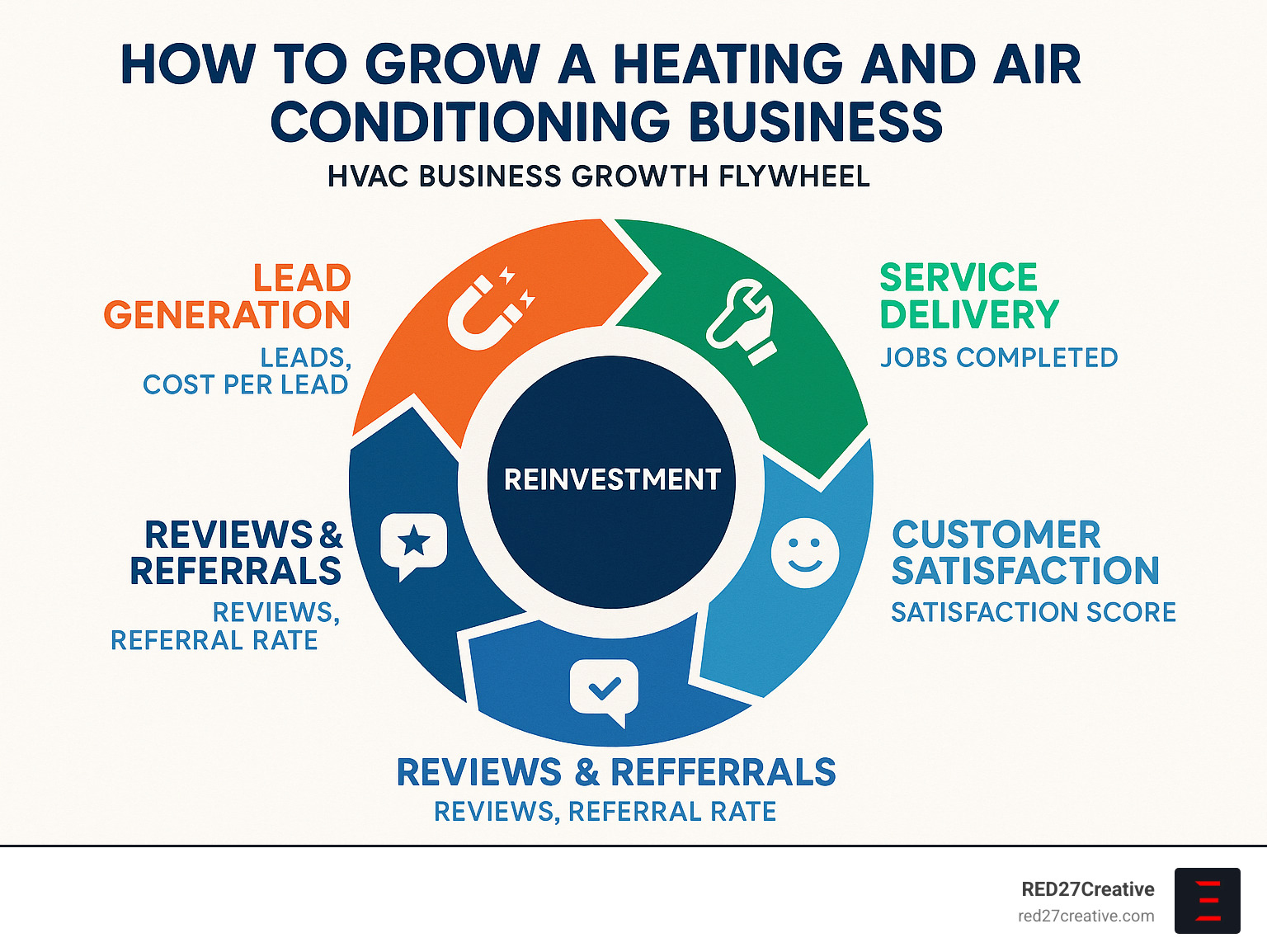
I’ve seen too many HVAC owners get excited about growth without having the right measuring sticks in place. Think of your business as a dashboard—you need to know which gauges to watch. Here are the key performance indicators that tell the real story of your business health:
Your revenue growth numbers should be broken down by service type (maintenance vs. replacement), customer segments (residential vs. commercial), and geographic areas. This granular view helps you spot exactly where your business is thriving.
Profit margins matter more than revenue alone—I’ve worked with companies doing $5 million in revenue but making less profit than others doing $1 million. Track both gross and net margins religiously.
Understanding your customer acquisition cost (CAC) prevents marketing waste. One of our clients finded they were spending $315 to acquire each customer through radio ads, but only $87 through targeted Facebook campaigns.
The real gold mine is your customer lifetime value (CLV). When you realize that a typical residential customer might be worth $23,000 over a 15-year relationship, you’ll make very different decisions about service quality and follow-up.
Conversion rates at every stage tell you where your sales funnel needs work. Are leads not converting to appointments? Are appointments not turning into sales? Fix the leaks instead of just pouring more leads into a broken funnel.
Your average ticket size is often the fastest path to profitability. I’ve seen HVAC companies increase profits by 30% just by improving their average ticket by $200 through better service offerings and technician training.
Technician productivity metrics like billable hours and revenue per tech help you identify both your stars and those who need additional training or support.
With these numbers at your fingertips, you can make truly informed decisions about your growth strategy. Maybe geographic expansion makes sense because your data shows strong demand in neighboring areas. Or perhaps service diversification into indoor air quality solutions is the right move because your existing customers are already asking about it.
Some companies find that focusing on specific customer segments (like new home communities or small offices) delivers dramatically better returns than trying to serve everyone. Others find that doubling down on their best-performing marketing channels creates a predictable growth engine.
Avoid the “Grow Broke” Trap
Here’s something rarely discussed in growth conversations: rapid expansion has killed more HVAC businesses than slow growth ever will. I call this the “grow broke” phenomenon—when a company expands faster than its cash flow and systems can handle.
Tom, an HVAC owner in Naperville, told me: “We grew revenue by 78% in one year, which felt amazing until we realized our systems couldn’t handle the volume. We had to completely pause marketing for three months to rebuild our operations. That pause cost us momentum and customers we’d worked hard to win.”
To avoid Tom’s fate, maintain adequate cash reserves—aim for at least three months of operating expenses as a safety net. Growth requires investment before you see returns.
Plan your expansion in staged phases rather than trying to grow everything simultaneously. Maybe focus on adding residential maintenance agreements before pushing into commercial work, or perfect your operations in one territory before expanding to the next.
Regularly audit your systems to ensure they can handle increased volume. Can your scheduling software handle twice as many appointments? Do you have enough vehicles and equipment? Will your customer service remain excellent if call volume doubles?
Monitor cash flow weekly during growth periods. Many profitable companies have gone under because they ran out of cash during an expansion phase. Remember: profit isn’t the same as cash flow.
Finally, secure financing before you need it. Establish lines of credit or other financing options while your business is stable and bankable, not when you’re in a cash crunch and desperate for funds.
The path to sustainable HVAC growth isn’t about moving fast—it’s about moving smart. Track the right metrics, make data-driven decisions, and expand at a pace your systems and cash flow can support. This measured approach might not make for exciting stories at industry meetups, but it creates the kind of stable, profitable business that thrives for decades.
Looking for more insights on growing your HVAC business through strategic marketing? Check out our marketing strategies that have helped dozens of HVAC companies achieve predictable, sustainable growth.
Frequently Asked Questions about Growing an HVAC Business
What profit margin should an HVAC company aim for?
While most HVAC companies barely scrape by with net profit margins under 2%, the industry leaders are enjoying a comfortable 10-20%. What’s their secret? It’s not magic—it’s methodical business practice.
Efficient operations form the foundation, coupled with value-based pricing that reflects your expertise rather than just covering costs. The real game-changers are typically high-margin services like maintenance agreements and indoor air quality solutions that provide recurring revenue with relatively low labor costs.
The math is simple but powerful: keep your total business expenses under 60% of what you bring in, with overhead staying between 25-35%. One owner told me, “When I finally got serious about my margins instead of just chasing revenue, my take-home pay doubled within a year.”
When is it time to hire more HVAC technicians?
Your phone is ringing off the hook, but your schedule is packed solid. You’re turning down good work. That’s the most obvious sign it’s hiring time—but wait! Before you post that job listing, make sure you have two critical elements in place.
First, do you have solid training systems ready? A new tech without proper training can damage your reputation faster than they can generate revenue. Second, have you done the revenue projections to ensure you’ll keep them busy? A well-trained technician should generate at least 3-4 times their salary in revenue.
Also consider the seasonal roller coaster of HVAC work. Many successful companies use a core team supplemented with seasonal help during the summer and winter rushes. As one Minnesota owner put it, “I’d rather have four busy technicians than six who are standing around during the shoulder seasons.”
Which marketing channel delivers the fastest HVAC leads?
When you need the phone ringing yesterday, Google Local Services Ads are your best friend. These ads appear at the very top of search results with that trustworthy “Google Guaranteed” badge, often delivering qualified leads within days of launching.
Google Ads (pay-per-click) is another quick starter, though you’ll typically pay more per lead. The trade-off is speed versus cost.
For long-term success, though, invest in local SEO. It’s like planting a tree—it takes time to grow, but eventually provides shade (and leads!) for years with minimal maintenance. One contractor in Toledo shared, “PPC got us through our first year, but our SEO investment is what’s allowed us to cut our marketing budget in half while growing 30% annually.”
How can I differentiate my HVAC business from competitors?
In a sea of HVAC companies all promising “quality service,” standing out requires intentional differentiation. The key is developing a clear unique selling proposition (USP) that addresses a specific customer pain point.
You might specialize in a particular niche market (high-efficiency systems, historic homes, or commercial refrigeration). Or perhaps offer bold guarantees that competitors won’t match (“on-time service or it’s free” or “lifetime labor warranty”).
Some companies differentiate through technological innovation (advanced diagnostics or smart home integration), while others focus on exceptional service models (24/7 availability with no overtime charges).
Whatever you choose, it must be two things: genuinely valuable to customers and consistently deliverable by your team. As one successful owner put it, “We’re not the cheapest, but we’re the only company in town that guarantees same-day service for families with newborns or seniors—and that specific promise has built our entire business.”
What’s the most cost-effective way to generate HVAC leads?
For established businesses, nothing beats the economics of referral programs and maintenance agreements. These leverage your existing happy customers to bring you new ones, often at acquisition costs 50-75% lower than traditional advertising.
Don’t have a big customer base yet? Focus on local SEO combined with a fully optimized Google Business Profile. While building momentum takes 4-6 months, the cost per lead eventually drops dramatically compared to paid advertising. Many contractors report organic leads costing one-third to one-fifth of what they pay for equivalent paid traffic.
The most overlooked lead source? Your existing customer database. One Chicago contractor told me, “We implemented a simple reactivation campaign targeting customers we hadn’t seen in 3+ years. For a $2,500 investment in postcards and calls, we generated $127,000 in system replacements in just one month. Best ROI we’ve ever seen.”
Conclusion
Growing an HVAC business isn’t just about being good with tools – it’s about being smart with strategy. After 20+ years helping heating and air conditioning companies thrive, I’ve seen that the difference between struggling and flourishing often comes down to the fundamentals we’ve covered.
Think about what we’ve learned together: tracking your numbers gives you the power to make decisions based on facts, not feelings. When you differentiate your business with a unique story and service approach, you escape the price-comparison trap that squeezes margins for so many contractors.
The most successful HVAC owners I’ve worked with invest consistently in marketing – allocating that critical 10-20% of revenue toward efforts that keep their phones ringing year-round. They understand that local SEO isn’t just a nice-to-have; it’s essential for survival in today’s digital-first world.
Building systems might not be as exciting as landing a big commercial contract, but those documented processes are what allow you to scale without the chaos that typically accompanies growth. When your business can run smoothly whether you’re there or not, you’ve built something truly valuable.
Your team is everything. When you develop technicians who can not only fix equipment but also communicate value and identify opportunities, you transform your workforce from an expense into a revenue-generating powerhouse. The companies that invest in training and culture consistently outperform those focused solely on technical skills.
I’ve watched too many good contractors go under because they were afraid to price for profit. Remember this: customers who value quality work will pay fair rates that allow you to maintain healthy margins. Those who only shop on price will cost you money in the long run anyway.
Finally, plan your growth with intention. The “grow broke” phenomenon claims too many promising HVAC businesses that expand faster than their systems and cash flow can support.
At RED27Creative, we’re passionate about helping HVAC businesses implement these exact strategies. Our team specializes in creating marketing systems that deliver predictable lead flow and brand positioning that helps you stand out in a crowded marketplace.
Whether you’re a one-truck operation looking to add your first employee or a multi-million dollar company aiming for the next level, the path forward requires both strategy and execution. By applying the principles in this guide, you’re positioning yourself to build an HVAC business that doesn’t just survive – it thrives.
Ready to put these ideas into action? Let’s talk about how to grow a heating and air conditioning business that delivers the lifestyle, income, and impact you’ve been working toward. Your journey to sustainable HVAC growth starts with a single step.

Kiel Tredrea
https://red27creative.comTop Marketing Agency • Web, SEO & Leads • RED27Creative