How to Master Sales Funnel Optimization Strategies

The Fundamentals of conversion funnel optimization
Conversion funnel optimization is the process of improving each step of your customer’s journey — from first click to final sale — so more visitors take the action you want.
Here’s a quick breakdown of how it works:
| Funnel Stage | Goal | Key Action |
|---|---|---|
| Awareness | Get noticed | Drive qualified traffic |
| Interest | Build engagement | Educate and inform |
| Desire | Create intent | Show value and proof |
| Action | Convert | Remove friction, close the sale |
The reality is sobering: 97% of visits to eCommerce websites won’t end in a sale. The global average conversion rate sits at just 2.86% — and for many industries, it’s even lower. That means most of your marketing spend brings people to the door who never walk through it.
The good news? You don’t need more traffic to grow. You need a smarter funnel.
If your funnel has leaks — confusing pages, slow load times, clunky checkouts, mismatched messaging — more traffic just means more lost opportunity. Conversion funnel optimization fixes the system you already have.
This guide shows how to map your funnel, spot drop-offs, test improvements, and build loyalty that compounds over time.
I’m Kiel Tredrea, founder of RED27Creative. For 20+ years, I’ve helped businesses build marketing systems where conversion funnel optimization is built into every layer — from website design to SEO to lead generation. Below are the frameworks and strategies we use to turn existing traffic into more predictable revenue.
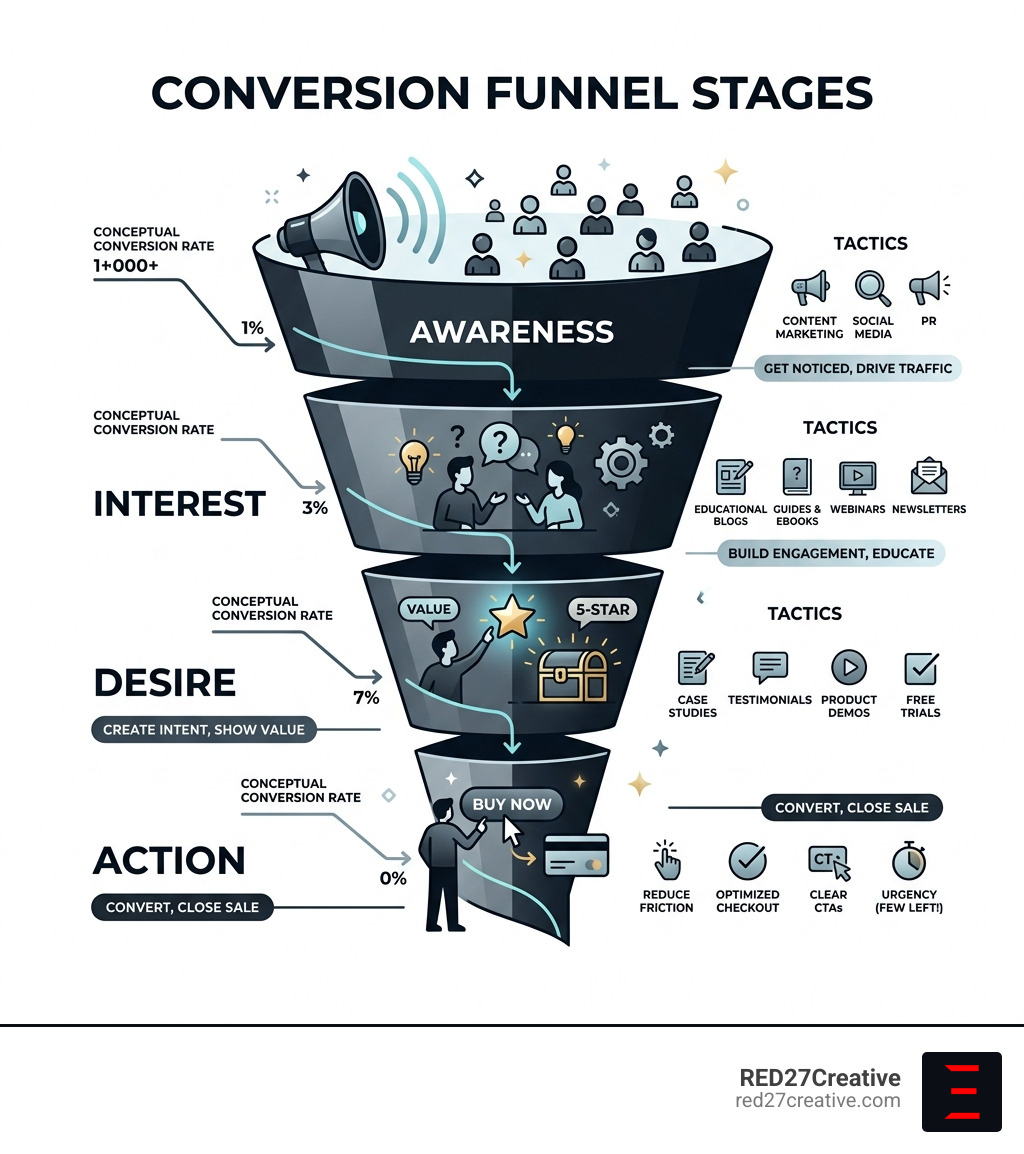
Conversion funnel optimization basics:
At its core, conversion funnel optimization is about aligning your digital experience with how people actually make decisions. Many businesses in Geneva and Naperville focus only on the “buy now” moment, but high-performing funnels start earlier.
The AIDA Model: A Practical Blueprint
AIDA breaks the journey into four phases:
- Attention (Awareness): TOFU. Get discovered via SEO, social media, and PPC.
- Interest: Earn engagement through helpful content and follow-up.
- Desire: Build intent with benefits, testimonials, and case studies.
- Action: BOFU. Make the final step fast and frictionless.
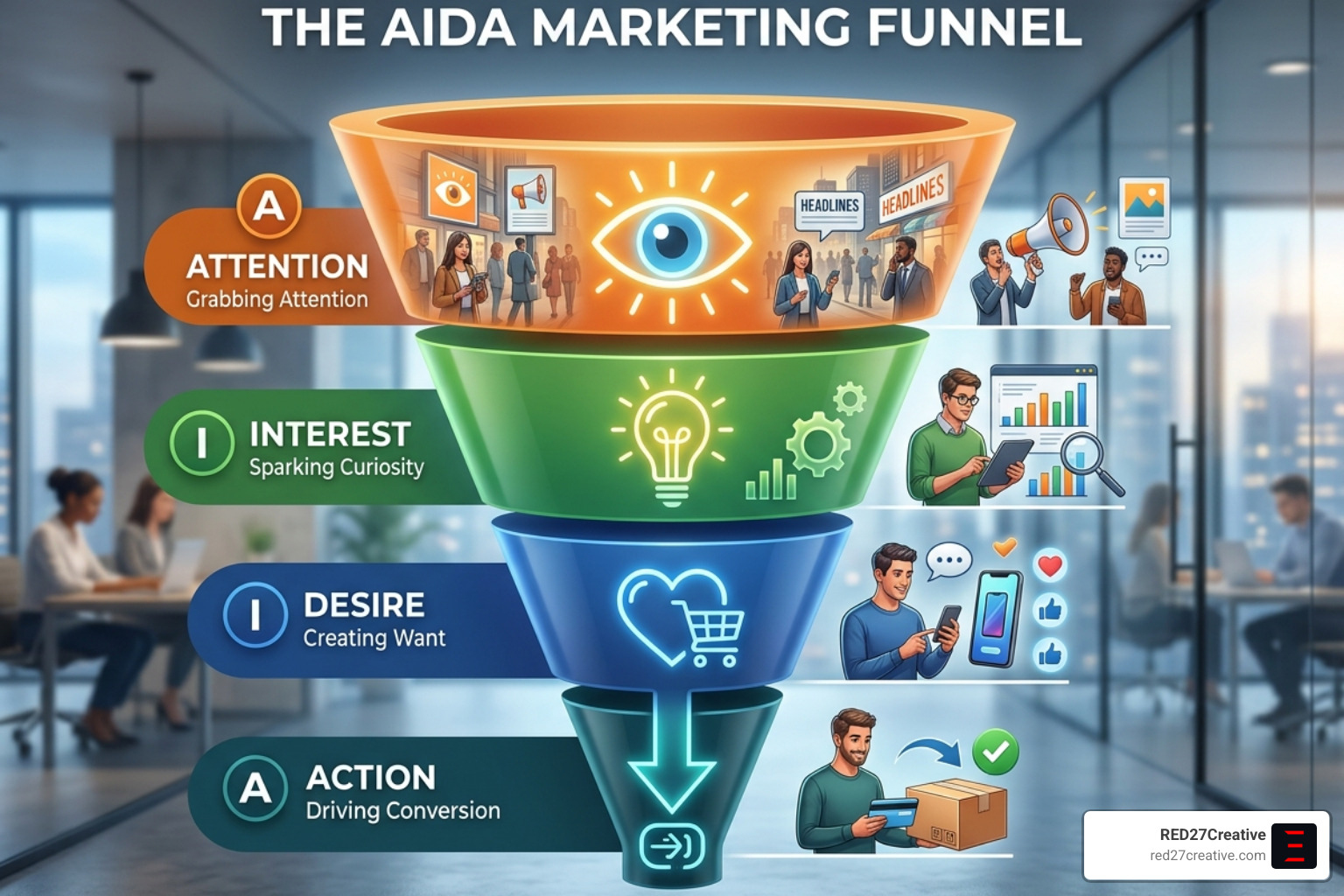
Understanding these stages helps you build a Complete Digital Marketing Funnels Guide that speaks to the user’s mindset at each touchpoint. For local support, Conversion Funnel Analysis Services in Naperville, IL can provide the data needed to pinpoint where stages succeed or fail.
Why conversion funnel optimization is Critical in 2026
Customer acquisition costs have risen sharply. Privacy-first tracking and competition mean you can’t afford to waste the traffic you already have.
Funnel optimization improves roi by increasing conversions without automatically increasing ad spend. It also boosts LTV by building trust and creating smoother experiences.
Benchmarking Your Funnel Performance
The global eCommerce average conversion rate is ~2.86%, but benchmarks vary by category. As of early 2026:
- Arts and Crafts: 3.79%
- Pet Care: 3.28%
- Health and Wellbeing: 3.62%
- Baby Products: 0.99%
This is why Website Conversion Rate Optimization should be tailored to your niche and market.
Identifying and Fixing Leaks in Your Sales Funnel
Every funnel has “leaks” — points where potential customers drop out for reasons that could have been avoided. To fix them, we need to stop guessing and start looking at the data.
Identifying these drop-off points requires a mix of quantitative data (the “what”) and qualitative data (the “why”). If your analytics show a 70% drop-off on your pricing page, you know what is happening. But you need to look closer to understand if the issue is the price itself, a lack of trust, or simply a confusing layout.
By Scoring Traffic Sources For Better Roi, we can also determine if the “leak” is actually a targeting problem. If your Facebook ads are bringing in thousands of visitors who bounce immediately, the problem isn’t your website — it’s the quality of the traffic. For those in the city, seeking the Best Conversion Rate Optimization Services In Chicago, IL can help bridge the gap between high-quality traffic and high-converting pages.
Essential Tools for conversion funnel optimization
To perform a deep-dive audit, we rely on a specific stack of tools that provide a 360-degree view of the user experience:
- Google Analytics 4 (GA4): This is the foundation. It allows us to map out the entire funnel and see exactly where the largest percentage of users are exiting.
- Heatmaps (e.g., Hotjar or Microsoft Clarity): These tools show us where people are clicking, scrolling, and moving their mice. If users are trying to click on an image that isn’t a link, that’s a friction point.
- Session Recordings: Watching real users navigate your site is often eye-opening. You might discover that a popup is blocking the “checkout” button on mobile devices, a common issue that kills conversions.
- A/B Testing Software: This allows us to test two versions of a page to see which performs better. We might test a green button vs. a red button, or a short form vs. a long one.
Using these tools is The Secret Of Marketing Roi. It moves your strategy away from “I think this looks good” to “The data proves this works.”
Key Metrics and KPIs to Track
You cannot manage what you do not measure. To keep your funnel healthy, we recommend tracking these key metrics weekly:
- Bounce Rate: The percentage of visitors who leave after viewing only one page. A high bounce rate on a landing page usually indicates a mismatch between your ad and your content.
- Cart Abandonment Rate: For eCommerce, this is the “final hurdle” metric. Nearly 70% of shoppers abandon their carts. Reducing this by even 5% can result in a significant revenue boost.
- Cost Per Acquisition (CPA): How much does it cost you to get one customer? If your CPA is higher than your profit margin, your funnel needs immediate optimization.
- Conversion Rate by Stage: Don’t just look at the final sale. Look at the “Visit to Lead” rate and the “Lead to Sale” rate. This tells you exactly which part of the funnel is broken.
Advanced Strategies for High-Growth Funnels
Once the basic leaks are plugged, it’s time to move into advanced strategies that create a competitive advantage. In 2026, this means moving away from a “one-size-fits-all” approach and toward hyper-personalization.
Personalization isn’t just about putting a customer’s name in an email. It’s about showing them content and products that are relevant to their specific behavior. If a user has spent ten minutes looking at “Commercial SEO” services on our site, our funnel should automatically prioritize case studies related to B2B growth, rather than local retail.
This level of detail is covered extensively in our Lead Generation Strategy Complete Guide, which emphasizes the importance of user segmentation.
Optimizing the Checkout Process to Reduce Abandonment
The checkout page is the most sensitive part of your entire website. Research shows that nearly 70% of online shoppers abandon their carts due to long forms and tedious processes. To combat this, we implement several “friction-reducers”:
- Limit Form Fields: One study found that requesting only 5 form fields resulted in an average conversion rate of 10%. Every extra field you add is another chance for the customer to change their mind.
- Guest Checkout: Forcing someone to create an account before they buy is a major deterrent. Always offer a guest checkout option.
- Security Badges and Trust Signals: In an era of digital skepticism, 88% of users say trust is a deciding factor. Show your SSL certificates, money-back guarantees, and secure payment icons prominently.
- Progress Indicators: If your checkout has multiple steps, show the user how far they’ve come and how much is left.
Building Conversion Focused Websites requires a “less is more” philosophy at the point of purchase. Remove the main navigation menu from the checkout page to prevent users from wandering away at the last second.
Leveraging AR and Emerging Tech for Higher Conversions
One of the most exciting trends we’ve seen in April 2026 is the mainstream adoption of Augmented Reality (AR) in the conversion funnel. Products featuring AR content have a 94% higher conversion rate than those that don’t.
Retail giants like Home Depot have already proven the model, reporting that shoppers who use their AR tools convert two to three times higher than those who don’t. Whether it’s seeing how a new rug looks in your Geneva living room or how a pair of glasses fits your face, AR removes the “uncertainty gap” that often prevents a sale.
Integrating these technologies is a core part of Ppc Roi Optimization. When your ads lead to an immersive, interactive experience, your engagement rates — and ultimately your sales — skyrocket.
Frequently Asked Questions about Sales Funnel Strategy
What is a conversion funnel?
A conversion funnel is a structured visualization of the customer journey, mapping the path from initial brand awareness to a final desired action, such as a purchase or sign-up. By analyzing each stage—Awareness, Interest, Desire, and Action—businesses can identify where prospects drop off and optimize the experience to increase total sales.
How do I identify drop-off points in my funnel?
You can identify drop-off points by using digital analytics tools like Google Analytics 4 to track stage-to-stage conversion rates. Additionally, behavioral tools such as heatmaps and session recordings reveal where users encounter friction, while exit surveys provide qualitative data on why potential customers are leaving your site without converting.
What is a good conversion rate for eCommerce?
As of April 2026, the global average eCommerce conversion rate sits at approximately 2.86%. However, “good” rates vary significantly by industry; for example, arts and crafts often see rates near 3.79%, while baby products may average closer to 0.99%. Benchmarking against your specific niche is essential for accurate performance evaluation.
How does site speed affect my funnel?
Site speed is a critical, often overlooked part of conversion funnel optimization. Over 50% of users are less likely to make a purchase if a site loads slowly, and nearly 37% won’t return to a slow site. In the markets of Naperville and Chicago, a three-second delay can be the difference between a sale and a bounce.
What role does email play in funnel optimization?
Email is your most powerful tool for “re-engaging” users who have dropped out of the funnel. By capturing email addresses early through lead magnets or discounts, you can use automated sequences to nurture prospects through the “Interest” and “Desire” stages, eventually bringing them back to complete the “Action” phase.
Conclusion
Mastering conversion funnel optimization is not a one-time project; it is a continuous cycle of measuring, testing, and refining. In the competitive digital landscape of April 2026, businesses that take a data-driven approach to their customer journey are the ones that will see sustainable, long-term growth.
At RED27Creative, based in Geneva, Illinois, we specialize in building these data-driven systems. Led by our founder, Kiel Tredrea, our team of designers, developers, and SEO experts works to connect every part of your marketing — from your local listings in Batavia and Oswego to your national lead generation campaigns — into one unified engine for growth.
We have spent over 20 years helping businesses across the Fox Valley and Chicago area turn visibility into consistent, qualified opportunities. Whether you need a complete website overhaul or a targeted strategy to reduce cart abandonment, everything we do is designed to drive leads and deliver a measurable ROI.
If you are ready to stop losing revenue through the cracks in your funnel and start building a marketing system that works together to attract, trust, and convert, we are here to help. Explore our Lead Generation Services today and let’s build a funnel that actually performs.

Kiel Tredrea
https://red27creative.comTop Marketing Agency • Web, SEO & Leads • RED27Creative