Advertising Your HVAC Business Without Burning Cash

Why HVAC Advertisements Are Critical for Business Growth
HVAC advertisements are paid marketing campaigns designed to generate leads, build brand awareness, and drive revenue for heating, ventilation, and air conditioning businesses. These ads span multiple channels—from Google search results to direct mail postcards—and can deliver exceptional returns when executed strategically.
Key Types of HVAC Advertisements:
• Digital ads – Google Ads, Facebook ads, Instagram Stories, YouTube videos
• Traditional ads – Direct mail postcards, radio spots, print flyers, truck wraps
• Local Services ads – Google-guaranteed listings with pay-per-lead pricing
• Seasonal campaigns – Spring tune-up offers, winter heating promotions
• Retargeting ads – Follow-up ads for website visitors who didn’t convert
The HVAC industry sees over 7 million monthly searches for heating and cooling services, with 90% of consumers using the internet to find local businesses. Yet many contractors struggle with ineffective campaigns that burn cash instead of generating profitable leads.
The difference between successful and failed HVAC advertising often comes down to timing, targeting, and message clarity. Companies that nail these fundamentals report impressive results—like Glass City Heating And Cooling, which received 10-15 calls within one week of their postcard campaign and generates approximately $20,000 in business from every 5,000-card mailing.
Smart HVAC businesses allocate 10-20% of their sales revenue to marketing, mixing digital channels with proven traditional methods. They understand that effective advertising isn’t about spending more—it’s about spending smarter with data-driven strategies that target the right customers at the right time.
I’m Kiel Tredrea, founder of RED27Creative, with over 20 years of experience helping HVAC companies optimize their HVAC advertisements for maximum ROI through strategic digital marketing and conversion-focused campaigns. My approach combines advanced SEO, targeted paid advertising, and performance analytics to ensure every dollar spent generates measurable business growth.
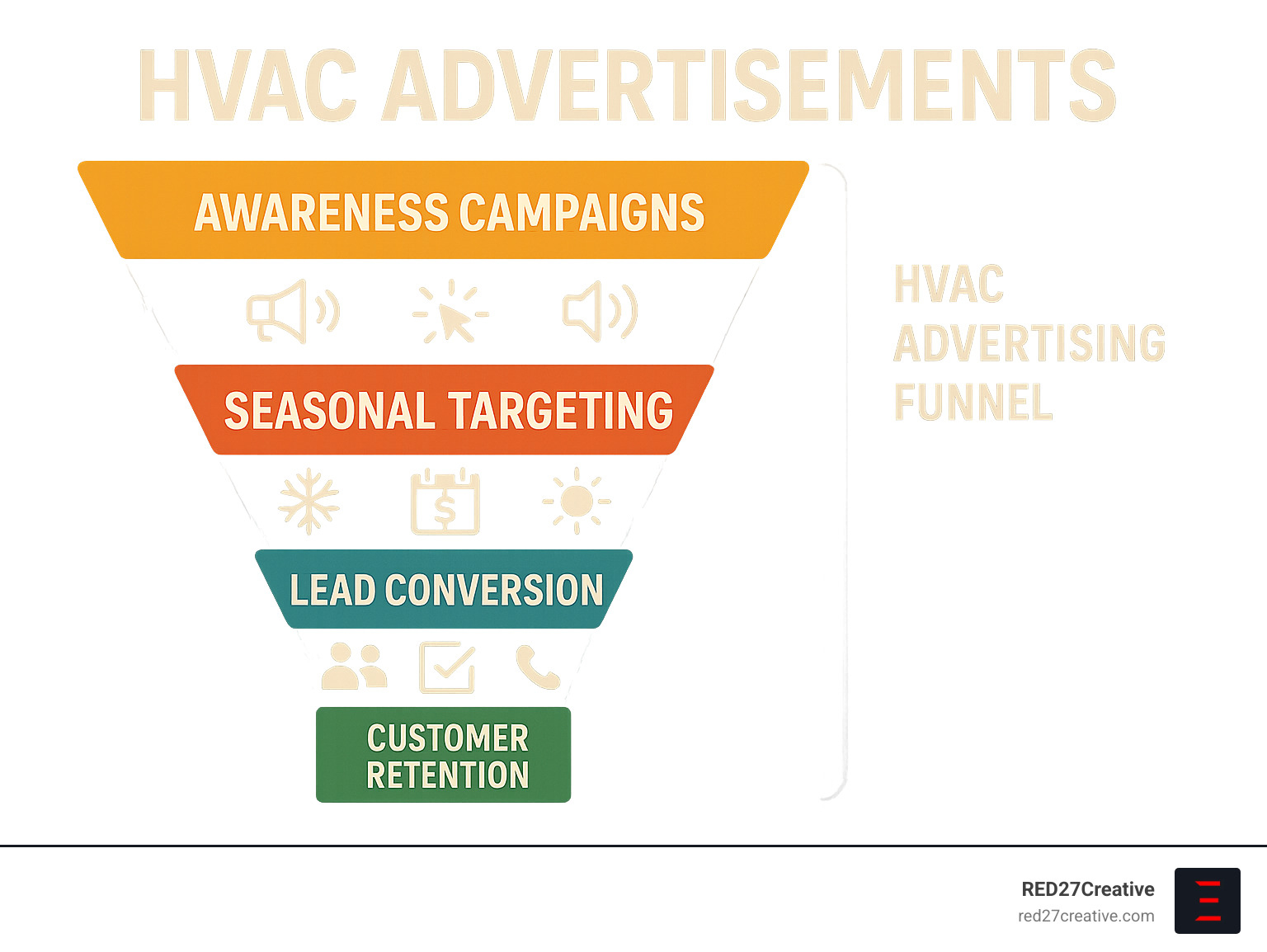
What Are HVAC Advertisements & Why They Matter
HVAC advertisements are your lifeline to connecting with homeowners when they need you most. Picture this: it’s 95 degrees outside, and someone’s air conditioner just gave up. They’re sweating, frustrated, and frantically searching for help. Your ad needs to be the reassuring voice that says “We’ve got you covered.”
These strategic marketing campaigns work because they address real pain points at the exact moment customers experience them. Whether it’s a furnace breakdown in January or an AC failure during a summer heatwave, effective advertising positions your company as the trusted solution when urgency meets necessity.
The numbers tell a compelling story. Companies using targeted email marketing earn $40 for every $1 spent, while well-executed direct mail campaigns regularly deliver returns exceeding 500%. Take LJ Refrigeration, who generated over $15,000 in sales from a postcard campaign costing just under $3,000—that’s a 556% return on investment that would make any business owner smile.
But here’s what many contractors miss: successful HVAC advertisements aren’t just about getting calls. They’re about building the foundation for long-term customer relationships in communities where reputation travels fast and word-of-mouth can make or break your business.
With 82% of customers reading online reviews for local companies and more than half refusing to consider businesses with less than 4 stars, your ads must incorporate trust signals and social proof to convert effectively. This isn’t just marketing—it’s about proving you’re worthy of being invited into someone’s home.
The Basics of HVAC Advertisements
Every successful HVAC advertisement follows a simple but powerful formula: identify the problem, offer the solution, and make it easy to take action. Think about your own customers—they’re not looking for clever wordplay or fancy graphics when their heating system fails at midnight. They want clear answers and immediate help.
Start with the customer’s pain point, but avoid fear-mongering tactics that can backfire in local markets. Instead of “Your furnace could kill you,” try “Stay warm and safe this winter with our certified heating inspections.” The message creates awareness without causing unnecessary alarm.
Urgency works when it’s genuine. Phrases like “Same-day service available” or “24/7 emergency repairs” speak directly to the immediate nature of HVAC problems. However, steer clear of false scarcity tactics like “Only 3 appointments left today” unless it’s actually true. In tight-knit communities, dishonest advertising damages your reputation faster than you can say “emergency repair.”
Your phone number deserves star treatment in every ad. Make it large, bold, and impossible to miss. Many successful HVAC companies invest in memorable vanity numbers or toll-free lines that customers can easily recall during stressful equipment failures. When someone’s furnace dies on a Sunday morning, you want them remembering your number, not your competitor’s.
How HVAC Advertisements Build Local Trust
Trust isn’t built overnight, but the right advertising approach can accelerate the process significantly. Social proof through customer testimonials, star ratings, and before-and-after photos creates instant credibility that generic claims simply can’t match.
The Google Guarantee badge available through Local Services ads provides powerful third-party validation. This program screens HVAC contractors and backs their work with Google’s guarantee, giving customers confidence to choose your services over unverified competitors. It’s like having Google vouch for your reliability—and that carries serious weight with nervous homeowners.
Customer testimonials in your ads should tell specific stories rather than offer generic praise. Instead of “Great service!” showcase reviews that mention your technicians by name, describe the actual problem solved, or highlight your response time. These details help potential customers envision their own positive experience with your company.
Consider American Home Heating And Air’s approach: they mail to approximately 4,000 customers and set appointments with about 8-10 percent, resulting in approximately $30,000 in revenue just from service calls. Their success comes from consistent messaging that emphasizes reliability and local expertise—qualities that matter most when someone needs to trust you with their home comfort and safety.
The key is consistency across all touchpoints. Your HVAC advertisements should reflect the same professionalism and reliability that customers experience when your technicians arrive at their door.
Choosing Your Channels: Digital vs. Traditional
Picture this: your ideal customer might be scrolling through Facebook while their neighbor prefers checking the mailbox for local deals. That’s exactly why successful HVAC advertisements need an omni-channel strategy that meets customers where they actually spend their time.
Smart HVAC contractors understand that the “digital versus traditional” debate misses the point entirely. The most profitable approach combines both worlds, typically investing 10-20% of sales revenue across multiple advertising channels. This isn’t about picking sides—it’s about maximizing your reach and revenue.
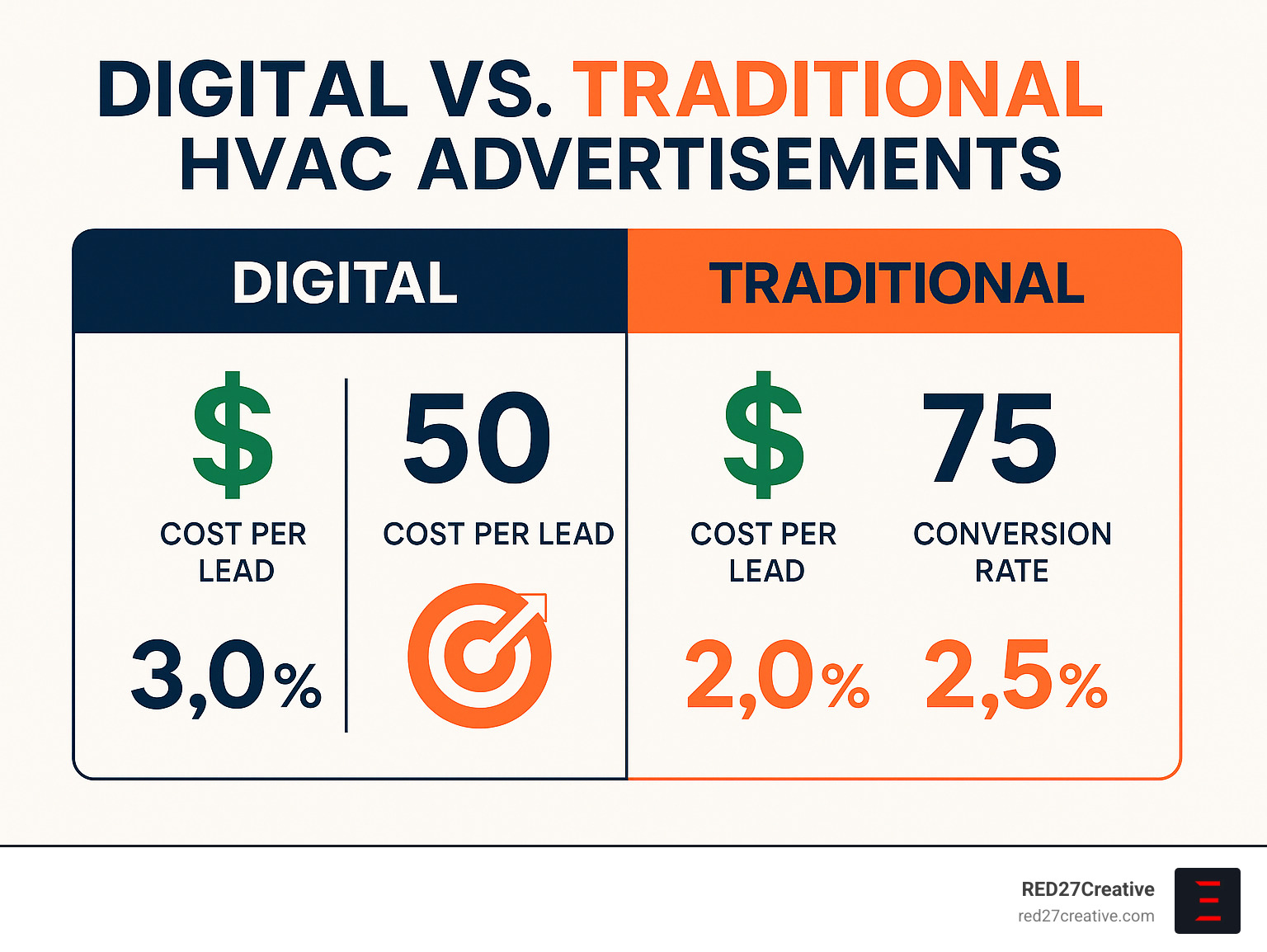
Digital channels shine when it comes to precision targeting and real-time tracking. You can literally target homeowners in specific neighborhoods who’ve recently searched for “furnace repair” or retarget someone who visited your website but didn’t call. The data tells you exactly which ads work and which ones drain your budget.
Traditional methods like postcards, radio spots, and door hangers still pack a serious punch, especially for reaching established homeowners who trust tangible marketing materials. Many contractors report their highest conversion rates come from direct mail campaigns that feel personal and local.
The secret sauce lies in understanding your local market demographics. Younger neighborhoods often respond better to Instagram Stories and Facebook ads, while established communities may prefer the credibility of a well-designed postcard or local newsletter advertisement. We always recommend testing both approaches initially, then shifting your budget toward whatever generates the most qualified leads.
Digital HVAC Advertisements That Convert
Google Ads remain the heavyweight champion of digital HVAC advertisements because they capture customers with immediate buying intent. When someone types “emergency AC repair near me” at 2 AM, they’re not browsing—they’re ready to hire the first qualified contractor who answers the phone.
The beauty of Google Ads lies in their precision. You can target specific service areas, set ads to run only during business hours, and even adjust bids based on local weather conditions. A smart campaign might increase bids for “AC repair” ads when temperatures hit 85 degrees or promote heating services when a cold snap hits your area.
Facebook and Instagram ads excel at a different game entirely—building relationships with future customers. These platforms let you target homeowners based on amazing criteria like recent moves, home value, or even life events like getting married. Instagram Stories featuring quick maintenance tips or seasonal reminders keep your brand visible when customers aren’t actively searching.
Retargeting pixels work like digital breadcrumbs, following website visitors who didn’t convert initially. These campaigns can showcase customer testimonials, highlight seasonal promotions, or provide helpful educational content that builds trust over time. Geo-fencing technology takes this further, allowing you to target people visiting competitors’ locations or home improvement stores.
Traditional HVAC Advertisements That Still Work
Don’t let anyone convince you that direct mail postcards are outdated—some contractors report conversion rates exceeding 40% within three months of mailing. The key lies in professional design, compelling offers, and laser-focused targeting. Postcards work exceptionally well for maintenance reminders and seasonal tune-up promotions.
Truck wraps transform your service vehicles into mobile billboards that generate brand awareness throughout your entire service area. A professionally designed wrap featuring your logo, key services, and contact information can create hundreds of daily impressions. Many contractors consider truck wraps their most cost-effective long-term advertising investment.
Yard signs at active job sites serve as powerful social proof in neighborhoods where reputation spreads quickly. Combine these with door hangers for nearby homes and local newsletter advertisements to establish strong community presence. The magic happens when traditional exposure reinforces your digital campaigns—someone who notices your yard sign might later click your Google ad, creating multiple touchpoints that build trust and recognition.
Radio advertising still reaches commuters during peak drive times, especially effective for promoting seasonal services or emergency availability. Local radio spots work best when they focus on your community involvement and local expertise rather than generic service lists.
Seasonal Strategy & Audience Targeting
Smart HVAC advertisements follow the rhythm of the seasons, much like your customers’ heating and cooling needs. Think about it—nobody searches for furnace repair in July, and AC installation ads in December are just burning money. The most successful HVAC contractors understand this natural flow and plan their advertising campaigns accordingly.
Spring represents your golden opportunity to capture customers before they’re sweating in broken-down houses. Start promoting air conditioning tune-ups and system installations while homeowners are still comfortable enough to think clearly about their cooling needs. This proactive approach positions you as the thoughtful contractor who helps customers avoid emergency situations.
Fall campaigns work similarly but focus on heating system preparation. Homeowners who schedule furnace maintenance in October are much happier than those calling you at midnight on the coldest day of winter. Your HVAC advertisements during this season should emphasize peace of mind and winter readiness.
Weather-triggered advertising takes seasonal strategy to the next level. Modern digital platforms allow you to automatically launch campaigns when local temperatures spike unexpectedly or drop below normal ranges. That surprise April heatwave suddenly makes your AC service ads incredibly relevant to homeowners who weren’t thinking about cooling just days before.
The key to successful audience targeting lies in understanding that not all customers are the same. A property manager overseeing multiple rental units has completely different concerns than a new homeowner trying to understand their first HVAC system. Your advertising messages need to speak directly to each group’s specific needs and pain points.
Timing HVAC Advertisements for Spring & Fall Surges
Launch your spring HVAC advertisements about six to eight weeks before peak cooling season hits your area. This timing gives homeowners enough advance notice to schedule maintenance without feeling rushed, while still keeping the upcoming hot weather fresh in their minds.
Early-bird discounts work exceptionally well during spring campaigns. Homeowners appreciate saving money on tune-ups, and you benefit from scheduling work during slower periods. Consider offering maintenance package deals or priority service agreements that provide ongoing value beyond the initial spring cleaning.
Fall advertising requires a slightly different approach. Your campaigns should emphasize the importance of heating system safety and reliability before winter arrives. Nobody wants to find their furnace has carbon monoxide issues during the first cold snap. Frame your maintenance services as essential safety checks rather than optional tune-ups.
Seasonal transition periods also present unique opportunities. Those in-between weeks when homeowners switch from heating to cooling (or vice versa) are perfect for promoting comprehensive system evaluations. These services generate revenue during traditionally slower periods while establishing your expertise across all seasons.
Tailoring HVAC Advertisements to Buyer Segments
Different customer segments respond to completely different motivations in your HVAC advertisements. New homeowners often feel overwhelmed by maintenance responsibilities and appreciate educational content that helps them understand their systems. Your ads to this group should emphasize guidance, reliability, and building long-term relationships.
Existing customers who’ve used your services before respond better to loyalty rewards and priority scheduling offers. They already trust your work—now you’re reinforcing that relationship and encouraging repeat business. Maintenance reminders work particularly well with this segment.
Property managers focus primarily on tenant satisfaction and operational efficiency. Your advertising to this segment should highlight quick response times, transparent pricing, and your ability to handle multiple units efficiently. Case studies showing how you’ve helped other property managers can be especially effective.
New residents in your service area represent a valuable opportunity. These homeowners are actively seeking local service providers and haven’t yet established relationships with your competitors. Welcome campaigns targeting recent movers can capture these customers early.
Warranty expiration campaigns target customers whose equipment protection is ending soon. These highly targeted HVAC advertisements can promote extended warranties, maintenance agreements, or replacement system consultations. The messaging focuses on continued protection and peace of mind rather than pushing immediate sales.
Homeowners with aging equipment (typically 10+ years old) form another distinct segment. These customers may not be experiencing problems yet, but they’re approaching the time when major repairs or replacements become necessary. Educational content about system efficiency and reliability can help position your company for future opportunities.
Crafting High-Converting HVAC Ads
Creating HVAC advertisements that actually convert starts with understanding what your customers really care about. When someone’s air conditioner breaks in July, they’re not interested in your company’s history or technical specifications—they want to know you can fix their problem fast and get their family comfortable again.
The most successful ads lead with benefits, not features. Instead of “We install Carrier units,” try “Stay cool all summer with reliable AC installation.” This simple shift puts the customer’s comfort first and creates an emotional connection that drives action.
One of the biggest mistakes contractors make is cramming multiple offers into a single ad. When you promote furnace maintenance, duct cleaning, and new installations all at once, customers get overwhelmed and often don’t respond at all. Focus on one clear offer per ad—whether that’s a spring tune-up special or emergency repair availability.
Your visuals should tell a story that resonates emotionally while maintaining professional credibility. Photos of comfortable families, clean modern equipment, and your uniformed technicians all work together to build trust. Most people will see your ads on their phones first, so every element needs to be clearly visible on a small screen.

Key Components Every HVAC Advertisement Must Include
Every HVAC advertisement that generates real leads contains certain non-negotiable elements. Your offer needs to be the star of the show—bold, clear, and valuable enough to motivate action. Whether you’re offering “$50 off maintenance” or “Same-day emergency service,” make sure a busy homeowner can understand your value proposition in three seconds or less.
Creating appropriate urgency without seeming pushy requires finesse. Seasonal deadlines work naturally—”Schedule your fall furnace check-up before winter weather arrives” feels helpful rather than manipulative. Avoid fake scarcity tactics that could damage your reputation when customers find your “limited time” offer runs indefinitely.
Your call-to-action should be impossible to miss and easy to follow. Phone numbers need to be large enough to read on mobile devices, and web forms should require minimal information. The easier you make it for customers to contact you, the more leads you’ll generate.
Trust signals deserve prominent placement without overwhelming your message. Google Guarantee badges, star ratings from review platforms, and industry certifications all contribute to credibility. These elements reassure nervous customers that you’re legitimate and reliable—crucial factors when they’re choosing who to let into their homes.
Your contact information should appear consistently across every ad format. This means the same phone number, website URL, and business name everywhere customers might encounter your brand. Consistency builds recognition and makes it easier for people to find you again when they’re ready to buy.
For comprehensive strategies on maximizing your advertising impact across all contractor trades, explore our detailed guide on Advertising for Contractors, which covers proven campaign structures and industry-specific best practices.
Leveraging Local SEO Inside Your Ads
Smart contractors understand that HVAC advertisements work best when they’re part of a cohesive local marketing strategy. Your ads should reinforce the same business information that appears on your website, Google Business Profile, and directory listings. This consistency—known as NAP consistency (Name, Address, Phone)—helps search engines trust your business information and can improve your ad performance.
When customers click your ads, they should land on pages that load quickly and work perfectly on mobile devices. A slow or confusing website wastes your advertising budget by preventing interested prospects from converting into actual customers.
Your Google Business Profile directly impacts how well your Local Services ads perform and where you appear in local search results. Complete profiles with accurate hours, service areas, recent photos, and regular customer reviews typically receive more visibility and engagement. The time you invest in optimizing these local search elements pays dividends across all your marketing efforts.
Schema markup might sound technical, but it’s simply a way to help search engines understand your business information, services, and customer reviews. This structured data can improve your ad performance by providing rich snippets in search results and boosting your local search visibility.
Our HVAC SEO Services help contractors optimize these critical local search elements that support advertising success. When your ads, website, and local listings all work together seamlessly, you’ll see better results from every marketing dollar spent.
Making sure your website is mobile-friendly isn’t optional anymore—it’s essential for converting the leads your ads generate. Customers who can’t easily contact you after clicking your ads represent wasted advertising spend and missed revenue opportunities.
Measuring Success & Avoiding Budget Burn
Smart tracking separates profitable HVAC advertisements from money-wasting campaigns. The difference between success and failure often comes down to monitoring the right metrics and making data-driven adjustments before your budget disappears.
Your cost-per-click (CPC) tells you how much you’re paying for each person who clicks your ad, while click-through rate (CTR) reveals how compelling your message is to potential customers. But the real magic happens when you track return on ad spend (ROAS)—this metric shows exactly how much revenue each advertising dollar generates.
Call tracking becomes absolutely crucial for HVAC businesses since most customers prefer picking up the phone over filling out online forms. By assigning unique phone numbers to different campaigns, you can pinpoint which ads actually drive profitable conversations with homeowners who need your services.
Conversion rate optimization might sound technical, but it’s really about making small tweaks that deliver big results. When you improve your conversion rate from 2% to 3%, you’re essentially getting 50% more leads from the same advertising spend. That’s the difference between a campaign that breaks even and one that funds your next truck purchase.
Tools to Track HVAC Advertisements
Google Analytics serves as your digital detective, following visitors from your HVAC advertisements through their entire journey on your website. You can see which campaigns bring the most traffic, which pages keep people engaged, and most importantly, which ads actually generate phone calls and form submissions.
Setting up goal tracking in Google Analytics transforms vague impressions into concrete dollar amounts. When you assign values to different conversion actions—like $50 for a maintenance inquiry or $500 for an installation quote request—you can calculate the true return on investment for each advertising campaign.
Call recording software opens your eyes to what happens after someone dials your number. Many contractors find their ads work perfectly, but their phone handling needs improvement. Maybe calls aren’t being answered promptly, or the person taking calls isn’t asking the right qualifying questions to convert interested prospects into scheduled appointments.
CRM integration creates a complete picture of your customer journey by tagging each lead with its original advertising source. This long-term tracking proves invaluable when that spring maintenance customer calls six months later for a furnace replacement. Without proper attribution, you might undervalue the campaign that originally brought them to your business.
Heatmap tools reveal the invisible story of what happens on your landing pages. You might find that visitors can’t find your phone number easily, or they’re getting confused by too many service options. These insights help you optimize the pages where your advertising traffic lands, ensuring you don’t waste clicks from interested customers.
Common Mistakes That Sink HVAC Advertisements
Poor follow-up systems destroy more HVAC advertisements than bad targeting or weak creative. You might generate plenty of leads, but if you’re not calling them back within the first hour, many will have already contacted your competition. The fastest responder often wins in the HVAC world, especially during emergency situations.
Weak landing pages kill conversions faster than almost anything else. When someone clicks your compelling ad about emergency AC repair, they expect to land on a page that matches that urgency. Instead, many contractors send traffic to generic homepage that mentions fifteen different services without emphasizing the specific problem the ad addressed.
Ignoring seasonality leads to frustrating budget waste and missed opportunities. Running air conditioning advertisements in December might seem obviously wrong, but many contractors make subtler timing mistakes. Starting your spring maintenance campaigns too late means missing the early-bird customers who plan ahead, while stopping them too early means missing the procrastinators who wait until the first hot day.
Broad geographic targeting sounds like a good way to reach more customers, but it often backfires spectacularly. Your ads might be showing to homeowners fifty miles outside your service area, generating clicks and calls from people you simply can’t help. This inflates your costs while providing zero return on investment.
Inconsistent branding across different advertising channels confuses potential customers and weakens your overall marketing impact. When your Google ads use different colors, messaging, and phone numbers than your direct mail postcards, you’re essentially starting from scratch with each touchpoint instead of building cumulative brand recognition that makes customers more likely to choose your services.
Frequently Asked Questions about HVAC Advertising
What’s the ideal budget for HVAC ads?
When contractors ask about HVAC advertisements budgets, the answer depends on your growth goals and current revenue. Industry experts consistently recommend allocating 10-20% of your sales revenue to marketing activities. Think of it this way: if your company generates $500,000 annually, you should invest $50,000-$100,000 in total marketing efforts across all channels.
Here’s the reality though—many contractors start with much smaller budgets and gradually increase spending as they see results. A 5% marketing budget is considered maintenance-level spending that keeps your business visible but won’t drive significant growth.
The sweet spot for digital advertising is 60-70% of your total marketing budget, with the remainder going to traditional channels like direct mail and local sponsorships. Start small to test different platforms, then double down on what works. Many successful HVAC companies begin with $1,000-$2,000 monthly digital ad spend and scale up based on performance.
How soon should I launch heater or AC campaigns before peak season?
Timing your HVAC advertisements correctly can make or break your seasonal campaigns. Launch heating campaigns 6-8 weeks before cold weather typically arrives in your area. This gives homeowners enough time to think about their furnace maintenance without feeling rushed.
Air conditioning campaigns should start even earlier—approximately 8-10 weeks before peak cooling season begins. Early spring advertising captures customers who plan ahead rather than waiting for emergency situations.
The customers you reach with early campaigns are often your most valuable prospects. They’re thinking strategically about their home comfort rather than panicking during equipment failures. These planned maintenance customers frequently become long-term clients who invest in comprehensive service agreements and eventually trust you with major system replacements.
Which metrics prove my ads are profitable?
Return on Ad Spend (ROAS) tells the real story of your HVAC advertisements performance. Calculate this by dividing total revenue generated by your advertising costs. A 5:1 ROAS means you earn $5 for every $1 spent on ads—that’s considered excellent performance for most HVAC campaigns.
But don’t stop there. Cost-per-lead and lead-to-customer conversion rates provide deeper insights into campaign health. Track these metrics separately for emergency repairs versus planned maintenance, since emergency calls typically convert much faster.
The most important long-term metric is Customer Lifetime Value (CLV). That customer you acquired through a $50 Google ad might generate thousands in revenue over several years through repeat service calls, referrals, and equipment replacements. Smart contractors track CLV to understand the true impact of their advertising investments and justify higher acquisition costs for quality customers.
Conclusion
Creating successful HVAC advertisements isn’t about luck or guesswork—it’s about combining smart timing, laser-focused targeting, and messages that speak directly to your customers’ needs. The contractors who thrive understand that every advertising dollar should work harder than the last, building momentum that transforms their business from reactive to proactive.
The future belongs to HVAC companies that accept data-driven decision making. This means testing different advertising channels with small budgets first, measuring what actually works in your local market, and then doubling down on the winners. Your competitors might still be throwing money at generic ads, but you’ll be capturing their customers with precisely targeted campaigns.

Consistent branding across all your touchpoints—from Google ads to door hangers—builds the trust that turns one-time customers into lifelong advocates. When homeowners see your professional logo, recognizable colors, and clear messaging everywhere they look, you become the obvious choice when their HVAC system fails at 2 AM on a Sunday.
The HVAC industry is experiencing a digital change that creates incredible opportunities for contractors ready to adapt. While some companies cling to outdated yellow page ads and generic flyers, forward-thinking businesses are combining the best of traditional methods with modern digital precision to capture more market share than ever before.
At RED27Creative, we’ve seen how the right advertising strategy transforms struggling HVAC companies into market leaders. Our HVAC Marketing Agency specializes in creating comprehensive campaigns that turn advertising expenses into profitable investments, generating consistent leads that keep your technicians busy year-round.
Ready to stop throwing money at advertising that doesn’t work? Let’s have a conversation about changing your HVAC advertisements from a necessary expense into your most reliable profit center. With our deep understanding of local markets throughout the Chicago area—including Geneva, Batavia, Aurora, St. Charles, Plainfield, Oswego, Naperville, and Chicago—we know exactly what drives successful HVAC advertising in your neighborhood.
Your next customer is searching for HVAC services right now. The question is: will they find your competitor’s ad, or yours?

Kiel Tredrea
https://red27creative.comTop Marketing Agency • Web, SEO & Leads • RED27Creative