Inbound B2B Lead Generation: Strategies for Success

Why Inbound B2B Lead Generation Services Are Essential for Growth
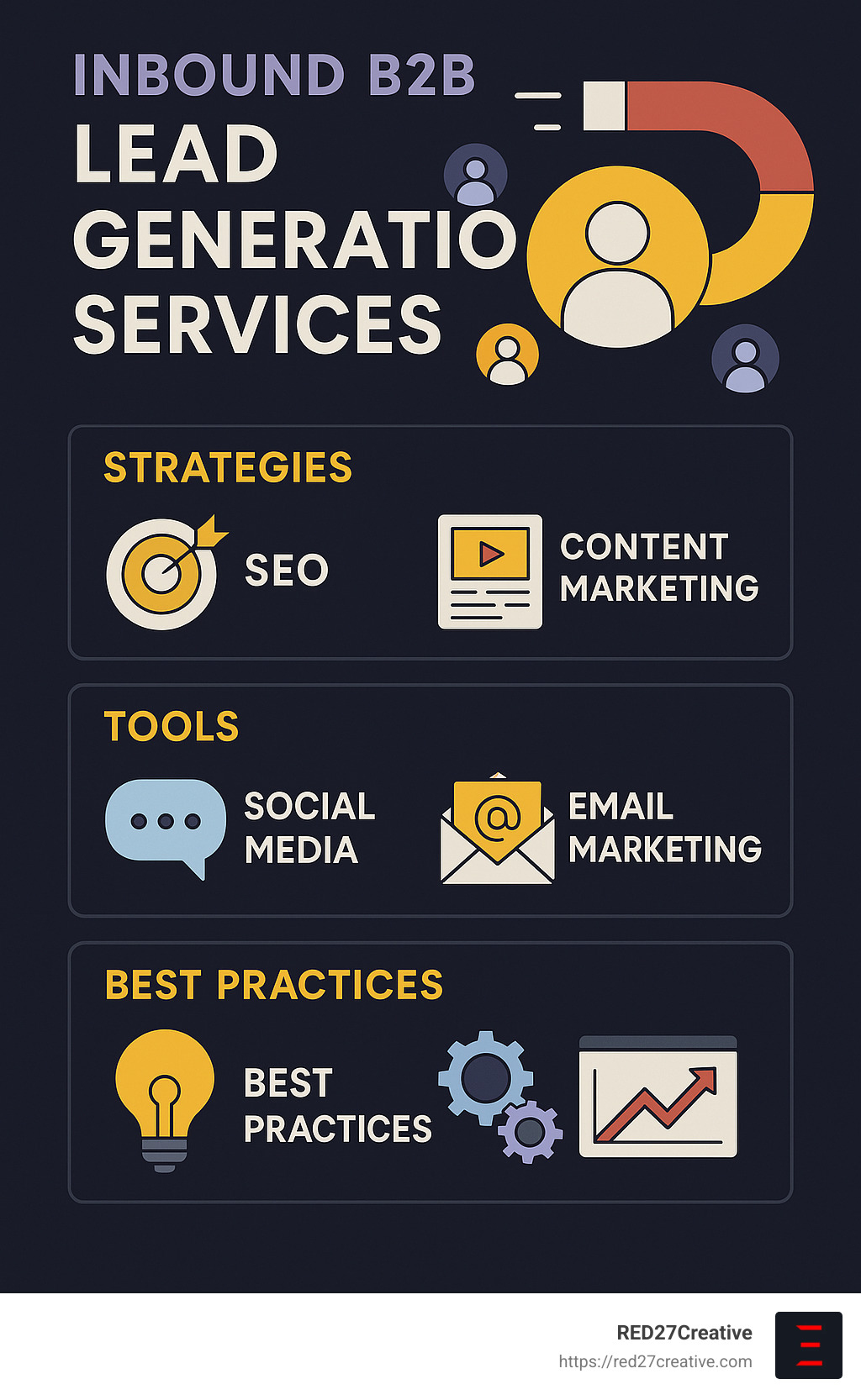
Inbound b2b lead generation services are marketing strategies designed to attract potential business customers by producing valuable content custom to their specific needs, rather than using disruptive or pushy methods.
Here’s how inbound B2B lead generation typically works:
- Attract: Create targeted content (blogs, videos, SEO) that answers customers’ common problems.
- Engage: Convert visitors into qualified leads with helpful guides, whitepapers, webinars, and optimized landing pages.
- Nurture & Convert: Use personalized messaging, email campaigns, and CRM systems to build trust and close deals.
Using inbound strategies helps businesses generate leads that are more relevant, cost-effective, and likely to convert than traditional outbound methods (e.g., cold calling or direct advertising).
Inbound b2b lead generation services further reading:
Understanding Inbound B2B Lead Generation Services
B2B buyers have completely transformed the way they research, evaluate, and ultimately purchase products or services. Think about your own buying habits—when was the last time you picked up your phone to call a salesperson right away? Probably not recently, right? You’re not alone. Studies show that over 70% of B2B buyers already have a clear understanding of their needs before they ever talk to a sales representative. What’s more, nearly half have identified possible solutions before reaching out!
Because of this dramatic shift in buyer behavior, inbound b2b lead generation services aren’t simply nice to have—they’ve become an essential ingredient for growing your business effectively in today’s digital marketplace.
What is Inbound B2B Lead Generation?
So, what exactly is inbound B2B lead generation?
In simple terms, it’s a marketing approach focused on pulling potential customers toward your business instead of pushing sales messages outward. Picture your business as a magnet, attracting customers not through loud, interruptive advertising, but through genuinely helpful, educational, and engaging content custom specifically to their interests.
Rather than annoying your audience by cold-calling or sending unwanted messages, inbound lead generation is all about creating valuable content that answers their questions, solves their problems, and helps them make informed decisions. After all, who doesn’t appreciate a helpful tip or an insightful guide?
According to industry insights, inbound marketing has proven incredibly effective at attracting quality leads. By positioning your brand as a trusted advisor rather than just another vendor, you’re doing more than just generating leads—you’re building relationships and trust. As one recent marketing report put it playfully: “Inbound marketing emerges as the guide of efficacy, guiding enterprises through the dynamic landscape of modern commerce.”
This methodology isn’t complicated. First, it involves using valuable, relevant content to draw potential customers to your website. Once they’re there, strategic conversion points—like carefully designed landing pages, helpful ebooks, or engaging webinars—transform these visitors into qualified leads. From there, it’s all about consistently nurturing these relationships with personalized messages, building trust until they’re ready to become loyal customers and enthusiastic brand advocates.
Does inbound marketing really deliver results? Absolutely! Research has found that businesses leveraging inbound marketing generate around 54% more leads compared to traditional, outbound methods alone. Even better, inbound marketing campaigns typically see a conversion rate that’s three times higher than outbound methods like cold-calling or unsolicited emails. Pretty impressive, right?
Difference Between Inbound and Outbound Lead Generation Services
To truly appreciate what makes inbound b2b lead generation services special, let’s quickly explore how they compare to traditional outbound marketing.
For starters, inbound methods use a “pull” approach—naturally attracting interested prospects looking for solutions. Outbound, on the other hand, relies on a “push” tactic—interrupting prospects who may not even be interested. Think of inbound marketing like setting out fresh-baked cookies on the counter; visitors are drawn in by the sweet aroma. Outbound is more like knocking door-to-door, offering cookies to everyone, even those on a diet!
Another significant factor is cost-effectiveness. Studies show inbound strategies cost roughly 62% less per lead compared to outbound methods. Plus, the leads generated through inbound efforts tend to have much higher intent and self-qualification, resulting in an impressive average close rate of 14.6% compared to just 1.7% for outbound leads.
Content style also varies widely between these two approaches. Inbound lead generation relies on creating genuinely educational and helpful content, whereas outbound tends to focus mostly on promotional, sales-driven messages. This difference drastically impacts customer experience: inbound is non-intrusive and value-driven, whereas outbound often comes across as interruptive and can even be irritating.
Finally, inbound marketing strategies are built to deliver long-term, sustainable results, whereas outbound campaigns are typically short-term and campaign-specific.
To visualize these differences clearly, here’s a handy comparison table:
| Aspect | Inbound Lead Generation | Outbound Lead Generation |
|---|---|---|
| Approach | Pull (attracts prospects) | Push (interrupts prospects) |
| Customer Mindset | Actively seeking solutions | May not be interested |
| Cost-Effectiveness | 62% less cost per lead | Higher acquisition costs |
| Lead Quality | Higher intent, self-qualified | Often lower qualification |
| Close Rate | 14.6% average | 1.7% average |
| Content Focus | Educational, helpful | Promotional, sales-focused |
| Timeline | Long-term, sustainable | Short-term, campaign-based |
| Customer Experience | Non-disruptive, value-adding | Often disruptive, interruptive |
As one marketing expert cleverly puts it, “A sharp hook with irresistible bait beats a passive fishnet every time.” Inbound marketing is like that irresistible bait: it carefully attracts exactly the right prospects, rather than blindly casting a wide net hoping to catch anyone.
At RED27Creative, we’ve personally witnessed remarkable results from businesses across Chicago, Naperville, Aurora, and throughout Illinois who’ve transitioned from traditional, outbound-heavy approaches to strategic inbound lead generation. If you’re ready to boost your business growth with inbound strategies, we’re here to help you get started.
Key Components of a Successful Inbound B2B Lead Generation Strategy
Creating a winning inbound b2b lead generation services strategy is a bit like cooking your favorite recipe. You need the right ingredients, the correct amounts, proper timing, and a dash of creativity. When done right, these ingredients combine seamlessly to attract, engage, and convert ideal customers for your business. Let’s explore the essential pieces that make up a powerhouse inbound strategy:

Content Marketing in Inbound B2B Lead Generation Services
Think of content marketing as the magnet pulling potential leads toward your business. Exceptional content answers your prospects’ biggest questions, solves their pain points, and establishes your company as a trusted guide in their buying journey.
Blogs and articles are usually the starting point of your content strategy. Businesses that regularly blog experience about 67% more leads monthly, according to the Content Marketing Institute. Well-written blogs addressing industry challenges can position your brand as a knowledgeable friend who always has the right answers.
Studies such as HubSpot’s 2018 State of Inbound Global Results highlight how well-crafted content can significantly improve inbound results, helping your brand stand out in a crowded marketplace.
Going deeper, resources like whitepapers and e-books provide rich insights, tackling complex industry issues. These are typically gated content, meaning prospects share their contact information to access them—changing visitors into leads.
Case studies share real-world stories of how your solutions have helped similar businesses succeed. These success stories build credibility and trust, reassuring potential customers that your services deliver results.
Webinars and engaging video content offer interactive experiences. They help build stronger relationships with leads by providing a face to your brand and allowing prospects to ask questions in real-time. Did you know nearly 52% of B2B buyers are more likely to choose a vendor after engaging with their content?
And don’t underestimate the power of visual content like infographics. Clearly displayed graphics simplify complex topics, making your message easy to consume and share.
At RED27Creative, we tailor our content marketing strategies specifically to your audience’s needs, ensuring maximum relevance for businesses in places like Geneva, Batavia, St. Charles, and beyond.
Leveraging SEO and Social Media
Even the most compelling content won’t attract leads if your audience can’t find it. That’s where Search Engine Optimization (SEO) and social media come into play as essential companions to your content strategy.
SEO helps your content show up at the top of search results when potential leads are actively looking for solutions. For B2B companies, SEO often involves targeting very specific, industry-focused keywords that decision-makers use during their research phase. When done effectively, SEO can give your business up to 11 times more visibility than brands that ignore it.
Social media platforms, especially LinkedIn, are vital for distributing your content to a targeted audience. LinkedIn alone generates approximately 80% of B2B social media leads, far surpassing other platforms like Twitter (13%) or Facebook (7%). Twitter remains valuable for industry discussions and content sharing, and YouTube, being the second-largest search engine, is excellent for educational videos. Even Facebook and Instagram can help reach business decision-makers through targeted ads.
SEO and social media channels drive the visibility your inbound strategy needs to succeed, creating natural opportunities for potential clients to engage with your brand.
Lead Nurturing and CRM Integration
Generating leads is only the beginning—turning them into loyal customers involves thoughtful nurturing and personalized communication. That’s where lead nurturing strategies and CRM tools become critical.
Lead scoring ensures your sales team prioritizes the right leads. By assigning scores based on factors like demographics (industry, company size) and behaviors (content interactions, downloads), you can identify the most promising prospects quickly. Companies that excel at nurturing leads typically generate 50% more sales-ready leads, at 33% lower cost than those who overlook this step.
Segmentation takes nurturing even further by categorizing your leads into groups based on shared characteristics. By sending highly personalized messages custom to each segment, your emails get roughly 100% higher click-through rates compared to generic messages.
A robust CRM system integrates seamlessly with your inbound strategy, providing a central hub for tracking customer interactions, automating personalized follow-ups, and keeping sales and marketing teams aligned. Think of your CRM as the heartbeat of your inbound effort—it tracks every touchpoint, optimizes engagement, and provides sales teams with valuable insights at their fingertips.
At RED27Creative, we help businesses across Plainfield, Oswego, and the greater Chicago area implement comprehensive lead nurturing solutions and CRM integration, aligning marketing and sales teams for real business growth.
By blending content marketing, SEO, social media, lead nurturing, and CRM technology, your inbound B2B lead generation becomes a well-oiled machine designed for sustainable growth—and maybe even a little fun along the way!
Strategies to Effectively Attract and Convert Inbound Leads
Now that you’re familiar with the key components of inbound b2b lead generation services, let’s explore some practical, proven strategies to attract and convert high-quality leads. These tactics will help you bridge the gap between visitor engagement and effective conversions.
Utilizing Calls-to-Action (CTAs) and Landing Pages
A well-crafted Call-to-Action (CTA) paired with an effective landing page can turn casual visitors into potential customers. Think of your CTA as a friendly salesperson gently nudging your visitors toward the next step.
Research shows personalized CTAs convert up to 202% better than generic ones. Why? Because people love feeling understood and valued.
When crafting CTAs, make sure to use clear, action-oriented language such as “Download Your Free Guide,” “Register for Our Webinar,” or “Get Started Now.” These phrases eliminate confusion, letting visitors know exactly what’s next.
You can also boost conversions by creating a sense of urgency in your wording. Phrases like “Limited Time Offer” or “Reserve Your Spot Today” encourage immediate action.
Be sure your CTA clearly communicates the value of the offer. Visitors should instantly see what’s in it for them. And visually, your CTA should stand out gracefully from the rest of your page—think bold colors, subtle shading, or inviting buttons.
As one lead generation expert puts it, “Volume isn’t the goal. Quality is everything.” It’s better to have fewer, thoughtfully placed CTAs than dozens cluttering your website.
Once visitors click your CTA, they arrive on your landing page. A landing page is simply a focused webpage designed specifically to capture visitor information in exchange for your offer—no distractions, no unnecessary links.
Effective landing pages should have just one clear goal and one offer. Keep navigation minimal to prevent visitors from leaving before converting. Clearly highlight benefits, feature social proof such as client testimonials or industry awards, and ensure your messaging matches the CTA exactly.
As a rule of thumb, your landing page form should be short and sweet. Only ask for essential information—usually name, email, and perhaps a company name or job title—so you don’t scare away potential leads with lengthy forms.
And don’t forget to optimize for mobile! With so many decision-makers researching solutions on their phones, your landing pages must look and work flawlessly on all devices.
Did you know companies with 40+ landing pages generate 12 times more leads compared to those with just five or fewer pages? But remember, quantity alone isn’t enough. Each landing page needs to be carefully custom to specific audience segments or offers.
Personalization and Segmentation in Inbound B2B Lead Generation Services
Gone are the days of generic, one-size-fits-all marketing. Today’s B2B buyers expect personalized experiences custom exactly to their needs. In fact, a recent study revealed that 72% of B2B customers want vendors to personalize engagement. Who doesn’t love feeling special?
One powerful way to do this is through Account-Based Marketing (ABM). ABM involves flipping the traditional marketing funnel upside-down. Instead of reaching out widely, you carefully select a set of high-value accounts first and then create custom content and experiences specifically for those target companies.
This approach perfectly complements inbound lead generation. It allows you to deliver highly relevant content directly to key decision-makers at businesses you’d love to partner with, dramatically boosting your conversion rates.
Another great approach is behavioral segmentation. Here, you group prospects based on how they interact with your content—whether it’s downloads, pages they’ve visited, or emails they’ve opened. Once segmented, you deliver targeted messages matching their interests and current stage in the buyer’s journey.
Finally, let’s talk about personalized content experiences. Imagine visiting a website that immediately displays content relevant to your industry or your specific needs—pretty helpful, right? You can implement similar dynamic content strategies to delight your website visitors.
Beyond the website, personalized email nurture sequences—custom based on visitors’ previous interactions—can dramatically improve engagement, gently guiding prospects closer toward conversion.
As one marketing strategist explains, “By using inbound B2B lead generation services, you can build a constant flow of prospects, making it easier for your team to close deals and increase revenue.” Personalization fine-tunes this flow, ensuring each prospect receives exactly the right information at just the right moment.
At RED27Creative, we’ve helped businesses throughout Chicago, Naperville, and surrounding areas implement powerful personalization and segmentation strategies. With the right tactics, you too can turn visitors into loyal clients—one personalized interaction at a time.
Measuring the Success of Inbound Lead Generation Campaigns
You’ve invested time, energy, and resources into your inbound b2b lead generation services, but how do you know if they’re truly working? The only way to be sure is to regularly measure your performance. By tracking key metrics, you can clearly see what’s effective, what’s falling short, and where to allocate your marketing budget moving forward.
Think of tracking your metrics like checking the scoreboard during a sports match—if you don’t know the score, how do you know if you’re winning? Let’s dig into the essential metrics that every B2B inbound campaign should monitor.
Essential Metrics to Track
Lead Generation Metrics
At the heart of your inbound campaign lies the ability to attract and convert valuable leads. To understand how well you’re doing, start by looking at the total leads generated. This simple number indicates your campaign’s overall performance in attracting potential customers.
Next, dig deeper and analyze your lead source performance. Knowing whether most of your leads come from organic search, social media, email newsletters, or paid channels helps you invest resources smartly.
However, quantity isn’t enough—it’s quality that really counts. That’s why it’s crucial to track lead quality metrics like your:
- Lead-to-MQL (marketing-qualified lead) conversion rate
- MQL-to-SQL (sales-qualified lead) conversion rate
- SQL-to-opportunity conversion rate
- Opportunity-to-customer conversion rate
These metrics help you understand how effectively leads move through your sales funnel, pinpointing exactly where prospects drop off and where you can improve nurturing strategies.
Don’t forget to keep an eye on your cost per lead (CPL)—the total inbound marketing spend divided by the number of leads generated. Lower CPL generally means higher efficiency, and inbound typically shines here. In fact, inbound marketing campaigns cost about 62% less per lead compared to outbound methods. (Not bad, right?)
Lastly, measure your time to conversion—how long it takes for leads to journey through the funnel and become customers. Shortening this timeline means faster revenue and improved efficiency overall.
Content Performance Metrics
Quality content powers your inbound marketing strategy. But how do you know if your content truly resonates with your audience?
First, check your traffic metrics, such as page views, unique visitors, and referral sources. This tells you which pieces of content are most popular and how visitors find your brand.
Next, evaluate engagement metrics (like time spent on page, scroll depth, and bounce rates). If visitors stick around and dive deeper into your content, it means you’re capturing their interest effectively. If they’re bouncing off quickly, perhaps it’s time to revisit your content strategy.
Don’t overlook your conversion metrics. How well does each piece of content convert visitors into leads? After all, generating traffic is great—but leads are what fuel growth.
To truly grasp content effectiveness, dive into attribution analysis. This helps identify exactly which content pieces impact leads at various stages of the buyer’s journey. Understanding attribution allows you to create content specifically custom to each stage, boosting your chances of conversion.
ROI Metrics
At the end of the day, executives want numbers. And by “numbers,” we mean return on investment (ROI). Show the real value of your marketing efforts by tracking financial metrics like:
Your customer acquisition cost (CAC)—the total spending required to turn a lead into a paying customer via inbound marketing.
Your customer lifetime value (CLV)—the total revenue you anticipate from a customer throughout their entire relationship with your business.
Your CLV:CAC ratio—ideally, your customer’s lifetime value should be at least three times your customer acquisition cost. This ratio indicates healthy profitability and sustainable business growth.
Finally, measure your time to ROI (the length of time it takes for your inbound marketing investments to pay for themselves). Shorter ROI times indicate more efficient, impactful campaigns.
At RED27Creative, we consistently help businesses around Chicago, Naperville, Aurora, and beyond use comprehensive analytics tools like CRM platforms, marketing automation software, and Google Analytics to track these essential metrics. Keeping an eye on your metrics ensures that your efforts consistently drive measurable, meaningful results.
As one seasoned marketer wisely said:
“Success can be measured by tracking key metrics like lead conversion rates, website traffic, email engagement, and overall sales growth using CRM and Google Analytics platforms.”
We couldn’t agree more. What gets measured gets improved—so keep tracking, analyzing, and refining your inbound b2b lead generation services to fuel lasting growth.
Overcoming Common Challenges in Inbound B2B Lead Generation
Inbound marketing is powerful, effective, and highly efficient—but let’s be real—it isn’t always easy. Like anything worth doing, inbound B2B lead generation services come with their share of challenges. Luckily, with a smart strategy and a bit of humor, these challenges become manageable stepping stones rather than stumbling blocks.
Let’s explore some of the most common roadblocks companies face and, more importantly, how you can overcome them.
Ensuring Lead Quality in Inbound Strategies
Generating a steady flow of leads is fantastic—unless those leads have no real interest in your products or services. Quality matters just as much as quantity (if not more). As the saying goes, “Quality leads are the foundation of a successful B2B sales strategy.”
The good news? You can maintain high-quality leads even as your traffic grows. Here’s how:
First, implement robust lead scoring. Think of lead scoring as your inbound marketing bouncer—it lets the right leads through while turning away those who aren’t quite right. Good lead scoring systems typically look at company characteristics (size, industry, revenue), how prospects engage with your content and website, the technology they currently use, and even intent signals like the topics they’re researching.
Next, refine your Ideal Customer Profile (ICP) regularly. Your ICP isn’t a “set it and forget it” thing. Regularly revisit it by analyzing your most successful customers, tracking market shifts, and gathering feedback from your sales team. A precise and updated ICP ensures you’re targeting the right audience with laser-like accuracy.
Lastly, balance gated and ungated content strategically. Ungated content helps you attract visitors and build awareness, while gated content allows you to capture valuable lead information. By mixing these two effectively—and using progressive profiling (asking for information gradually)—you can gently guide visitors into becoming highly qualified leads.
Content Saturation: Standing Out from the Crowd
Today, everyone is creating content. Your competitors are blogging, running webinars, and publishing guides—so how do you stand out?
Simple: focus on deeper, specialized content. Instead of writing surface-level articles everyone else has covered, create content that tackles specific pain points with unique insights. When your content offers something truly valuable and different, prospects naturally gravitate toward your brand and trust grows.
Aligning Sales and Marketing Teams
Ever felt like your sales and marketing departments are speaking entirely different languages? You’re not alone! But aligning these two teams can make your inbound strategy soar.
To bridge this gap, try creating clear service-level agreements (SLAs) between sales and marketing. These agreements outline exactly what each department expects and provides. Establishing clear lead handoff processes and creating open feedback loops also helps keep everyone on the same page. When sales and marketing teams communicate openly, everyone wins—especially your bottom line.
Working Around Resource Constraints
If you don’t have unlimited budget or time (spoiler alert: nobody does!), you might feel overwhelmed by inbound marketing’s demands. Relax—effective inbound lead generation doesn’t necessarily require massive resources.
Start small by focusing on high-impact content types first, like detailed guides or targeted webinars. Then get creative by repurposing content in multiple formats. For example, turn one detailed guide into blog posts, infographics, and social media snippets. And if needed, don’t hesitate to partner with specialized agencies like us at RED27Creative. A little experienced help can go a long way!
Dealing with Long Sales Cycles
B2B sales cycles can take months—or even years. Staying patient and consistent through these long cycles can test your inbound marketing resolve.
The solution? Create nurturing campaigns specific to each stage of the buyer’s journey. When leads lose steam, implement re-engagement campaigns to revive their interest. And pay close attention to buying intent signals (content viewed, pages visited, search queries) to identify when prospects are ready to move ahead. This helps your sales team focus their efforts effectively and shortens your sales cycle over time.
Attribution Challenges: Proving What’s Working
With multiple touchpoints and channels involved, pinpointing exactly what drives conversions can feel like detective work. But clear attribution is possible—and critical—for optimizing your inbound strategy.
Adopt multi-touch attribution models to clearly identify important interactions across channels. Consistently use UTM parameters to track sources effectively, and ensure tight integration between your marketing automation platform and your CRM. When data flows smoothly, attribution becomes simpler, letting you confidently invest in what truly drives growth.
At RED27Creative, we’ve helped businesses in Geneva, Batavia, Aurora, St. Charles, and beyond tackle these common challenges head-on. By combining insightful strategies, advanced technology integration, and a bit of good-natured humor, we ensure your inbound B2B lead generation services not only succeed but truly thrive.
Essential Tools and Technologies for Effective Inbound B2B Lead Generation
Remember when marketing tools meant a rolodex and a fax machine? Those days are long gone! Today, the right digital toolkit can transform your inbound b2b lead generation services from merely functional to absolutely phenomenal. Let’s explore the game-changing technologies that modern B2B marketers simply can’t live without.

Think of your tech stack as the engine that powers your lead generation machine. At the heart of this engine sits your CRM system – the central nervous system that connects everything else. Whether you prefer the user-friendly interface of HubSpot CRM, the robust customization of Salesforce, the affordability of Zoho CRM, or the Microsoft integration of Dynamics 365, your CRM should serve as the single source of truth for all customer interactions.
“I remember when we finally consolidated all our customer data into one CRM,” a client once told me. “It was like someone turned on the lights in a dark room. Suddenly, we could see everything clearly.” This clarity is invaluable when tracking the complex journey from prospect to customer.
Beyond your CRM, marketing automation platforms like HubSpot Marketing Hub, Marketo, Pardot, or ActiveCampaign handle the heavy lifting of nurturing leads. These platforms don’t just save time – they create personalized experiences that would be impossible to deliver manually. Imagine having a tireless team member who remembers every prospect interaction, sends perfectly timed follow-ups, and always knows exactly what content to share next. That’s what good automation provides.
Your website serves as your digital storefront, making your content management system (CMS) another critical piece of technology. WordPress remains the most popular option due to its flexibility and extensive plugin ecosystem, while HubSpot CMS Hub offers seamless integration with their marketing and sales tools. Drupal provides enterprise-level security, and Contentful excels for companies managing content across multiple platforms.
The digital landscape is constantly evolving, which is why SEO and analytics tools are non-negotiable components of your stack. Google Analytics provides the foundation for understanding website performance, while specialized tools like SEMrush, Ahrefs, and Moz Pro help identify opportunities to improve visibility. One of our clients at RED27Creative increased their organic traffic by 87% in six months simply by implementing the keyword insights we finded through these tools.
Social media has transformed from a nice-to-have to a must-have channel for B2B lead generation. Tools like Hootsuite, Buffer, and Sprout Social help manage posting schedules and engagement, while LinkedIn Sales Navigator offers powerful targeting capabilities specifically for B2B prospecting. The social landscape may seem overwhelming, but with the right tools, it becomes manageable and measurable.
Want to know more about your prospects without making them fill out lengthy forms? Lead intelligence and enrichment tools like ZoomInfo, Clearbit, and BuiltWith can provide valuable insights about companies visiting your site. This technology helps you understand your prospects better and personalize your approach accordingly.
Finally, don’t forget about conversion optimization tools. Platforms like Unbounce make it easy to create and test landing pages, while Hotjar reveals how users actually interact with your pages through heatmaps and session recordings. Google Optimize offers A/B testing capabilities that help you continuously improve conversion rates.
The impact of these technologies is profound. According to industry research, companies leveraging marketing automation generate an astounding 451% more qualified leads than those relying on manual processes. That’s not just an incremental improvement – it’s a complete change of what’s possible.
At RED27Creative, we’ve seen how the right technology can amplify results for businesses across Chicago, Naperville, and beyond. One manufacturing client struggled for years with disconnected marketing tools that created data silos and inefficient workflows. After helping them implement an integrated stack with HubSpot at the center, their lead quality improved dramatically while their team spent less time on administrative tasks and more time on creative strategy.
Though – technology is only as good as the strategy behind it and the people using it. The most sophisticated tools in the world won’t help if they’re not aligned with your business goals and properly configured for your specific needs. That’s why we help clients not just select the right tools but also ensure they’re properly implemented, integrated, and optimized for their unique requirements.

As you build your technology stack for inbound b2b lead generation services, integration is key. Tools that work well together create efficiencies and insights that standalone solutions simply can’t match. Start with your core needs, then gradually expand as your team becomes comfortable with each new addition. Technology should empower your team, not overwhelm them.
The right technology doesn’t just make inbound lead generation possible—it makes it scalable, measurable, and increasingly effective over time. When your tools work in harmony, you create a system that continuously improves, delivering better results with less effort as it matures.
Frequently Asked Questions about Inbound B2B Lead Generation Services
What role does content marketing play in inbound B2B lead generation?
Content marketing isn’t just a buzzword; it’s the very heart of inbound B2B lead generation services. Think of it like setting out a tasty snack on your kitchen counter—that irresistible treat that draws everyone into the room.
High-quality, SEO-optimized content helps attract potential customers who are actively searching for answers. By publishing blogs, guides, and videos that directly address your target audience’s pain points, you naturally draw them toward your business.
Beyond simply attracting visitors, strategic content marketing positions your company as a trusted thought leader. Creating educational, insightful content establishes your expertise and makes prospects eager to connect with your brand.
But the journey doesn’t end at attracting prospects. Carefully crafted content custom to each stage of your buyer’s journey can nurture leads, gently guiding prospects from initial awareness through to purchase readiness. And when the sales team steps in, compelling case studies, whitepapers, and product guides provide invaluable resources to overcome objections and close more deals.
In fact, research indicates that B2B companies with active blogs generate 67% more leads per month than those without. Bottom line? Content marketing isn’t optional—successful inbound lead generation.
How can SEO and social media improve inbound lead generation efforts?
SEO and social media are like your inbound marketing dynamic duo—Batman and Robin, peanut butter and jelly—they’re simply better together.
SEO (search engine optimization) is all about ensuring your content appears front and center when prospects turn to Google for help. By targeting strategic keywords aligned with your audience’s pain points, SEO drives targeted, high-intent traffic directly to your website. Over time, consistent SEO efforts build credibility and establish your brand as an authoritative resource in your industry. Plus, insights from SEO analytics give you valuable data on customer preferences and behavior, helping shape your future content strategies.
Social media complements SEO by expanding your reach beyond organic search results. While SEO captures the demand that already exists, social media lets you proactively build relationships with prospects and industry influencers. Platforms like LinkedIn, Twitter, and even YouTube enable you to share your content, engage directly with potential buyers, and provide additional avenues for lead nurturing.
According to industry research, organic search drives about 53% of website traffic, while social media contributes around 5%. But don’t underestimate social media—leads coming through these channels often demonstrate higher engagement, quicker conversions, and stronger affinity with your brand.
Together, SEO and social media form a powerful inbound lead-generation engine that continuously attracts qualified prospects and nurtures them toward becoming loyal customers.
What are effective ways to measure the success of inbound lead generation campaigns?
Measuring success in inbound B2B lead generation services isn’t about vanity metrics or simply counting visitors. It’s about clearly tracking performance across every stage of your funnel, from attraction through to conversion and ROI.
At the top of your funnel, you’ll want to monitor metrics like website traffic numbers, engagement rates (such as page views and time on page), and growth across channels like social media. These numbers offer clues about how effectively your content attracts visitors and captures their attention.
Moving further down, it’s important to measure how effectively your visitors convert into leads. Keep an eye on metrics such as lead conversion rates, Marketing Qualified Leads (MQLs), and email engagement figures. Regularly analyzing these numbers helps you find which content and campaigns resonate best with your audience.
As leads move closer to purchase, focus on bottom-of-the-funnel metrics. These include Sales Qualified Leads (SQLs), opportunities created, sales cycle length, and closing ratios. Understanding these metrics reveals insights into your sales effectiveness and helps you optimize your strategies to shorten cycles and increase win rates.
Finally, don’t forget to track your ROI metrics. These include cost per lead, customer acquisition cost (CAC), customer lifetime value (CLV), and overall return on marketing investment (ROMI). By continually assessing these numbers, you’ll clearly understand the profitability and efficiency of your inbound strategies—and how to continually refine, optimize, and scale your approach.
At RED27Creative, we build comprehensive measurement frameworks customized specifically for our clients across Plainfield, Oswego, Naperville, and Chicago. The goal? Helping you gain complete visibility into your inbound lead generation performance, so you can continually improve and grow your business.
Conclusion
As we’ve explored throughout this guide, inbound b2b lead generation services have evolved from a nice-to-have marketing approach to an absolute necessity for companies looking to thrive in today’s digital landscape. The numbers don’t lie – and they tell a compelling story about why businesses are shifting their strategies.
Think about it: when inbound leads close at a rate of 14.6% compared to outbound’s measly 1.7%, it’s not just a slight improvement – it’s a complete change of your sales potential. And who doesn’t want to pay less for better results? With inbound marketing costing 62% less per lead than traditional methods while delivering 3x higher conversion rates, the business case practically writes itself.
But successful inbound marketing isn’t something you can just switch on overnight. It requires a thoughtful blend of compelling content, technical expertise, and strategic planning. The businesses we’ve helped across Geneva, Batavia, Aurora, St. Charles, Plainfield, Oswego, Naperville, and throughout Chicago have finded that the magic happens when all these elements work in harmony.
At RED27Creative, we’ve seen how transformative a well-executed inbound strategy can be. We’ve watched clients go from struggling with expensive, low-converting outbound tactics to building sustainable lead generation engines that consistently attract their ideal customers. The beauty of inbound is that it gets stronger over time – each piece of content you create continues working for you long after publication, unlike paid advertising that stops the moment you stop funding it.
Inbound success isn’t about quick wins or overnight changes. It’s about building a system that consistently attracts, engages, and delights your ideal customers through valuable content and meaningful interactions. With patience and the right approach, your business can create a lead generation machine that powers growth for years to come.
The digital landscape will continue evolving, but the fundamental principle of inbound marketing remains constant: when you focus on providing genuine value to your prospects before asking for anything in return, you build trust that translates into lasting business relationships.
Ready to transform your approach to lead generation? Learn more about our B2B Lead Generation Services and find how RED27Creative can help your business build a sustainable pipeline of qualified leads. Your future customers are already searching for solutions – let’s make sure they find you.
FAQ: Inbound B2B Lead Generation
What is the difference between inbound and outbound lead generation?
Think of inbound and outbound lead generation strategies like inviting someone over versus knocking unannounced on their door. Inbound lead generation focuses on attracting potential customers by sharing helpful, valuable content custom specifically to their needs. It works because prospects are already searching for solutions, making them more receptive and engaged.
In contrast, outbound lead generation interrupts potential customers with promotional messages they might not want, like cold calls or random email blasts. While outbound might reach more people faster, inbound typically delivers higher quality leads at a fraction of the cost—actually about 62% less! Plus, inbound leads convert at an impressive 14.6%, compared to outbound leads that typically close at a mere 1.7%.
So, inbound is like inviting interested prospects to come to you, while outbound is more like going door-to-door and hoping someone answers!
How long does it take to see results from inbound B2B lead generation?
Great question—and the honest answer is: it depends. Typically, you’ll start seeing initial results from your inbound b2b lead generation services within the first month or two, especially if you use paid tactics like social media promotion or PPC ads to amplify your content.
However, organic inbound methods—such as content marketing and SEO—take a bit more patience. Usually, these strategies start building significant traction after about 3 to 6 months.
For the full benefits of inbound marketing—including higher search engine rankings, establishing your brand as an authority, and creating a steady pipeline of quality leads—you’ll usually need to invest in consistent efforts for 6 to 12 months. Think of inbound marketing as planting a garden. Flowers don’t bloom overnight, but with the right care and nurturing, you’ll enjoy a beautiful harvest of leads and customers down the road.
What types of content work best for B2B inbound lead generation?
When it comes to content, there’s no one-size-fits-all solution—but certain formats consistently perform well for B2B inbound lead generation. In-depth blog posts that address common industry challenges, comprehensive guides and ebooks, and informative case studies demonstrating your real-world successes are all highly effective.
Interactive webinars and video content also stand out, as they help you engage directly with potential customers and build stronger relationships. Don’t overlook original research either—providing your prospects with unique industry insights can truly set your brand apart.
The best content answers your ideal customers’ questions clearly and thoroughly, positioning you as a trusted resource and thought leader in your field. By tailoring your content to each stage of the buyer journey, you’ll continually move your prospects closer toward becoming loyal clients.
How much should I budget for inbound B2B lead generation?
Budgeting for inbound b2b lead generation services can feel tricky at first—but let’s simplify it. Typically, B2B companies dedicate around 2-5% of their total annual revenue to marketing, with roughly half to two-thirds of that specifically allocated toward inbound lead generation.
For example, a mid-sized B2B business might invest between $5,000 and $15,000 monthly into their inbound marketing strategy. Of course, your exact budget will depend on factors like your industry competition, your growth goals, and your existing marketing setup.
Many companies start small, focusing on targeted initiatives. As they see ROI and build momentum, they scale their efforts and budget accordingly. At RED27Creative, we’ve helped businesses across Geneva, Naperville, and throughout Chicago start strategically and scale successfully.
How do I integrate inbound lead generation with my existing sales process?
Integrating your inbound efforts with your current sales process is all about alignment and clear communication between marketing and sales teams. First, define your lead stages clearly: Marketing Qualified Leads (MQL), Sales Qualified Leads (SQL), and opportunities. These definitions set expectations and streamline your lead handoff process.
Next, create established processes to ensure smooth transitions between marketing and sales. Effective CRM integration is crucial for tracking the full customer journey, keeping everyone on the same page. Regular meetings and open communication channels between teams ensure feedback flows easily, helping to continuously refine your efforts.
Lastly, accept service-level agreements (SLAs) between your marketing and sales teams. SLAs outline clear commitments and accountability standards, ensuring everyone knows their role in nurturing inbound leads and driving business growth.
At RED27Creative, we specialize in helping B2B businesses in Aurora, St. Charles, and beyond effectively integrate inbound lead gen with their existing sales processes. We’re here to ensure your teams not only coexist peacefully—but thrive together!

Kiel Tredrea
https://red27creative.comTop Marketing Agency • Web, SEO & Leads • RED27Creative