The Innovation Station: Transforming Manufacturing Processes

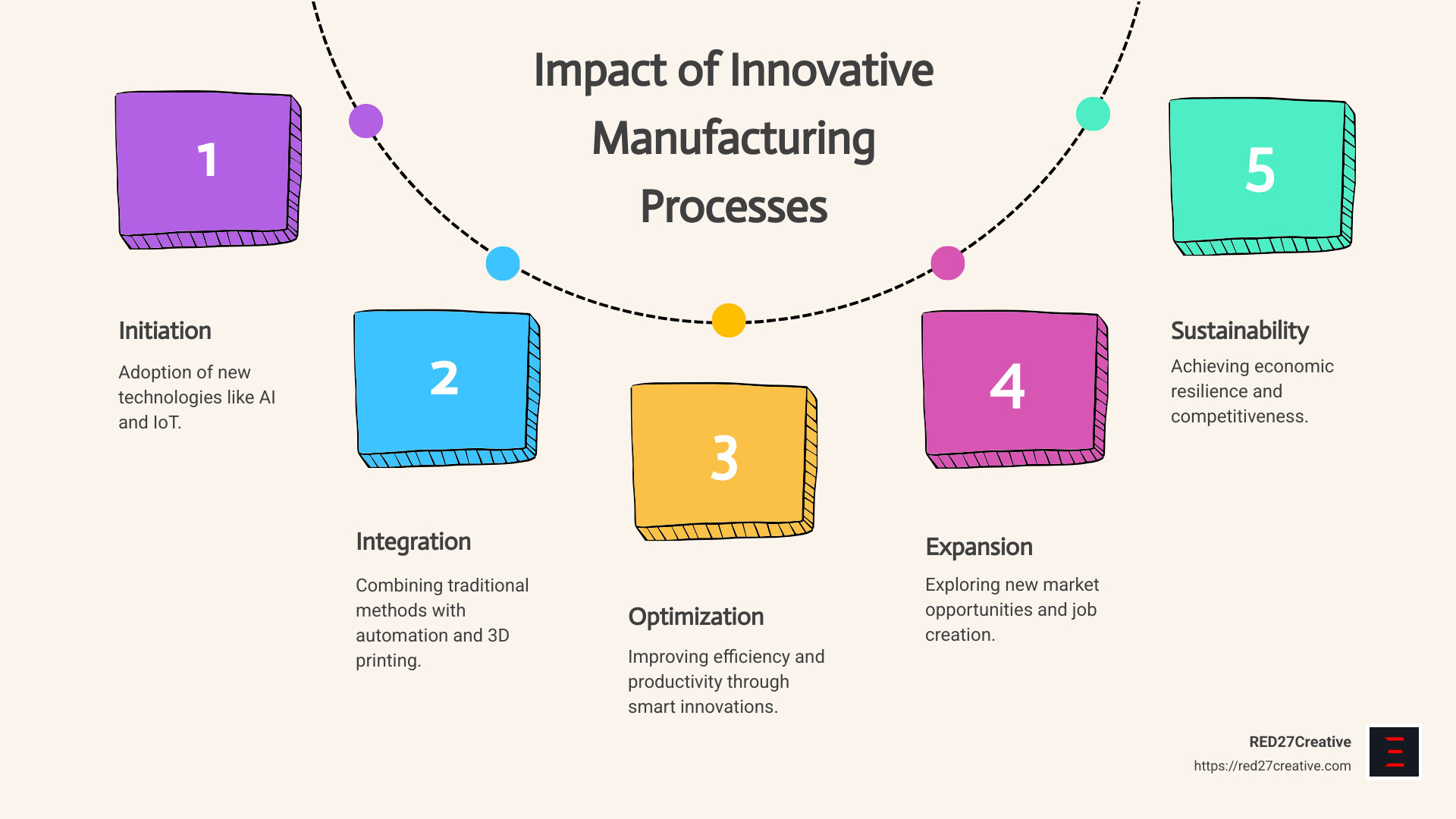
Innovative manufacturing processes are revolutionizing industries worldwide by integrating advanced technologies with traditional production methods. This transformation is essential for economic growth, driving industries towards more efficient and sustainable practices that align with evolving market demands. Let’s delve into how this innovation is reshaping the manufacturing landscape:
-
Catalyst for Economic Growth: Emerging manufacturing techniques enhance productivity, generate employment, and create new market opportunities.
-
Technological Advancements: Automation, 3D printing, IoT, and AI are at the forefront of modernizing manufacturing processes.
As we explore manufacturing innovation, it’s evident that these advancements are both necessary and powerful tools for fostering economic resilience and competitiveness.
My name is Kiel Tredrea. With over 20 years of experience in digital marketing and branding, I’ve observed how innovative manufacturing processes can transform industries by enhancing efficiency and driving economic growth.
Innovative manufacturing processes terms to know:
– Content marketing for manufacturers
– Industrial product photography
Understanding Innovative Manufacturing Processes
In the changing world of manufacturing, innovative manufacturing processes are the backbone of change. These processes integrate advanced technologies to improve efficiency, precision, and flexibility in production. Let’s break down some key concepts that drive this innovation:
Manufacturing Process Innovation
Manufacturing process innovation involves reimagining how products are made. This can mean adopting new technologies, improving existing methods, or even developing entirely new processes. The goal is to increase efficiency, reduce waste, and improve product quality. For instance, the shift from traditional labor-intensive methods to technology-led, flexible manufacturing is a prime example of this innovation. This shift allows manufacturers to be closer to market demand and reduce lead times, which is crucial for staying competitive.
Advanced Manufacturing
Advanced manufacturing uses cutting-edge technology to improve products and processes. This includes robotics, automation, and computer-aided design (CAD), which allow for high precision and complex designs. Techniques like laser metal deposition and ultrasonic soldering are paving the way for products that are not only more efficient but also more sustainable. These technologies enable manufacturers to work with advanced materials, such as carbon fiber composites, which are lighter and stronger, leading to more efficient products.
Manufacturing Process Innovation Index (MPI2)
To quantify and rank the effectiveness of these innovations, the Manufacturing Process Innovation Index, or MPI2, was developed. MPI2 evaluates manufacturing processes based on three core capabilities: precision, geometric complexity, and throughput speed. It also considers economic drivers like material compatibility, scalability, and development pace. This index helps manufacturers identify which processes offer the most value and are worth investing in.
Real-World Applications
Industries like aerospace and defense are at the forefront of using advanced manufacturing techniques. They use carbon fiber composites to build lighter, stronger aircraft, improving fuel efficiency and range. Meanwhile, the semiconductor industry is leveraging automation and new materials to meet the demands of AI and IoT applications. These sectors exemplify how innovative manufacturing processes are not just theoretical concepts but practical tools driving industry success.
By embracing these innovations, companies can not only improve their production capabilities but also position themselves as leaders in a competitive market.
In the next section, we’ll dive into the key technologies driving these innovations, such as automation, 3D printing, and AI. These technologies are essential for modernizing manufacturing processes and staying ahead in today’s industrial landscape.
Key Technologies Driving Innovation
In the rapidly evolving landscape of manufacturing, several key technologies are propelling innovation and changing production processes. Let’s explore how these technologies—automation and robotics, 3D printing, IoT, AI and machine learning, and advanced materials—are reshaping the industry.
Automation and Robotics
Automation and robotics are at the forefront of manufacturing innovation. These technologies improve efficiency and safety by taking on repetitive and hazardous tasks. Modern robotic systems are now more intelligent and versatile, capable of performing complex operations alongside human workers. This synergy not only speeds up production but also improves product quality and consistency.
3D Printing
3D printing, or additive manufacturing, is revolutionizing how products are designed and produced. By building items layer by layer, this technology minimizes waste and allows for rapid prototyping and customization. Industries from aerospace to fashion are using 3D printing to create intricate designs that were previously too costly or complex to manufacture using traditional methods.
- Example: Aerospace companies use 3D printing to produce lightweight components, enhancing fuel efficiency and reducing costs.
Internet of Things (IoT)
The Internet of Things (IoT) is changing manufacturing by enabling real-time data exchange and connectivity. IoT devices in factories collect data that manufacturers use to optimize operations, predict maintenance needs, and improve supply chain efficiency. This connectivity ensures that production processes are more agile and responsive to changes in demand.
- Case Study: An electronics manufacturer used IoT to virtually eliminate material handling labor through automated vehicles and robots, significantly boosting productivity.
AI and Machine Learning
Artificial Intelligence (AI) and Machine Learning (ML) are crucial for analyzing the vast amounts of data generated in modern manufacturing environments. These technologies enable real-time optimization of production processes, predictive maintenance, and proactive planning. By identifying inefficiencies and predicting future trends, AI and ML help manufacturers continuously improve and innovate.
Advanced Materials
Advanced materials offer new possibilities for innovation in product design and manufacturing processes. These materials, such as carbon fiber composites and biodegradable plastics, provide improved strength, durability, and environmental benefits. They are crucial for creating products that meet modern sustainability standards and performance expectations.
- Insight: Aerospace and defense industries lead in using advanced materials to create fuel-efficient and long-range aircraft.
By integrating these technologies, manufacturers can achieve greater productivity and efficiency, gain a competitive advantage, and optimize their supply chains. As these innovations continue to evolve, they promise to redefine what is possible in manufacturing.
In the next section, we’ll dig into the benefits of innovative manufacturing processes, exploring how they improve productivity, offer competitive advantages, and improve product quality and safety.
Benefits of Innovative Manufacturing Processes
Innovative manufacturing processes are reshaping industries by enhancing productivity, offering competitive advantages, optimizing supply chains, and improving product quality and safety. Let’s dig into these benefits and see how they transform manufacturing.
Productivity and Efficiency
One of the most significant advantages of innovative manufacturing processes is the boost in productivity and efficiency. By incorporating technologies like automation and robotics, manufacturers can streamline operations, reduce human error, and increase throughput. This not only shortens the time to market but also maximizes the use of resources.
- Stat: Every dollar spent in manufacturing generates an additional $2.79 for the U.S. economy.

Competitive Advantage
Manufacturers that prioritize innovation gain a competitive edge in the marketplace. By adopting cutting-edge technologies, they can enter new markets, attract more customers, and build stronger brand loyalty. This strategic positioning is crucial in an industry that is both hypercompetitive and commoditized.
- Case Study: An aerospace company used 3D printing to produce lightweight components, reducing costs and enhancing fuel efficiency, thus outpacing its competitors.
Supply Chain Optimization
The COVID-19 pandemic highlighted the fragility of global supply chains. Innovative manufacturing processes, supported by the Internet of Things (IoT) and AI, enable manufacturers to create more resilient and efficient supply chains. These technologies allow for real-time monitoring and predictive analytics, helping companies anticipate and respond to disruptions effectively.
- Example: A manufacturer implemented IoT solutions to automate material handling, drastically reducing labor costs and improving supply chain efficiency.
Product Quality and Safety
Innovation ensures that product quality and safety are not compromised despite rapid production processes. Advanced manufacturing techniques, such as AI-based inspections and quality analytics, help identify and rectify defects early, ensuring that only the best products reach the market.
- Insight: A European automobile manufacturer increased its first-pass task completion by 40% using real-time problem-solving tools.
Innovative manufacturing processes offer substantial benefits that extend beyond immediate operational improvements. They pave the way for long-term sustainability, economic growth, and job creation by enabling manufacturers to adapt and thrive in an changing market landscape.
In the next section, we’ll address some frequently asked questions about innovative manufacturing processes, including what they entail and how they contribute to economic growth.
Frequently Asked Questions about Innovative Manufacturing Processes
What is manufacturing process innovation?
Manufacturing process innovation refers to the introduction of new methods, technologies, and materials to improve production efficiency, quality, and flexibility. It encompasses various types of manufacturing, such as repetitive, discrete, and job shop manufacturing.
-
Repetitive Manufacturing: This involves the continuous production of the same product or component. Think of an assembly line where identical items are produced non-stop. Innovation here might involve automating tasks to reduce labor costs and increase output.
-
Discrete Manufacturing: Unlike repetitive, discrete manufacturing deals with distinct items, often customized. It requires flexibility and precision. Innovations like 3D printing allow for rapid prototyping and production of unique parts.
-
Job Shop Manufacturing: This method produces small batches of custom products. It’s akin to a tailor making bespoke suits. Innovations in this area focus on enhancing precision and reducing setup times, often through advanced software and machinery.
What are examples of innovative manufacturing processes?
Innovative manufacturing processes are at the forefront of changing production capabilities. Here are some cutting-edge examples:
-
Laser Metal Deposition: This technique involves using lasers to melt metal powder, which is then deposited layer by layer to create complex structures. It’s used in aerospace for repairing and building parts with high precision.
-
Ultrasonic Soldering: This process uses ultrasonic vibrations to bond materials without the need for flux. It’s particularly useful for joining dissimilar materials and is popular in electronics manufacturing.
-
Thermal-Diffusion Galvanizing: A method that applies a protective zinc coating to steel or iron to prevent rusting. It’s more uniform and environmentally friendly compared to traditional galvanizing techniques.
How do innovative processes impact economic growth?
Innovative manufacturing processes have a profound impact on economic growth through several key avenues:
-
Economic Scalability: By improving efficiency and reducing costs, innovative processes allow manufacturers to scale operations more economically. This scalability leads to higher production volumes and lower costs per unit.
-
Job Creation: As manufacturing processes become more advanced, there is a growing need for skilled workers to manage and maintain new technologies. This demand creates high-quality jobs and boosts employment.
-
Market Opportunities: Innovation opens up new markets and customer segments. For instance, the use of advanced materials like carbon fiber in aerospace has led to lighter, more fuel-efficient aircraft, meeting the demands of a growing eco-conscious market.

Innovative manufacturing processes are not just about improving production efficiency; they are catalysts for broader economic benefits. As manufacturers adopt these processes, they open up new opportunities for growth and sustainability.
In the following section, we’ll explore how RED27Creative can help businesses leverage innovation strategies for growth.
Conclusion
Innovation is the driving force behind business growth, and at RED27Creative, we harness this power to propel success. Our innovation strategies are rooted in our expertise in marketing, SEO, and web design. By seamlessly integrating these elements, we empower businesses to transform their operations and achieve new levels of success.
Innovation Strategies for Success
In today’s competitive market, adopting innovative manufacturing processes is essential. However, innovation requires a strategic approach that aligns with a company’s objectives and leverages cutting-edge technologies. At RED27Creative, we assist businesses in developing these strategies, ensuring they are well-equipped to seize new opportunities.
-
Custom Solutions: Recognizing that every business is unique, we collaborate closely with clients to create tailored innovation strategies that address their specific needs and challenges.
-
Comprehensive Services: Our services encompass all facets of digital marketing, from lead generation to visual media. This holistic approach ensures that businesses not only innovate but also effectively communicate their innovations to the market.
-
Expert Guidance: With our extensive industry knowledge, we offer insights into the latest trends and technologies, helping businesses stay ahead of the curve and maintain a competitive edge.
Driving Business Growth
Innovation extends beyond adopting new technologies; it’s about unlocking growth potential. By implementing effective innovation strategies, businesses can enhance productivity, improve product quality, and optimize supply chains, leading to increased market share and profitability.
-
Improved Productivity: Innovative processes streamline operations, reducing waste and boosting efficiency. This enables businesses to produce more with less, driving growth and profitability.
-
Market Expansion: Enhanced capabilities allow businesses to explore new markets and customer segments, opening up new revenue streams and growth opportunities.
-
Sustainability: By adopting eco-friendly processes, businesses can meet the growing demand for sustainable products, benefiting the environment and enhancing brand reputation and customer loyalty.
At RED27Creative, we are dedicated to helping businesses thrive in the digital age. Our social media content creation services exemplify our commitment to supporting innovation and growth. By crafting compelling, results-driven content, we help businesses connect with their audience and achieve their goals.
As we look to the future, embracing innovation is more crucial than ever. With the right strategies and support, businesses can navigate the challenges of the modern market and emerge stronger. Let’s innovate together and build a brighter future for your business.

Kiel Tredrea
https://red27creative.comTop Marketing Agency • Web, SEO & Leads • RED27Creative