Manufacturers Without Borders – Your International SEO Playbook

Why Global Expansion Demands Strategic SEO
International SEO for manufacturers is the strategic process of optimizing your website and content to rank in search engines across multiple countries and languages, helping industrial companies capture qualified leads from global markets while navigating technical complexities like site architecture, content localization, and regional search behaviors.
The manufacturing industry has undergone a fundamental change in how buyers find and evaluate suppliers. Gone are the days when procurement teams relied solely on trade shows and referrals. Today’s industrial buyers conduct extensive online research before ever picking up the phone, making your digital presence the first—and often most critical—touchpoint in the sales process.
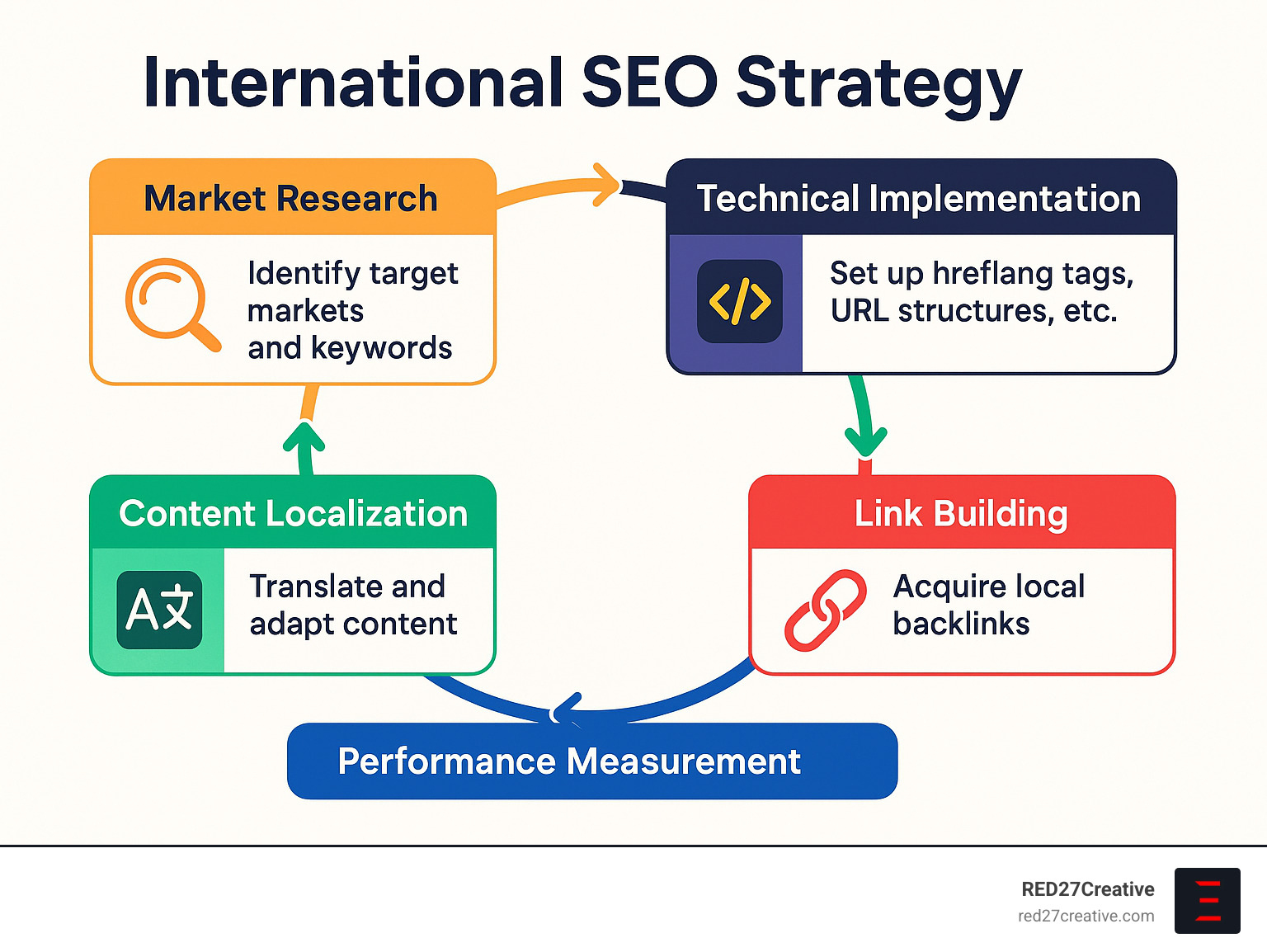
Key Components of International SEO for Manufacturers:
• Market Research – Identify high-potential countries using analytics data and keyword demand
• Technical Setup – Implement hreflang tags, choose URL structure (ccTLD vs subfolder), optimize for mobile
• Content Localization – Translate product specs, adapt measurement units, create region-specific content
• Link Building – Acquire backlinks from local industry directories, trade publications, and suppliers
• Performance Tracking – Monitor organic traffic, lead quality, and ROI across target markets
The manufacturing landscape has fundamentally shifted. Organic traffic generates 69% of leads for manufacturing companies, yet 75% of searchers never venture past the first page of results. This creates both massive opportunity and fierce competition.
For manufacturers, international SEO isn’t just about translation—it’s about economic resilience. Companies that diversify revenue streams across global markets reduce dependency on local economic conditions while opening new channels for growth. When supply chain disruptions hit one region, manufacturers with strong international presence can pivot to alternative markets and maintain revenue stability.
The stakes are higher than ever. A precision CNC manufacturer might dominate “aerospace machining” searches in Ohio but remain invisible to German automotive companies searching for “Präzisionszerspanung für Automotive.” That’s revenue walking out the door.
Consider the broader economic implications. Manufacturing companies that establish strong international digital presence before their competitors gain significant first-mover advantages. They capture market share in regions where competition remains limited, build brand recognition among international buyers, and establish distribution partnerships that create long-term competitive moats.
The complexity of modern manufacturing supply chains demands global thinking. Your next major contract might come from a German automotive supplier, a Canadian aerospace manufacturer, or a Mexican electronics company. Each of these markets has unique search behaviors, regulatory requirements, and business practices that impact how potential customers find and evaluate suppliers.
As Kiel Tredrea, founder of RED27Creative, I’ve spent over 20 years helping B2B manufacturers build scalable marketing systems that drive measurable revenue growth. My expertise in international SEO for manufacturers comes from developing advanced search optimization and backlink acquisition campaigns that significantly improve search rankings across multiple markets and languages.
The digital change of manufacturing procurement has accelerated dramatically. Industrial buyers now expect the same level of digital sophistication they experience in consumer markets. They want detailed product specifications available 24/7, downloadable technical documentation, and the ability to compare suppliers across multiple criteria—all before engaging with sales teams.
This shift creates unprecedented opportunities for manufacturers willing to invest in comprehensive international SEO strategies. While traditional marketing channels become increasingly expensive and less effective, organic search provides a cost-effective way to reach qualified prospects actively searching for manufacturing solutions.
International seo for manufacturers terms to know:
Why International SEO Matters for Modern Manufacturers
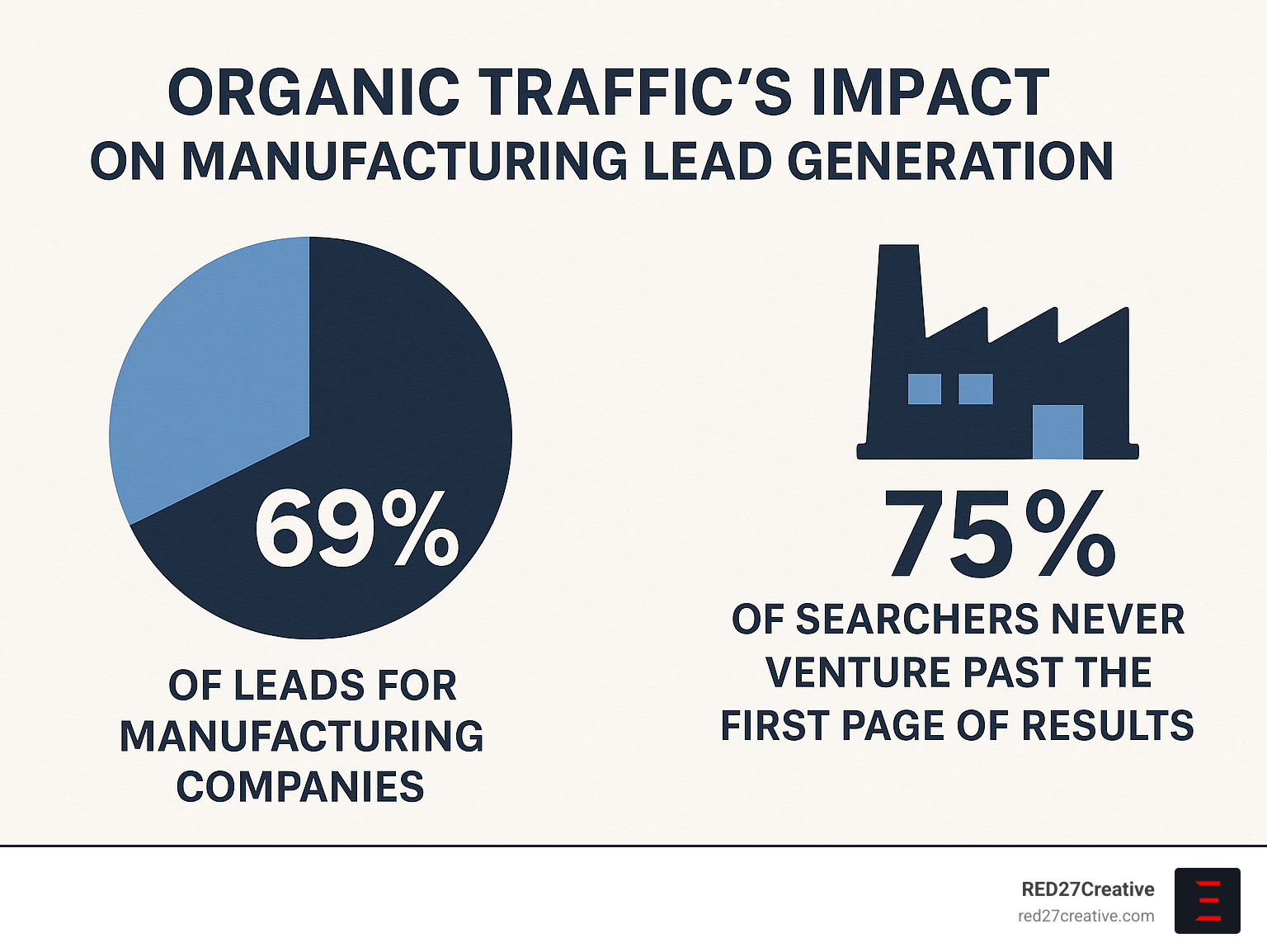
Organic search already drives 69 % of manufacturing leads, yet most plants still optimise only for home-market keywords. That leaves global buyers0nabled by the internet—and often looking for higher-value, long-term supply partners—unable to find you.
International SEO for manufacturers does more than increase traffic. It diversifies revenue, hedges against local slow-downs, and positions you ahead of lagging competitors. Apple earns 60 % of sales overseas; Ford, 37 %. Industrial suppliers that follow suit create economic resilience and open up wider applications for their capabilities.
Key Benefits at a Glance
Brand visibility to engineers and procurement teams on every continent
Highly qualified, high-intent leads ready to spec you into projects
Compounding ROI; rankings keep working long after ad budgets stop
Early-mover advantage that forms a durable competitive moat
For many manufacturers, the next big contract will originate from a search like “fabricacin de precisin aeroespacial” or “Pr e4zisionszerspanung f fcr Automotive.” If you are not optimised for those queries, you are invisible the moment it matters.
Blueprint: Developing an International SEO Strategy
Global expansion is easier when you treat it like any other manufacturing process: phased, measurable, and continuously improved.
Phase 1 — Market Analysis
- Dig into GA4: which countries already visit, download spec sheets, or fill forms?
- Validate demand with Semrush, Ahrefs, and local trade data.
- Map regional buyer personas and seasonality.
Phase 2 — Competitive Gap Assessment
- Identify who currently ranks for target terms in each market.
- Analyse their content depth, backlink sources, and technical set-up.
- Spot underserved niches where you can become the default supplier.
Phase 3 — Resource Planning & Roll-out
- Focus on one high-potential region first; expand after success metrics are hit.
- Budget for translation, localisation, technical dev, and link building over 12-18 months.
- Align marketing with sales so international leads are handled expertly.
Phase 4 — Technical Foundation & Content
- Pick a scalable URL structure (subdirectories work for most firms).
- Implement hreflang, CDN, and Core Web Vitals fixes before launching translated pages.
- Localise—not merely translate—spec sheets, case studies, and certifications. Convert units, reference DIN/CSA/CE, and use authentic terminology (e.g., “CNC-Bearbeitung” not literal “Pr e4zisionszerspanung” if that’s what German engineers actually search).
Successful international SEO for manufacturers boils down to disciplined research, focused execution, and ruthless quality control—exactly how you already run your shop floor.
Technical Foundations — Architecture, hreflang & Performance
The difference between international SEO success and failure often comes down to technical execution. I’ve seen manufacturers spend thousands on content translation only to find their hreflang tags were broken, making all that work invisible to search engines.
Think of technical implementation as the foundation of a building. You can have the most beautiful content in the world, but if your technical foundation is shaky, the whole structure collapses. This is especially true for international SEO for manufacturers, where technical complexity multiplies across languages and regions.
Hreflang tags are your international SEO lifeline. These small pieces of code tell search engines which language and country each page targets. Get them wrong, and Google might show your English content to German users or your Canadian pricing to Mexican customers.
The most critical requirement is using correct specific codes like en-US for American English or de-DE for German in Germany. Many manufacturers make the mistake of using just language codes (like “en” instead of “en-US”), which creates ambiguity for search engines.
Self-referential tags are non-negotiable. Every page must include an hreflang tag pointing to itself. This might seem redundant, but it’s how search engines understand the complete language structure of your site. Missing this step is like giving someone directions but forgetting to tell them where they’re starting from.
The x-default tag acts as your safety net. When someone searches from a country you don’t specifically target, x-default tells search engines which version to show. For most manufacturers, this should point to your primary English version.
Performance optimization becomes exponentially more important when serving global audiences. A manufacturing website that loads quickly in Chicago might crawl for users in Mumbai or São Paulo. Core Web Vitals impact rankings everywhere, but user expectations vary dramatically by region.
Content Delivery Networks (CDNs) are essential for international manufacturing sites. Instead of forcing a German engineer to wait while content travels from servers in Texas, CDNs serve your pages from European servers. This isn’t just about user experience—page speed directly impacts search rankings.
Mobile optimization takes on new dimensions internationally. While 95% of American manufacturers might access your site from desktop computers during business hours, buyers in other markets increasingly use mobile devices. In some countries, mobile usage dominates B2B research.
Site Architecture Checklist
Crawl budget management becomes critical with international sites. Search engines allocate limited crawling resources to each domain. Poor architecture forces Google to waste time crawling duplicate or low-value pages instead of finding your important content.
XML sitemaps strategy requires careful planning for international sites. Create separate sitemaps for each language and country combination, then include hreflang annotations directly in the sitemaps. This gives search engines a clear roadmap of your international content structure.
Don’t forget about local search engines beyond Google. If you’re targeting China, submit sitemaps to Baidu. For Russia, include Yandex. These platforms often have different technical requirements and submission processes.
Internal linking must respect language boundaries. Link only to pages in the same language to maintain user experience and search engine clarity. A German user clicking through your site should never accidentally land on English content unless they specifically choose to switch languages.
Schema markup adds another layer of international complexity. Implement Organization schema with local business information for each region. Use Product schema with local pricing, currency, and availability data. If you have regional offices or distributors, LocalBusiness schema helps search engines understand your global presence.
Canonical tags prevent duplicate content issues across language versions. Each page should include a self-referential canonical tag, and you should never canonical different language versions to each other. This maintains the independence of each regional site while preventing dilution of search authority.
Content Localization & Authority Building
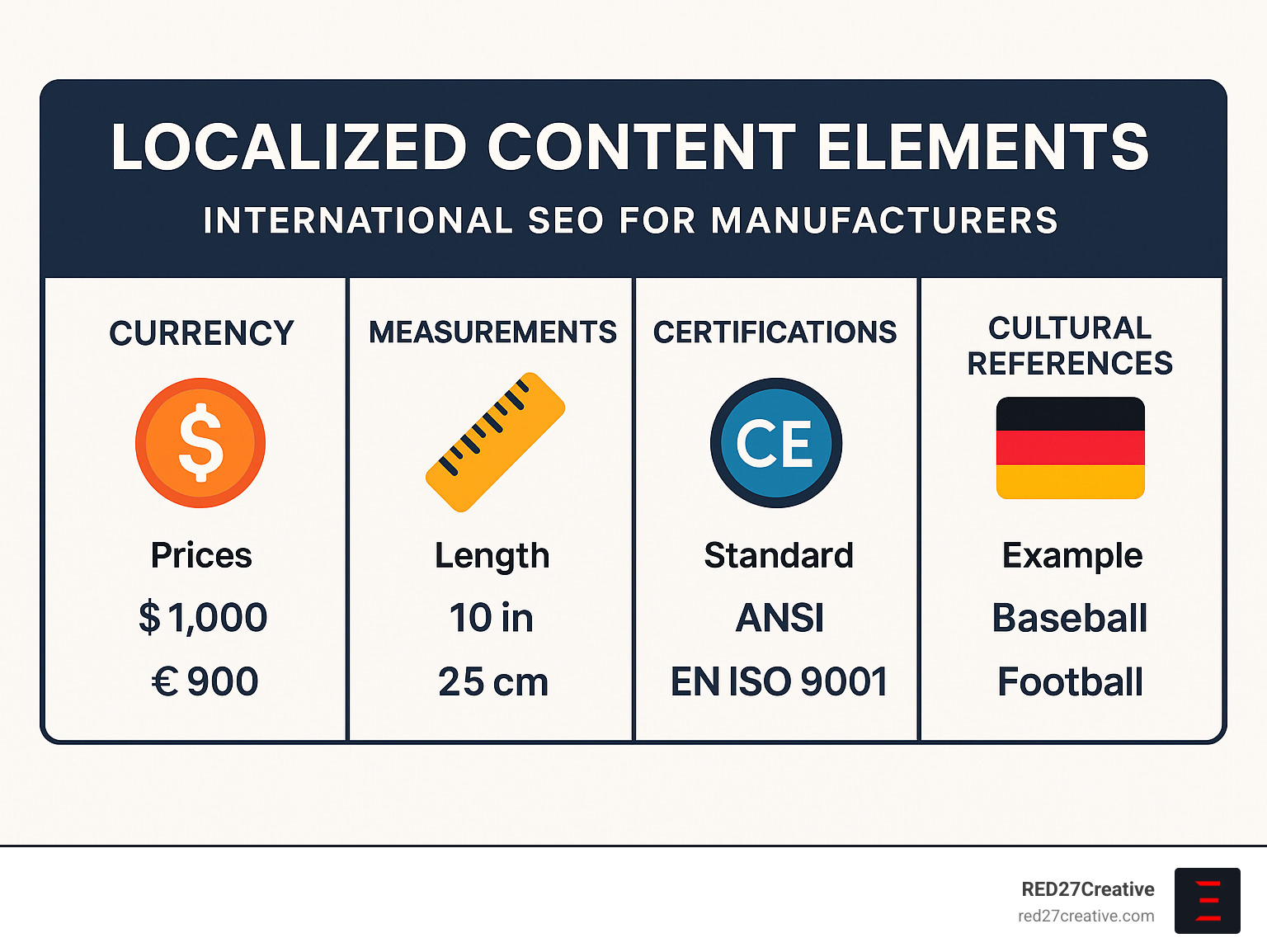
Translation converts words; localisation converts trust. German engineers expect DIN references, metric tolerances and CE labels. Canadian buyers prefer CSA standards and bilingual spec sheets. Tailor each page accordingly.
High-Impact Local Content
- Technical guides addressing local regulations
- Region-specific case studies
- Product pages with auto-converted units & currencies
- Industry-news posts highlighting local supply-chain trends
Building Global Backlinks
- Submit to authoritative, industry-specific directories in each target country.
- Pitch guest articles to regional trade magazines; solve local pain points, link from author bio.
- Leverage supplier or distributor partnerships for co-authored content and reciprocal links.
Tools like Ahrefs reveal who already links to competitors abroad, giving you a ready-made prospect list. Because international link landscapes are often less crowded, quality links are easier—and faster—to earn.
Measure, Iterate & Balance Local vs Global Efforts
International campaigns live or die on data. Configure GA4 and Search Console to separate metrics by country/language, then focus on outcomes—not vanity visits.
Core KPIs
- Qualified organic sessions by market
- Downloads of technical assets
- Lead-to-quote rate and revenue per region
- Ranking distribution for priority keywords
- New local backlinks & referring domains
Start with the 70-20-10 budget rule: 70 % proven domestic SEO, 20 % first new market, 10 % experimentation. Review KPIs quarterly, re-allocate budget toward regions showing fastest traction.
Remember: complex industrial deals often span months. Attribute success across the entire journey—first search to final PO—before judging ROI.
Frequently Asked Questions about International SEO for Manufacturers
What is the difference between local and international SEO?
Local SEO targets buyers near your facility and relies on Google Business Profile listings. International SEO adds multiple languages, hreflang, and country-specific content so you appear in search results worldwide.
How long until we see ROI?
Expect early ranking gains in 4–6 months and meaningful revenue in 12–18 months, reflecting longer industrial sales cycles.
Do we need separate country domains?
Usually no. Subdirectories (yourcompany.com/de/) keep authority in one domain and are easier to maintain. Migrate to ccTLDs only when local operations justify the overhead.
How do we convert specs between metric and imperial?
Use a master database that feeds regional pages. Auto-convert units (±0.001 in → ±0.025 mm) and reference relevant standards (DIN, CSA, ANSI) for each market.
Biggest mistake manufacturers make?
Treating global SEO as pure translation. Without cultural, regulatory, and terminology localisation, translated pages fail to rank and convert.
How do we judge traffic quality?
Track engagement: time on page, spec-sheet downloads, and repeat visits. Combine with lead scoring to confirm company size, industry, and budget authority.
Does mobile matter for B2B industrial buyers?
Yes—especially in regions where engineers research suppliers on phones during travel or plant visits. Fast, responsive pages equal higher rankings and lower bounce rates.
Why highlight local certifications?
Displaying relevant certifications proves compliance and shortens procurement cycles. Create dedicated pages listing ISO, CE, CSA, or other regional approvals.
Conclusion
International SEO is no longer optional; it is the most scalable path to diversified, recession-proof growth. While competitors scrap over domestic traffic, you can claim first-page positions in markets where demand outstrips supply.
RED27Creative has helped manufacturers from Illinois to global hubs build those positions—and the revenue that follows. Ready to make your factory borderless? Explore our SEO marketing services and let’s map your first international win today.

Kiel Tredrea
https://red27creative.comTop Marketing Agency • Web, SEO & Leads • RED27Creative