Beyond the Click: Crafting a Winning Lead Generation Strategy

Why a Lead Generation Strategy Is Essential for Sustainable Growth
A lead generation strategy is the systematic process of turning strangers into prospects who have shown interest in your products or services. For B2B companies with long sales cycles, a consistent flow of high-quality leads is the foundation of sustainable growth.
An effective strategy includes:
- Defining your target audience with buyer personas and ICPs.
- Building awareness through content, SEO, and social media.
- Capturing leads with optimized landing pages and forms.
- Qualifying prospects using lead scoring and behavioral data.
- Nurturing relationships via email and marketing automation.
- Converting leads by aligning sales and marketing.
- Measuring and optimizing with data and continuous testing.
This matters because 63% of marketers say generating leads is their biggest challenge. A winning strategy isn’t about volume; it’s about attracting the right people at the right time. It connects your website, SEO, and content into a unified engine that turns anonymous visitors into qualified leads.
I’m Kiel Tredrea, founder of RED27Creative. For over 20 years, my team has built integrated lead generation strategies that drive measurable growth, connecting every component—website, SEO, local presence, and lead generation—into a single, performance-driven framework.
The Foundation: Understanding the Lead Generation Funnel
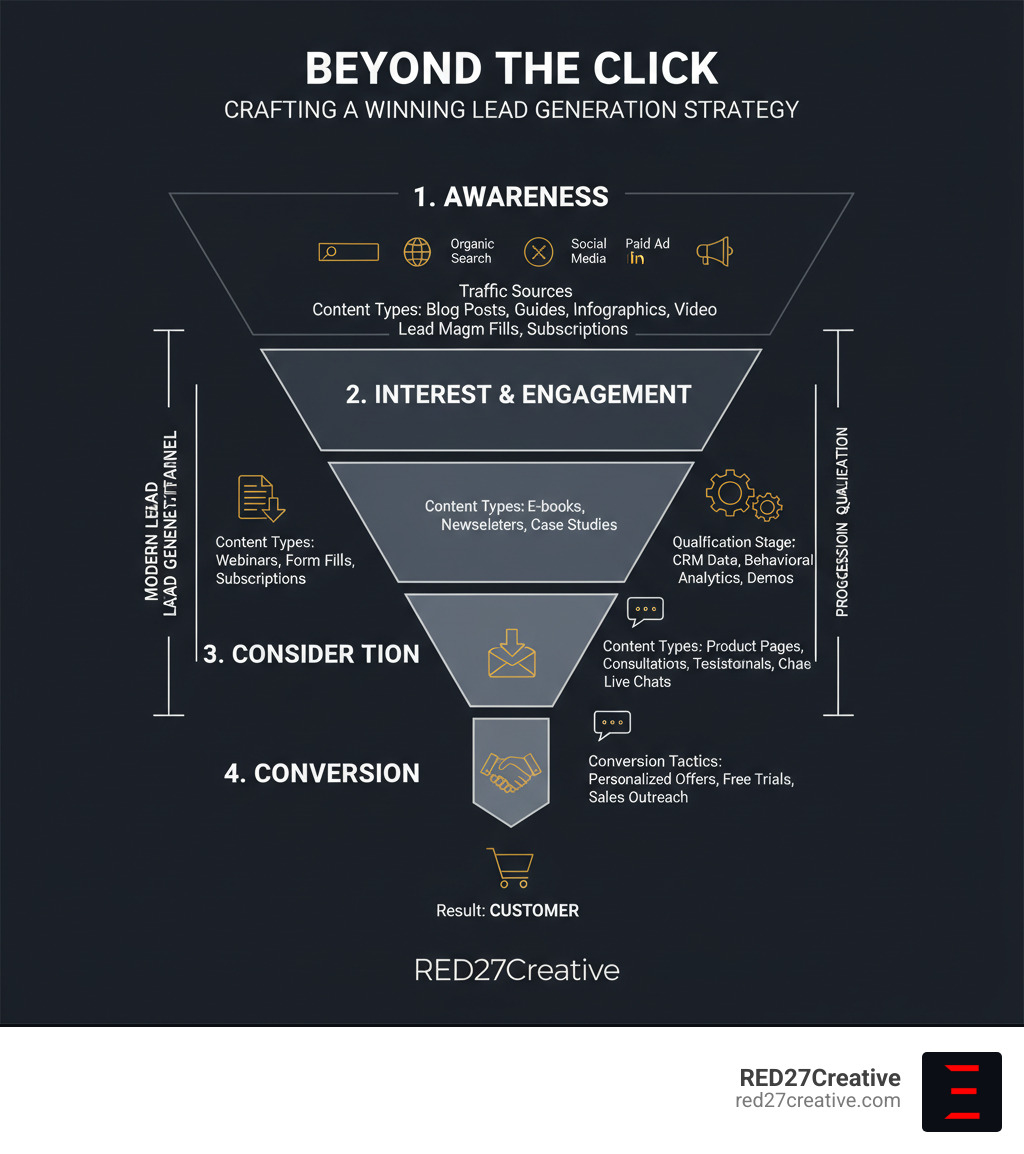
Before building a lead generation strategy, you must understand the funnel—the roadmap from stranger to customer.
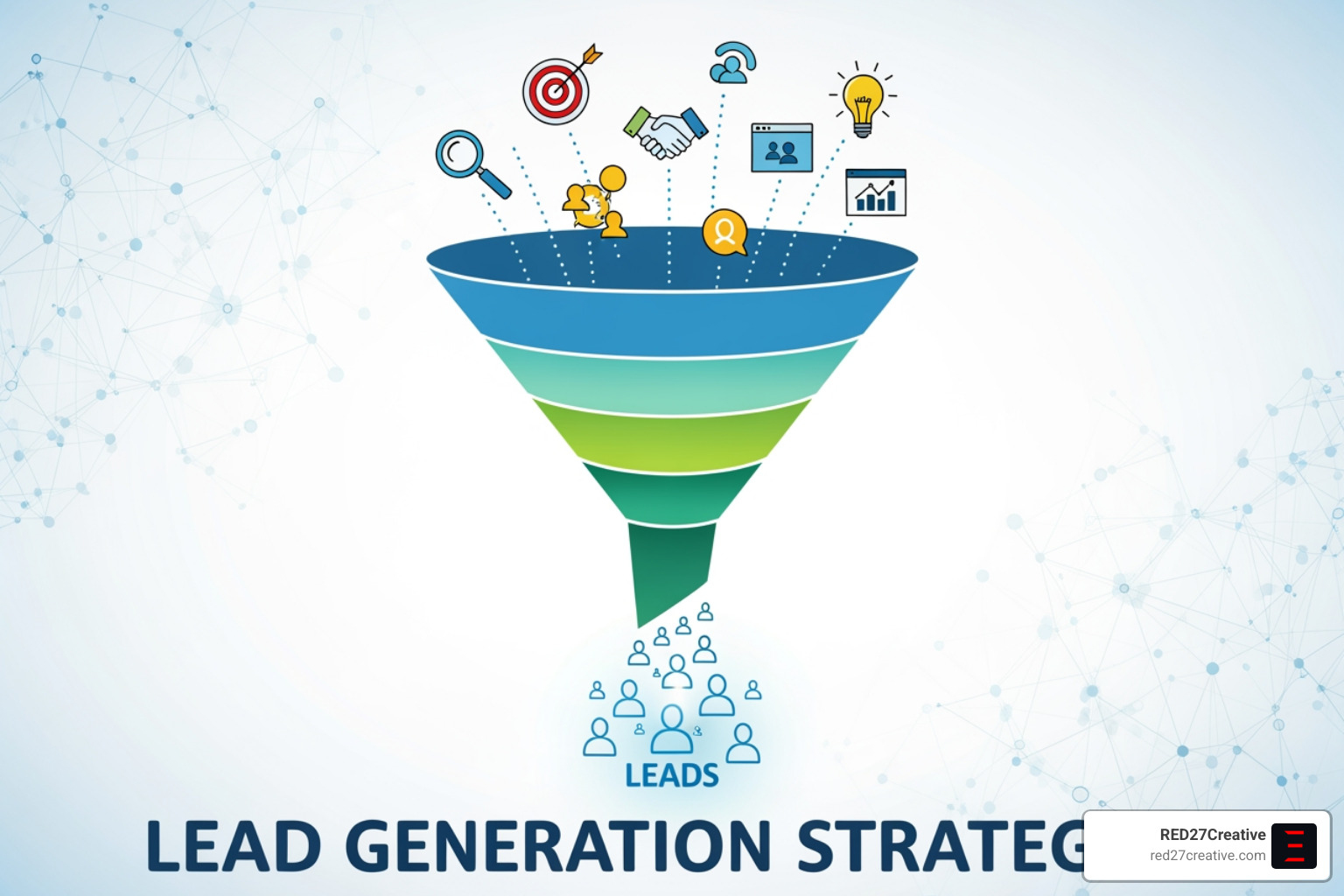
Many confuse demand generation (creating broad awareness) with lead generation (capturing contact info from those already interested). Demand generation creates the buzz; lead generation captures the resulting interest. Both are vital, which is why lead generation accounts for 36% of B2B marketing budgets.
Here’s a quick comparison:
| Feature | Demand Generation | Lead Generation |
|---|---|---|
| Primary Goal | Create awareness and interest. | Capture contact information. |
| Focus | Broad, entire market. | Specific, targeted acquisition. |
| Timing | Long-term, educational. | Shorter-term, immediate capture. |
| Metrics | Brand awareness, traffic, engagement. | Conversion rates, CPL, lead volume. |
| Relationship | Precedes and supports lead gen. | A component of demand gen. |
| Example Tactics | Content marketing, webinars, PR. | Forms, landing pages, CTAs. |
The Key Stages of the Funnel
Your strategy must meet prospects at each stage of their journey.
Top-of-Funnel (TOFU): Awareness. Prospects are just realizing they have a problem. Your goal is to educate and build trust with content like blog posts and guides, not to sell.
Middle-of-Funnel (MOFU): Consideration. Prospects are now researching solutions. You demonstrate expertise with case studies, whitepapers, and webinars to position your brand as the smart choice.
Bottom-of-Funnel (BOFU): Decision. The prospect is ready to buy. You provide free trials, demos, and pricing guides to build confidence and make it easy to say yes.
Since 48% of companies say leads require a long sales cycle, nurturing them through each stage is critical.
The Role of Content and Buyer Personas
Content fuels your funnel, but it must be custom to your audience. Buyer personas—detailed profiles of your ideal customers—are essential for this.
Understanding your audience’s challenges, goals, and pain points is key to creating personalized content. 81% of buyers want brands to understand them, and strong personas allow you to deliver relevant content at the right time, building trust and improving conversion rates. For a deep dive, learn how to create customer personas with data.
Building Your Inbound Lead Generation Strategy
Inbound marketing pulls customers to your business by creating valuable content they actively seek. An inbound lead generation strategy builds trust, establishes authority, and attracts warm prospects who have already raised their hand.

At RED27Creative, we build inbound systems for businesses in Geneva, Naperville, Chicago, and beyond, connecting web design, content, and SEO into a unified growth engine. Our SEO services are designed to pull in qualified leads organically.
Using SEO for High-Intent Leads
SEO is a cost-effective way to generate leads by targeting people actively searching for your solutions. The key is focusing on high-intent keywords that signal a user is close to making a decision.
- Keyword Research: We use tools like Ahrefs and SEMrush to find the exact terms your ideal customers use when they’re ready to buy.
- On-Page SEO: We optimize your content and site structure to answer user questions and guide visitors, turning every page into a potential entry point for qualified traffic.
- Local SEO: For businesses serving specific areas like Aurora or St. Charles, optimizing your Google Business Profile and local content is a game-changer. Our local SEO services help you dominate your local market.
- Bottom-of-the-Funnel Content: Creating comparison pages and solution-focused guides that rank for high-intent searches positions you as the obvious choice. Learn more about crafting bottom-of-the-funnel content that converts.
Developing a Content-Driven Lead Generation Strategy
Content educates your audience and guides them through the buyer’s journey. Companies that publish 15 blog posts a month generate almost 1,200 new leads per month on average.
- Blog Posts: Drive organic traffic and establish expertise.
- Gated Content: Offer valuable ebooks or whitepapers in exchange for contact information.
- Webinars: Position you as an authority and attract a targeted audience. 89% of marketers say webinars produce more qualified leads than other channels.
- Video Marketing: Humanize your brand and build connection with engaging, shareable content.
- Case Studies: Provide real-world proof that your solution delivers results, helping to close deals.
Leveraging Social Media for Engagement
Social media is a powerful lead generation channel, especially for B2B.
- Organic Social Media: Share valuable content to position your brand as a helpful resource, building trust that translates into leads.
- LinkedIn: As the gold standard for B2B, LinkedIn allows you to connect directly with decision-makers and build relationships using proven lead generation tactics.
- Community Engagement: Participate in relevant groups to build credibility and stay top of mind.
- Social Listening: Monitor conversations to identify pain points and tailor your content accordingly.
Proactive Outreach: Effective Outbound and Paid Tactics
While inbound strategies draw leads in, a complete lead generation strategy also includes proactive outbound and paid tactics to reach specific audiences directly and accelerate results.

Outbound marketing is the active pursuit of prospects through paid advertising, retargeting, and Account-Based Marketing (ABM). Unlike SEO, which builds momentum over time, paid channels can drive qualified traffic today, delivering a strong return on ad spend (ROAS).
Paid Advertising Across Digital Channels
Paid ads offer speed and precision, driving potential leads to your website or landing pages.
- Google Ads: Capture high-intent users who are actively searching for solutions. Lead form assets can streamline conversions by allowing users to submit information directly within the ad.
- Social Media Advertising: Platforms like Meta Ads Manager and LinkedIn Campaign Manager offer sophisticated targeting based on job titles, company size, and interests. Lead gen ads on these platforms simplify the process for users.
- Retargeting Campaigns: Show ads to users who have visited your site but didn’t convert. This re-engages your warmest audience with personalized content to overcome final objections.
- Lookalike Audiences: Use algorithms to find new prospects who share characteristics with your best customers, bringing high-quality leads into your funnel.
Creative and Event-Based Strategies
Creative approaches can differentiate your brand and drive engagement.
- Co-marketing Partnerships: Collaborate with complementary businesses to leverage each other’s audiences and expertise. Since 84% of buyers start from a referral, a partner’s trust is invaluable.
- Event Marketing: Live events, from trade shows to webinars, create opportunities for genuine connection. Forbes notes that 70% of marketers find live events crucial for marketing success. Promote webinars on social media or host them on platforms like LinkedIn Events.
- Interactive Content and Gamification: Use quizzes, polls, or calculators to capture attention and generate leads. Requiring an email to participate provides qualified, self-selected prospects.
Conversion is Key: Optimizing Your Digital Assets
A great lead generation strategy is useless if your website doesn’t convert visitors into leads. Attracting traffic is only half the battle; the other half is making it easy for prospects to take the next step.
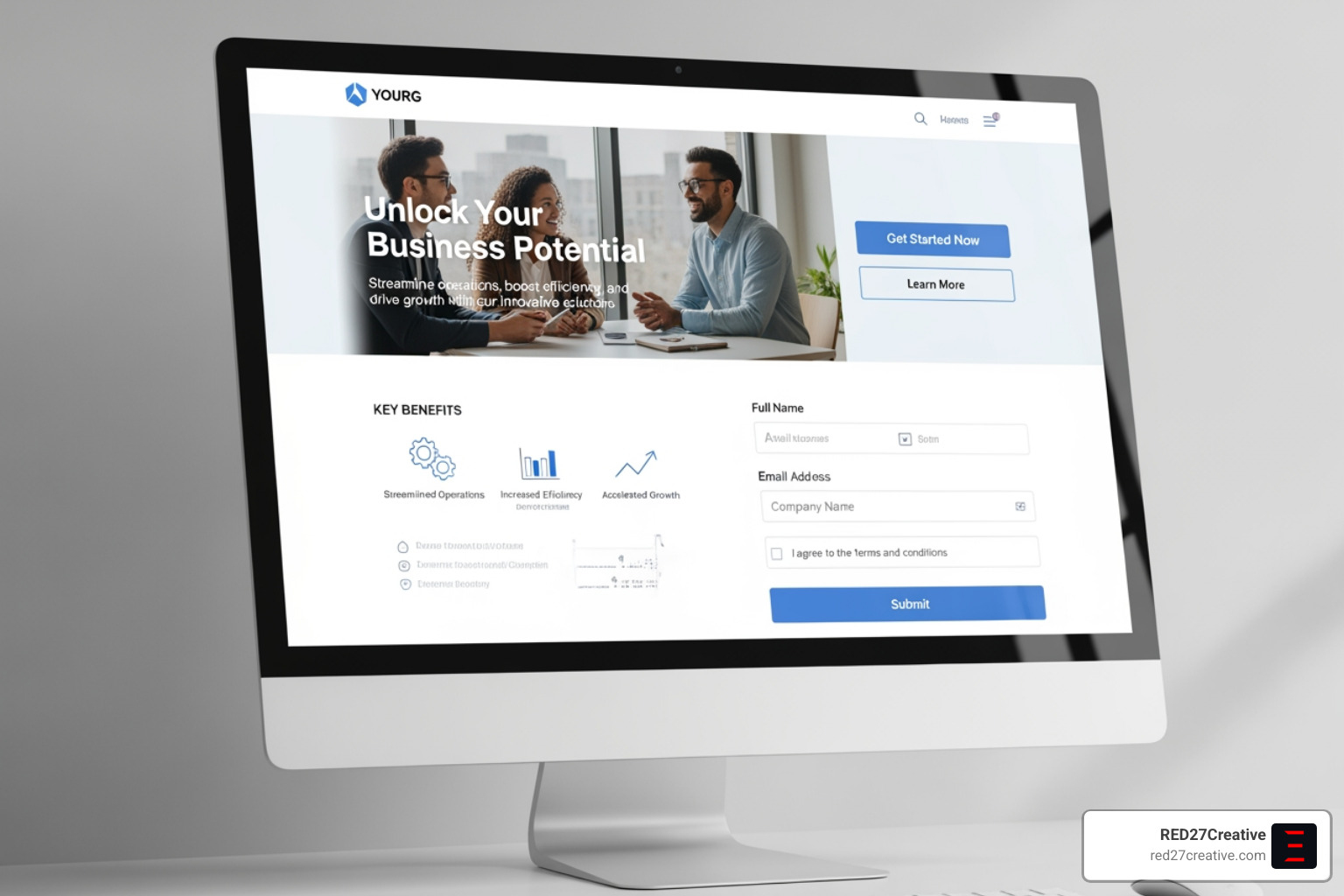
This is where Conversion Rate Optimization (CRO) and user experience (UX) are critical. Your website should be a machine designed to turn visitors into qualified leads. At RED27Creative, our web design services are engineered for conversion, ensuring every element serves this purpose.
Best Practices for Landing Pages and Forms
Your landing pages and forms are the final checkpoints before a prospect becomes a lead.
- Use a compelling headline that instantly communicates value.
- Include a clear, action-oriented CTA that stands out visually.
- Minimize form fields. The average form has five fields, but fewer fields lead to higher conversions. Ask only for what you absolutely need, as 81% of people have abandoned a form after starting it. Tools like Typeform’s lead capture forms create a more conversational experience.
- Add social proof. Testimonials, case studies, and client logos build instant credibility. If others trust you, new prospects are more likely to as well. You can see examples on our testimonials page.
- Include trust signals like privacy disclaimers and security badges.
- Use pop-ups strategically. While often disliked, the average pop-up has a 3.09% conversion rate. Exit-intent or scroll-triggered pop-ups can capture leads without being overly disruptive.
Integrating AI and Automation for Efficiency
AI and automation are essential for a modern lead generation strategy. These tools engage prospects 24/7, personalize experiences, and free up your team for high-value conversations.
AI chatbots and live chat software are game-changers for website engagement, answering questions and capturing lead info instantly. They can intelligently route qualified prospects to the right team members or even schedule meetings automatically.
Beyond chatbots, marketing automation handles lead scoring and email nurturing. When a prospect downloads a resource, an automated email sequence can move them down the funnel without manual effort, improving efficiency and impacting your bottom line.
From Lead to Customer: Qualification, Nurturing, and Measurement
Capturing a lead is just the start. A successful lead generation strategy requires careful qualification, consistent nurturing, and continuous measurement to turn leads into customers. In fact, 67% of lost sales result from improper lead qualification.
The Importance of Lead Qualification and Scoring
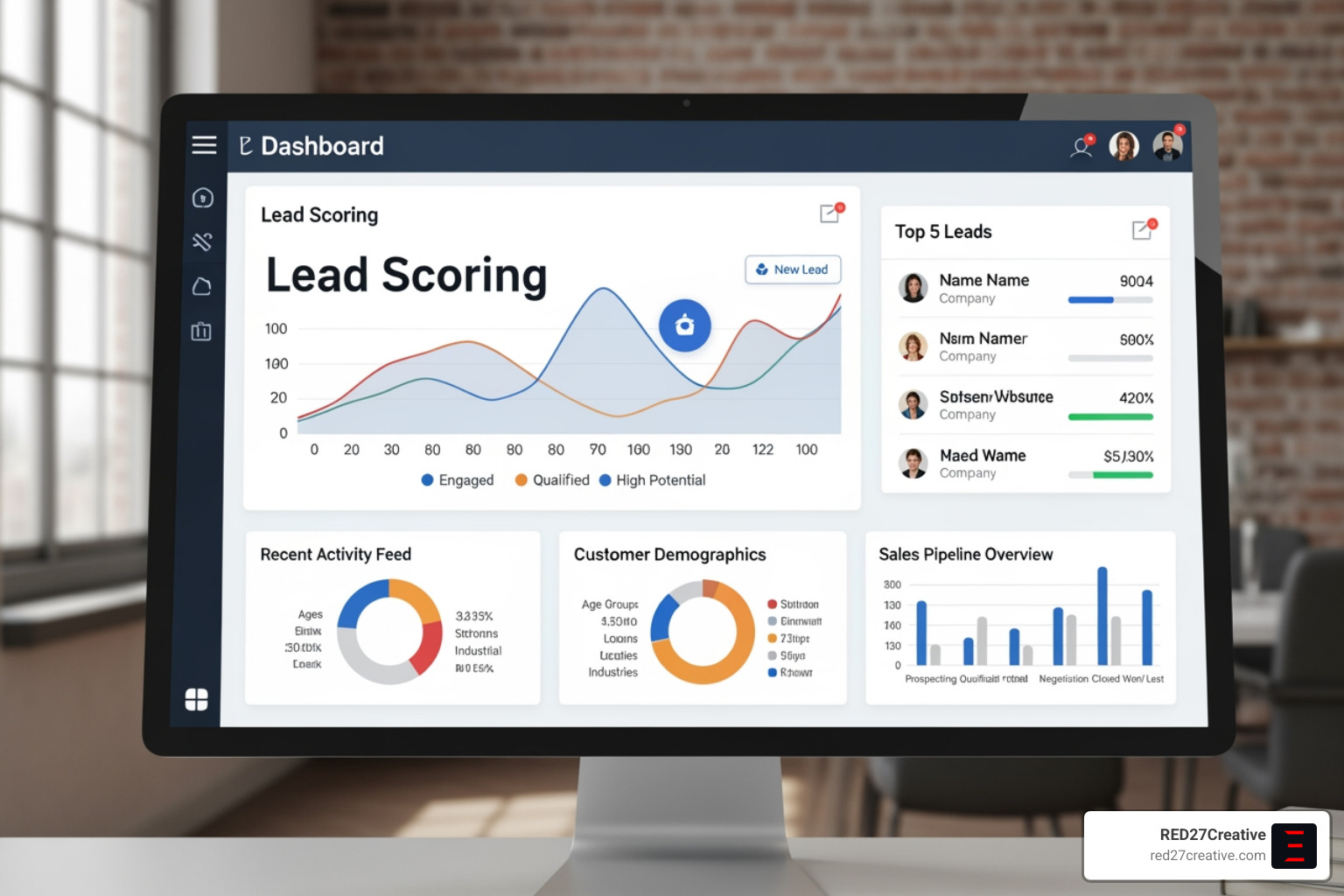
Lead qualification determines if a prospect is a good fit and likely to convert, ensuring your sales team focuses on the best opportunities.
- Lead Scoring Models: Use lead scoring to assign points to leads based on demographics, online behavior, and engagement. A high score indicates a sales-ready lead.
- Qualification Criteria: Assess leads against buyer personas and firmographics (company size, industry), and use frameworks like BANT (Budget, Authority, Need, Timeline) to gauge their readiness.
Using Data and Analytics to Refine Your Approach
Data is the fuel for continuous improvement.
- Website Analytics: Tools like Google Analytics 4 (GA4) provide insights into visitor behavior, helping to identify what’s working and what needs optimization.
- Intent Data: This data on online activities signals a buyer’s intent to purchase. Almost 70% of businesses plan to increase their spend on intent data, which helps create personalized content and shorten sales cycles. Learn more about the power of intent data.
- A/B Testing: Continuously test headlines, CTAs, and forms to optimize for higher conversion rates.
- CRM Integration: Connecting tools with your CRM (like HubSpot or Salesforce) enables seamless lead tracking, nurturing, and sales follow-up.
Measuring Your Lead Generation Strategy for Continuous Improvement
To ensure your strategy is effective, track these key metrics:
- Cost Per Lead (CPL): The cost to acquire a single lead.
- Conversion Rate: The percentage of visitors who become leads, and leads who become customers.
- Customer Lifetime Value (CLV): The total revenue a customer generates.
- ROI Calculation: The overall return on investment of your marketing efforts.
Continuous monitoring allows you to double down on effective tactics and refine your approach.
Frequently Asked Questions about Lead Generation
Here are answers to common questions about building a lead generation strategy.
What is the primary goal of a lead generation strategy?
The primary goal is to systematically attract and convert strangers into interested prospects. The focus is on quality over quantity—filling your sales pipeline with potential customers who are a good fit for your business to drive sustainable growth.
How do you measure the success of lead generation?
Measure success with KPIs like Cost Per Lead (CPL), lead-to-customer conversion rate, and Return on Investment (ROI). These metrics reveal campaign efficiency and profitability, allowing you to optimize your strategy. A data-driven approach ensures continuous improvement.
What is the difference between inbound and outbound lead generation?
Inbound lead generation attracts customers with valuable content like blogs and SEO, pulling them to your brand. Outbound lead generation proactively reaches out to prospects through paid ads or direct outreach. A strong lead generation strategy combines both, using inbound for long-term authority and outbound for immediate, targeted results.
Conclusion: Build Your Growth Engine
A winning lead generation strategy is a living system that evolves with your business. When all the pieces work together—content, SEO, conversion optimization, and measurement—you create a predictable, scalable engine for growth.
This isn’t about chasing fads; it’s about building an integrated system where every component supports the others. Your website attracts visitors, your content builds trust, and your data shows you what to improve.
At RED27Creative, we’ve spent over 20 years helping businesses in the Chicago area build these systems. We connect your website, SEO, and lead generation into a unified framework that delivers results because real growth comes from strategy, not isolated tactics.
The businesses that win are the ones that treat lead generation as an investment. They measure what matters, test relentlessly, and never let valuable leads slip through the cracks.
If you’re ready to grow with a lead generation strategy built for sustainable results, contact us to build your lead generation system and turn your marketing into a measurable growth engine.

Kiel Tredrea
https://red27creative.comTop Marketing Agency • Web, SEO & Leads • RED27Creative