Mastering Local SEO: The Essential Guide for Every Business

Why Local SEO for Business Is the Foundation of Modern Growth
Local SEO for business is the process of optimizing your online presence to attract customers searching for products or services in your specific geographic area. It connects you with people who are actively looking for what you sell, right when they need it.
Think about the last time you needed something urgently, like a car repair or a last-minute gift. You likely grabbed your phone and searched for a “mechanic near me” or “flower shop open now.” That’s local SEO in action.
Why It Matters:
- Nearly half of all Google searches have local intent.
- 76% of people who search for something nearby visit a business within 24 hours.
- 80% of local mobile searches lead to a purchase.
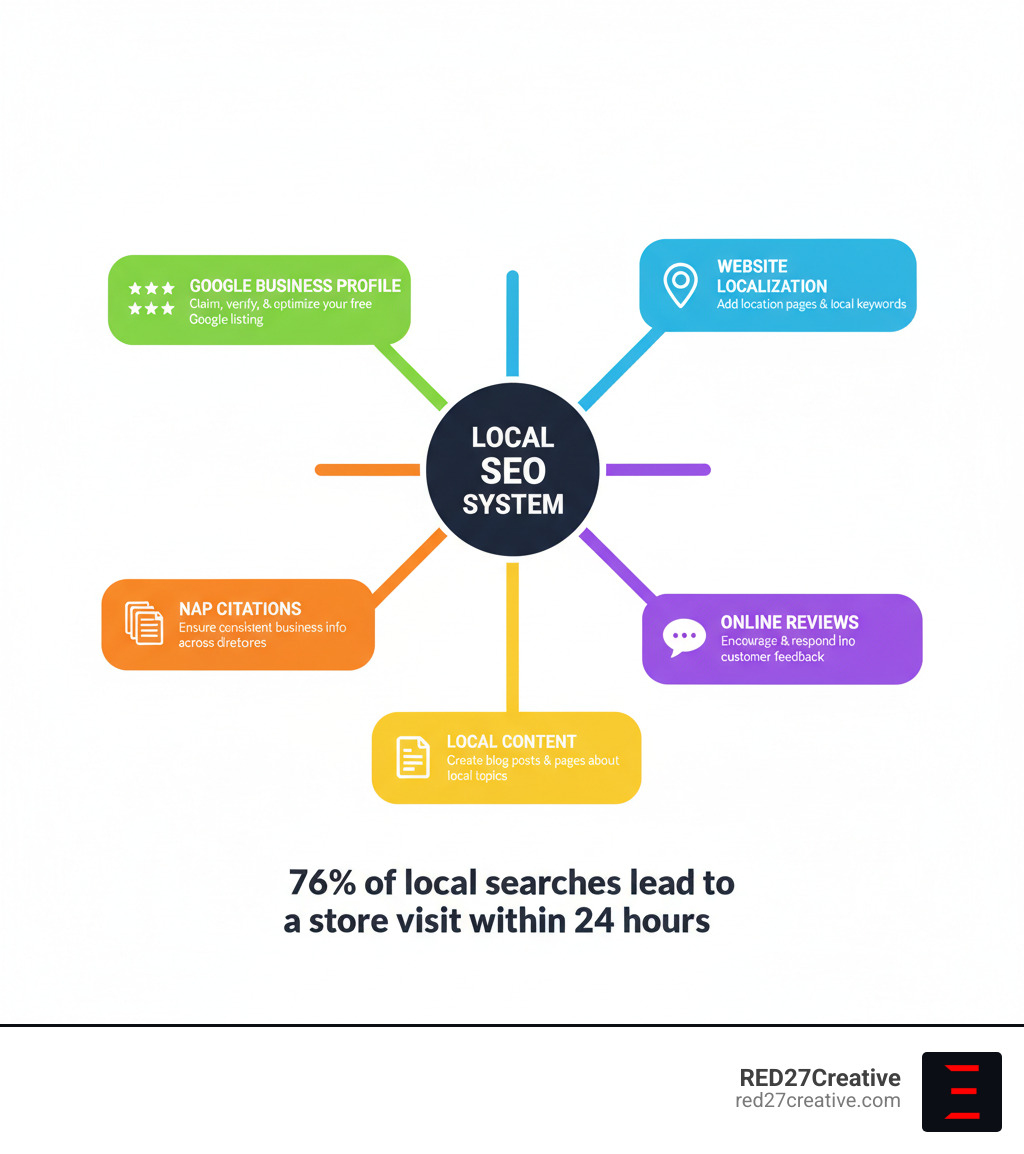
The businesses that appear in those results don’t get there by accident. They invest in a strategic local SEO system that makes them visible when it matters most. While many businesses treat local SEO as a side project, the ones winning local search build a complete system connecting their website, local listings, reviews, and content into a unified strategy.
If you’re not showing up in local search results, you’re invisible to customers actively looking for you. Your competitors are capturing that traffic, those calls, and those sales. Local SEO isn’t optional anymore; it’s the foundation of how modern consumers find and choose local businesses.
In this guide, I’ll show you how to build a local SEO strategy that drives real results. I’m Kiel Tredrea, founder of RED27Creative, and for over 20 years, I’ve helped businesses master local SEO for business to dominate their markets. This guide distills that experience into actionable steps you can implement today.
What is Local SEO and Why Is It Critical for Growth?
When someone searches for “coffee shop near me” or “emergency plumber Geneva IL,” they’re not just browsing—they’re ready to act. That’s the power of local SEO for business. It’s a specialized approach that puts your business in front of people in your area who are actively looking for what you offer.
Unlike traditional SEO that casts a wide net, local SEO zeroes in on your community. It ensures that when someone in Naperville, Aurora, or St. Charles needs your service, you’re the business they find first. These are high-intent customers who are ready to visit, call, or buy.
The numbers tell the story. Roughly 80% of local searches on mobile devices lead to a conversion, and about half of all users visit a store within a day of a local search. They need help now, and they’re going to choose one of the first businesses they see.
For small businesses, this is a game-changer. You don’t need a massive marketing budget to compete. You just need to show up in your local market at the exact moment your customer needs you.
The Difference Between Local and General SEO
Local SEO focuses on a specific geographic area, while general SEO targets a national or global audience. Google uses a different set of ranking factors for local searches, prioritizing businesses that are relevant, physically close, and prominent in the local community.
Here’s how they stack up:
| Feature | Local SEO | General SEO |
|---|---|---|
| Goal | Rank in a specific geographic area for local searches | Rank nationally or globally for broad keywords |
| Key Factors | Proximity, Relevance, Prominence (Google Business Profile, reviews, NAP consistency) | Broad keyword authority, Domain-level backlinks, website content, technical SEO |
| Target Audience | Customers in a defined local area (e.g., Chicago, Naperville) | Global or national audience |
| Search Queries | “Plumber near me,” “bakery Geneva IL,” “restaurants open now” | “Best marketing strategies,” “how to build a website” |
| Primary Listing | Google Business Profile (Map Pack) | Organic search results (blue links) |
Google’s unique local ranking factors are Proximity, Relevance, and Prominence. Proximity is how close you are to the searcher. Relevance is how well your services match their query. Prominence is your overall reputation, including reviews and online authority.
If someone in downtown Geneva searches for “Italian restaurant,” Google shows the best-reviewed, most relevant restaurants within a few miles. That’s local SEO at work. To dive deeper, check out Why SEO Rocks for Local Business: Why You Need It Now.
Why Local SEO Matters More Than Ever
The Yellow Pages are gone. Today, the vast majority of people rely on the internet to find local businesses. The internet is the new Yellow Pages—it’s instant, it’s on everyone’s phone, and it’s always open.
A strong local SEO for business strategy ensures you appear in the “Local Pack”—the map with three business listings at the top of Google search results. This is prime real estate. Since 76% of consumers who search for something “near me” visit a business within a day, this visibility translates directly into foot traffic and revenue.
Here’s the opportunity: many local businesses still haven’t claimed their Google Business Profile listing. This means a significant portion of your competitors aren’t even in the game yet. By acting now, you can dominate your local market while others are still figuring out the basics.
For small and medium-sized businesses, local SEO is the most cost-effective way to compete with larger companies. You don’t need to outspend them nationally; you just need to outrank them locally. When you master local SEO, you connect with customers who are ready to buy, right when they need you most.
The Core Components of a Winning Local SEO Strategy
Building a powerful local SEO for business strategy is about creating a connected system. Think of it like building a house: you need a solid foundation, strong walls, and a roof. Miss one element, and the whole structure weakens.
The businesses that dominate local search build a comprehensive presence that signals to Google—and customers—that they’re legitimate, trustworthy, and the right choice.
Let’s break down the core components that make this work.
Optimize Your Google Business Profile (GBP)
Your Google Business Profile is the single most important asset in your local SEO arsenal. It powers the Local Pack and is often the first impression customers have of your business.
Most businesses fill in the basics and forget it. Treat your GBP as a dynamic marketing tool. Claim and verify your profile, then complete every section with care. Your business name, address, phone number, and hours must be precise.
Choose the most specific primary category for your business, as this directly impacts where you appear. Your business description is prime real estate for keywords that describe your services and location.
Photos are critical. Businesses with photos get more requests for directions and more clicks to their websites. Upload high-quality images of your location, team, and work.
Use Google Posts to share updates and offers, and actively manage the Q&A section. Every interaction signals to Google that you’re a responsive and relevant business.
Manage Online Reviews to Build Trust and Prominence
Reviews can make or break your business. The vast majority of consumers read reviews, and Google considers them a major ranking factor. They are social proof that builds trust and visibility.
The businesses winning at local SEO have a system for earning reviews. This means asking satisfied customers at the right moment and making the process easy.
What truly separates the great from the good is responding to every review, positive and negative. Google states that responding to reviews strengthens your local presence. It shows potential customers you care about their experience and are willing to make things right.
Localize Your Website Content
Your website needs to tell Google exactly where you operate and who you serve. This is where website localization turns a generic site into a local lead-generation machine.
Create location-specific service pages, such as “HVAC Services in Naperville” or “Furnace Repair in Geneva.” Each page should speak directly to that community.
Write blog posts about local events, news, and topics relevant to your audience. This content signals local relevance to Google while building genuine community connections.
Embed a Google Map on your contact page to reinforce your geographic relevance. On the backend, implement LocalBusiness schema markup to give search engines structured data about your business, helping you appear in rich results.
If you need a website built to convert local traffic, explore our Web Design Services.
Ensure NAP Consistency with Local Citations
NAP stands for Name, Address, Phone number—and consistency is everything. Google cross-references your business information across hundreds of online directories like Yelp and Bing Places.
When your NAP is consistent, it builds trust with Google. When it’s inconsistent—using “St.” on one listing and “Street” on another—it creates confusion and hurts your rankings.
Local citations are mentions of your business on other websites. The more quality citations you have with consistent NAP information, the stronger your local SEO foundation.
We use specialized tools to audit citations, fix inconsistencies, and clean up your online presence. It’s meticulous but foundational work. Learn more about how to Navigate the Maze: How to Choose Your Local SEO Listings Management.
These four components form the core of any winning local SEO for business strategy. For a deeper dive, explore our Small Business SEO services.
Effective Techniques for Local SEO for Business Growth
Once you’ve built a solid foundation, it’s time to expand your local SEO for business strategy with techniques that create deeper connections in your community. These tactics range from simple first steps to more sophisticated approaches that leverage real-world relationships.
Beginner-Friendly Local SEO Techniques
If you’re just starting out, focus on the activities that will make the biggest difference first. You’ll start seeing results faster than you might expect.
- Claim and fully complete your Google Business Profile. Fill out every single field, including services, a detailed description, and high-quality photos.
- Get your first 5-10 reviews. Your happy customers often want to help. Send a follow-up email with a direct link to your review page, or simply ask in person.
- Add your full Name, Address, and Phone number (NAP) to your website. Make sure it appears consistently, especially in the footer and on your contact page.
- Ensure your website is mobile-friendly. Most local searches happen on smartphones. A slow or clunky mobile site will lose you customers.
These initial steps create momentum and are often enough to help you start appearing in local search results. For a comprehensive approach, our Small Business SEO solutions can help.
Best Practices for Local Link Building
Backlinks from other local websites are like votes of confidence for Google. When a respected local organization links to you, it signals that you’re a trusted part of the community.
The best local links come from real relationships. Sponsor a local charity event or youth sports team to earn a link on their website. Join your local Chamber of Commerce or a business association, as most offer member directories with valuable backlinks.
Host a community event or workshop related to your expertise. A bakery could host a kids’ baking class, or an HVAC company could offer a home energy efficiency seminar. These events create natural link opportunities.
Partner with neighboring, non-competing businesses for cross-promotion. These authentic partnerships create links that Google values because they reflect real business relationships.
Using User-Generated Content (UGC) to Improve Local SEO for Business

Your customers can be your most powerful marketing asset. User-generated content (UGC) adds authenticity that no amount of professional marketing can match.
Encourage customers to post photos on social media using a specific hashtag. Feature these images on your website in a dynamic gallery to show real people enjoying what you offer. This social proof is incredibly powerful for building trust.
The Q&A section on your Google Business Profile is an underused goldmine. When you or other customers answer questions, you’re creating keyword-rich content that lives right on your profile. This provides valuable information while naturally incorporating the terms people search for.
UGC provides fresh, authentic content that search engines love and creates social proof that converts browsers into customers. For more guidance on building a comprehensive local presence, explore our Local SEO Services.
The Future of Local Search: Advanced Strategies and Trends
The world of local search never stands still. For businesses serious about local SEO for business, staying ahead of trends is essential for growth. The most important trends are already here, reshaping how customers find and choose local businesses.
The Impact of Voice Search and Mobile-First on Local SEO for Business
Many adults now use voice search daily. They’re not typing keywords; they’re asking full questions like, “Who’s the best emergency plumber near me?” Your content needs to answer these conversational, natural-language questions directly.
This means incorporating long-tail keywords and writing in a way that mirrors how people speak. It’s a shift from keywords to intent.
Furthermore, mobile-first indexing means Google uses the mobile version of your website for ranking. If your site is slow or difficult to use on a phone, you’re losing customers and rankings. A fast, responsive mobile experience isn’t optional anymore.
Leveraging AI and Machine Learning in Your Strategy
Artificial intelligence is changing local SEO for business. AI tools can analyze local search trends, help generate hyper-relevant content for specific locations, and even draft personalized responses to customer reviews at scale.
This doesn’t mean robots are taking over. It means we can work smarter, focusing our human expertise where it matters most while AI handles the heavy lifting of data analysis.
One of the most powerful applications is an AI chatbot for lead generation on your website. These assistants can answer questions, provide quotes, and capture leads 24/7, boosting conversions by meeting customers when they’re ready to engage. To learn more, read our article on AI in Marketing Transforms Business Growth.
Key Metrics to Track for Local SEO Performance
You can’t improve what you don’t measure. Tracking the right metrics tells you if your local SEO for business strategy is actually driving results.
- Local Pack Rankings: Are you showing up in the top three map listings for your most important keywords? Monitor your position and track movement over time.
- Google Business Profile Insights: Track how many people are clicking to call, requesting directions, or visiting your website from your GBP listing. These are high-intent customers.
- Google Search Console: See which search queries bring people to your site and your click-through rates. This data reveals opportunities for optimization.
- Google Analytics: Track organic traffic from your target service areas and, most importantly, conversions. Are visitors filling out your contact form or calling your business?
We build comprehensive tracking systems that monitor these metrics in one place. This data-driven approach ensures your local SEO investment delivers measurable ROI.
Frequently Asked Questions about Local SEO
When you’re working on local SEO for business, certain questions come up again and again. We’ve answered the most common ones here, drawing from our 20 years of experience helping businesses dominate their local markets.
What is the most important first step in local SEO?
The single most important first step is to claim and completely optimize your Google Business Profile (GBP). This free listing is the foundation of your visibility in Google Maps and local search results. An accurate, detailed, and active profile is critical for ranking and attracting local customers.
How does local SEO differ from traditional SEO?
Local SEO focuses on ranking in a specific geographic area, while traditional SEO targets a national or global audience. Google uses unique local ranking signals like proximity to the searcher, local citations (NAP consistency), and the prominence of your Google Business Profile to determine who ranks for “near me” searches.
How long does it take to see results from local SEO?
While quick wins like optimizing your GBP can show results in weeks, meaningful, sustainable growth typically takes 3 to 6 months. Local SEO is an ongoing strategy, not a one-time fix. Consistent effort in content creation, review management, and link building is what delivers long-term, compounding returns.
What role do online reviews play in local SEO?
Online reviews are crucial. They directly influence your prominence as a local ranking factor and heavily impact customer decisions. A steady stream of positive reviews builds trust and credibility. Responding to all reviews—positive and negative—shows Google and customers that you are engaged and value feedback, which is a competitive advantage.
How can businesses ensure consistency in their Name, Address, and Phone Number (NAP)?
NAP consistency is foundational. The key is to regularly audit your listings across all major online directories. Even small inconsistencies can confuse search engines. Using a listing management tool can automate this process, pushing consistent information to multiple platforms and ensuring accuracy across the web. Learn more with our guide on how to choose your local SEO listings management.
Drive Real Growth with a Mastered Local SEO Strategy
Mastering local SEO for business is an ongoing commitment, but it’s one of the smartest investments you can make. When you optimize for local search, you connect with real people in your community at the exact moment they’re ready to buy, turning visibility into measurable traffic, leads, and revenue.
The difference between businesses that thrive and those that struggle is a unified system. Too many treat their website, GBP, and listings as separate projects. We take a different approach.
At RED27Creative, we build data-driven systems that unify your website, SEO, and local presence into a powerful engine for growth. Every element reinforces the others, creating a compound effect that drives consistent results. Our focus is on what matters: qualified leads and measurable ROI.
If you’re ready to stop guessing and start growing, we’re ready to help. Explore our Local SEO Services to see how we can transform your local visibility, or contact us today for a consultation.
We partner with businesses throughout Geneva, Batavia, Aurora, St. Charles, Plainfield, Oswego, Naperville, and Chicago, IL. The customers are searching. Let’s make sure they find you.

Kiel Tredrea
https://red27creative.comTop Marketing Agency • Web, SEO & Leads • RED27Creative