Unlock Your Neighborhood: A Local SEO Strategy That Works
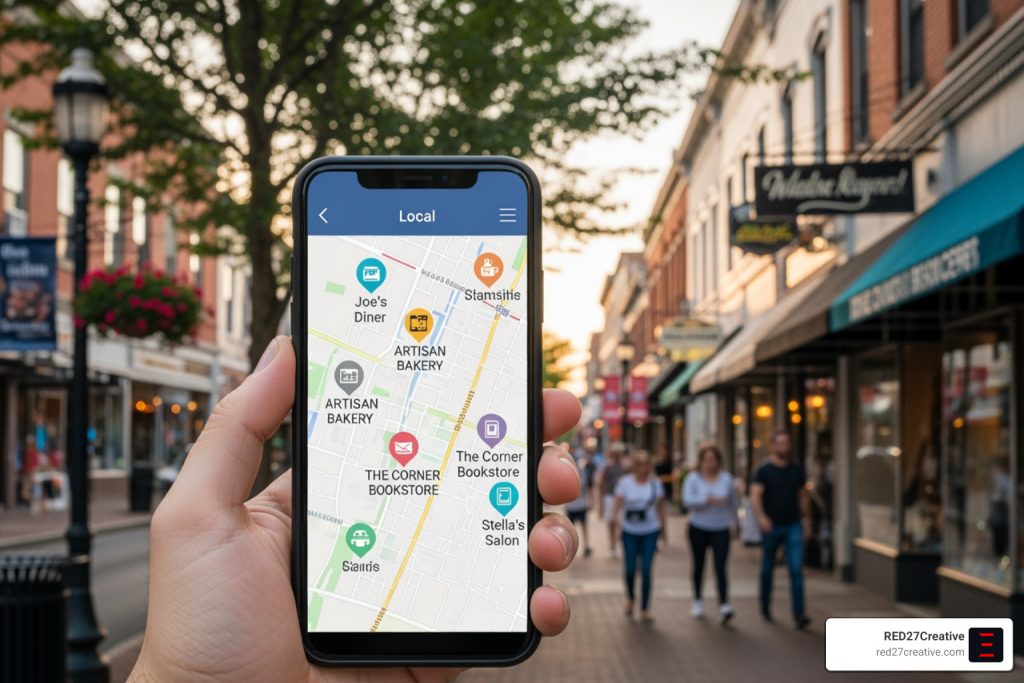
Why Your Local Business Needs to Win at Search
A local SEO strategy is the process of optimizing your online presence so your business shows up when nearby customers search for what you offer. Here’s why it matters:
- 46% of all Google searches have local intent — nearly half of all searches are looking for something nearby
- 76% of people who search “near me” visit a business within a day — these are high-intent buyers ready to act
- It’s easier to rank locally than nationally — you’re competing with businesses in your area, not mega-brands across the country
- Google delivers billions of local search results every month — if you’re not visible, your competitors are
Local SEO helps you appear in Google’s Map Pack (the top three local results), Google Maps, and organic search results for location-based queries. It combines your Google Business Profile, on-site content, online reviews, and local citations to make your business the obvious choice when someone searches for your services.
The world has changed. Your customers no longer flip through the Yellow Pages. They pull out their phone, type “best [service] near me,” and choose from the results that appear. If your business isn’t showing up, you’re invisible.
I’m Kiel Tredrea, founder of RED27Creative, and I’ve spent over 20 years helping local and national businesses grow through strategic SEO, web design, and digital marketing systems. A strong local SEO strategy is often the fastest path to predictable, qualified leads — and it’s built on a foundation that compounds over time.
Local SEO strategy further reading:
The Foundations: How Local Search Works and What Google Wants
When someone searches for a local business or service, Google’s algorithms kick into gear, using a different set of signals than traditional organic search. This is why understanding how local SEO works is crucial for your business. Google aims to connect searchers with the most relevant, reliable, and proximate businesses.
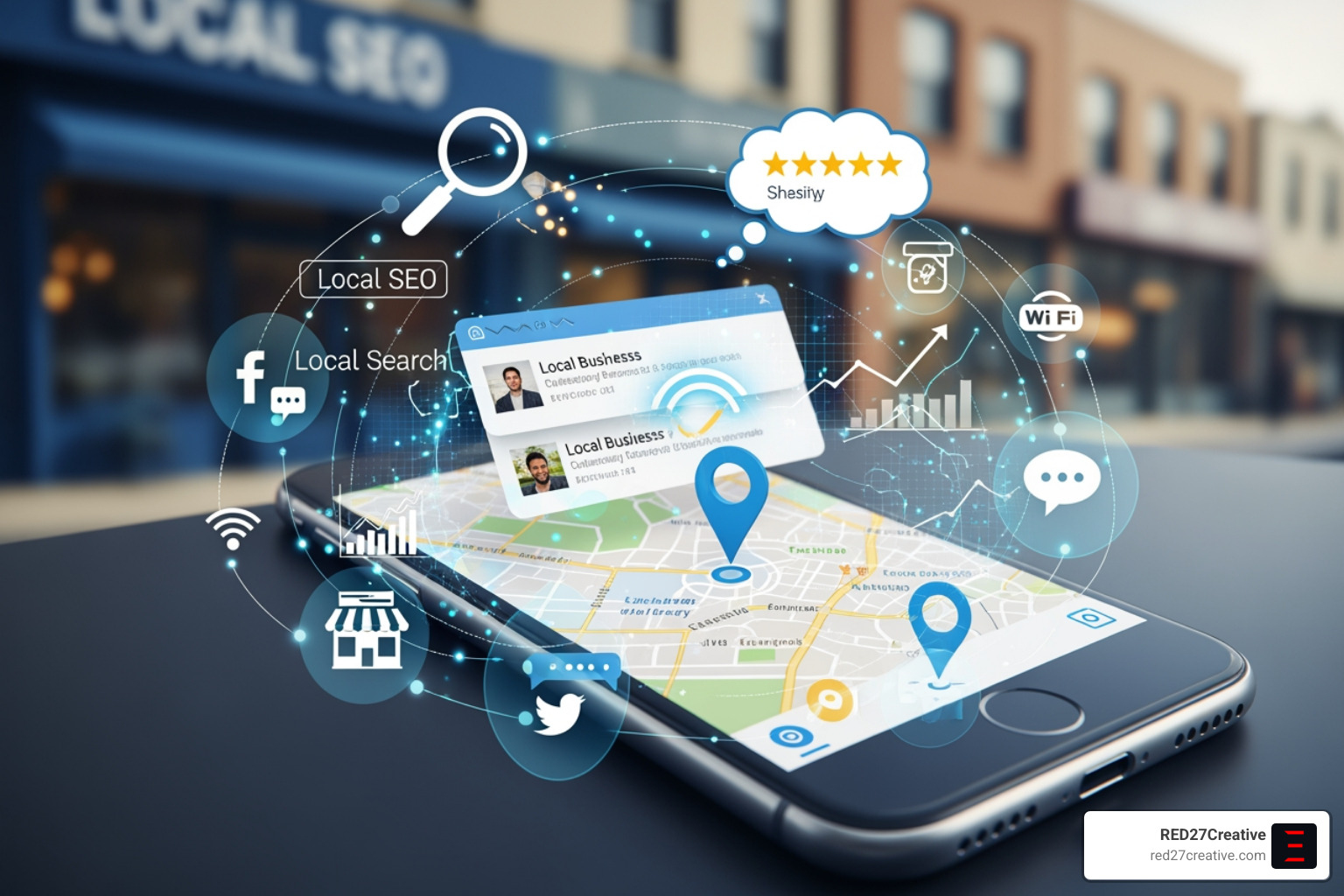
When you search for something like “plumber near me” or “coffee shop in Geneva, IL,” Google often displays a map with three business listings at the top of the search results. This is known as the “Map Pack” or “Local Pack.” Below that, you’ll find “local organic results,” which are standard website listings that Google deems relevant to your local query. The goal of a robust local SEO strategy is to appear prominently in both.
Understanding Local Ranking Factors
Google’s local search algorithm considers three primary factors when determining rankings: Relevance, Distance, and Prominence. These factors work together to provide the best possible results for local searchers.
- Relevance: How well your business profile matches what someone is searching for. This means ensuring your Google Business Profile (GBP) is complete and accurately describes your services. If a searcher is looking for “HVAC repair in Aurora, IL,” your GBP should clearly state that you offer HVAC repair in Aurora.
- Distance: How far your business is from the searcher’s location. Google uses the searcher’s device location (or the location specified in the search query) to determine proximity. This is a factor you can’t directly control, but you can ensure your address is accurate.
- Prominence: How well-known and respected your business is. This is influenced by several signals, including:
- GBP signals: A complete, accurate, and active profile.
- On-page signals: Local keywords, quality content, and mobile-friendliness.
- Backlink signals: Quality links from other websites, especially local ones.
- Review signals: The number, quality, and recency of customer reviews. Google considers these a known ranking factor, and 84% of people trust them.
- Citation signals: Consistent Name, Address, and Phone number (NAP) across online directories.
- User behavior signals: Clicks for directions, phone calls, and website visits from your listing.
Traditional SEO vs. Local SEO: What’s the Difference?
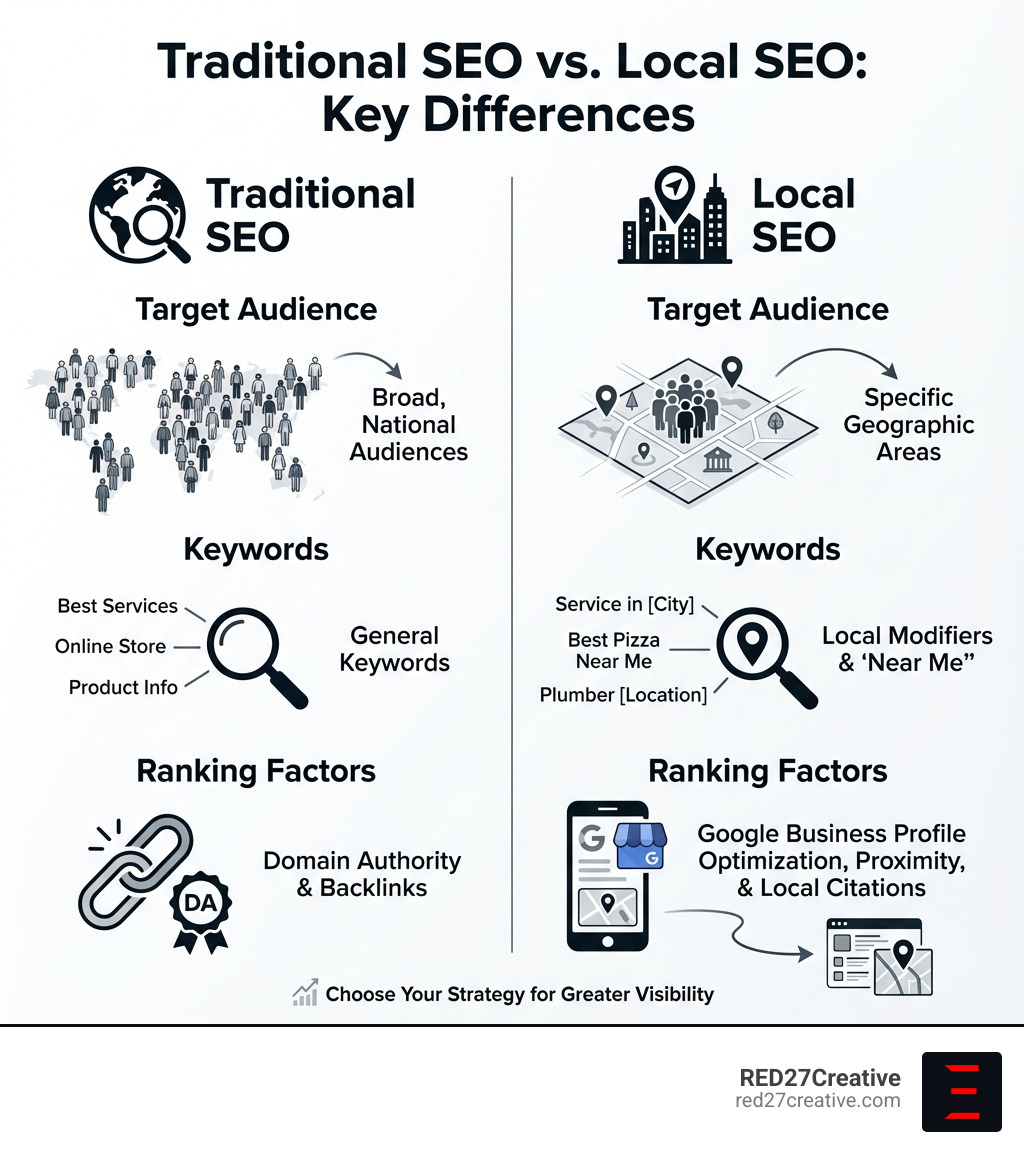
While both traditional (or national) SEO and local SEO strategy aim to improve search engine visibility, their focus and methods differ significantly. Traditional SEO targets a broad, geographically diverse audience, while local SEO hones in on specific regions and searchers.
| Feature | Traditional SEO | Local SEO |
|---|---|---|
| Geographic Targeting | National/global audience | Specific cities or service areas |
| Keyword Intent | Broad keywords (e.g., ‘digital marketing’) | Local keywords (e.g., ‘digital marketing Chicago’) |
| Key Ranking Signals | Domain authority, backlinks, content, technical SEO | GBP optimization, proximity, reviews, NAP consistency, local links |
| Primary Tools | GSC, keyword/backlink tools | GBP, citation/review tools, local rank trackers |
| Competition | High (large brands) | Lower (local businesses) |
| Conversion Rates | Varies, lower for general queries | High due to immediate purchase intent (80% of mobile local searches convert) |
The Cornerstone: Mastering Your Google Business Profile (GBP)
Your Google Business Profile (GBP) is arguably the single most important asset in your local SEO strategy. It’s a free tool that allows local businesses to manage their online presence across Google Search and Google Maps. Optimizing your GBP increases the likelihood of ranking highly when potential customers in nearby areas like Geneva, Naperville, or Chicago search for relevant terms. With only 56% of local businesses having claimed their GBP listing, there’s a huge opportunity to get ahead!
Claiming and Optimizing Your Profile
The first step to mastering your GBP is to claim and verify it. This process confirms that you are the legitimate owner of the business. You can start by visiting google.com/business.
- Claiming your business: Search for your business name. If it appears, claim it. If not, you can create a new listing.
- Verification process: Google wants to confirm your business is real. This often involves receiving a postcard with a code, a phone call, or an email verification.
- NAP consistency: Your Name, Address, and Phone number (NAP) must be identical across your GBP, website, and all online directories. Inconsistencies can hurt your rankings. Ensure your business name matches your legal documents.
- Choosing correct categories: Select the most accurate primary category for your business, and add up to nine secondary categories. These tell Google what your business does.
- Writing a compelling business description: Highlight your unique selling points and include relevant keywords naturally.
- Uploading high-quality photos and videos: Showcase your business, products, and team. Businesses with photos get more clicks and direction requests. Add fresh images regularly.
For more in-depth guidance, check out our guide on Mastering Google Business Profile.
The Power of Reviews and Reputation Management
Online reviews are a cornerstone of any effective local SEO strategy and are deeply intertwined with your online reputation. Google explicitly states that “high-quality, positive reviews from your customers can improve your business visibility and increase the likelihood that a shopper will visit your location.”
- Reviews as a ranking factor: Google uses review quality, quantity, and recency to determine Map Pack rankings. More positive reviews give you a significant edge.
- 84% trust online reviews: Consumers trust online reviews as much as personal recommendations. This social proof is vital for converting searchers into customers.
- Encouraging customer reviews: Ask satisfied customers for reviews. Make it easy with a direct link or QR code.
- Responding to all reviews: Engage with every review, positive or negative. Thank positive reviewers and professionally address concerns in negative ones. Responding shows you care and strengthens your local presence. Ignoring reviews is a mistake.
- Using GBP Q&A: Proactively use the Q&A section to answer common questions, provide helpful information, and demonstrate expertise.
On-Site and Content: Optimizing Your Website for Local Customers
Your website is a critical component of your local SEO strategy, reinforcing your local relevance to your target audience. It requires on-page SEO and content that resonates with local searchers.
Finding the Right Local Keywords
Keyword research for local SEO is similar to traditional SEO but with a geographical twist. We’re looking for what local people are typing into Google when they need your services.
- Keyword research process: Brainstorm terms related to your business and add local modifiers (e.g., “web designer in Naperville, IL”).
- Using modifiers: Phrases like “near me” or city names are crucial, high-intent local keywords.
- Tools: Use Google Keyword Planner, Semrush, or Ahrefs to find keywords and check local search volume.
- Analyzing competitors: Use tools like Semrush to find keywords your local competitors rank for.
- Long-tail local keywords: Target specific phrases like “emergency HVAC repair in Oswego, IL.” They often have lower volume but higher conversion rates.
Creating Hyper-Local Content
Once you have your keywords, it’s time to create content that speaks directly to your local audience. This isn’t just about stuffing keywords; it’s about providing genuine value and demonstrating your connection to the community.
- Creating location-specific service pages: If you serve multiple areas, create unique landing pages for each. Detail your services for that area, include local testimonials, and mention local landmarks.
- Writing blog posts about local events: Showcase community involvement by writing about local festivals, charity events, or partnerships. This positions you as a community resource.
- Showcasing local case studies: Feature projects completed in specific neighborhoods. “Before-and-after” photos of local work are incredibly compelling.
Technical On-Page Signals for a Local SEO Strategy
Beyond compelling content, your website’s technical foundation needs to be optimized for local search.
- Title tags and meta descriptions: Include your primary keyword and location (e.g., “Best SEO Services in Chicago | RED27Creative”).
- Header tags (H1, H2): Structure content and include local keywords in headers. Your H1 should state the page’s topic and location.
- Internal linking: Link between pages using local anchor text (e.g., linking to your Naperville service page with “Naperville SEO”).
- Adding Local Business schema: Use schema markup to give search engines explicit details about your business (NAP, hours, etc.). Use Google’s Rich Results Test to validate your code. This is crucial for rich snippets and AI search.
- Embedding a Google Map on your contact page: This reinforces your physical location to Google and makes it easy for customers to find you.
- Ensuring mobile-friendliness: Your website must be responsive and fast on mobile, as many local searchers visit a business within a day.
Off-Site Authority: Building Citations and Local Backlinks
Beyond your GBP and website, a comprehensive local SEO strategy requires building off-site authority. These signals tell Google your business is a legitimate, popular community resource.
Mastering Local Citations
Local citations are any online mentions of your business’s Name, Address, and Phone number (NAP). Consistency across these listings is paramount.
- What are citations: These can be formal listings in directories or informal mentions on blogs and news sites.
- NAP consistency is critical: Your business Name, Address, and Phone number must be identical everywhere. Even minor variations (e.g., “St.” vs. “Street”) can confuse search engines and dilute your authority.
- Types of citations: Citations can be structured (formal directory listings like Yelp or Apple Maps) or unstructured (mentions on local blogs or news sites).
- Top directories: List your business on major platforms like Yelp, Apple Maps, and Facebook, plus relevant industry-specific directories.
- Local Chamber of Commerce: A listing with your local Chamber of Commerce provides a highly trusted citation.
For assistance with managing your local listings and ensuring NAP consistency, explore our insights on How to Choose Your Local SEO Listings Management.
Building a Backlink Profile for Your Local SEO Strategy
Backlinks–links from other websites to yours–are a powerful signal of authority for Google. For local SEO, the focus shifts to acquiring backlinks from relevant and authoritative local sources.
- Local link building tactics: Connect with other local businesses and organizations.
- Sponsor local events or teams: Sponsoring a local team or event can earn a relevant backlink from the event’s website, increasing brand visibility.
- Partner with neighboring businesses: Complementary businesses can exchange links or feature each other in blog posts.
- Join the local Chamber of Commerce: Membership often includes a directory listing with a highly trusted backlink.
- Local press and PR: Pitch newsworthy stories to local news outlets or offer to be a local expert to earn mentions and backlinks.
Measuring Success and Future-Proofing Your Strategy
A local SEO strategy is an ongoing process requiring continuous monitoring and adaptation. Results can appear within weeks to months, depending on your industry’s competitiveness and the quality of your efforts.
Essential Tools and Metrics for Monitoring Performance
To truly understand the impact of your local SEO efforts, you need to track the right metrics and use the right tools.
- Key features in local SEO software: Look for platforms that offer:
- Listing Management (for NAP consistency).
- Review Management (to track and respond to reviews).
- Geotargeting (to reach the right local audience).
- Local Rank Tracking (to monitor search positions).
- Reporting and Analytics (to measure performance).
- Rank tracking for the Map Pack: Use specialized tools to track your ranking in the local pack for specific keywords across different locations, which is crucial for multi-location businesses.
- Using Google Search Console (GSC): This free tool provides invaluable insights into which local queries drive traffic to your site and how Google views your pages.
- Analyzing GBP Insights: Your GBP dashboard provides insights into customer interactions. Track:
- Calls: How many people called your business directly from your GBP.
- Direction requests: How many asked for directions to your location.
- Website clicks: How many visited your website.
- Photo views: How many times your photos were viewed compared to competitors.
- Website traffic: Use Google Analytics to monitor organic local search traffic and identify top-performing pages.
For more detailed performance insights, check out our Local SEO Insights articles.
Advanced Tactics and Future Trends
The local search landscape is constantly evolving, with new technologies and algorithm updates shaping how businesses connect with customers. Staying ahead means adapting your local SEO strategy.
- Multi-location businesses: Each location needs its own optimized GBP and dedicated website page. Ensure consistent branding, accurate NAP, and centralized management of listings and reviews.
- Service-area businesses (SABs): If you serve customers at their locations (like a plumber), set up your GBP as an SAB. Hide your address, define your service areas, and list the cities you serve on your website.
- AI and voice search: Voice search and AI-powered results are growing. They rely on structured data and clear answers from your GBP and website. Google’s AI Overviews may pull directly from your GBP content.
- Preparing for AI Overviews: To prepare, optimize your GBP and ensure your website content directly answers customer questions. Encourage reviews that mention specific services and locations to help your business appear in AI summaries.
Frequently Asked Questions about Local SEO Strategy
What are the three most important factors for local SEO?
The three core pillars Google emphasizes for local rankings are Relevance, Distance, and Prominence. Relevance is how well your business profile matches a search. Distance is the proximity of your business to the searcher. Prominence refers to how well-known your business is, based on factors like links, articles, and especially online reviews.
How long does it take to see results from a local SEO strategy?
While some quick wins like optimizing your Google Business Profile can show results in weeks, a comprehensive local SEO strategy typically takes 3 to 6 months to gain significant traction. Factors like your industry’s competitiveness, your location, and the consistency of your efforts will influence the timeline for improved rankings and traffic.
Can I do local SEO myself?
Yes, many foundational local SEO tasks can be done yourself, such as claiming and optimizing your Google Business Profile and encouraging reviews. However, more technical aspects like schema markup, citation management, and local link building often require specialized expertise to be effective and can be time-consuming for a business owner.
Put Your Business on the Map
A strong local SEO strategy is no longer optional–it’s the most effective way to connect with customers in your community who are actively searching for your services. By optimizing your Google Business Profile, creating relevant local content, and building your online authority, you can turn search visibility into real, measurable growth. The team at RED27Creative specializes in building these data-driven systems that drive consistent, qualified opportunities. If you’re ready to dominate your local market, explore our Marketing Strategy and Consulting Services to build a roadmap for success.

Kiel Tredrea
https://red27creative.comTop Marketing Agency • Web, SEO & Leads • RED27Creative