Benchmark Bonanza: Key Performance Indicators in Manufacturing

Why Manufacturing Industry Benchmarks Matter for Your Business
Manufacturing industry benchmarks are critical standards used to measure and compare your company’s performance with industry peers, highlighting strengths and areas for improvement.
For a fast overview, these benchmarks typically focus on:
- Operating Efficiency: Metrics like Overall Equipment Effectiveness (OEE) and cycle time.
- Cost Management: Total manufacturing cost, cost of goods sold, and labor costs.
- Inventory Control: Inventory turnover ratio and fill rate.
- Financial KPIs: Revenue growth, EBITDA, and gross margin.
Simply put, if you’re not benchmarking your manufacturing business, you’re missing valuable insights that could boost your efficiency by an average of 20-25%.
I’m Kiel Tredrea, founder of RED27Creative, with over 20 years helping manufacturers leverage Manufacturing industry benchmarks to improve operations and marketing performance. In this guide, I’ll show you exactly how benchmarks can lift your manufacturing business.
Related content about Manufacturing industry benchmarks:
– Content marketing for manufacturers
– Innovative manufacturing processes
– Manufacturing case studies
Understanding Manufacturing Industry Benchmarks
Let’s face it—manufacturing has come a long way over the last few decades. Back in the day, benchmarking was just about comparing products side-by-side. Fast forward to today, and Manufacturing industry benchmarks have evolved into comprehensive tools that measure every aspect of your operations—from production times to overall business efficiency.
At its heart, benchmarking is simply measuring your company’s performance against industry standards or your competitors. It helps you spot gaps in your processes and highlights opportunities to become better, faster, and more cost-efficient.
Recent industry research shows that manufacturers who regularly benchmark their operations can improve efficiency by around 20-25%. That’s not pocket change! It’s clear why benchmarking has become essential for any manufacturer aiming to stay competitive in today’s rapid-paced market.
As one manufacturing expert humorously puts it, “Stop operating in the dark! Benchmarking is like turning on the lights in your manufacturing plant—without it, you’re bumping into things you didn’t even know were there.” Benchmarking illuminates exactly where your business stands, providing valuable context for your performance numbers.

Types of Benchmarking in Manufacturing
Knowing the different types of benchmarking can really help you get the most value out of the process. Let’s quickly break down these categories in simple terms, so you know exactly what’s what.
Internal Benchmarking involves comparing different areas within your own organization. For instance, maybe your afternoon shift consistently produces more units per hour than your morning shift. Comparing them helps you pinpoint what’s driving that difference and replicate the success.
With Competitive Benchmarking, you’re looking at how your direct competitors are performing. This might be analyzing their market share, product quality ratings, or customer satisfaction scores. Getting detailed competitor data can be tricky—but even general comparisons can give you a valuable sense of how you stack up.
Performance Benchmarking zeroes in on specific metrics directly related to your operations, like production cycle times, defect rates, machine output, or cost per unit. If your competitors consistently have shorter cycle times, performance benchmarking helps you understand exactly where you need to focus to catch up.
Sometimes, great ideas come from outside your industry—this is where Functional Benchmarking comes in. It compares similar processes across different industries. For example, a food manufacturer might adopt Total Quality Management principles originally developed in the automotive world. You never know where you’ll find your next game-changing idea!
Lastly, Generic Benchmarking is broad and universal. It compares processes that almost every business has, like customer service or order fulfillment. For example, studying how an e-commerce giant handles customer inquiries could inspire you to improve your own customer experience.
By combining these types strategically, you’ll create a complete picture of how your manufacturing operation is performing—and exactly where you can improve.
Importance of Manufacturing Industry Benchmarks
So, why exactly should you care about Manufacturing industry benchmarks? Let’s talk about the key benefits in a natural, human-friendly way.
Benchmarking is your best friend when it comes to process improvement. Because it clearly shows where you’re excelling—and where you’re falling short—you’ll know exactly where to allocate your resources. For example, if your equipment changeover time is 45 minutes and the industry standard is 30, it’s clear where your next improvement focus should be.
Another big bonus is identifying performance gaps. We all have blind spots, and benchmarking is like a friendly colleague who points them out—politely, of course. Peeter Põder, a Mill Manager who successfully used benchmarking in his facility, says it best: “You can only drive change if everyone understands, in a unified way, what is happening in production and what the problems are.” When everyone sees the issues clearly, things start to improve quickly.
Setting realistic goals can also become much easier with benchmarking. Without comparing yourself to industry standards, you’re shooting in the dark. Benchmarking provides real-world targets, like knowing your fill rate should be around 98.5% if top manufacturers in your sector hit that mark. No more guessing or internal politics—just clear, achievable goals.
Finally, benchmarking isn’t a one-and-done deal—it’s your pathway to continuous improvement. It’s an ongoing cycle that keeps your business always moving forward. As one wise industry veteran once noted, “Metrics should change behaviors. People must understand why they exist and how they lead to tangible benefits.” By regularly revisiting your benchmarks, you create a culture of continuous, measurable progress.
Explore these helpful resources:
– Latest research on manufacturing benchmarks
– Content marketing for manufacturers
– Lead Generation for Manufacturing Companies
Key Performance Indicators (KPIs) in Manufacturing
When it comes to improving your manufacturing operations, tracking the right metrics can make all the difference. These metrics, known as manufacturing industry benchmarks, provide a clear picture of how your business stacks up against competitors and industry standards.
By focusing your attention on these essential KPIs, you can pinpoint exactly where to improve, cut unnecessary costs, and boost your overall efficiency.
Let’s explore the most important categories of KPIs to include in your benchmarking strategy:

Manufacturing Costs Benchmarks
Managing costs effectively is the key to maintaining healthy profitability. Here are the most important cost-related benchmarks manufacturers should monitor carefully:
Total Cost to Manufacture: This number covers every cost needed to produce your products—labor, materials, overhead, utilities, and depreciation. Ideally, manufacturing businesses should aim to keep this below 65% of total revenue. The lower your total manufacturing costs, the higher your profit margins.
Cost of Goods Sold (COGS) as Percentage of Revenue: This metric indicates how much of your revenue goes directly into producing the goods you sell. Industry benchmarks suggest that manufacturers typically keep COGS around or below 65% of revenue. Top manufacturing companies have consistently held a 32% average gross margin even through inflationary pressures, demonstrating excellent cost management practices.
Labor Costs as Percentage of Cost of Goods Sold: Labor is one of the biggest expenses for manufacturers. Industry best practices suggest that labor costs should ideally be between 20% and 35% of your COGS. Recent industry data shows successful manufacturers typically report labor expenses around 20% of their revenue, highlighting effective workforce management.
Material Costs as Percentage of Cost of Goods Sold: Materials usually make up the largest component of the manufacturing cost structure—typically 50% to 75% of COGS. Keeping a close eye on material costs is crucial, especially during times of supply chain disruptions or volatility.
Yield: Yield measures the percentage of products that pass quality standards without having to be scrapped or reworked. High-performing manufacturers achieve yields above 95%, significantly reducing waste and production costs. One food and beverage manufacturer increased their yield from 92% to 97% through targeted process improvements, saving over $500,000 annually.
Productivity Benchmarks
Effective productivity benchmarks help you understand how efficiently your resources convert inputs into finished products. These metrics directly influence your operational success:
Operator Loading: This metric shows how much of the available labor hours are used productively. Top manufacturers maintain operator loading rates of 85% to 90%, balancing productive output without overloading workers.
Changeover Time: Minimizing changeover time—the time required to switch a production line from one product to another—boosts flexibility and throughput. World-class manufacturers have dramatically reduced changeover times from hours down to mere minutes with techniques like SMED (Single-Minute Exchange of Dies).
Capacity Utilization: This measures how fully you’re utilizing production equipment and facilities. Industry benchmarks recommend aiming for 85%-90% capacity utilization to optimize asset efficiency without overstretching resources.
Cycle Time: Simply put, cycle time measures how long it takes to complete the manufacturing process from start to finish. Industry standards vary widely—world-class manufacturers can achieve completion times below 24 days, while lagging businesses might exceed 96 days. The shorter your cycle times, the quicker you can meet customer demand and improve profitability.
Schedule Attainment: This KPI indicates how often you’re able to achieve your planned production schedule. Consistently achieving above 95% schedule attainment shows excellent operational control, reliability, and effective planning.
While every manufacturing plant is unique, the most critical productivity KPIs to track include operator loading, changeover time, capacity utilization, cycle time, schedule attainment, labor productivity, throughput, first pass yield, order fulfillment lead time, and production attainment. By keeping an eye on these metrics, you’ll easily spot opportunities for improvements.
Equipment Effectiveness Benchmarks
Equipment performance directly impacts productivity and profitability. Understanding and improving your equipment’s performance through these benchmarks can significantly boost factory efficiency:
Overall Equipment Effectiveness (OEE): OEE is a widely-used metric that combines availability, performance, and quality into one key number. It provides a complete picture of your equipment’s effectiveness.
It’s calculated using the formula: Availability × Performance × Quality = OEE.
Most manufacturers average an OEE of about 60%-65%, while world-class manufacturers achieve over 85%. Realistically, only around 10% of manufacturers globally reach world-class OEE scores. The real aim is continuous improvement—taking your OEE score higher little by little, as one expert advises: “Don’t fixate on the absolute value of OEE, instead fixate on your ability to improve your OEE incremental steps at a time.”
Unplanned Machine Downtime: This metric measures how much production time you lose due to unexpected breakdowns. High-performing manufacturers typically see around just 3% downtime, compared to around 6% for lower performers. Lowering this number through proactive maintenance programs can significantly boost your output and profitability.
Machine Availability: As part of OEE, machine availability represents the percentage of scheduled time machinery is ready and capable of operation. World-class manufacturers regularly achieve availability rates above 90% thanks to effective maintenance and timely issue resolution.
Asset Availability: Similar to machine availability, asset availability includes all production assets. High-performing manufacturers aim for at least 95% availability, ensuring equipment remains in reliable working condition.
Planned Maintenance Percentage (PMP): PMP tracks how often maintenance is planned ahead, rather than reacting after issues arise. Leading manufacturers push for PMP rates of 80% or more, which dramatically reduces unexpected breakdowns and minimizes downtime. For example, an automotive manufacturer successfully boosted PMP from 60% to 85% through predictive maintenance strategies, reducing their unplanned downtime by 40%.
Focusing on these manufacturing industry benchmarks will help you identify performance gaps, target specific improvement areas, and foster a culture of continuous performance optimization. Whether you’re a large manufacturer or a growing small business, these KPIs provide clear insights and actionable steps to drive your company’s success.
Implementing Benchmarking in Manufacturing
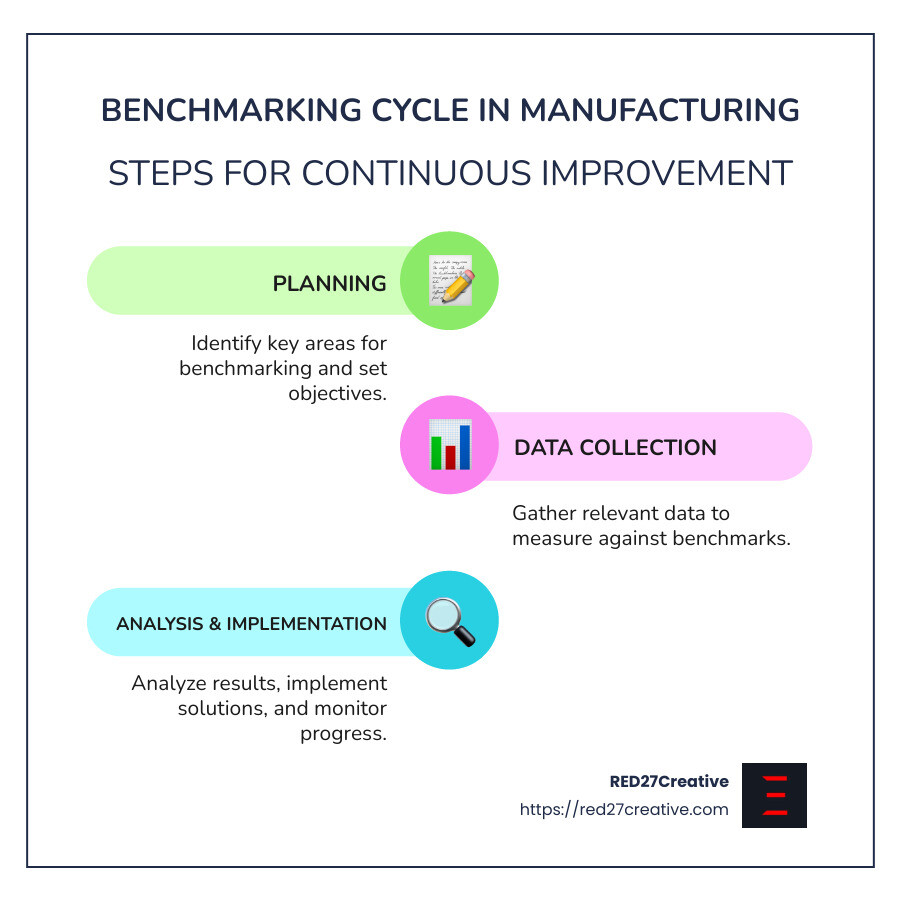
Successfully integrating Manufacturing industry benchmarks into your operations isn’t about complex theory—it’s about following a simple, structured approach to continuous improvement. Let’s walk through the key steps involved, keeping things clear, practical, and achievable.
Planning Phase
Before diving straight into benchmarking, clearly lay out your roadmap. Start by defining exactly what you’re trying to achieve. Are you after cost reductions, higher quality, or greater overall operational efficiency? Clarifying your objectives from the start keeps everyone aligned and focused.
Next, choose the right metrics to track. Rather than trying to measure everything under the sun, pinpoint specific KPIs that reflect your strategic goals. For example, a leading manufacturing executive once shared how their entire organization rallied around improving Overall Equipment Effectiveness (OEE): “Choosing OEE was our smartest decision—it simplified our focus and got everyone on the same page.”
Decide who you’ll compare your performance against. Will you benchmark internally across departments, against direct competitors, or even against top-performing businesses from other industries? Each approach offers unique insights.
Lastly, establish your baseline. Clearly document your current performance so you can accurately measure improvements as you move forward.
Data Collection
Accurate, quality data is the lifeblood of effective benchmarking. Begin by systematically collecting internal data—consistency is key, so ensure measurement methods remain the same across your organization. Also, gather external benchmarking data from reputable industry sources, trade associations, or specialized benchmarking research.
Always double-check your data quality. As seasoned benchmarkers note, “Different companies might define metrics differently—make sure you’re comparing apples to apples.” Standardizing your definitions and measurements upfront eliminates confusion later on. For example, clearly distinguish between in-line waste versus end-of-line rejects when measuring quality.
Analyzing Metrics
Once your data is in hand, it’s time to uncover meaningful insights. Begin by identifying performance gaps—areas where your business falls short compared to industry benchmarks.
But don’t stop there. Dig deeper to find root causes behind these gaps. For instance, if afternoon shifts consistently outperform morning shifts, explore why. Is it due to differences in staffing, equipment usage, or even leadership styles?
Prioritize your improvement opportunities based on both impact and feasibility. Instead of attempting every possible improvement at once, narrow your focus to the few changes that will deliver the biggest payoff.
Finally, set realistic but challenging targets based on your findings. Aiming for world-class metrics immediately—like an 85% OEE—can feel overwhelming and demotivating. Instead, set smaller incremental goals you can achieve within a few months, then continue building momentum.
Communication and Buy-In
Benchmarking success isn’t just about numbers—it’s about people. Transparent communication across all levels is crucial. Share your benchmarking findings throughout your organization, from the factory floor to the executive suite.
Involve your team in creating and implementing improvement plans. Often, the best solutions come directly from employees closest to the issues. Engaging your team fosters a sense of ownership and encourages everyone to participate in the journey toward improvement.
Proactively address any resistance or skepticism by clearly explaining the benefits of benchmarking. Invite those who might resist to actively contribute and voice their concerns—they might even offer valuable insights you hadn’t considered.
Finally, develop clearly defined action plans with assigned responsibilities, deadlines, and resources. As a mill manager who successfully acceptd benchmarking once said, “Driving meaningful change only happens when everyone understands exactly what’s happening and why it matters.”
Continuous Monitoring
Benchmarking isn’t a “set it and forget it” kind of thing. It’s about continuous, ongoing improvement. Regularly track your progress against your benchmarks and previously set targets.
Adjust strategies as needed based on real-world results. Celebrate even small wins along the way—recognition keeps your team motivated and engaged in the process.
As you reach your initial targets, reset benchmarks to push your organization even further. The pursuit of excellence never truly ends. One manufacturer increased their OEE score from 40% to 75% within a year simply by consistently focusing on incremental improvements.
Best Practices for Effective Benchmarking
For truly impactful benchmarking, accept these proven best practices:
-
Choose relevant metrics: Focus on KPIs tied directly to your strategic goals—not every metric matters equally. Prioritize those that genuinely drive value and meaningful change.
-
Ensure data accuracy: Insights are only as reliable as the data behind them. Invest effort into verifying data quality and consistency.
-
Involve stakeholders: Effective benchmarking involves everyone. From senior leadership to frontline operators, ensure everyone understands your benchmarks and their role in improving them.
-
Set achievable targets: World-class benchmarks inspire, but intermediate targets motivate real change. If your OEE is currently at 40%, setting an immediate goal of 85% might feel unrealistic. Aim instead for something attainable within a few months—a stretch goal that’s challenging yet achievable.
-
Use technology: Leverage digital solutions to simplify data collection, analysis, and reporting. Advanced analytics, ERP systems, and real-time performance monitoring tools make tracking benchmarks easier, faster, and more accurate. For example, a food manufacturer in Chicago adopted an automated OEE tracking system, boosting their OEE by 20% in just six months.
By thoughtfully integrating these steps and best practices, your manufacturing operation can leverage Manufacturing industry benchmarks to gain a true competitive edge. You’ll benefit from consistent progress, improved efficiency, and strengthened profitability—everything today’s manufacturers need for lasting success.
Overcoming Challenges in Benchmarking
Let’s face it – implementing manufacturing industry benchmarks isn’t always smooth sailing. Even with the best intentions, you’ll likely hit a few roadblocks along the way. But don’t worry! These challenges aren’t deal-breakers – they’re just part of the journey toward operational excellence.
Data Variability
One of the most frustrating aspects of benchmarking is when you’re trying to compare apples to apples but keep ending up with oranges.
“The first time we tried benchmarking against industry standards, we realized everyone was measuring cycle time differently than we were,” shared a manufacturing manager from Naperville. “It was like speaking different dialects of the same language.”
This data variability happens because different organizations often define and measure the same metrics in different ways. To overcome this common challenge:
- Document your measurement methodologies with crystal-clear definitions
- Take time to understand how external benchmarks are calculated before making comparisons
- Consider joining industry associations that have established standardized definitions everyone follows
- When definitions simply can’t align perfectly, focus on trends rather than absolute numbers
The goal isn’t perfect comparison – it’s meaningful insights that drive improvement.
Resource Constraints
For many manufacturers, especially smaller operations, the thought of launching a comprehensive benchmarking program can feel overwhelming. With limited staff, technology, and time, how can you possibly tackle such an initiative?
Solution: Start small and focused.
A medium-sized manufacturer in Aurora, IL took this approach and saw tremendous success. Instead of trying to benchmark everything at once, they focused on just three critical metrics: OEE, inventory turnover, and on-time delivery. This targeted approach required minimal resources yet delivered significant improvements that eventually funded the expansion of their benchmarking program.
Other practical ways to overcome resource limitations include:
- Leveraging industry associations that provide benchmarking services as part of membership
- Implementing benchmarking in phases, growing as you demonstrate value
- Using automated data collection tools to reduce manual effort
- Focusing first on internal benchmarking before expanding to competitive comparisons
Alignment with Strategic Objectives
Have you ever enthusiastically started a benchmarking initiative only to watch it fizzle out months later? This often happens when benchmarking activities become disconnected from what really matters to your business.
“We were tracking dozens of metrics because they were industry standards, but we realized we weren’t using half of them to drive any decisions,” admitted one operations director. “We were collecting data for data’s sake.”
To ensure your benchmarking efforts remain relevant and sustainable:
- Begin by explicitly linking your chosen metrics to strategic priorities
- Schedule regular reviews to adjust your benchmarking focus as strategies evolve
- Secure executive sponsorship to maintain strategic alignment
- Clearly communicate how benchmarking activities contribute to organizational success
When everyone understands how benchmarking connects to the company’s goals, it transforms from a burdensome exercise into a valuable business tool.
Change Management
Perhaps the most challenging aspect of benchmarking isn’t the technical implementation but the human element. After all, implementing improvements identified through benchmarking often requires significant changes to established processes – and change rarely comes easily.
A manufacturing executive shared this insight: “We found that when we showed operators how their performance compared to best-in-class, it sparked natural competitiveness and intrinsic motivation to improve. The key was presenting the data as an opportunity rather than a criticism.”
To effectively manage the change that comes with benchmarking:
- Involve those affected by changes early in the benchmarking process
- Communicate the “why” behind benchmarking initiatives – people need context
- Provide adequate training and support for new processes
- Celebrate and publicize early wins to build momentum
- Use benchmarking data to create a compelling case for change
When people understand both the reason for change and see early successes, resistance naturally diminishes.
Leveraging Technology for Benchmarking
Remember when benchmarking meant spreadsheets, clipboards, and manual calculations? Thankfully, technology has transformed this process, making benchmarking more accessible, accurate, and actionable for manufacturers of all sizes.
Advanced Analytics
Modern analytics platforms have revolutionized how manufacturers extract value from benchmarking data. These powerful tools can:
- Dig beneath surface-level metrics to identify root causes of performance gaps
- Forecast future performance based on historical trends
- Let you simulate potential improvements before implementing them
- Uncover surprising relationships between different performance metrics
This isn’t just a nice-to-have capability – it’s becoming standard practice. According to IDC, manufacturers accounted for half of the $150.8 billion investment in analytics, showing just how seriously the sector takes data-driven decision making.
Real-Time Data Tracking
Gone are the days when benchmarking meant looking in the rearview mirror at last month’s performance. Today’s IoT sensors and connected machines enable you to monitor performance as it happens:
- Live dashboards displaying OEE and other critical metrics
- Instant alerts when performance dips below benchmarks
- The ability to make immediate adjustments to optimize performance
- Continuous feedback loops that dramatically speed up improvement cycles
I recently visited a manufacturer in St. Charles, IL that implemented real-time OEE monitoring with a simple traffic light system visible throughout their production floor. Green meant performance was on target, yellow indicated caution, and red signaled immediate attention needed. This visual management approach led to a 15% improvement in OEE within just three months as operators became more engaged in performance optimization.
ERP Systems
While not as flashy as some newer technologies, Enterprise Resource Planning systems remain the backbone of effective benchmarking by:
- Centralizing data from across your organization
- Standardizing measurement methodologies
- Automating data collection and reporting
- Providing integrated analytics capabilities
- Making it easy to compare performance across different business units
The average IT spend in manufacturing is about 1.95% of revenue, with a significant portion dedicated to systems that support performance measurement and improvement. For many manufacturers, this investment pays for itself many times over through the operational improvements it enables.
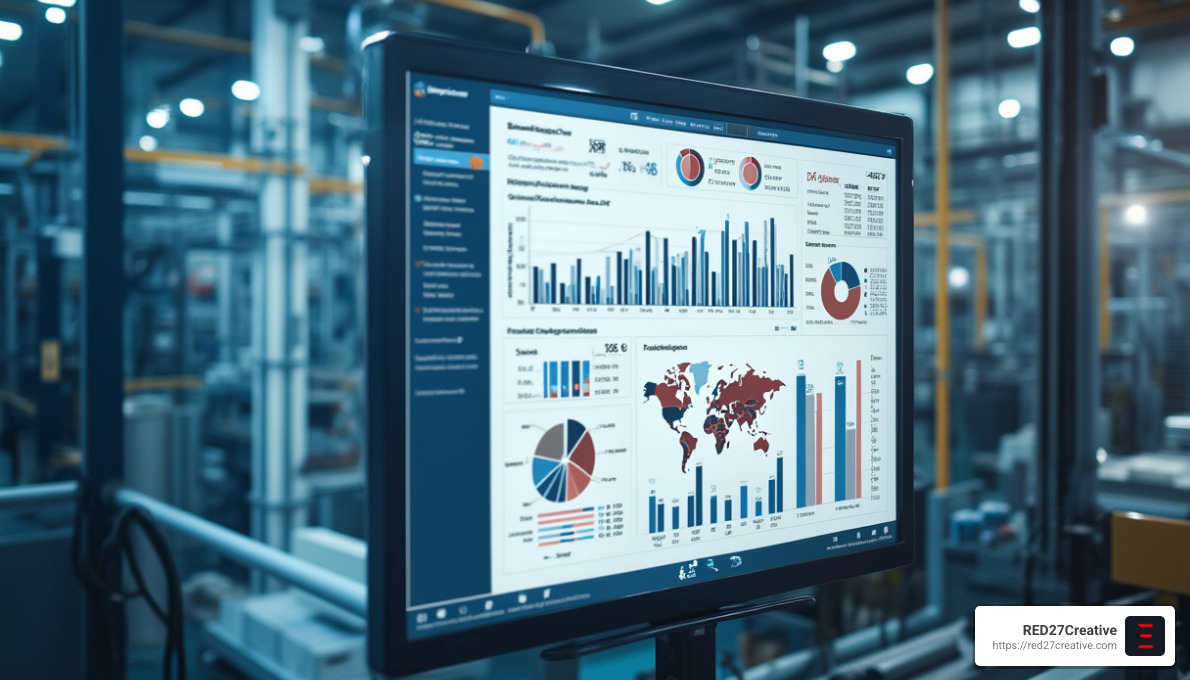
The right technology doesn’t just make benchmarking easier – it transforms the entire process from an occasional exercise into an ongoing capability that drives continuous improvement. As one plant manager put it, “Once we had real-time data at our fingertips, benchmarking went from something we did quarterly to something that informed our decisions every single day.”
Whether you’re just starting your benchmarking journey or looking to improve an established program, tackling these common challenges head-on will help you realize the full potential of manufacturing industry benchmarks for your business.
Manufacturing Industry Benchmarks for Small and Mid-Sized Manufacturers
Running a smaller manufacturing operation can feel like you’re playing in the big leagues without all the equipment. While your larger competitors might have entire departments dedicated to performance analysis, you’re likely wearing multiple hats already. But here’s the good news – manufacturing industry benchmarks might actually be more valuable for your business than for the industry giants.
Why? Because benchmarks give you the roadmap to compete effectively against those bigger, better-funded rivals. They help you focus your limited resources exactly where they’ll make the biggest difference.
Practical Strategies
As a small or mid-sized manufacturer, you don’t need an elaborate benchmarking program to see real results. I’ve worked with dozens of manufacturers who’ve transformed their operations with these straightforward approaches:
Start with Critical Few Metrics
Rather than drowning in data, focus on the vital few metrics that directly impact your bottom line. I’ve seen remarkable success when manufacturers concentrate on just 3-5 key indicators:
Overall Equipment Effectiveness (OEE) gives you that comprehensive view of how well your equipment is performing. It’s like having a doctor’s report on your production line’s health.
On-Time Delivery directly affects customer satisfaction and retention. One manufacturer I worked with increased repeat orders by 22% simply by improving this single metric.
Inventory Turnover shows how efficiently you’re managing your working capital – critical when resources are tight.
First Pass Yield measures quality right at the source, helping you reduce costly rework and scrap.
Cash Conversion Cycle is particularly crucial for smaller operations where cash flow can make or break your business.
I remember working with a cabinet manufacturer in Elgin who was struggling with profitability. By focusing just on OEE and inventory turnover, they identified that excessive setup times and overproduction were their biggest issues. Within six months, they increased profitability by 15% without any additional capital investment.
Leverage Industry Associations
You don’t have to go it alone. Industry associations offer incredible resources specifically designed for smaller manufacturers:
Association-sponsored benchmarking studies provide anonymized data that lets you see how you stack up against peers. Industry conferences aren’t just networking events – they’re goldmines of best practices and informal benchmarking opportunities. Manufacturing consortiums can give you access to expertise and resources that would be unaffordable individually.
The Illinois Manufacturing Excellence Center (IMEC), for example, offers benchmarking services that have helped hundreds of small manufacturers identify improvement opportunities they would have otherwise missed.
Adopt Simplified Measurement Methods
You don’t need complex systems to start benchmarking effectively:
Simple templates for consistent data collection can be created in basic spreadsheet programs. Establishing regular measurement rhythms – daily, weekly, monthly – helps make benchmarking part of your routine rather than an extra burden. Visual management boards in production areas keep metrics visible and top-of-mind for everyone.
A small manufacturer in Naperville created a simple daily management board tracking just four metrics: daily production output, quality rejects, machine downtime, and safety incidents. This visual approach required minimal resources yet drove significant performance improvements by making the entire team aware of how they were doing against targets.
Limited Resources
The resource challenge is real for smaller manufacturers, but it’s not impossible. Here’s how to make benchmarking work even with tight constraints:
Cross-Train Employees
Instead of hiring dedicated specialists, make benchmarking part of everyone’s job:
Train existing employees in basic benchmarking methods during lunch-and-learn sessions. Rotate benchmarking responsibilities among team members to build broader organizational capability. Make performance measurement a natural part of daily work rather than a separate activity.
I worked with a small metal fabricator who trained their shift leads to collect and analyze basic performance data. Not only did this distribute the workload, but it also created healthy competition between shifts that drove continuous improvement.
Use Free and Low-Cost Resources
You’d be amazed at the quality resources available at little or no cost:
The Manufacturing Extension Partnership (MEP) offers subsidized consulting and benchmarking services specifically for smaller manufacturers. Many industry publications regularly share benchmark data in their articles and reports. Local universities often have programs where business or engineering students can help with benchmarking projects as part of their coursework.
Prioritize High-ROI Improvements
With limited resources, you need to be strategic about where you invest your improvement efforts:
Use Pareto analysis (the 80/20 principle) to identify the vital few opportunities that will deliver the greatest impact. Calculate potential ROI before investing in improvements – some of the highest-return opportunities require minimal investment. Focus on quick wins first to build momentum and generate resources for larger initiatives.
A manufacturer in Aurora used their benchmarking data to identify that 70% of their quality issues came from just two process steps. By focusing improvement efforts on these areas, they reduced defects by 45% in just three months.
Incremental Improvements
For smaller manufacturers, the path to excellence usually involves steady, consistent progress rather than dramatic overnight changes:
Set Progressive Targets
Instead of being intimidated by world-class benchmarks, create a stair-step approach:
Establish a solid baseline of your current performance – you can’t improve what you don’t measure. Set initial improvement targets of 10-15% – challenging but achievable. Celebrate achievements when you hit these targets, then set new ones. Build a culture of continuous improvement through regular small wins rather than occasional big initiatives.
Implement Plan-Do-Check-Act Cycles
This simple but powerful improvement methodology works especially well for smaller operations:
Plan: Identify a specific improvement opportunity based on your benchmarking data. Do: Implement a small-scale change that doesn’t require major resources. Check: Measure the results against your benchmarks to see if it worked. Act: Standardize effective changes and start the cycle again with a new improvement.
A manufacturer in Plainfield used this approach to reduce their changeover times by 50% over six months through a series of weekly small improvements rather than a major project. Each week, they identified one small change to their setup process, implemented it, measured the results, and either standardized it or tried something different.
Focus on Low-Hanging Fruit
Begin with the obvious improvement opportunities that your benchmarking reveals:
Address chronic bottlenecks that are limiting your throughput. Eliminate the most common quality defects that are hurting your first-pass yield. Reduce setup times on constraint equipment to increase available production time. Optimize your layout to reduce unnecessary material handling and movement.
By starting with these accessible improvements, you’ll generate early wins that build confidence and provide resources for more ambitious initiatives. More importantly, you’ll create momentum and belief in the power of using manufacturing industry benchmarks to drive your business forward.
For more information on growing your manufacturing business through effective lead generation, visit our Lead Generation for Manufacturing Companies page.
Frequently Asked Questions about Manufacturing Industry Benchmarks
What is benchmarking in manufacturing and why is it important?
Benchmarking in manufacturing is simply the process of measuring your company’s performance against industry standards, competitors, or top companies in other industries. Think of it like checking your health at the doctor’s office—you measure key indicators, figure out how you stack up, and identify what needs improvement.
This practice matters because it provides clear, objective reference points rather than guessing games. By comparing your business to established Manufacturing industry benchmarks, you uncover specific, actionable improvements that boost your operational effectiveness.
Research shows that companies regularly using benchmarks achieve an efficiency boost of 20-25%. In other words, benchmarking takes the guesswork out of improvement, allowing you to focus your resources on areas that will truly move the needle.
How can benchmarking improve operational efficiency?
Benchmarking is your secret weapon for operational efficiency—it highlights areas where you’re falling short and shows exactly how to improve. For example, maybe you’re taking 40% longer to set up your equipment compared to industry peers. Knowing this, you can take targeted action to cut down setup times, freeing up valuable production hours.
By leveraging Manufacturing industry benchmarks, you’ll quickly spot hidden inefficiencies like excess inventory, unnecessary steps in processes, or equipment downtime. This clarity helps you allocate resources strategically, setting realistic goals backed by data rather than arbitrary numbers.
Benchmarking also promotes healthy internal competition—show your team their improvement opportunities, and watch their natural drive to excel kick in. For instance, a manufacturer in Geneva, IL finded through benchmarking that their setup times were significantly above average. After implementing focused improvements, they reduced setup times by 35%, freeing up 20 productive hours per week—without extra equipment or personnel.
What are common KPIs used in manufacturing industry benchmarks?
When you’re diving into Manufacturing industry benchmarks, focusing on the right Key Performance Indicators (KPIs) is crucial. Some of the most common and impactful KPIs include:
-
Productivity Metrics: Overall Equipment Effectiveness (OEE), Cycle Time, Changeover Time, Capacity Utilization. Typically, an OEE of 60-65% is average, while 85% and above is considered world-class.
-
Quality Metrics: First Pass Yield (aim for 95% or higher), Defect Rate (measured in parts per million—below 50 PPM is excellent), Customer Return Rates (under 1% is ideal), and Scrap Rate (less than 2% recommended).
-
Cost Metrics: Total Manufacturing Cost (ideally under 65% of revenue), Labor Costs as Percentage of COGS (20-35%), Material Costs (typically 50-75% of COGS), and Energy Cost per Unit (continuously improving).
-
Inventory Metrics: Inventory Turnover (industry average around 8.5, higher is better), Days of Supply (5-10 days for raw materials), and Fill Rate (top performers achieve over 98.5%).
-
Financial Metrics: Gross Margin (industry average around 32%), EBITDA (around 10%), Return on Fixed Assets, and Revenue per Employee (high performers reaching about $450,000 per employee).
These KPIs provide a powerful starting point, but always remember—it’s important to adjust these benchmarks based on your specific industry and unique business circumstances.
Conclusion
Manufacturing industry benchmarks aren’t just cold statistics or data points on a spreadsheet – they’re powerful catalysts for change that can breathe new life into your operations. Throughout this guide, we’ve explored how these benchmarks serve as both compass and roadmap, pointing the way toward operational excellence while providing practical steps to get there.
The numbers tell a compelling story: manufacturers who accept benchmarking see efficiency improvements of 20-25% on average. That’s not just an impressive statistic – it translates directly to healthier profit margins, happier customers, and a more competitive position in your market.
As I reflect on what we’ve covered, several key insights stand out:
First, effective benchmarking requires a holistic approach. It’s not enough to track just productivity or quality metrics in isolation. The most successful manufacturers look at the complete picture – from equipment effectiveness and productivity to costs and financial performance – creating a 360-degree view of their operations.
Second, benchmarking is a journey, not a destination. The best manufacturers understand that it’s an ongoing cycle of measuring, analyzing, improving, and then starting all over again. This continuous loop drives perpetual improvement that keeps you ahead of competitors.
Third, size doesn’t matter when it comes to benchmarking benefits. Whether you’re operating a massive facility or a small shop, benchmarking works for manufacturers of all sizes. Small and mid-sized manufacturers might need to be more focused in their approach, but the principles and benefits remain the same.
Fourth, technology has democratized benchmarking. With today’s digital tools, sophisticated benchmarking capabilities that were once the exclusive domain of industry giants are now accessible to virtually everyone. Modern ERP systems, IoT sensors, and analytics platforms have transformed what’s possible.
Finally, successful benchmarking is as much about culture as it is about metrics. As Peeter Põder wisely noted: “You can only drive change if everyone understands, in a unified way, what is happening in production and what the problems are.” Benchmarking creates this shared understanding and common purpose.
At RED27Creative, we understand that operational excellence deserves to be showcased. That’s why we help manufacturers not only implement effective benchmarking programs but also communicate their achievements through strategic Content Marketing for Manufacturers. When you’ve worked hard to optimize your operations, your customers and prospects should know about it!
Manufacturing continues to evolve at a breathtaking pace. New technologies emerge daily, customer expectations constantly shift, and global competition intensifies. In this dynamic landscape, manufacturing industry benchmarks provide stability – a reliable reference point that helps you steer change and maintain your competitive edge.
I invite you to explore our Social Media Content Creation Services to find how we can help you share your manufacturing success stories and connect with customers in meaningful ways.
The journey to manufacturing excellence starts with a simple question: “How do we compare?” Benchmarking helps you answer that question honestly and then chart a course toward where you want to be. The path to improvement begins with that first step of measurement – are you ready to take it?

Kiel Tredrea
https://red27creative.comTop Marketing Agency • Web, SEO & Leads • RED27Creative