Lights, Camera, Manufacturing! Why Process Animations Matter

Bringing Manufacturing to Life: The Power of Visual Processes
Manufacturing process animation is a specialized form of 3D or 2D visualization that transforms complex industrial procedures into clear, engaging visual sequences. For manufacturers looking to improve training, marketing, or internal communication, these animations offer a powerful solution.
What is manufacturing process animation?
– Definition: Dynamic visual representation of manufacturing steps, machinery operations, or product assembly
– Types: 3D animation, 2D animation, motion graphics
– Common uses: Training, marketing, sales presentations, safety instruction
– Benefits: Improved comprehension, reduced training time, improved marketing materials
– Cost range: $7,000-$20,000 per minute of finished animation
Manufacturing process animations work by converting technical data (often from CAD models) into sequential visual stories that show exactly how products are made or how machines operate. Unlike static diagrams or text instructions, these animations can demonstrate motion, timing, and spatial relationships in ways that dramatically improve understanding.
For industrial companies, these visualizations solve critical problems: they simplify complex processes for new employees, demonstrate invisible internal mechanics to customers, and create compelling marketing assets that stand out in a crowded marketplace.
I’m Kiel Tredrea, founder of RED27Creative with over 20 years of experience helping manufacturing clients develop effective manufacturing process animations that transform technical complexity into clear visual stories that drive business results.
Find more about Manufacturing process animation:
– Industrial photography services
– Innovative manufacturing processes
– Advanced manufacturing technologies
What Is Manufacturing Process Animation?
Manufacturing process animation transforms complex industrial procedures into engaging visual stories that anyone can understand – even if they’ve never set foot on a factory floor. It’s like having X-ray vision into how products come to life, showing the journey from raw materials to finished goods in a way that static images simply can’t match.
Think of it as the difference between reading about how to ride a bicycle versus watching someone demonstrate it. The animation brings movement, timing, and spatial relationships to life, making technical concepts instantly clear.

These visual stories come in several flavors, each with unique strengths:
3D Animation offers depth and dimension that feels almost tangible – perfect for showing how machine components interact or visualizing complex assemblies from any angle. When you need to see inside equipment or demonstrate precise spatial relationships, 3D delivers best realism.
2D Animation excels at clarity and simplicity. Like a blueprint brought to life, 2D animations strip away distractions and focus on essential processes. They’re ideal for training materials where understanding the sequence matters more than photorealistic detail.
Motion Graphics blend text, data, and simplified visuals into dynamic presentations. They’re particularly effective for explaining concepts, highlighting statistics, or providing context around manufacturing processes.
What makes manufacturing process animation particularly valuable is that it leverages existing CAD data – those detailed engineering files created during product development can be repurposed into powerful visual content that serves multiple business functions, from training to marketing.
Why the Term Matters in Industry
The phrase manufacturing process animation has become increasingly vital in industrial settings because it sits precisely at the intersection where technical precision meets visual storytelling. Unlike generic animations, these specialized visualizations must maintain engineering accuracy while making complex processes accessible to non-technical audiences.
For manufacturing professionals, this term represents content that preserves technical integrity while following actual production sequences and timing. It demonstrates real physical principles and effectively communicates complex procedures to everyone from new hires to potential customers.
As manufacturing faces growing challenges with training budgets and skilled labor shortages, these animations have evolved from marketing nice-to-haves into essential communication tools. Industry research shows that 96% of customers prefer watching product videos to reading manuals – a clear signal that visual learning has become the expectation, not the exception.
How It Works in 60 Seconds
The creation of manufacturing process animation involves a fascinating technical journey that transforms static information into dynamic visuals.
It begins with data conversion, where CAD files or technical drawings are imported into specialized animation software. These raw assets are then optimized, textured, and prepared for animation – like actors getting ready for their performance.
Animators set keyframes – defining where objects should be at specific moments in time – while the software calculates all the in-between frames, creating smooth motion. The scene comes alive as lighting and materials are applied, giving surfaces realistic appearances that reflect their real-world counterparts.
The computer then renders each frame – essentially taking a digital photograph of the scene – before final touches like text overlays, graphics, and sound design complete the experience. Narration, music, and sound effects don’t just improve engagement; they reinforce learning by engaging multiple senses.
As one manufacturing client told us at RED27Creative, “What used to take two hours to explain with diagrams and words now takes two minutes with animation.” That’s the power of translating complex technical information into a format anyone can instantly understand.
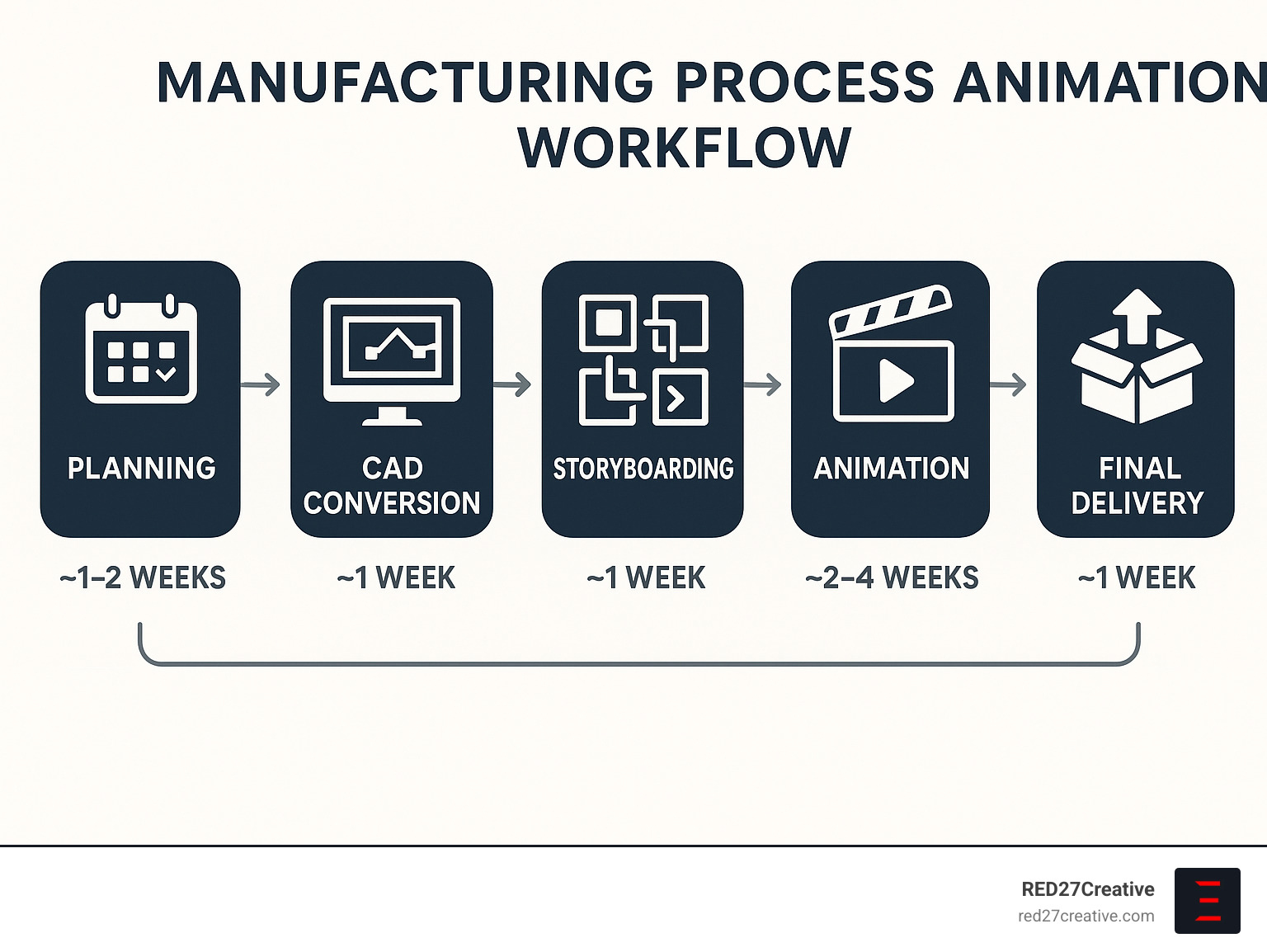
Manufacturing Process Animation Workflow (Step-by-Step)
Creating beautiful manufacturing process animations isn’t magic – it’s a well-crafted journey that we’ve refined through years of working with manufacturers across Illinois. From Chicago’s industrial corridors to Aurora’s manufacturing hubs, we’ve developed a process that balances technical precision with visual storytelling.
1. Pre-Production Planning
Every great animation starts with thoughtful planning. Think of this as the foundation of your manufacturing story. We sit down with your team to understand exactly what processes need visualization and who’ll be watching.
Are we creating training materials for new hires? Marketing videos to wow potential clients? Sales tools to explain complex machinery? By defining clear goals upfront and gathering all your technical documentation, we avoid costly revisions later. Many clients tell us this initial planning saves weeks of back-and-forth later in the process.
2. Script Development
The script is where technical complexity transforms into clarity. Our writers work closely with your engineers to translate specialized terminology into language anyone can understand – without sacrificing accuracy.
We craft a narrative flow that guides viewers logically through your manufacturing process, with careful attention to timing. One manufacturing client in Schaumburg told us, “I was amazed at how you made our complex injection molding process sound so straightforward without dumbing it down.” Every script goes through your team’s approval to ensure we’ve captured the technical details correctly.
3. Storyboarding
Think of storyboards as the visual blueprint for your animation. This crucial step lets you see how your manufacturing process will unfold before we invest in animation.

We map out camera angles that best showcase your machinery, break complex processes into digestible segments, and establish a visual hierarchy that draws attention to the most important elements. This is your opportunity to make adjustments while changes are still easy and inexpensive. Many clients have those “aha!” moments during storyboard reviews when they see their processes from a fresh perspective.
4. Asset Building
Now we roll up our sleeves and prepare all the visual elements. This technical-meets-creative phase is where your CAD files transform into animation-ready assets.
We carefully optimize your engineering files, build any missing elements, and add textures that make surfaces look realistic. The magic happens when we “rig” your machinery – essentially adding digital joints and controls that allow for natural movement. One automotive parts manufacturer told us, “I couldn’t believe that was our actual machine design – it looked better than the real thing!”
5. Animation Production
This is where everything springs to life! Our animators carefully choreograph the movements of your manufacturing process, setting key positions and refining timing for maximum clarity.
We craft camera movements that showcase your process from the most revealing angles – sometimes showing perspectives that would be impossible to see in real life. For a food packaging client, we created animations showing the internal mechanics of their sealing process, something that helped their maintenance team better understand the machinery they were servicing.
6. Lighting & Rendering
Lighting isn’t just technical – it’s an art form that brings drama and clarity to your manufacturing story. We carefully place light sources to highlight the most important parts of your process, refine how materials respond to light, and then set our powerful computers to work rendering each frame.
This rendering process transforms the raw animation data into beautiful finished frames – often requiring specialized computer farms for complex projects. The results are worth the wait, as one client noted: “The lighting made our CNC machining process look like something from a high-end car commercial.”
7. Post-Production
The final stage is where all the pieces come together into a cohesive whole. We combine the rendered animation with graphics and text, adjust colors for consistency, add professional narration and sound effects, and fine-tune the timing of every transition.
This attention to detail lifts your manufacturing process animation from merely informative to truly engaging. As one client put it, “The sound design made all the difference – hearing the machines work alongside seeing them operate created a much more immersive experience.”
| Animation Type | Best For | Typical Cost Range | Production Time | Level of Realism |
|---|---|---|---|---|
| 2D Animation | Process flows, simplified concepts | $7,000-$15,000/min | 2-4 weeks | Low to Medium |
| Motion Graphics | Data visualization, abstract concepts | $5,000-$12,000/min | 1-3 weeks | Low |
| 3D Animation | Machinery operation, product assembly | $10,000-$20,000/min | 3-8 weeks | Medium to High |
| Photorealistic 3D | Marketing, high-end presentations | $15,000-$30,000/min | 4-12 weeks | Very High |
Converting CAD to Stunning Visuals
The change from technical CAD files to engaging visuals is where science meets art. Your engineering data contains all the technical accuracy we need, but turning it into something visually compelling requires both technical know-how and creative vision.
We start by converting your native CAD formats into animation-friendly files, carefully simplifying overly complex geometry without sacrificing accuracy. We organize parts and subassemblies logically, define materials that look authentic, and add lighting that brings dimension to flat technical drawings.
One manufacturing client in Naperville was genuinely surprised when they saw their CAD data transformed: “We’ve been looking at these designs for years, but never saw them like this. The animation made us appreciate our own product design in a whole new way.”
Client Feedback & Iterations
Creating perfect manufacturing process animations is a collaborative dance. Your team’s expertise combined with our visualization skills leads to the best results, which is why we’ve built a structured feedback process into every project.
We schedule regular milestone reviews at key stages – script, storyboard, rough animation, and final delivery. Each review includes dedicated revision cycles where your team can suggest refinements. We work closely with your engineers to validate technical accuracy while marketing teams can weigh in on messaging.
A client in the medical device manufacturing sector told us, “The iterative process caught several technical inaccuracies that would have confused our trainees. But what impressed me most was how you incorporated our feedback without delaying the project timeline.”
This collaborative approach ensures your final animation is both technically precise and visually engaging – the perfect tool for training, marketing, or sales presentations that truly showcase your manufacturing excellence.
Benefits & Real-World Use Cases
When you see a complex manufacturing process clearly visualized before your eyes, something magical happens – confusion melts away and understanding clicks into place. That’s the power of manufacturing process animation at work, and it’s changing how companies operate across Illinois and beyond.
Training & Knowledge Transfer
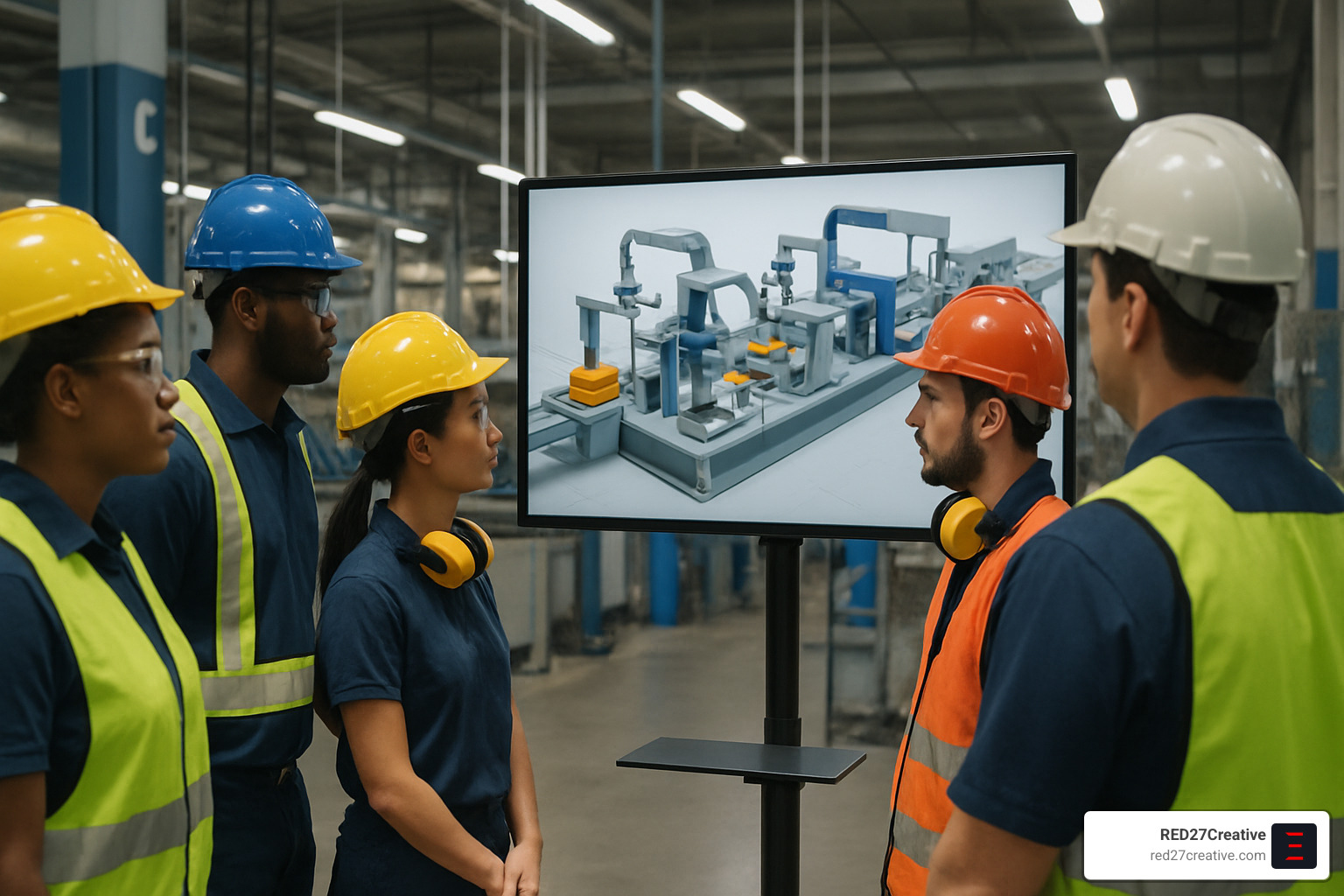
Overwhelming feeling of starting a new job with a 200-page manual dropped on your desk? Our clients have finded that visual learning through animation cuts training time nearly in half. New employees at a Chicago-based electronics manufacturer absorbed assembly procedures 45% faster with animated instructions than with traditional methods.
Manufacturing process animation creates consistency too – every single employee sees the exact same demonstration, whether they’re in the main plant or a remote facility. This visual approach has proven especially valuable for preserving institutional knowledge as experienced workers retire, capturing their expertise in a format that will last for years.
Safety & Compliance
Safety training becomes dramatically more effective when workers can actually see potential hazards without any real danger. A metal fabricator in Geneva told us their team retention of safety protocols improved by 38% after implementing animated demonstrations.
These visualizations shine when explaining emergency procedures that can’t be safely practiced in real life. Plus, when regulatory requirements change, updating an animation is far simpler than retraining your entire workforce from scratch.
Marketing & Sales Enablement
“But how is your manufacturing process different from your competitors?” It’s a question sales teams dread when they can’t show what happens behind closed doors. Manufacturing process animation solves this problem beautifully.
One of our St. Charles clients uses their animation as a “wow factor” at trade shows, drawing crowds to their booth and leaving lasting impressions. Another reports their website engagement time doubled on pages featuring process animations.
These visual assets work overtime across multiple channels – from social media to sales presentations to customer education. They transform technical advantages into clear visual stories that stick in customers’ minds.
More info about Content Marketing for Manufacturers
Process Improvement
Sometimes you don’t see inefficiencies until you visualize the entire process. A food processing equipment manufacturer in Aurora used animation to identify a bottleneck that had been slowing production for years – it simply wasn’t obvious until they saw the whole system in motion.
Manufacturing process animation creates a shared visual language that helps engineering, production, and management align on improvements. When everyone can literally see the same process, collaboration improves dramatically.
One client reported their cross-departmental meetings became 30% shorter after implementing process animations because they spent less time explaining and more time problem-solving.
Industries That Gain the Most
While virtually any manufacturer can benefit from process animation, we’ve seen particularly strong results in certain sectors:
Aerospace Manufacturing thrives with animation because of the extraordinary complexity involved. When building components that must function flawlessly at 30,000 feet, visualization ensures every critical tolerance and safety procedure is understood perfectly. The stakes couldn’t be higher.
Automotive Production leverages animation to standardize procedures across massive workforces. When you’re producing thousands of vehicles daily, consistency is everything. These visualizations also help explain the fascinating interplay between human workers and robotic systems.
Medical Device Manufacturing faces unique challenges with cleanroom procedures and microscopic assembly. Animation allows for training without contamination risk and can zoom in to show details impossible to see with the naked eye. One client’s FDA compliance documentation was strengthened significantly by including process animations.
Energy & Power Generation deals with enormous equipment that’s often impossible to see in its entirety. Animation can shrink a 50-foot turbine to fit on a screen while still showing every critical maintenance point. Safety protocols for hazardous environments become crystal clear when visualized.
Original Equipment Manufacturers (OEMs) find animation invaluable for both customer education and dealer training. When your products will be sold and serviced by partners, ensuring consistent knowledge across all channels becomes critical to maintaining quality.
Before vs After Animation
The change companies experience after implementing manufacturing process animation is often remarkable:
Before animation, a precision machining company in Plainfield struggled with inconsistent training, slow onboarding, and difficulty explaining their manufacturing advantages. Their sales team dreaded technical questions, and process improvements moved at a glacial pace because visualizing changes was so difficult.
After implementing animations, that same company saw new hire productivity reach standards in just 5 weeks instead of 10. Their safety incident rate dropped by 22% in the first year. Most impressively, their sales conversion rate jumped 27% because representatives could confidently demonstrate manufacturing capabilities that previously remained hidden behind factory walls.
“We used to spend the first 15 minutes of every sales meeting just trying to explain our process,” their VP of Sales told us. “Now we show the animation and immediately jump to discussing how our precision benefits their specific application. It’s completely changed our sales approach.”
The return on investment for well-crafted manufacturing process animation typically becomes clear within months, not years – making it one of the most effective visual tools in the modern manufacturer’s toolkit.
Planning, Budget & Timelines
Planning your manufacturing process animation is a bit like preparing for a journey – you need a clear destination, a good map, and the right resources to get there successfully. Let’s walk through how to set your project up for success.
Setting Clear Objectives
Before jumping into production, take time to clarify exactly what you want your animation to achieve. Are you training new hires on complex machinery? Showing potential customers your unique manufacturing process? Or perhaps visualizing a safety procedure?
Be specific about your goals:
Training objectives should identify exactly which procedures you want to demonstrate and what skills viewers should gain. One of our clients in Aurora wanted to show the precise steps for changeover on their injection molding equipment – being specific helped us create an animation that reduced training time by 35%.
Marketing goals need to highlight what makes your manufacturing process special. Is it your precision? Your sustainable practices? Your innovative approach? These key differentiators will guide the visual storytelling.
Technical communication requires clarity about which processes need explanation. The more complex the procedure, the more important this step becomes.
Audience definition matters tremendously. An animation for experienced engineers will differ greatly from one created for non-technical sales prospects or new employees.
Scope Definition
With clear objectives in hand, it’s time to establish boundaries for your project:
How long should your animation be? While you might be tempted to show everything, shorter is often better – typically 1-5 minutes per concept. We’ve found that breaking complex processes into several focused animations often works better than creating one lengthy video.
The level of detail is another crucial decision. Do you need to show every bolt and connection, or just the major steps? This choice significantly impacts both budget and timeline.
Visual style requirements range from highly photorealistic (great for marketing) to more simplified and schematic (often better for training). Your choice should align with your objectives and audience.
Finally, consider where and how you’ll use the animation. Will it live on your website? Play at trade shows? Be part of an internal training program? Each distribution channel might have different technical requirements.
Vendor Selection
Finding the right animation partner makes all the difference. When evaluating options (including us at RED27Creative), look beyond just price and portfolio:
Technical understanding is non-negotiable. Your animation partner should quickly grasp manufacturing concepts and ask intelligent questions about your processes. Nothing wastes more time than repeatedly explaining basic manufacturing principles.
Portfolio relevance matters more than general animation skills. Creating compelling characters for a cartoon requires very different expertise than accurately showing how a CNC machine transforms raw material into a finished part.
Production capability should match your needs. A single freelancer might be fine for a simple animation, but complex projects require a team with diverse skills and the capacity to deliver on schedule.
Communication style can make or break your project experience. Look for a partner who listens carefully, responds promptly, and explains technical concepts clearly. Our clients in St. Charles often tell us that our regular updates and clear explanations make the process surprisingly enjoyable.
How Much Does It Cost?
Let’s talk about the investment required for manufacturing process animation. The honest answer is: it depends on several factors.
Think of animation like building a house – the size, materials, and complexity all affect the final price. For animation, the main cost drivers are:
Animation length is the most obvious factor – more seconds means more work. But there’s good news: per-minute costs typically decrease for longer projects because setup time is spread across more content.
Visual complexity significantly impacts cost. Showing a simple assembly process costs less than visualizing an entire factory floor with dozens of moving parts and processes.
Style requirements matter too. Photorealistic rendering that looks like actual photography costs more than simplified 3D or 2D styles because it requires more detailed modeling, advanced lighting, and longer rendering times.
Asset availability can save money. If you have accurate, well-organized CAD models, you’re already ahead. If we need to create models from scratch based on photos or drawings, costs increase.
For professional-quality manufacturing process animation, here’s what you can expect to invest:
2D Animation: $7,000-$15,000 per finished minute
3D Animation (Standard): $10,000-$20,000 per finished minute
3D Animation (Photorealistic): $15,000-$30,000 per finished minute
While these numbers might seem significant, our manufacturing clients throughout Chicagoland consistently find the ROI justifies the investment. One client in Naperville calculated that their training animation paid for itself within three months through reduced training costs and fewer production errors.
How Long Will It Take?
Time is often as important as budget, especially when animations support product launches or training initiatives. Here’s what to expect:
Simple 2D Process Flow: These can typically be completed in 2-4 weeks from concept to delivery.
Standard 3D Machinery Operation: Plan for 4-8 weeks, depending on complexity and revision cycles.
Complex 3D Production Line: These larger projects usually require 8-12 weeks to complete properly.
Several factors can extend these timelines:
Approval processes with multiple stakeholders often take longer than expected. We recommend identifying a single point person who can coordinate feedback.
Asset preparation varies widely depending on the state of your CAD files. Well-organized, animation-ready files speed the process considerably.
Rendering requirements for photorealistic projects can add days to the timeline as complex scenes may take hours to render per frame.
Revision rounds are part of every project, but extensive changes after animation has begun can significantly impact schedules.
At RED27Creative, we work with clients throughout Illinois to create realistic timelines that balance quality with business needs. Our structured production process includes built-in review cycles while keeping your project moving forward predictably.
Good planning upfront almost always saves both time and money in the long run. The clearer your objectives and specifications, the smoother your animation journey will be.
Trends & Best Practices in 2024
The world of manufacturing process animation is constantly evolving, with exciting new technologies reshaping how we visualize industrial processes. As we move through 2024, several key trends are making waves across the manufacturing landscape.
Interactive 3D Experiences
Gone are the days of passive viewing! Today’s animations invite users to become active participants in the learning experience. Rather than simply watching a predetermined sequence, users can now control their journey through the content.
Imagine giving your trainees or customers the power to rotate a complex machine in 3D space, examining it from any angle they choose. They can trigger specific assembly sequences on demand, toggle between different operational modes, and truly explore your manufacturing processes at their own pace. This self-directed approach not only improves engagement but dramatically improves retention of technical information.
One of our clients in Aurora saw training completion rates jump by 32% after switching from traditional videos to interactive 3D experiences. As their training manager told us, “It’s the difference between watching someone cook and actually cooking yourself.”
VR/AR Integration
Virtual and augmented reality have transformed from futuristic concepts to practical tools in the manufacturing visualization toolkit. Manufacturing process animation now extends beyond screens into immersive, spatial experiences.
VR training environments create consequence-free spaces where operators can practice complex procedures before touching actual equipment. Meanwhile, AR overlays are revolutionizing maintenance by projecting animated instructions directly onto physical machinery. A technician wearing AR glasses can see animated repair steps floating in space, perfectly aligned with the actual components they’re working on.
The spatial learning these technologies enable taps into how our brains naturally process information about physical objects and spaces. As one manufacturing trainer in Chicago put it: “What used to take three training sessions now clicks after one VR experience.”
Real-Time Rendering Engines
Game engine technology has crashed the industrial visualization party—and it’s a welcome guest! Software like Unreal Engine and Unity now powers manufacturing process animations with capabilities that were once the exclusive domain of video game developers.
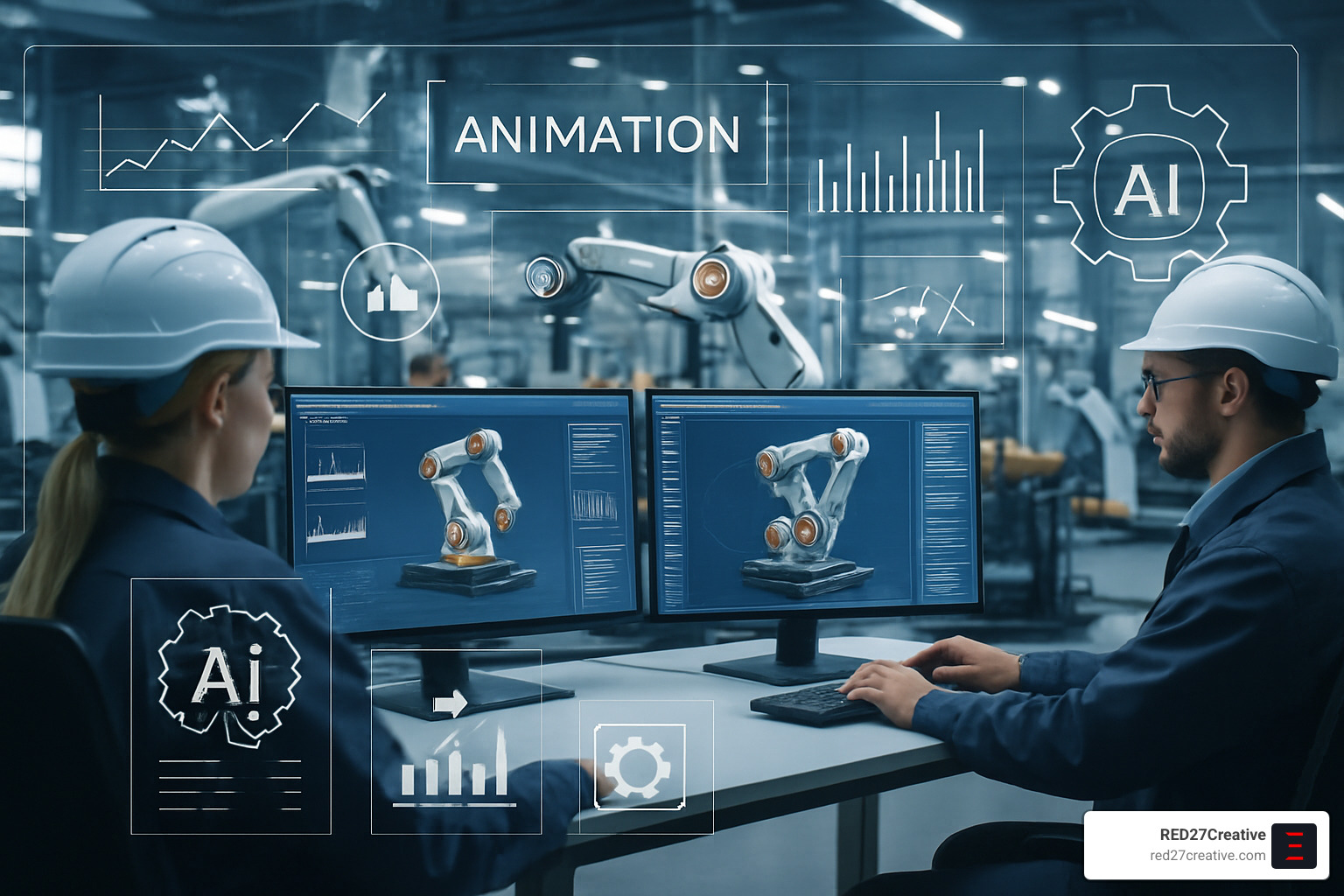
The benefits are substantial: instant visualization without lengthy rendering times, physically accurate simulations of how components interact, and stunning visual quality with realistic shadows and reflections calculated on the fly. Best of all, these engines provide remarkable platform flexibility—the same assets can power experiences on web, mobile, desktop, and VR platforms.
A machinery manufacturer in Naperville recently told us, “We used to wait overnight for renders. Now we can make changes with clients in real-time during meetings. It’s completely transformed our design review process.”
AI-Improved Production
Artificial intelligence isn’t just changing the products we manufacture—it’s revolutionizing how we create manufacturing process animations too.
AI tools now assist with tedious tasks like rigging (preparing 3D models for animation), generating realistic mechanical movements, and even converting written procedures directly into visual sequences. These tools don’t replace human creativity but amplify it by handling technical challenges that once consumed hours of production time.
Perhaps most exciting is how AI is optimizing the rendering process itself, improving both quality and efficiency. Animations that once required massive computing resources can now be produced more quickly and at lower cost, making high-quality visualization accessible to smaller manufacturers.
Sustainability Storytelling
In today’s environmentally conscious marketplace, manufacturers are increasingly using animation to highlight their sustainability initiatives. Manufacturing process animation has become a powerful tool for showing—not just telling—how companies are reducing their environmental impact.
From visualizing energy-efficient production lines to illustrating closed-loop recycling systems, these animations help stakeholders understand complex sustainability concepts. They’re particularly effective at demonstrating material flow analysis, carbon footprint reduction strategies, and circular economy processes that might otherwise be difficult to grasp.
The numbers back up this approach—73% of marketing professionals report that video content provides better ROI than static images when communicating complex topics like sustainability. Latest research on video marketing statistics
Avoiding Common Mistakes
Even the most beautiful manufacturing process animation will fall flat if it makes these common mistakes:
Technical Overload
It’s tempting to show every gear, sensor and valve in your process, but overwhelming viewers with too much detail can backfire. Most viewers aren’t engineers—they need the essence, not every specification.
The solution: Focus on core concepts and use progressive disclosure. Start with the big picture, then allow viewers to dive deeper into technical details if they choose. As one of our clients in St. Charles wisely noted, “We’re not trying to build engineers—we’re trying to build understanding.”
Unclear Objectives
Many animations fail because they try to do too much at once. A single animation can’t effectively serve as training material, marketing content, and technical documentation simultaneously.
The solution: Define specific goals and target audience before production begins. Be ruthless about staying focused on those objectives throughout the project. A clear call to action or learning objective should guide every decision in the production process.
Production Problems
Technical issues like poorly optimized CAD files, inconsistent visual styles, or weak narrative structure can undermine even the best animation concepts.
The solution: Follow a structured production workflow with clear checkpoints and quality controls. At RED27Creative, we’ve developed a rigorous process that catches these issues early, saving our clients from costly revisions later.
Distribution Limitations
Creating a beautiful animation means little if people can’t access it easily across different devices and platforms.
The solution: Plan for multi-channel distribution from the start. This includes optimizing for mobile viewing, adding captions for accessibility, and ensuring your animation works well across different browsers and platforms. Don’t forget alternative text for images to improve both accessibility and SEO performance.
Tools & Tech Stack
Behind every great manufacturing process animation is a sophisticated toolkit of specialized software. These are the tools shaping the industry in 2024:
For 3D modeling and animation, professional studios typically rely on powerhouses like Autodesk Maya and 3ds Max, though the open-source Blender has made remarkable strides in recent years. Cinema 4D remains popular for its intuitive interface and motion graphics capabilities.
CAD integration tools like Solidworks Visualize and KeyShot create direct pathways from engineering files to visualization, while real-time engines such as Unreal Engine and Unity enable interactive experiences with stunning visual quality.
On the rendering and post-production side, V-Ray and Arnold continue to set standards for photorealistic output, while Adobe After Effects and DaVinci Resolve handle compositing, motion graphics, and color grading.
At RED27Creative, we maintain expertise across these platforms to deliver the right solution for each client’s specific needs. Whether you’re in Chicago, Batavia, or anywhere in between, we’ll help you steer this complex technology landscape to create manufacturing process animations that truly shine.
Frequently Asked Questions about Manufacturing Process Animation
What is manufacturing process animation?
Manufacturing process animation brings industrial processes to life through movement and visual storytelling. Think of it as your factory’s operations translated into a clear, engaging visual sequence that anyone can understand.
These animations take complex technical procedures—how your products are made, how your machinery works, or how your assembly lines function—and transform them into digestible visual stories. The beauty lies in how they combine technical accuracy with compelling narratives, making even the most complex industrial processes accessible to everyone from shop floor workers to potential customers and investors.
Unlike static diagrams or lengthy manuals, these animations show exactly how things move, interact, and progress over time—something that’s incredibly difficult to convey through text or still images alone.
How does manufacturing process animation improve training and safety?
When it comes to training your team, manufacturing process animation is like having your best trainer available 24/7. These animations provide consistent, visual instruction that connects with different learning styles and dramatically speeds up comprehension.
Our clients routinely report training time reductions of 40-60% compared to traditional methods. Why? Because seeing a process in action creates much stronger neural connections than reading about it. Your employees can watch proper procedures multiple times before attempting them, building confidence and reducing errors from day one.
For safety training, animations are truly invaluable. They can demonstrate dangerous scenarios without putting anyone at risk. Imagine showing exactly what happens during a machine malfunction, highlighting emergency protocols, or illustrating proper PPE usage—all without exposure to actual hazards.
The numbers speak for themselves: people typically retain about 65% of information presented visually, compared to just 10% from text alone. That difference can literally save lives when it comes to safety procedures.
How do 3D, 2D, and motion graphics differ for manufacturing visuals?
Each animation style brings something special to your manufacturing process animation toolkit:
3D Animation is like having X-ray vision for your machinery. It excels at:
* Revealing internal components that would be impossible to see otherwise
* Showing precisely how parts fit and move together in three-dimensional space
* Creating photorealistic representations of your products and processes
* Demonstrating complex assembly procedures from any angle
One manufacturing client told us, “The 3D animation finally helped our customers understand why our precision machining process justifies the premium price.”
2D Animation is your clarity champion. It shines when:
* Explaining process flows and sequences without distracting details
* Breaking complex concepts into clean, easy-to-follow visuals
* Creating training materials that focus on the essential steps
* Needing to produce content quickly and cost-effectively
Motion Graphics combine text, data, and simple visuals to tell your story. They’re perfect for:
* Bringing your performance metrics and statistics to life
* Explaining abstract concepts like quality control processes
* Creating branded technical content that reinforces your identity
* Supporting presentations with dynamic visual elements
Most of our most successful projects at RED27Creative actually blend elements from all three approaches. We might use 3D to show a machine’s internal operation, 2D to map out the overall process flow, and motion graphics to highlight key performance data—all working together to create a comprehensive visual story of your manufacturing excellence.
The right choice depends on your specific goals, audience needs, and budget considerations. We’re always happy to discuss which approach would work best for your unique situation.
Conclusion
Manufacturing process animation has come a long way from being just a fancy marketing tool. Today, it’s an essential asset for modern manufacturers who want to stay competitive and efficient. Throughout this guide, we’ve seen how these visual stories solve real business challenges that manufacturers face every day.
Think about it – how many times have you tried to explain a complex manufacturing process with just words and static diagrams? It’s like trying to teach someone to dance through written instructions. Manufacturing process animation brings your processes to life, making the complicated simple and the invisible visible.
For your team members, these animations create consistent training experiences that stick in their minds. New employees grasp concepts faster, and your veteran staff has reliable references for complex procedures. The result? Fewer mistakes, better safety compliance, and smoother operations across your factory floor.
For your customers and prospects, animations open a window into your manufacturing excellence. Instead of telling them you have world-class processes, you can show them exactly what makes your production special. This visual storytelling creates powerful connections that static content simply can’t match.
Here at RED27Creative, we’ve partnered with manufacturers throughout Chicagoland – from busy Chicago factories to specialized operations in Geneva, Aurora, St. Charles, Plainfield, Oswego, and Naperville. We’ve seen how the right animations transform technical expertise into compelling stories that drive real business results.
The manufacturing world isn’t getting any simpler. With increasing complexity, higher skill requirements, and customers who expect greater transparency, visual communication isn’t just nice to have – it’s a competitive necessity. Whether you’re training tomorrow’s workforce, showcasing your capabilities to potential customers, or documenting critical procedures, manufacturing process animation delivers clarity and engagement that words alone simply can’t achieve.
Ready to bring your manufacturing processes to life? Let’s talk about how we can transform your technical expertise into visual stories that educate, engage, and inspire action. Our team at RED27Creative will work with you to develop animations custom to your specific processes, audience, and budget – no cookie-cutter solutions, just custom visual storytelling that works.
More info about social media content creation services
The machines, processes, and expertise that make your manufacturing operation special deserve to be seen and understood. Let’s work together to create manufacturing process animations that showcase your excellence and drive your business forward.

Kiel Tredrea
https://red27creative.comTop Marketing Agency • Web, SEO & Leads • RED27Creative