Why Manufacturing Research and Development is Your Secret Weapon

Why Manufacturing Research and Development Powers Industry Success
Manufacturing research and development is the systematic pursuit of technological advances that overcome obstacles, resolve uncertainty, and improve manufacturing methods, processes, machines, or systems. Here’s what you need to know:
Key Components of Manufacturing R&D:
– Product R&D – Developing new products or enhancing existing ones
– Process R&D – Improving manufacturing processes and methods
– Machine-level R&D – Advancing equipment accuracy, capacity, and efficiency
– Systems R&D – Integrating controls, sensors, and IT across production lines
– Environmental R&D – Focusing on sustainability, workforce safety, and regulatory compliance
Why It Matters:
– Drives innovation and competitive advantage
– Improves product quality and operational efficiency
– Reduces manufacturing costs and waste
– Enables faster adaptation to market demands
– Supports sustainability and regulatory compliance goals
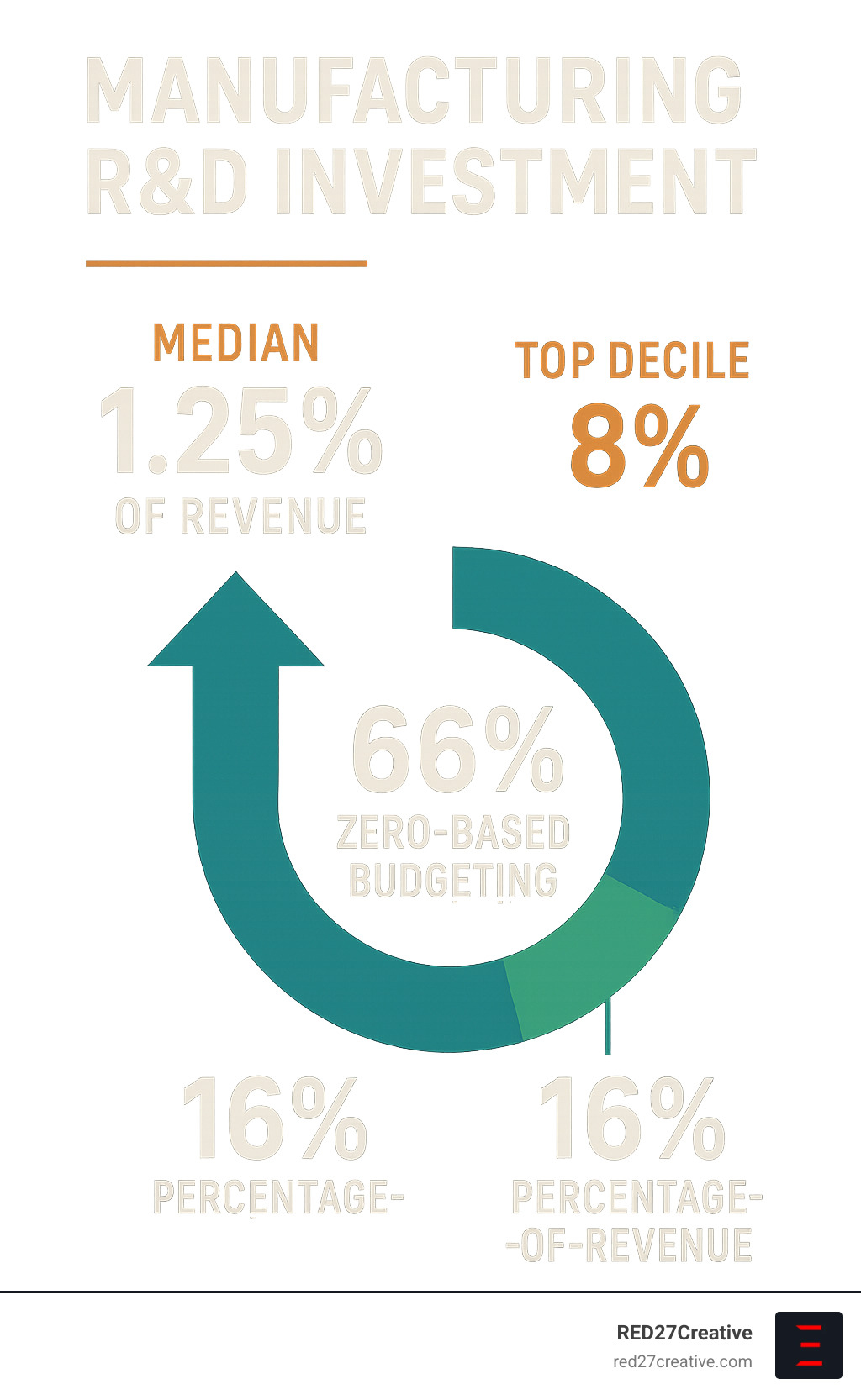
The median U.S. manufacturer invests just 1.25% of net revenues in R&D, while top performers invest up to 8%. Companies that derive more revenue from internally developed products consistently invest more in research and development activities.
As manufacturing adopts Industry 4.0 technologies – including AI, IoT, robotics, and digital twins – R&D becomes even more critical for staying competitive. Modern manufacturing research and development spans everything from developing lightweight automotive materials to creating energy-efficient semiconductor processes.
I’m Kiel Tredrea, founder of RED27Creative, and I’ve spent over 20 years helping B2B manufacturers develop strategic marketing approaches that showcase their innovation capabilities. Through my work with manufacturing clients, I’ve seen how effective communication of Manufacturing research and development achievements drives lead generation and establishes market authority.

Handy Manufacturing research and development terms:
– Innovative manufacturing processes
– Advanced manufacturing technologies
– Manufacturing workforce development
Manufacturing Research and Development 101
Think of manufacturing research and development as your company’s innovation engine. It’s the systematic process of exploring new technologies, solving complex problems, and pushing the boundaries of what’s possible in production. But here’s the thing – it’s not just about creating flashy new products. It’s about building a competitive edge through smart experimentation and technological advancement.
What is Manufacturing Research and Development?
Manufacturing research and development is essentially organized curiosity with a business purpose. It’s how companies tackle technological uncertainty through careful experimentation, whether they’re trying to make a product lighter, a process faster, or a system more efficient.
Here’s what makes manufacturing R&D unique: it’s capital-intensive and inherently risky. You’re investing significant resources into uncertain outcomes, but the potential returns can be game-changing. When a automotive manufacturer spends months testing a new lightweight alloy, they’re not just hoping for better performance – they’re systematically working through technological challenges that could revolutionize their entire product line.
The beauty of manufacturing research and development lies in its systematic approach. You’re not just tinkering in a garage (though that has its place too). You’re following documented processes, measuring results, and building on previous knowledge. This methodical approach helps transform wild ideas into practical solutions that can scale across entire production systems.
What sets R&D apart from routine problem-solving is the focus on technological advancement. When your maintenance team fixes a broken conveyor belt, that’s problem-solving. When they design a new conveyor system that reduces energy consumption by 30%, that’s R&D.
Types of Manufacturing Research and Development Projects
Manufacturing research and development unfolds across five interconnected levels, each tackling different pieces of the production puzzle. Understanding these levels helps you identify where your biggest opportunities might be hiding.
Unit process level technologies form the foundation of manufacturing innovation. This is where you dive deep into the fundamental science of how things are made. Maybe you’re experimenting with advanced alloys for improved metal durability, or developing new coatings that make components last twice as long. These projects often involve partnerships with material suppliers and can take years to perfect, but they create lasting competitive advantages.
Machine level technologies focus on the equipment that does the actual work. This includes additive and subtractive manufacturing innovations, advanced robotics, and precision machinery upgrades. Think about a company that develops a custom 3D printing process for creating complex internal geometries that traditional machining can’t achieve. These advances often deliver immediate productivity gains.
Systems level technologies bring everything together through smart integration. This is where IoT sensors for real-time monitoring and AI-powered quality control systems shine. You’re not just improving individual machines – you’re creating intelligent production networks that can adapt and optimize themselves. These projects often deliver the highest ROI because they multiply the effectiveness of existing equipment.
Societal and environmental level technologies address the human and sustainability aspects of manufacturing. This includes ergonomic improvements to reduce worker fatigue, development of training systems for advanced manufacturing skills, and implementation of circular economy principles. These projects are increasingly important as companies balance productivity with social responsibility.
Extended enterprise integration represents the newest frontier in manufacturing research and development. This involves collaborative product development with suppliers and customers, life-cycle cost optimization, and quality systems that span multiple organizations. It’s complex work, but it can transform entire supply chains.
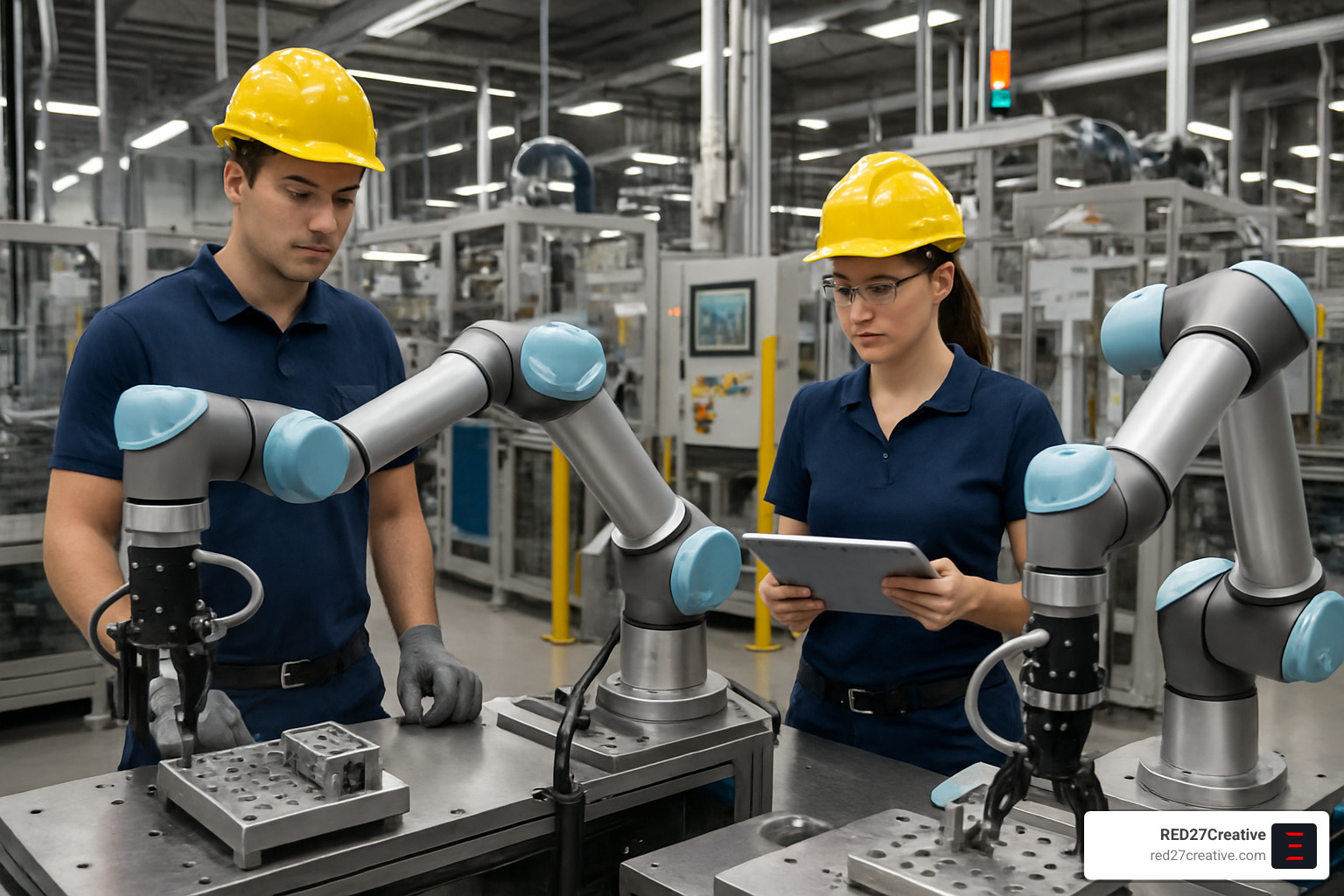
The most successful manufacturers don’t pick just one level – they develop integrated R&D strategies that span multiple areas. A company might simultaneously work on new materials (unit process), upgrade their equipment (machine level), and implement smart monitoring systems (systems level) as part of a coordinated innovation push.
Why R&D is the Engine of Modern Manufacturing
Manufacturing research and development serves as the foundation for competitive advantage in today’s rapidly evolving industrial landscape. Companies that invest in R&D consistently outperform their peers in multiple key metrics.
How Manufacturing Research and Development Drives Innovation
Innovation through R&D manifests in two primary ways: breakthrough developments and incremental improvements. Both are essential for sustained competitive advantage.
Breakthrough Innovation creates entirely new product categories or manufacturing processes. Consider how the development of the first commercial water-soluble cutting fluid transformed metalworking practices, or how additive manufacturing has enabled production of previously impossible geometries.
Incremental Innovation focuses on continuous improvement of existing products and processes. This might involve:
– Enhancing product features to add consumer value
– Streamlining manufacturing steps to reduce unit costs
– Improving material properties for better durability
– Optimizing production layouts for increased efficiency
The automotive industry exemplifies both approaches. While companies invest heavily in breakthrough technologies like electric vehicle powertrains and autonomous driving systems, they simultaneously pursue incremental improvements in lightweight materials, fuel efficiency, and manufacturing precision.
Time-to-market advantages represent another critical benefit. Companies with robust R&D capabilities can respond more quickly to changing customer demands and market opportunities. This agility becomes increasingly important as product lifecycles shorten and customer expectations rise.
Manufacturing Research and Development and Sustainability Goals
Modern manufacturing research and development increasingly focuses on environmental and social responsibility. With the U.S. aiming for net-zero greenhouse gas emissions by 2050, manufacturers face both regulatory pressure and market demand for sustainable solutions.
Carbon Reduction Initiatives drive significant R&D investment across industries:
– Development of energy-efficient production processes
– Research into renewable energy integration in manufacturing
– Creation of carbon-neutral or carbon-negative materials
– Innovation in waste heat recovery and utilization systems
Circular Economy Principles guide R&D toward closed-loop manufacturing:
– Design for disassembly and recyclability
– Development of bio-based and biodegradable materials
– Innovation in remanufacturing and refurbishment processes
– Creation of industrial symbiosis networks
The Scientific research on renewable materials demonstrates how federal investment supports sustainable manufacturing innovation. The National Science Foundation’s $42.4 million investment in semiconductor research includes significant focus on sustainable materials and processes.
Regulatory Compliance increasingly drives R&D priorities. Companies must innovate to meet evolving environmental standards while maintaining competitiveness. This creates opportunities for first-movers who can develop compliant solutions before regulations take effect.

Funding & Managing R&D: Budgets, Incentives, Tax Credits
Effective manufacturing research and development requires strategic financial planning and understanding of available incentives. Our research reveals that two-thirds of manufacturers use zero-based budgeting approaches tied to expected ROI rather than simply allocating a fixed percentage of revenue.
Identifying and Prioritizing R&D Projects
Stage-Gate Methodology provides a structured approach to R&D project management. This process involves:
- Idea Generation and Screening – Collecting and evaluating potential R&D opportunities
- Preliminary Investigation – Conducting initial feasibility studies
- Detailed Investigation – Performing comprehensive technical and market analysis
- Development – Creating prototypes and conducting testing
- Testing and Validation – Verifying performance and market acceptance
- Commercialization – Full-scale production and market launch
Voice-of-Customer Integration ensures R&D efforts align with market needs. This involves:
– Regular customer interviews and surveys
– Analysis of customer complaints and service requests
– Monitoring of competitive offerings and market trends
– Collaboration with sales teams on customer feedback
Risk Matrix Assessment helps prioritize projects based on technical feasibility and market potential. High-impact, low-risk projects typically receive priority, while high-risk, high-reward projects require careful evaluation and staged investment.
Technology Readiness Levels (TRL) provide standardized metrics for assessing R&D progress:
– TRL 1-3: Basic research and proof of concept
– TRL 4-6: Technology development and demonstration
– TRL 7-9: System integration and operational deployment
Tax Credits and Government Incentives for Manufacturing R&D
Federal R&D Tax Credits provide significant financial incentives for qualifying research activities. The credit applies to expenses that meet a four-part IRS test:
- Permitted Purpose – Activities must aim to develop new or improved business components
- Technological in Nature – Work must rely on engineering, computer science, or physical sciences
- Uncertainty Elimination – Activities must address technical uncertainty
- Process of Experimentation – Systematic evaluation of alternatives is required
Eligible R&D Expenses include:
– Employee wages for qualified research activities
– Supply costs for prototype development
– Machine tooling and specialized equipment
– Research chemicals and materials
– Contract research expenses
Section 174 Changes under the Tax Cuts and Jobs Act now require R&D costs to be capitalized and amortized over five years for domestic expenses and fifteen years for foreign expenses. This change significantly impacts cash flow and requires careful tax planning.
State and Local Incentives vary by jurisdiction but often include:
– Sales tax exemptions on R&D equipment and materials
– Property tax abatements for R&D facilities
– Workforce training grants for R&D personnel
– Economic development incentives for R&D expansion
California’s Revenue and Taxation Code section 6377.1 provides partial sales tax exemption for qualified R&D equipment, demonstrating how state-level incentives support manufacturing innovation.
For manufacturers looking to leverage these opportunities effectively, Lead Generation for Manufacturing Companies can help communicate R&D capabilities to potential customers and partners.

Overcoming Risks and Surfing Future Trends
Manufacturing research and development faces both traditional challenges and emerging opportunities. Understanding these dynamics helps manufacturers steer uncertainty while positioning for future success.
Common Challenges in Manufacturing Research and Development
Cost Overruns represent the most frequent R&D challenge. Projects often exceed initial budgets due to:
– Underestimation of technical complexity
– Scope creep during development phases
– Unexpected regulatory or compliance requirements
– Supply chain disruptions affecting prototype materials
Talent Recruitment and Retention creates ongoing pressure. The manufacturing sector faces significant skills shortages, particularly in:
– Advanced materials science and engineering
– Digital manufacturing and Industry 4.0 technologies
– Data analytics and artificial intelligence applications
– Sustainability and environmental engineering
Regulatory Compliance adds complexity and cost to R&D projects. Manufacturers must steer:
– Environmental regulations affecting materials and processes
– Safety standards for new equipment and technologies
– International trade requirements for global markets
– Intellectual property protection across jurisdictions
Data Security and IP Protection become increasingly critical as R&D digitizes. Key concerns include:
– Protection of proprietary designs and processes
– Cybersecurity for connected manufacturing systems
– International IP theft and competitive intelligence
– Employee mobility and knowledge transfer risks
Emerging Trends Reshaping Manufacturing Research and Development
Industry 4.0 Integration continues accelerating across manufacturing sectors. Key technologies include:
– Artificial Intelligence and Machine Learning for predictive maintenance and quality control
– Internet of Things (IoT) sensors providing real-time production data
– Digital Twins enabling virtual testing and optimization
– Cyber-Physical Systems connecting digital and physical manufacturing processes
Autonomous Experimentation represents a approach to R&D. AI-powered systems can:
– Design and conduct experiments with minimal human intervention
– Analyze results and suggest follow-up investigations
– Optimize multiple variables simultaneously
– Accelerate findy timelines from years to months
The U.S. Department of Commerce’s investment of up to $100 million in AI-powered autonomous experimentation for sustainable semiconductor materials demonstrates federal commitment to this emerging field.
Wide-Bandgap Semiconductors are changing power electronics and energy efficiency. Silicon carbide and gallium nitride technologies enable:
– Higher temperature and voltage operation
– Improved energy efficiency in power conversion
– Smaller, lighter power electronics systems
– Improved performance in electric vehicles and renewable energy
The CHIPS digital-twin institute receiving $285 million in proposed funding highlights how digital twin technology is reshaping semiconductor manufacturing R&D.
Quantum Manufacturing emerges as the next frontier. While still in early stages, quantum technologies promise:
– Unprecedented precision in materials characterization
– Revolutionary approaches to process optimization
– New possibilities for molecular-level manufacturing
– Improved security for manufacturing data and communications
Sustainable Manufacturing Innovation drives increasing R&D investment:
– Carbon-neutral and carbon-negative manufacturing processes
– Circular economy integration throughout production cycles
– Bio-based materials replacing traditional petroleum-derived inputs
– Energy storage and renewable energy integration
For manufacturers seeking to communicate these advanced capabilities effectively, Marketing Automation for Manufacturing provides tools to showcase innovation leadership.
Frequently Asked Questions about Manufacturing Research and Development
What percentage of revenue should manufacturers invest in R&D?
The median U.S. manufacturer invests 1.25% of net revenues in R&D, while the top decile invests approximately 8%. However, the optimal investment level depends on several factors:
- Industry sector – Computer and electronics manufacturers typically invest more than food or primary metals companies
- Company stage – Early-stage companies often invest heavily despite current unprofitability
- Product lifecycle – Companies deriving more revenue from new products tend to invest more in R&D
- Competitive position – Market leaders may invest more to maintain advantage, while followers invest to catch up
Two-thirds of manufacturers use zero-based budgeting tied to expected ROI rather than fixed percentage allocation, suggesting that strategic considerations should drive investment levels more than arbitrary benchmarks.
Who qualifies for R&D tax credits in manufacturing?
Qualified persons include businesses primarily engaged in manufacturing, research and development, and electric power generation or distribution under specific NAICS codes. Qualifying personnel include:
- Engineers and designers involved in experimental work
- Scientists and researchers conducting systematic investigations
- Technicians supporting R&D activities
- Project managers overseeing qualifying research projects
- Quality control personnel involved in testing and validation
- Production staff engaged in experimental manufacturing processes
The four-part IRS test requires activities to meet all criteria: permitted purpose (developing new business components), technological nature (relying on engineering or physical sciences), uncertainty elimination (addressing technical questions), and process of experimentation (systematic evaluation of alternatives).
How does R&D improve supply-chain resilience?
Manufacturing research and development improves supply-chain resilience through multiple mechanisms:
Alternative Materials Development reduces dependence on single suppliers or regions. R&D efforts focus on:
– Identifying substitute materials with similar performance characteristics
– Developing new materials from locally available resources
– Creating bio-based alternatives to petroleum-derived inputs
– Improving recycling and reuse of existing materials
Dual-Sourcing Strategies supported by R&D ensure continuity:
– Qualifying multiple suppliers for critical components
– Developing flexible manufacturing processes that accommodate supplier variations
– Creating modular designs that enable component substitution
– Establishing regional supplier networks to reduce transportation risks
Predictive Analytics powered by R&D investments enable proactive risk management:
– AI-powered demand forecasting reduces inventory risks
– Predictive maintenance prevents unexpected equipment failures
– Supply chain monitoring systems provide early warning of disruptions
– Scenario planning tools help prepare for various contingencies
Conclusion
Manufacturing research and development isn’t just another line item in your budget—it’s the heartbeat of competitive manufacturing. Think about it: while most manufacturers cautiously invest just 1.25% of their revenue in R&D, the industry leaders are putting in 8% and absolutely crushing it with revenue from their own innovations.
Here’s what we’ve learned: R&D touches everything. It’s not just about creating the next breakthrough product (though that’s exciting too). It’s about revolutionizing how you make things, upgrading your equipment, connecting your systems, and yes—making your entire operation more sustainable and profitable.
The timing couldn’t be better. Industry 4.0 technologies are reshaping manufacturing faster than ever. AI, IoT, digital twins, autonomous experimentation—these aren’t sci-fi concepts anymore. They’re real tools that forward-thinking manufacturers are using right now to leave their competition in the dust.
And let’s talk money for a second. The financial support is incredible. Federal R&D tax credits, state exemptions, programs like the CHIPS Act—the government wants you to innovate. Smart manufacturers are leveraging these incentives while using zero-based budgeting approaches that tie every R&D dollar directly to expected returns.
But here’s the bigger picture: Manufacturing research and development solves the problems keeping you up at night. Supply chain disruptions? R&D helps you develop alternative materials and dual-sourcing strategies. Sustainability requirements? R&D creates the clean technologies you need. Talent shortages? R&D-driven automation and improved processes help you do more with your existing team.
The companies that get this aren’t just surviving the current disruption—they’re creating the next one. They understand that R&D isn’t a cost center eating into profits. It’s the engine that powers sustainable competitive advantage.
At RED27Creative, we’ve spent over 20 years helping manufacturers like you tell their innovation stories effectively. When you develop breakthrough technologies or optimize existing processes, the world needs to know about it. That’s how you turn R&D investments into market leadership and serious lead generation.
The future belongs to manufacturers who treat R&D as their secret weapon. While your competitors debate whether they can afford to invest in innovation, you’ll already be implementing the solutions that define tomorrow’s manufacturing standards.
Ready to showcase your manufacturing innovation to the world? Our social media content creation services help B2B manufacturers turn technical achievements into compelling stories that drive business growth.

Kiel Tredrea
https://red27creative.comTop Marketing Agency • Web, SEO & Leads • RED27Creative