The Talent Tapestry: Weaving Workforce Development into Manufacturing

The Critical State of Manufacturing Workforce Development
Manufacturing workforce development is the strategic process of creating, training, and maintaining a skilled workforce to meet both current and future needs of the manufacturing industry. It involves addressing skills gaps, implementing targeted training programs, and fostering collaboration between industry, education, and government.
These efforts go far beyond simply filling open positions. By aligning workforce strategies with evolving technological demands, manufacturers can secure the talent needed to power economic growth and stay globally competitive.
Key Elements of Manufacturing Workforce Development:
* Developing education and training programs aligned with industry needs
* Creating clear career pathways in advanced manufacturing
* Implementing apprenticeships and on-the-job training initiatives
* Building public-private partnerships to support workforce initiatives
* Attracting diverse and underrepresented groups to manufacturing careers
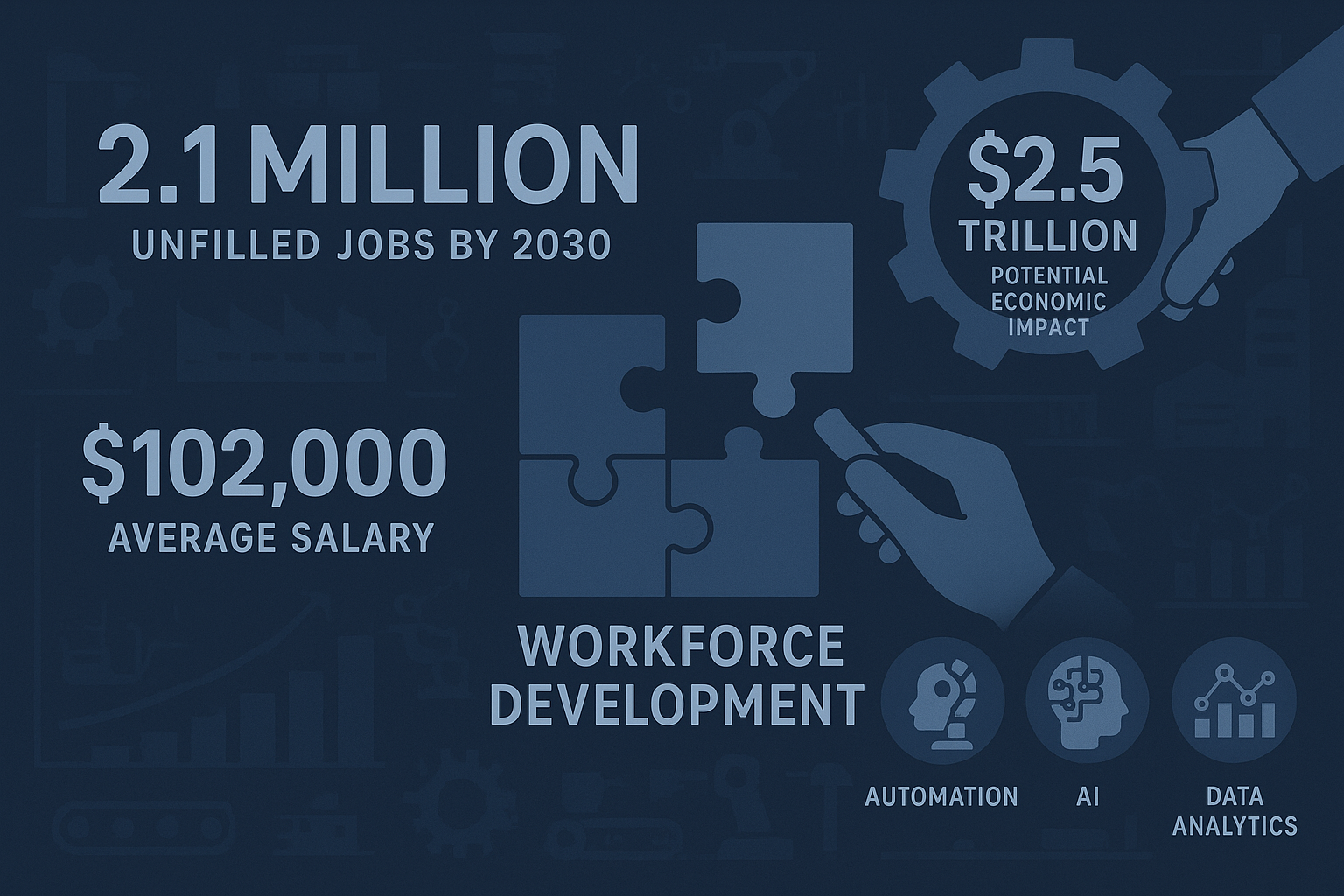
The manufacturing sector faces a critical workforce crisis in 2025. Projections indicate that 2.1 million manufacturing positions—53 out of every 100 jobs—may go unfilled through 2030 due to a skilled labor shortage. This gap threatens to cost the U.S. economy up to $2.5 trillion in lost output over the next decade.
The challenge is multifaceted. Modern manufacturing demands workers skilled in robotics, automation, AI, and data analytics. Yet, the U.S. currently ranks only ninth globally for workforce readiness to adapt to increased workplace automation.
“Manufacturing is not just about innovation and economic growth; it’s about opportunity. It’s about ensuring that every community, every aspiring maker, builder and creator—no matter their background—can have access to the skills, training and careers that will define the future.” – Carolyn Lee
The potential rewards are tremendous. The average annual earnings for a manufacturing employee, including pay and benefits, exceeds $102,000. This underscores how investing in workforce development is not only good for industry but also a massive opportunity for workers and communities.
I’m Kiel Tredrea, a strategic marketing leader who has helped manufacturing businesses develop comprehensive workforce development strategies. By attracting and retaining top talent through effective marketing and training, these companies create sustainable advantages that drive long-term success.
Important Manufacturing workforce development terms:
– Manufacturing industry benchmarks
– Innovative manufacturing processes
– Manufacturing case studies
Understanding the Manufacturing Workforce Crisis
Let’s examine what’s happening today in manufacturing as of 2025. This isn’t just another “help wanted” scenario—it’s a genuine talent emergency. By 2033, American manufacturing will need nearly 3.8 million workers. The sobering reality is that almost half of those positions may remain vacant, simply because we lack people with the right skills.
Here at RED27Creative, we’ve seen how this skills gap impacts manufacturers in Geneva, Aurora, St. Charles, and throughout the Chicago region. These companies aren’t just fighting to fill open roles; they’re struggling to find people who grasp the modern, technology-driven manufacturing environment.
If unaddressed, the economic impacts could be dire. Studies suggest up to $2.5 trillion in lost economic output over the next decade. This is more than a money problem—it means factories operating below capacity, fewer new products coming to market, and American manufacturing losing ground to foreign competitors.
Research from the Manufacturing Institute reveals 65% of manufacturers report that skills are evolving faster than their workforce can adapt. Meanwhile, 87.2% plan to increase technology usage. Without serious commitment to manufacturing workforce development, that gap will grow.
Key Challenges Facing the Manufacturing Industry
Several factors converge to form a perfect storm for manufacturers:
Aging workforce reality: With a median age of around 44, manufacturing is losing experienced talent to retirement. These workers leave with decades of irreplaceable know-how.
Outdated public perception: Despite cleaner, high-tech factories, many still assume manufacturing is dirty, dangerous, and dull—turning away younger talent.
Technological change: Robotics, AI, and data analytics dominate modern production. These advanced tools require workers adept in skills rarely taught in traditional programs a decade ago.
Education-industry disconnect: Classroom learning often lags behind real-world needs. Graduates regularly require hefty retraining, creating frustration for both employers and new hires.
Diversity and inclusion challenges: Historically, manufacturing has tapped a narrow demographic, missing huge talent pools and fresh perspectives.
“Manufacturing is facing a talent emergency that’s only getting bigger. We’re not just looking at a worker shortage—we’re looking at a skills revolution that requires entirely new approaches to workforce development.”
Cybersecurity adds further complexity. Increased connectivity between production floors and business networks demands a new blend of IT security and manufacturing expertise.
The manufacturing crisis isn’t just a headcount issue. It’s about having people with the right skills at the right time. Overcoming this challenge requires fresh thinking on how we attract, train, and retain the manufacturing workforce of tomorrow.
The Importance of Manufacturing Workforce Development
Make no mistake—manufacturing workforce development is no passing trend. It has become a lifeline for manufacturers pivoting in today’s rapidly changing market. When I consult with manufacturing clients in Geneva and Aurora, the topic almost always circles back to their biggest challenge: finding workers ready to operate modern, tech-driven lines.
When your team can quickly adopt new technologies and methods, your operations transform. You don’t just maintain pace; you set it. Contrast this with competitors who struggle to bring in skilled talent—they lag behind when it comes to efficiency, innovation, and profitability.
Financially, the stakes are enormous. The projected $2.5 trillion in lost output from unfilled manufacturing jobs isn’t just an economic footnote—it’s a tangible reflection of halted projects, dead-end expansions, and companies failing to keep up with rising demand. Those that invest in workforce development aren’t merely filling a need; they’re securing a significant slice of that lost potential.
From my perspective, manufacturers that prioritize their workforce show remarkable resilience. They adapt quickly to supply chain disruptions, integrate new technologies with minimal downtime, and maintain higher-quality outputs. These strengths stem from having employees who blend traditional manufacturing know-how with an accept of advanced tools and analytics.
Look at how manufacturing skill requirements have evolved:
| Traditional Manufacturing Skills | Advanced Manufacturing Skills |
|---|---|
| Manual machine operation | Programming and monitoring automated systems |
| Visual quality inspection | Data analysis and statistical process control |
| Physical material handling | Robotics operation and maintenance |
| Blueprint reading | CAD/CAM and digital twin technology |
| Basic tool maintenance | Predictive maintenance using IoT sensors |
| Mechanical troubleshooting | Cybersecurity for operational technology |
| Individual workstation focus | Integrated systems thinking |
Yesterday’s machine operator is tomorrow’s digital systems integrator. This metamorphosis demands that companies adopt manufacturing workforce development strategies that train, nurture, and retain talent.
Addressing the Skills Gap Through Workforce Development
Effective manufacturing workforce development requires thinking beyond recruiting new hires. Upskilling the existing workforce is often an even more impactful strategy.
Upskilling focuses on building advanced capabilities in employees who already understand your industry and processes. A seasoned machine operator can learn to program automated systems or interpret complex production data, bridging the old and new manufacturing worlds in one go.
Reskilling shifts employees into high-demand roles. For instance, a manufacturer might train assembly line workers to become automation technicians, preserving institutional knowledge while addressing immediate skills shortages.
The best training includes hands-on exercises in tandem with digital learning. Online modules and simulations create a foundation, while live practice cements that knowledge. Immediate on-the-job application accelerates mastery and helps boost retention.
A Chicago-based training manager shared: “Shifting from purely classroom-based learning to our blended approach cut skill development time by 40%. Employees began applying new skills immediately, and our error rates plummeted.”
In short, manufacturing workforce development isn’t a luxury. It’s the bedrock of 21st-century manufacturing success, fueling innovation, quality, and growth. Companies that commit to it are positioning themselves to thrive in a competitive, technology-centric marketplace.
National Initiatives Driving Workforce Development
Several major efforts across the United States aim to reverse this manufacturing talent crisis. These initiatives aren’t just government programs; they’re alliances unifying federal agencies, educational institutions, and industry leaders with a shared goal of reshaping manufacturing workforce development.
One leading example is Manufacturing USA, a nationwide network comprising 16 advanced manufacturing innovation institutes. Each institute focuses on a distinct aspect of manufacturing technology, bridging scientific research with hands-on workforce training. By connecting cutting-edge findies to real industrial needs, Manufacturing USA acts as a catalyst for both innovation and education.
The flagship strategy guiding these efforts is the National Roadmap to Revitalize the U.S. Manufacturing Workforce. Unlike many well-meaning but neglected reports, this roadmap demands urgent action.
It underscores a pressing reality: despite historic investments in domestic manufacturing facilities, genuine progress hinges on having a skilled workforce ready to fill newly created jobs. Without it, those investments risk stalling.
The roadmap highlights three core objectives:
Equip with Skills – Develop and distribute training that addresses the technical and professional competencies needed in advanced manufacturing.
Broaden Access – Open doors for everyone, particularly underrepresented groups, to enter the manufacturing sector.
Spark Interest – Modernize outdated views of manufacturing, inspiring a new generation to consider it a viable, exciting career.
For a deeper dive into these initiatives, the Revitalizing America’s Manufacturing Workforce: A Manufacturing USA National Roadmap provides comprehensive insights and specific action steps.
Manufacturing USA’s Role in Workforce Development
Manufacturing USA turns theory into practice through its 16 specialized institutes. Each hub focuses on a distinct manufacturing technology—ranging from 3D printing to biomanufacturing—and boosts its sector by creating custom training solutions.
From 2020 to 2024, the Department of Defense Manufacturing Innovation Institutes (MIIs) alone introduced more than 700 education and workforce projects. These benefited over half a million learners, spread across K-12 students, college enrollees, current manufacturing workers, and teachers.
Collaboration is central to these accomplishments. Rather than operating in isolation, these institutes create alliances between:
• Community colleges attuned to local workforce needs
• Universities at the forefront of research
• Manufacturers requiring specialized skill sets
• State and local workforce boards
• Community nonprofits engaging underserved populations
A standout approach involves competency-based learning. Students and trainees advance once they master skills rather than waiting through standard academic timelines. This approach significantly benefits working adults, career-changers, and others who benefit from flexible scheduling.
As one institute director noted: “By making competency the priority over classroom seat time, graduates emerge fully job-ready. We’ve effectively compressed the training timeline without compromising skill quality.”
These institutes function like innovation testbeds. Successful methods at one location quickly spread to the entire network, multiplying their impact. Here at RED27Creative, we’ve observed that companies plugged into these initiatives gain a definite edge in recruiting and developing top-tier talent.
Leveraging Technology to Shape the Future Workforce
Technology in manufacturing can feel like a paradox—on one hand, it reshapes jobs; on the other, it offers new avenues for training people to handle that change. Manufacturing workforce development is living at this intersection.
By 2030, advanced technological skills are predicted to surge by 50% in U.S. manufacturing. This shift creates entirely new jobs while changing traditional roles. One Manufacturing USA institute’s Digital Manufacturing Jobs Taxonomy identified 165 distinct roles in modern manufacturing, with 20 labeled as pivotal “bridge” positions connecting today’s workforce to tomorrow’s demands.
These roles span robotics, AI, the Industrial Internet of Things, operational technology cybersecurity, data analytics, and advanced materials processing. As an industry veteran explained: “A worker from 20 years ago wouldn’t recognize the factory floor today. The coming decade will bring changes that are even more dramatic.”
Fortunately, technology is also revolutionizing how training gets delivered:
Virtual and augmented reality let workers practice intricate tasks or risky operations safely. One technician likened it to a “practice mode for real life.”
Digital learning platforms eliminate geographical barriers. Workers in remote areas can access the same high-quality instruction as those in major industrial hubs, studying on their own schedules.
AI-powered personalized learning tailors material to individual learning styles, ensuring each person receives extra support exactly where needed.
Digital credentials and badging streamline skills verification, letting workers promptly prove their up-to-date qualifications to potential employers.
These methods are proving their worth. One training director saw a 60% drop in errors and a 40% reduction in overall training time thanks to VR-based learning modules.
Embracing Automation and AI in Manufacturing
There’s a persistent myth that automation and AI exist to replace humans. In reality, they’re tools that amplify human capabilities. Effective manufacturing workforce development prepares workers to collaborate with these systems.
The upsides of AI and robotics are evident: higher production output, consistency, improved safety, and data-driven decisions. Tapping these benefits, however, demands a workforce with the necessary technical basics.
Currently, the U.S. ranks ninth worldwide in preparing its workforce for increased automation—a wake-up call for more aggressive training. The new roles require proficiency in programming automated machinery, analyzing data, and safeguarding cyber-physical systems.
Equally critical are human skills like critical thinking, flexibility, and creativity. According to one plant manager: “Our best employees aren’t the ones who know robotics inside out. They’re the ones who can integrate robotic capabilities with human instincts to solve challenges no robot alone can handle.”
This kind of human-machine synergy is where manufacturing truly shines. Successful manufacturing workforce development programs build this dual skill set, positioning workers to flourish alongside technology while making work more rewarding and safer.
Partnerships Between Education and Industry
When educators and manufacturers unite, remarkable things happen in manufacturing workforce development. Schools handle the theoretical side, while industry pros bring real-world insights. Together, they create students who are technically competent and fully aligned with workplace demands.
We’re witnessing promising results across the country. Community colleges recalibrate their courses in response to local manufacturers, ensuring graduates are primed for emerging roles. As one executive remarked, “Our local community college can overhaul a curriculum in mere months—exactly the responsiveness we need.”
Vocational and technical schools reinforce learning by doing. Students practice on industry-supplied equipment, mapping directly to technologies and workflows they’ll see on the job. Meanwhile, universities offer a higher-level research angle, partnering with local manufacturers to develop specialized training modules for advanced manufacturing roles.
Even K-12 schools are stepping up to the plate with STEM programs and innovative labs. These help younger learners see that today’s manufacturing plants are modern, advanced, and rewarding places to build a career.
Building a Skilled Workforce Through Education and Training
When done deliberately, education-industry collaborations close the gap between classroom theory and factory-floor realities.
Industry-informed curricula keep learning objectives relevant. Manufacturers review course outlines, ensuring they reflect the complexities of actual operations.
Equipment donations from local factories let students train on state-of-the-art machinery. By graduating with hands-on experience, they transition more smoothly to full-time roles.
Teacher development initiatives bring instructors into industrial environments. Firsthand exposure translates into updated, engaging lessons that captivate students.
Work-based learning programs like internships, co-ops, and apprenticeships merge textbook knowledge with hands-on growth. Both students and employers get a chance to evaluate mutual fit, lowering hiring risks.
The Federation for Advanced Manufacturing Education (FAME) exemplifies these principles. Students alternate between classroom sessions and paid work, earning wages while they learn and emerging with minimal debt. Retention rates and starting salaries surpass industry norms.
One FAME graduate shared, “I’m debt-free, experienced, and better paid than peers who took a purely academic route. Seeing how my coursework applied at work each week was invaluable.”
Such collaborations benefit everyone: students gain relevant skills, schools boost placement rates, manufacturers secure quality employees, and local communities gain economic momentum. From our vantage point at RED27Creative, successful programs like these often become cornerstones of compelling industry marketing and recruiting efforts.
Attracting and Engaging a Diverse Talent Pool
Manufacturing’s diversity shortfall poses a big challenge in today’s talent-hungry market. Tapping broader talent pools isn’t just a moral imperative—it’s a strategic necessity. Manufacturing workforce development strategies that open doors for a wide range of applicants yield significant rewards.
Women form half of the U.S. workforce yet only comprise about 30% of manufacturing roles. Veterans bring discipline and technical prowess, but they’re often overlooked. Communities of color and those seeking second-chance careers offer additional substantial reservoirs of potential skill.
Recruitment alone isn’t enough. Companies must create welcoming, growth-oriented workplaces that encourage diverse employees to stay and excel. One manufacturing leader put it bluntly: “For years, we overlooked massive segments of potential talent. When we deliberately started hiring from these communities and creating inclusive cultures, our workforce shortage eased almost immediately.”
Initiatives to Broaden Access and Spark Interest
Misinformation and stigma about manufacturing remain common. Many potential applicants imagine grimy, outdated factory floors when, in reality, today’s manufacturing settings are modern, tech-driven, and offer substantial opportunity for career growth.
Effective diversity initiatives share common traits:
Targeted outreach: By collaborating with community groups, churches, and veterans’ organizations, manufacturers can meet prospective employees where they already are.
Representation: Showcasing diverse success stories in marketing and recruitment materials inspires others to envision similar achievements.
Mentorship: Supporting new hires by pairing them with seasoned mentors from similar backgrounds improves retention and job satisfaction.
Programs like Heroes MAKE America prove how successful this can be. By guiding transitioning service members and military spouses into manufacturing with relevant training and job placement, they’ve posted over 90% placement rates for participants.
Similarly, Women MAKE Awards (formerly STEP Ahead) amplifies the successes of women in production roles, supporting the idea that manufacturing careers can be inclusive and rewarding. Manufacturing Day—recently expanded to Manufacturing Month—also enables curious students, family members, and community leaders to see modern production facilities firsthand.
As one participant from an inclusive training initiative said, “I never realized how advanced and high-paying manufacturing was. Meeting women and people of color already thriving in this field shattered my preconceptions—and now I’m on a path to a long, fulfilling career.”
Diversity doesn’t just fill vacancies; it also broadens perspectives and fuels innovation. People from varied backgrounds spot different problems and opportunities, sparking new ideas. For an industry rooted in creativity, this influx of fresh thoughts might be manufacturing’s greatest hidden resource.
Case Studies: Successful Workforce Development Programs
Seeing what works on the ground is incredibly valuable. Here are a few manufacturing workforce development success stories that shine a light on how to tackle the skills gap.
Heroes MAKE America stands out by bridging veterans and manufacturing. Recognizing that many who served in the armed forces bring technical and leadership abilities, the program condenses manufacturing training into an 8-10 week, full-time plan. Participants earn recognized certifications, receive career coaching, and connect directly with hiring employers. With over 1,000 military-affiliated graduates and placement rates topping 90%, the program’s benefits are clear.
One proud participant revealed, “The transition from military to manufacturing felt natural once I had the right support—and the pay and benefits were even better than I’d expected.”
Another initiative, Federation for Advanced Manufacturing Education (FAME), delivers a distinctly modern apprenticeship model. Students learn in the classroom part of the week and work in paid positions the rest, essentially integrating academic knowledge with on-the-job experience. Early immersion in the company’s culture drives high retention, and salaries for graduates often outpace standard entry-level roles by a whopping 60%.
Apprenticeship 2000 in North Carolina provides a four-year track blending technical education with paid shop-floor engagement. Upon completion, participants graduate with an associate degree, specialized certifications, and guaranteed full-time roles at sponsoring companies.
The Economic Return of Workforce Development Investment
Workforce development investment pays dividends at multiple levels. Individuals can land high-paying manufactuing jobs—often earning above $100,000 annually (pay plus benefits)—without shouldering the debt from extended academic programs.
Companies realize a compelling return, too. Studies show that for every dollar spent on manufacturing training, businesses see about $3.50 in returns through improved productivity, fewer errors, and lower turnover.
On a national scale, successful manufacturing workforce development reduces the looming $2.5 trillion output shortfall caused by unfilled positions. It also strengthens national security, nurtures innovation, and stimulates local communities through steady employment.
Bottom line: when approached correctly, workforce development programs yield a win-win-win scenario. Workers get stable, rewarding careers. Employers secure adaptable, forward-looking teams. And communities gain the stability and tax base that come with thriving local manufacturing.
Frequently Asked Questions about Manufacturing Workforce Development
Below are some direct answers to common questions about manufacturing workforce development, designed to help industry professionals, educators, and job seekers alike.
What is manufacturing workforce development?
Manufacturing workforce development is a holistic framework to resolve skill shortages in the manufacturing sector. It involves training, education, recruitment, and retention strategies aimed at cultivating a robust, future-ready workforce.
How does technology impact manufacturing jobs?
Technology automates repetitive tasks but introduces fresh, high-tech roles. Workers skilled in areas like robotics, AI, and data analytics are in high demand. Modern manufacturing teams solve complex problems, collaborate with automated systems, and leverage real-time insights for better productivity.
What strategies can attract younger generations to manufacturing careers?
Younger workers respond well to immersive experiences showcasing today’s advanced manufacturing environments. Facility tours, social media spotlights, student internships, and clear career growth maps (including salary benchmarks) are highly effective in reversing outdated perceptions.
How are apprenticeships contributing to manufacturing workforce development?
Apprenticeships blend formal learning with paid practice. Programs like FAME or Apprenticeship 2000 guide participants through real-world tasks while they earn wages and credentials. These models create a pipeline of skilled workers and often result in higher retention.
What role do community colleges play in manufacturing workforce development?
Community colleges are critical, offering swift curriculum updates to match changing skill demands. Their hands-on labs mirror modern factory settings, ensuring graduates are job-ready. They also serve as academic partners in apprenticeships, where students gain both technical certificates and practical experience.
How can small and medium manufacturers approach workforce development?
Collaborating with nearby businesses, schools, and labor boards can help share training costs. Many smaller manufacturers partner with community colleges to develop custom programs. Apprenticeship tax credits and workforce grants are available in many areas, reducing financial barriers to creating a skilled, sustainable workforce pipeline.
Conclusion
The future of American manufacturing rests on people—individuals capable of using technology, creativity, and craftsmanship. Manufacturing workforce development is more than an industry buzzword; it’s the key to open uping innovation, growth, and prosperity.
We’ve explored how shifting skill demands, demographic changes, and persistent misconceptions have fueled a significant talent shortage. Yet, far from being impossible, this gap presents an incredible opportunity to reinvent manufacturing through collaboration between schools, industry, and government.
Initiatives like Manufacturing USA, FAME, and Heroes MAKE America are proving what’s possible when training is strategically designed and purposefully delivered. Companies who accept these resources and forge strong education partnerships attract and retain the skilled employees they need.
“Manufacturing is not just about innovation and economic growth; it’s about opportunity.”
At RED27Creative, we’ve witnessed how targeted marketing and storytelling can strengthen recruitment efforts, showcasing the modern, vibrant side of manufacturing to potential new hires. By spotlighting the rewarding salaries, cutting-edge technology, and societal contributions manufacturing offers, businesses can connect with a broader audience.
The path forward involves building a pipeline of talent with both technical expertise and the adaptability to thrive in rapidly evolving environments. Through proactive manufacturing workforce development, we can ensure that American manufacturing remains a global leader well beyond 2025.
For more strategies and insights on social media content creation, visit this page.

Kiel Tredrea
https://red27creative.comTop Marketing Agency • Web, SEO & Leads • RED27Creative