The Map Pack Magic: Unlocking Higher Local Search Rankings

Why the Map Pack is the New Main Street
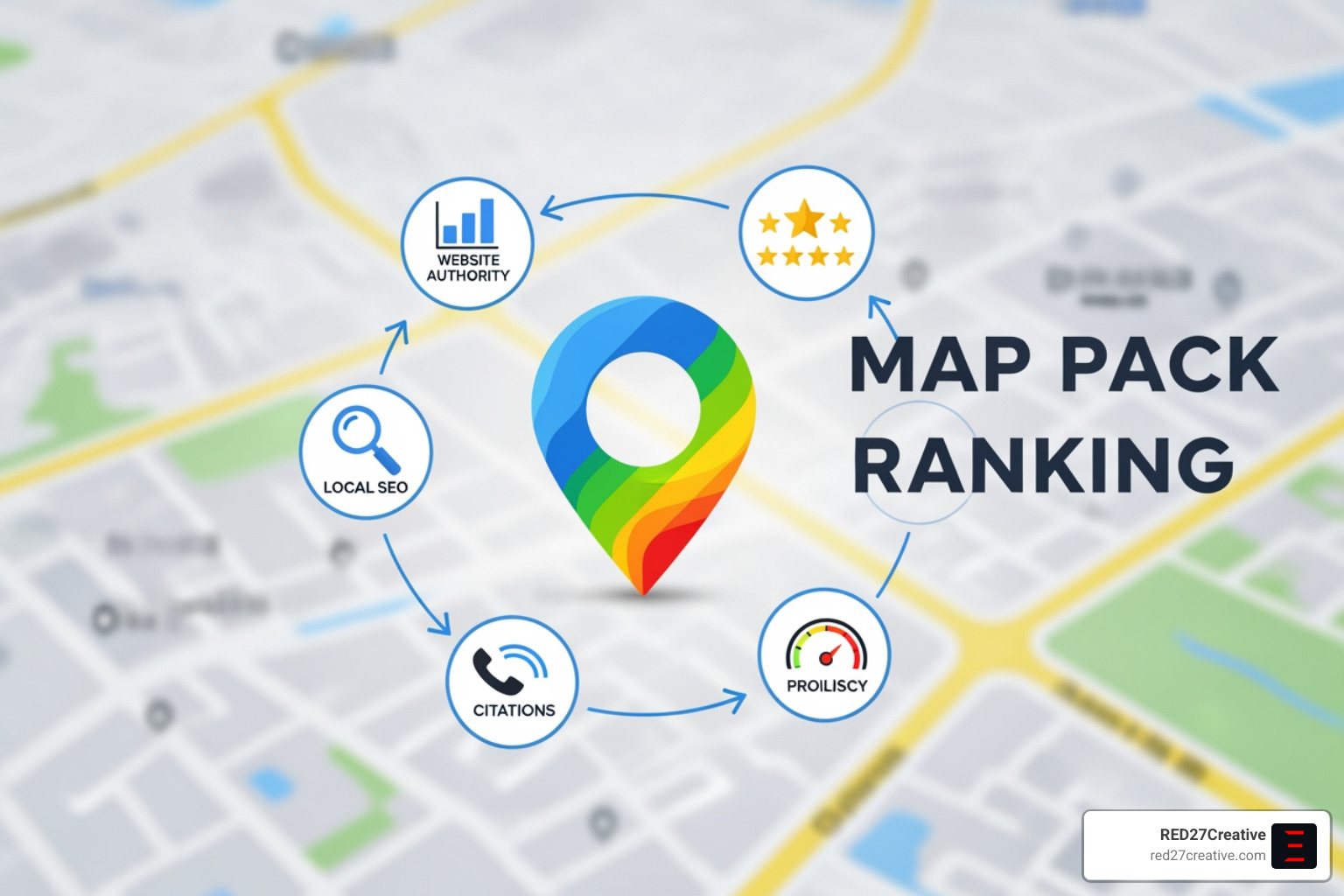
Map pack ranking determines if your business appears in the top three local search results on Google—the most valuable digital real estate for local businesses. To improve your ranking, focus on three core pillars:
The Three Pillars of Map Pack Ranking:
- Relevance: Optimize your Google Business Profile with accurate categories and keyword-rich descriptions that match customer searches.
- Distance: Ensure your business location is verified and your service areas are clearly defined to match local search intent.
- Prominence: Build authority through online reviews, local citations with consistent NAP (Name, Address, Phone) data, and quality backlinks.
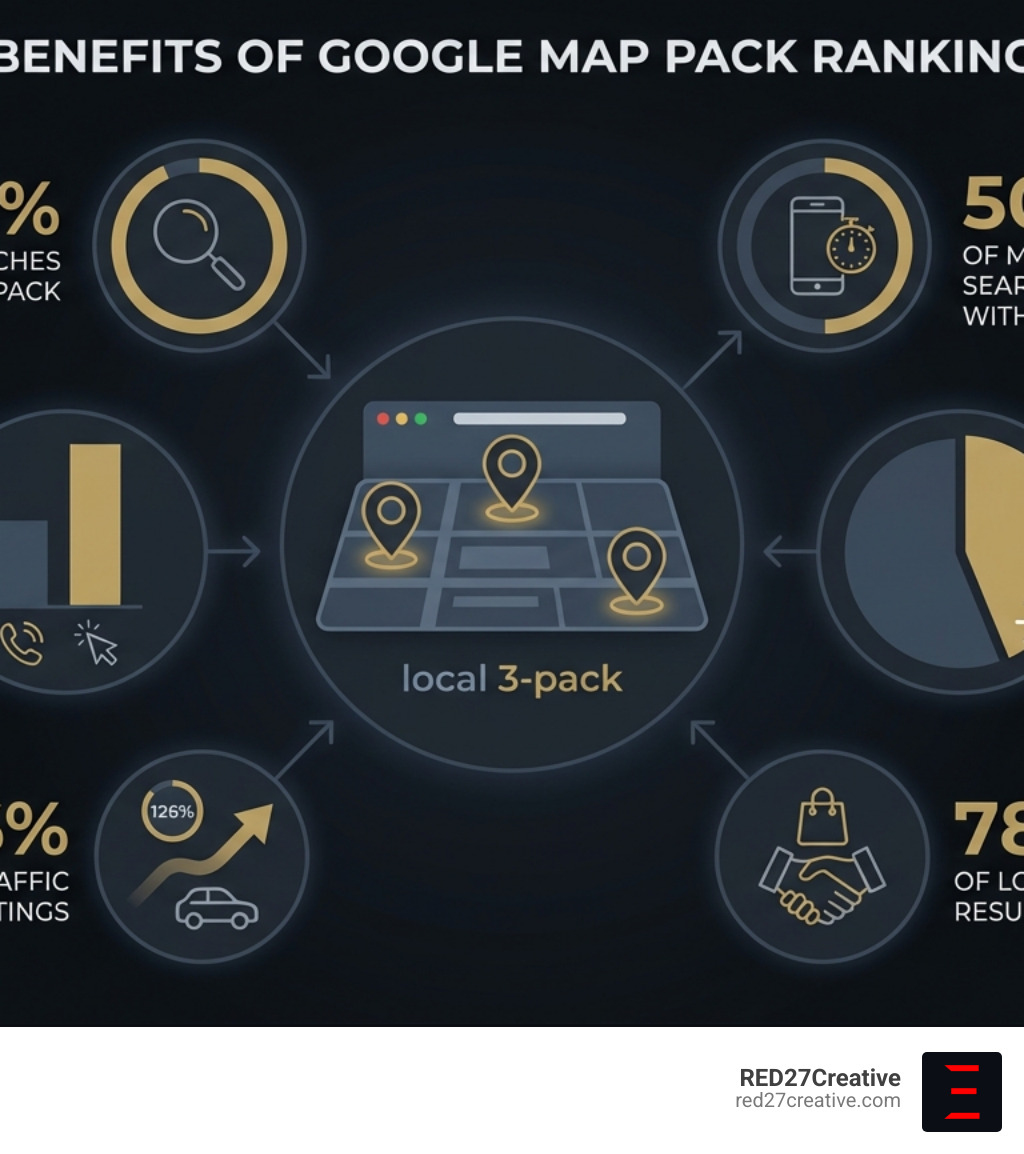
When someone searches for “plumber near me,” they want immediate answers. Google delivers them through the Map Pack, the three business listings at the top of local search results. This isn’t just another ranking; it’s the digital equivalent of a Main Street storefront. In fact, 93% of searches with local intent feature the local 3-pack, and businesses ranked there see 93% more actions (calls, website visits) than those ranked 4–10.
The Map Pack captures as much as 44% of total clicks on search results pages. With mobile searches for “best place to buy” growing over 70% in two years, and 50% of local mobile searchers visiting a business within 24 hours, the stakes are clear. The Map Pack connects you with high-intent customers at the exact moment they’re ready to act.
However, many businesses assume a Google Business Profile is enough. It’s not. Google’s algorithm uses relevance, distance, and prominence to select the top three. If you’re not actively optimizing for these factors, you’re invisible.
This guide will show you how to master Map Pack ranking and dominate your local market. I’m Kiel Tredrea, founder of RED27Creative, and I’ve spent 20 years helping businesses strengthen their local presence with data-driven SEO and Map pack ranking strategies that generate measurable results.
Important Map pack ranking terms:
What is the Google Map Pack and Why Is It Your Most Valuable Local Asset?
When someone in Geneva searches for “emergency plumber,” they’re looking at the Map Pack—the three business listings at the top of Google’s search results, complete with a map, phone number, and reviews. This isn’t just a listing; it’s prime digital real estate, where clicks and calls turn into customers within hours.
The Google Map Pack, or local 3-pack, is a special feature for searches with local intent. It appears above traditional organic listings, making it the first thing potential customers in Chicago, Naperville, or Aurora see. This placement is gold because it gives users everything they need to take immediate action.
Google used to show seven businesses, but the shift to a three-pack for mobile users made the competition fiercer and the reward greater. On a mobile screen, the Map Pack often fills the entire view, providing answers without any need to scroll.
Each listing includes essentials like business name, address, phone number, star ratings, and hours. These details are conversion tools, allowing users to call, get directions, or visit your site directly from the search results page.
The benefits of a strong Map pack ranking are significant. Businesses in the top three see a 93% increase in customer actions—calls, clicks, and direction requests—compared to those ranked just below. This translates directly into more leads and sales. When Google places you in the Map Pack, it acts as an endorsement, building trust and driving action in a way other rankings can’t.
Differentiating Local Search Features
It’s important to understand the difference between the Google Map Pack, Google Maps, and the Google Local Finder, as each plays a distinct role in the customer journey.
- Google Map Pack: The initial three listings on the main search results page, designed for quick decisions.
- Google Maps: The full application for detailed exploration, navigation, and deeper research.
- Google Local Finder: An expanded list of businesses that appears when a user clicks “More businesses,” allowing for comparison and filtering.
| Feature | Purpose | Format | User Journey |
|---|---|---|---|
| Google Map Pack | Immediate answers, quick decisions | Top 3 business listings with map on SERP | User searches locally, sees 3 top options, and takes immediate action. |
| Google Maps | Navigation, detailed exploration | Interactive map, comprehensive business profiles | User clicks a Map Pack listing or searches in Maps to get directions or more details. |
| Google Local Finder | Comprehensive list, filtering | Expanded list of businesses with a larger map | User clicks “More businesses” to browse and compare additional options. |
Optimizing for the Map Pack first ensures you capture attention at the most critical stage. To learn more, explore our guide on mastering Google Business Profile to maximize your local visibility.
Decoding the Algorithm: How Google Determines Map Pack Rankings
While Google keeps its local ranking algorithm’s exact formula secret, it does reveal the core ingredients. Understanding these factors gives businesses in Plainfield, Oswego, and St. Charles a significant advantage. Google’s official guidance on improving local rankings confirms that success hinges on three pillars: Relevance, Distance, and Prominence.

Pillar 1: Relevance
Relevance answers one question: Does your business match the searcher’s intent? If someone in Naperville searches for “HVAC repair,” Google aims to show HVAC companies, not dentists. Your Google Business Profile is the starting point for establishing relevance.
Choosing the right primary category is the strongest signal you can send. Be specific—select “Plumber” instead of “Contractor.” Your business description, services, and products should also use the language your customers use, reinforcing what you do and helping Google match you to the right searches. Finally, your website’s on-page SEO should mirror your GBP to confirm your expertise.
Pillar 2: Distance
Distance measures how close your business is to the searcher. For “near me” searches, Google uses GPS data to prioritize the closest options. Even for geo-modified searches like “plumber in Geneva IL,” proximity within that area is a key factor.
For service area businesses (SABs) without a storefront, you can hide your address and define a service area in your Google Business Profile. This tells Google where you operate, ensuring you appear in relevant local searches without needing a physical location for customers to visit.
Pillar 3: Prominence
Prominence is Google’s measure of how well-known and trusted your business is. Online reviews are a major signal; Google considers their quantity, quality, and recency. A business with 200 recent, high-quality reviews will likely outrank one with only a few, even if they are 5-star.
Local citations—mentions of your Name, Address, and Phone number (NAP) on sites like Yelp or industry directories—also build prominence. NAP consistency is crucial; any variation can confuse Google and weaken your authority. Backlinks from reputable local sites and even general brand mentions further signal that your business is a trusted entity, which is key to a better Map pack ranking.
The Ultimate Checklist for Dominating Your Map Pack Ranking
Now that you understand the algorithm, it’s time to take control with proven strategies. Building a strong Map pack ranking requires consistent effort in three key areas: optimizing your Google Business Profile, managing your online reputation, and strengthening your website’s local signals.
Businesses in Geneva and Naperville that treat local SEO as an ongoing investment see the best results. Let’s walk through the steps to transform your local presence.
Step 1: Master Your Google Business Profile for a Higher Map Pack Ranking
Your Google Business Profile is the most important factor for your Map pack ranking. Start by heading to manage your business to claim and verify your profile. This step is non-negotiable for earning Google’s trust.
Next, complete every section. Your Name, Address, and Phone number (NAP) must be identical everywhere online. Choose a specific primary category (e.g., “HVAC Contractor” instead of “Contractor”) and add relevant secondary categories. Write a compelling business description using terms your customers search for.
Detail your offerings in the services and products section. Upload high-quality photos and videos of your work, team, and location—businesses with photos get 42% more direction requests. Use Google Posts weekly to share updates and promotions, and actively manage the Q&A section to provide helpful information.
For a complete walkthrough, explore our guide on mastering google business profile.
Step 2: Build Trust and Authority with a 5-Star Review Strategy
Reviews are the lifeblood of local SEO, directly impacting your prominence score and influencing customer decisions. A passive approach isn’t enough; you need a system to generate a steady flow of feedback.
Aim for a rating between 4.0 and 5.0 stars, as 80% of consumers trust businesses in this range. Make it easy for your happiest customers to leave a review by sending follow-up emails with a direct link or using QR codes at your location. Train your team to ask for reviews after a positive interaction.
Responding to every review is just as important. Thank positive reviewers by name. For negative reviews, respond quickly and professionally, acknowledge their concerns, and offer to resolve the issue offline. This shows potential customers you are engaged and trustworthy.
Step 3: Amplify Prominence with Citations and On-Page SEO for a Better Map Pack Ranking
While your GBP is central, local citations and strong on-page SEO are essential for dominating the rankings. Citations are mentions of your NAP on other websites, like directories and local blogs. Google uses them to verify your information and gauge your prominence.
Consistency is everything. Even a small variation in your NAP can create confusion and hurt your ranking. We help businesses build and clean up citations across all relevant directories to ensure a strong, consistent signal.
Your website must also send strong local signals. Create dedicated location-specific service pages (e.g., “HVAC Services in Oswego IL”) with unique content. Implement local business schema markup to help search engines easily understand your business details. Finally, embed a Google Map on your contact or service area pages to reinforce your location.
These strategies can be custom for specific industries, as shown in our approach to local seo for manufacturers. For comprehensive support, our local seo services provide a complete system for market domination.
Measuring Success and Adapting to the Future of Local Search
You can’t improve what you don’t measure. Tracking your Map pack ranking performance is essential for proving ROI and identifying growth opportunities. Fortunately, clear metrics and tools can show you exactly how your local SEO efforts are performing.
How to Measure Your Map Pack Ranking Performance
Start with your Google Business Profile Insights, which tracks calls, website clicks, and direction requests. For a deeper analysis, local rank tracking tools generate GeoGrid reports that visualize your ranking across different points in your service area. This creates a heat map of your visibility in Geneva, Naperville, or Aurora.
One key metric is Share of Local Voice (SoLV), which measures your Map Pack visibility for target keywords compared to competitors. A higher SoLV means you’re capturing more local search traffic. Monitoring these metrics allows us to prove ROI and make data-driven decisions to refine your strategy.
The Future is Here: AI and the Evolution of Local Search
Local search is evolving rapidly with the rise of AI. Google’s AI Overviews and platforms like ChatGPT are changing how users find local businesses. This shift requires a new focus on Generative Engine Optimization (GEO)—ensuring your business information is easily understood and cited by AI systems.
To win in this new landscape, make your business data AI-friendly. This starts with a perfectly maintained Google Business Profile and the use of structured data (like local business schema) on your website. This helps AI quickly parse your services, location, and other key details.
Voice search optimization is also critical. When a user asks Alexa or Siri to “find the best HVAC repair near me,” they expect a single, confident answer. To be that answer, your content must be conversational, your NAP data consistent, and your review signals strong. Our AI chatbot solutions for businesses help generate the structured, conversational data that AI prioritizes, preparing you for the future of search.
Frequently Asked Questions about Map Pack Ranking
How long does it take to rank in the Google Map Pack?
Ranking in the Map Pack can take weeks or months, depending on your industry’s competition and location. Consistent optimization of your Google Business Profile, active review generation, and steady citation building are key. A steady, ongoing effort will always yield faster and more sustainable results than sporadic updates.
Can I rank in the Map Pack without a physical address?
Yes, service-area businesses (SABs) can rank without a physical address. In your Google Business Profile, hide your address and define your service areas. Since you lack a physical map pin, you must focus heavily on prominence (reviews, citations) and relevance (website content) to prove your legitimacy and service locations to Google.
Do Google Ads affect my organic Map Pack ranking?
No, Google Ads do not directly improve your organic Map pack ranking. The ad (“Sponsored”) and organic sections use separate algorithms. However, ads increase visibility and can lead to more profile engagement and reviews. This increased activity can indirectly boost your prominence signals over time, but it’s not a substitute for SEO.
Conclusion: Turn Your Local Visibility into Real Growth
Dominating the Map pack ranking isn’t about a single trick; it’s about building a comprehensive, consistent local presence that both Google and your customers trust. By mastering your Google Business Profile, managing your reputation through authentic reviews, and strengthening your website’s local signals, you create a powerful engine for attracting high-intent customers.
The businesses that win on Main Street today are the ones that win in the Map Pack first. They understand that local visibility translates directly into calls, direction requests, and website visits from real people ready to buy.
However, sustainable success requires ongoing attention. The local search landscape is constantly evolving with AI and changing consumer behaviors. Having a partner who stays ahead of these changes is critical.
At RED27Creative, we build data-driven systems that connect your local presence to real business results. We create integrated marketing systems where your local SEO, website, and reputation management work together to generate consistent, qualified opportunities.
Take control of your local presence with our expert local SEO services and turn visibility into measurable growth. We’ll help you build the foundation for long-term success in the Map Pack and beyond.

Kiel Tredrea
https://red27creative.comTop Marketing Agency • Web, SEO & Leads • RED27Creative