IT Company Marketing: Strategies for Success

The Critical Role of Marketing in a Hyper-Competitive Tech Landscape
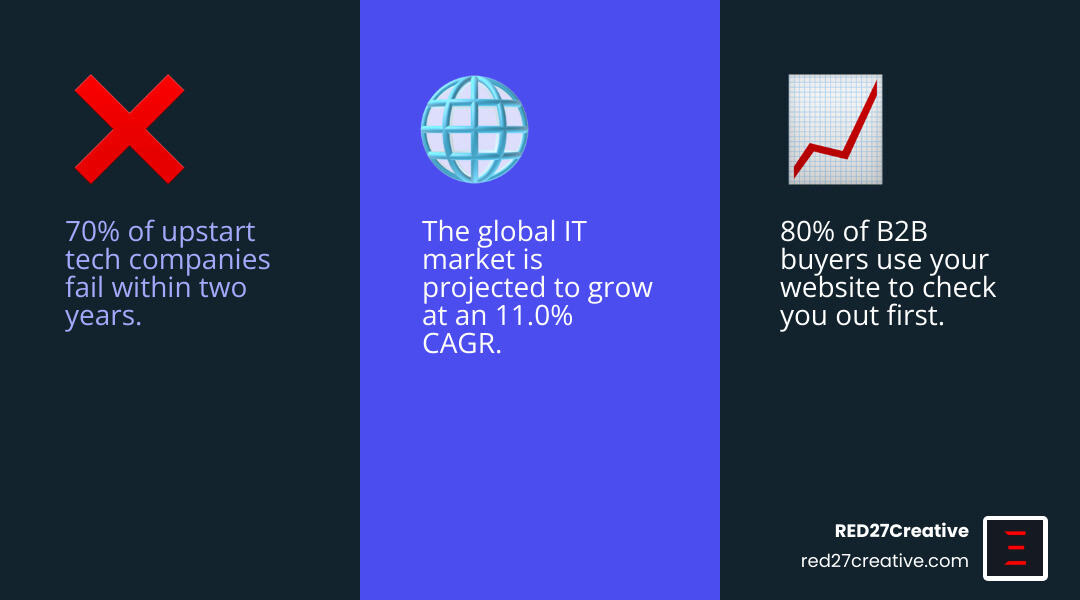
Marketing for IT companies has become a make-or-break factor in today’s rapidly evolving technology landscape. The global information technology market is projected to grow at an impressive 11.0% CAGR from 2023 to 2032, creating massive opportunities but also intensifying competition.
Key Marketing Strategies for IT Companies:
- Content Marketing – Educate prospects through blogs, whitepapers, and case studies
- Search Engine Optimization (SEO) – Drive organic visibility and qualified leads
- Social Media Marketing – Build thought leadership and engage technical audiences
- Paid Advertising (PPC) – Generate immediate visibility and targeted lead generation
- Video Marketing – Simplify complex technical concepts for broader audiences
- Website Optimization – Convert visitors with compelling user experiences
The stakes are high: 70% of upstart tech companies fail within two years, often due to poor marketing, not poor technology. In contrast, high-growth IT firms are 44% more likely to use comprehensive growth strategies and 60% more likely to tie marketing to performance metrics.
B2B buyer behavior has changed. 80% of buyers research your website before making contact, and 44% of millennials prefer minimal sales interaction. Your marketing must educate and convert prospects digitally before they ever speak to a sales representative.
Thriving companies know marketing is a growth engine, not an afterthought. High-growth firms are over twice as likely to accept digital change and nearly three times more likely to have a strong market differentiator.
I’m Kiel Tredrea, founder of RED27Creative. With over 20 years of experience, I help IT companies steer these challenges with strategic branding, digital marketing, and web development. Success in marketing for IT companies comes from integrated systems that build authority, generate leads, and drive measurable revenue.
Understanding the Foundation: Strategy, Branding, and Your Website
Before executing tactics like social media or paid ads, you need a solid foundation: a clear strategy, a differentiated brand, and a high-performing website. Without these, even the best campaigns will fail to deliver results.
Defining Your IT Marketing Strategy
Effective marketing for IT companies begins with understanding your marketplace. Define your unique market position, pricing, and services, then promote the specific benefits you offer to your target audience.
High-growth IT firms approach marketing differently. They are 44% more likely to implement growth strategies and 60% more likely to track performance metrics tied to campaigns. This data-driven approach eliminates guesswork and creates measurable systems for predictable results.
Digital maturity is key. 55% of no-growth firms have low digital maturity, while 20% of high-growth firms have reached the highest stage. Evolving your digital capabilities is essential for survival.
If strategic planning feels overwhelming, you’re not alone. Our Business Consulting services are designed to help you gain clarity and build a roadmap for sustainable growth.
Building a Differentiated Brand
In a competitive IT market, a strong brand differentiator is essential for survival. High-growth firms are almost three times more likely to have one. Without it, you blend in with competitors claiming to offer “innovative solutions.”
True differentiation is more than a logo. It’s a unique value proposition that makes it clear to your ideal clients why you are not just different, but better than the competition.
A strong differentiator allows for more targeted and effective marketing. You’ll attract the right clients, stand out in a crowded market, avoid price wars, and build authority in your niche.
Consistent messaging across all channels builds trust and recognition. This coherence makes you memorable and authoritative, turning you from just another vendor into the obvious choice.
Your Website: The Digital Hub of Your Marketing
Your website is more than a digital brochure; it’s your marketing hub and a prospect’s first impression. 80% of buyers use your website to check you out before making contact.
Your site must immediately engage, educate, and convert visitors into leads. A poor website can eliminate you from consideration, even if you were referred.
A high-performing website needs strong technical fundamentals like speed, responsive design, and clean code for SEO. It must also provide an exceptional user experience (UX) with clear navigation, compelling content, and strong calls to action (CTAs).
Your website acts as a 24/7 sales representative. It should feature expert content, differentiated messaging, and benefit-focused service pages that show how you solve client problems.
If your site isn’t generating qualified leads, it’s time for an upgrade. We create high-converting websites that turn visitors into clients. Learn more about our Website Design services.
Core Digital Marketing Strategies for IT Companies
With a strong foundation, leverage these core digital channels to drive visibility, generate leads, and build authority.
Content Marketing: Educate, Engage, and Build Trust

Content marketing is the heartbeat of effective marketing for IT companies. It cuts through the noise by providing helpful information that addresses prospect challenges, positioning your firm as a trusted expert.
Your content works 24/7 to educate and guide prospects during their research, building essential credibility and trust. Align content with the buyer’s journey: use blogs for awareness, case studies for consideration, and demos for the decision stage.
66% of top performers in tech content marketing have a documented content strategy, ensuring content aligns with growth goals.
Original research is a secret weapon. Publishing unique surveys or industry insights positions you as a thought leader and provides content that can be repurposed across multiple channels.
We create compelling content that converts. Learn about our Content Marketing for Manufacturers services, which we adapt for IT companies.
Why SEO is Crucial for Marketing for IT Companies
Search Engine Optimization (SEO) is crucial for connecting with prospects actively searching for your solutions. Since B2B researchers average 12 searches before engaging with a brand, SEO ensures you appear in those critical moments.
The numbers are clear: SEO leads have a 14.6% close rate, far higher than outbound’s 1.7%. This is because SEO attracts prospects who are already interested, rather than relying on interruption.
Effective SEO requires a multi-layered approach:
- Keyword Research: Understand the exact language your prospects use.
- On-Page SEO: Naturally incorporate keywords into content that serves both search engines and human readers.
- Technical SEO: Cover behind-the-scenes factors like site speed and mobile-friendliness.
- Off-Page SEO: Build your reputation through high-quality backlinks.
SEO is a long-term investment that compounds over time, delivering results long after paid ads stop. Explore our comprehensive SEO services to see how we help IT companies dominate search results.
Social Media Marketing: Fostering Community and Conversation
For IT companies, social media is an essential channel for building relationships and thought leadership. With global social media user count surpassing 4.59 billion, your prospects are on these platforms.
LinkedIn is often the most impactful platform for B2B IT companies, as it’s where prospects research trends and partners. Don’t overlook X (formerly Twitter) for real-time industry discussions.
Success on social media comes from conversation, not broadcasting. Engage in discussions to position your firm as a resource, not just a vendor.
Leverage employee advocacy. Content shared by team members often gets more traction and expands your reach to new networks because people connect with people, not logos.
The goal is not to go viral, but to build genuine relationships with ideal clients and industry influencers who can drive business.
Amplifying Your Reach: Advanced Growth Tactics
With a solid foundation, accelerate growth with advanced tactics to reach high-value audiences and create powerful feedback loops for your marketing engine.
Paid Advertising (PPC) for Immediate Impact
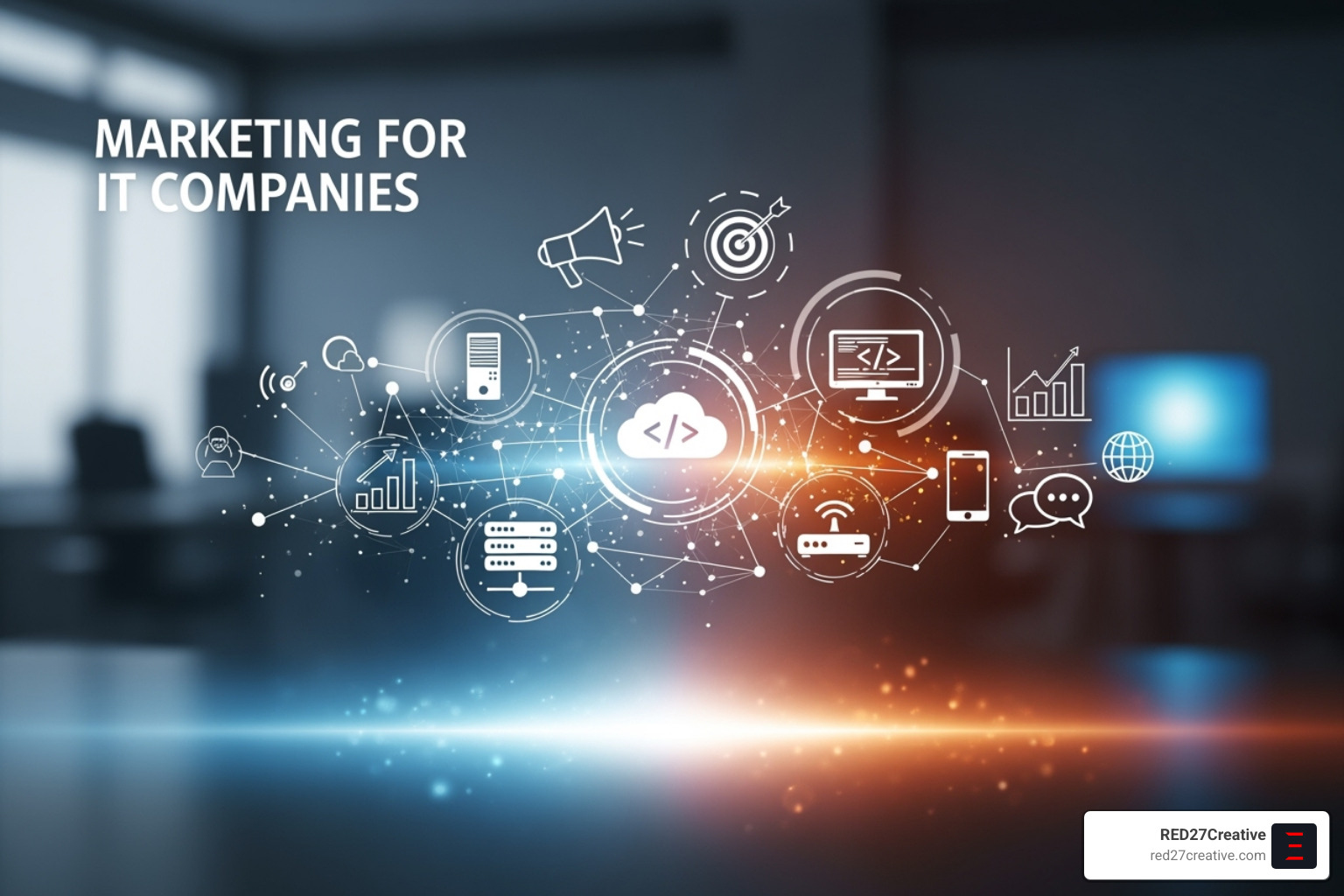
While SEO builds long-term organic presence, Pay-Per-Click (PPC) advertising offers immediate visibility. It’s the express lane to reaching prospects actively searching for your solutions.
The tech industry’s high average cost per click ($3.80) demands careful campaign management. Success relies on targeting specific keywords, demographics, and behaviors that match your ideal client.
Retargeting nurtures warm leads by showing ads to previous website visitors. PPC also provides immediate feedback for testing ad copy and landing pages, informing your overall strategy.
Our team manages sophisticated PPC campaigns that turn clicks into customers. Find out how our Google Paid Search (PPC) services can accelerate your growth.
Video Marketing: Simplifying the Complex
Video marketing simplifies complex IT solutions into engaging content. It can boost brand awareness by 41% by making your message more memorable.
- Explainer Videos: Break down how your software or service works.
- Product Demos: Let your solutions speak for themselves and build confidence.
- Customer Testimonials: Provide powerful social proof and build trust.
- Thought Leadership Videos: Position your team as experts through webinars or interviews.
Video humanizes your brand. Let our Photo and Videography services help you create compelling video content that connects with your audience.
Building Credibility with Case Studies and Reviews
In IT, trust is everything. Case studies and reviews provide proof of results. 49% of SaaS marketers consider case studies ‘very effective’ at boosting sales because they demonstrate real-world value.
Compelling case studies follow a clear narrative: challenge, solution, and results. Use concrete numbers like cost savings or efficiency gains to help prospects visualize their own success.
Third-party customer reviews on platforms like G2, Capterra, and Clutch offer powerful independent validation. A strong, positive presence on these sites heavily influences purchasing decisions.
We help IT companies leverage these credibility-building tools through our B2B Lead Generation services.
Key Considerations for Marketing for IT Companies
Success requires understanding your market’s unique dynamics and choosing strategies that align with your business model and audience.
- B2B vs. B2C: B2B marketing involves long sales cycles and a focus on ROI, while B2C focuses on personal benefits and shorter purchase journeys.
- Product-Led Growth (PLG): Effective for products with free trials or freemium models, but complex solutions still need a direct sales approach.
- Partnership Marketing: Multiplies your reach by leveraging complementary businesses for high-quality leads.
- Event Marketing: Webinars and conferences remain powerful for demonstrating expertise and generating leads.
- Emerging Tech: Keep your marketing innovative with tools like AI chatbots. Our AI Chatbot Solutions for Businesses can improve your automation.
Frequently Asked Questions about Marketing for IT Companies
Here are answers to the most common questions we hear from IT companies.
What are the primary challenges in marketing for IT companies?
The primary challenges are communicating complex products simply, navigating long B2B buying cycles with multiple stakeholders, and standing out in a hyper-competitive market. Additionally, 68% of tech marketers struggle to create content that appeals to both technical and business roles, making consistent engagement difficult.
How can an IT company establish thought leadership?
Establish thought leadership by consistently providing value. Publish original research, data-driven analysis, and insightful blog posts. Amplify your voice by speaking at industry events, hosting webinars, and actively participating in expert discussions on platforms like LinkedIn. The goal is to become a go-to resource, not just a vendor.
What is the difference between B2B and B2C tech marketing?
B2B tech marketing targets logic, ROI, and efficiency for multiple business stakeholders over a long sales cycle, requiring deep educational content like whitepapers. B2C tech marketing appeals to emotion and personal benefit for individual consumers with a short sales cycle, using tactics like social proof and quick videos.
Conclusion: Your Roadmap to Sustainable Growth
Success in marketing for IT companies comes from integrating individual tactics into a unified system. Like a sophisticated piece of software, each component—strategy, content, SEO, and ads—must work seamlessly together.
Your foundation—strategy, brand, and website—supports all other efforts. Content builds trust, SEO drives findy, social media amplifies your voice, and paid advertising provides immediate reach. Each element is critical.
What separates thriving companies from the 70% of tech companies that fail is a cohesive marketing ecosystem. Winners ensure their brand story is consistent across their website, content, social media, videos, and paid campaigns.
The data is clear: an integrated, data-driven approach is essential for survival and leadership in today’s competitive landscape. Strategies that boost brand awareness and generate high-quality leads like those with a 14.6% close rate are non-negotiable.
At RED27Creative, our two decades of experience have shown us how strategic thinking, compelling branding, and expert digital marketing transform IT companies into industry authorities. Our comprehensive approach ensures every marketing piece works together for lasting growth.
Your roadmap to growth begins with a strategic first step. The key is a clear vision and the right partner to help you refine your brand, overhaul your website, or develop a content strategy that converts.
Ready to build your growth engine? Explore how our IT Consulting Companies Chicago services can create the integrated marketing system your IT company deserves. Let’s ensure your company cuts through the noise and leads the future.

Kiel Tredrea
https://red27creative.comTop Marketing Agency • Web, SEO & Leads • RED27Creative