National SEO Strategies: How to Scale Your Visibility Beyond Your Backyard

Why National SEO Strategies Are the Growth Engine Your Business Needs
National SEO strategies are the structured approach businesses use to rank for high-value, non-location-specific keywords across the entire country — not just in their local market.
If you’re evaluating whether national SEO is right for your business, here’s a fast-reference summary:
National SEO at a Glance:
| Question | Quick Answer |
|---|---|
| What is it? | Ranking for broad, non-geographic keywords across the U.S. |
| Who needs it? | E-commerce, SaaS, B2B services, multi-location brands |
| How long does it take? | 6–12 months for meaningful traction |
| What does it cost? | $5,000–$100,000+/month depending on competition |
| What’s the ROI? | Avg. $22 returned for every $1 spent |
| How is it different from local SEO? | Authority and content depth replace proximity signals |
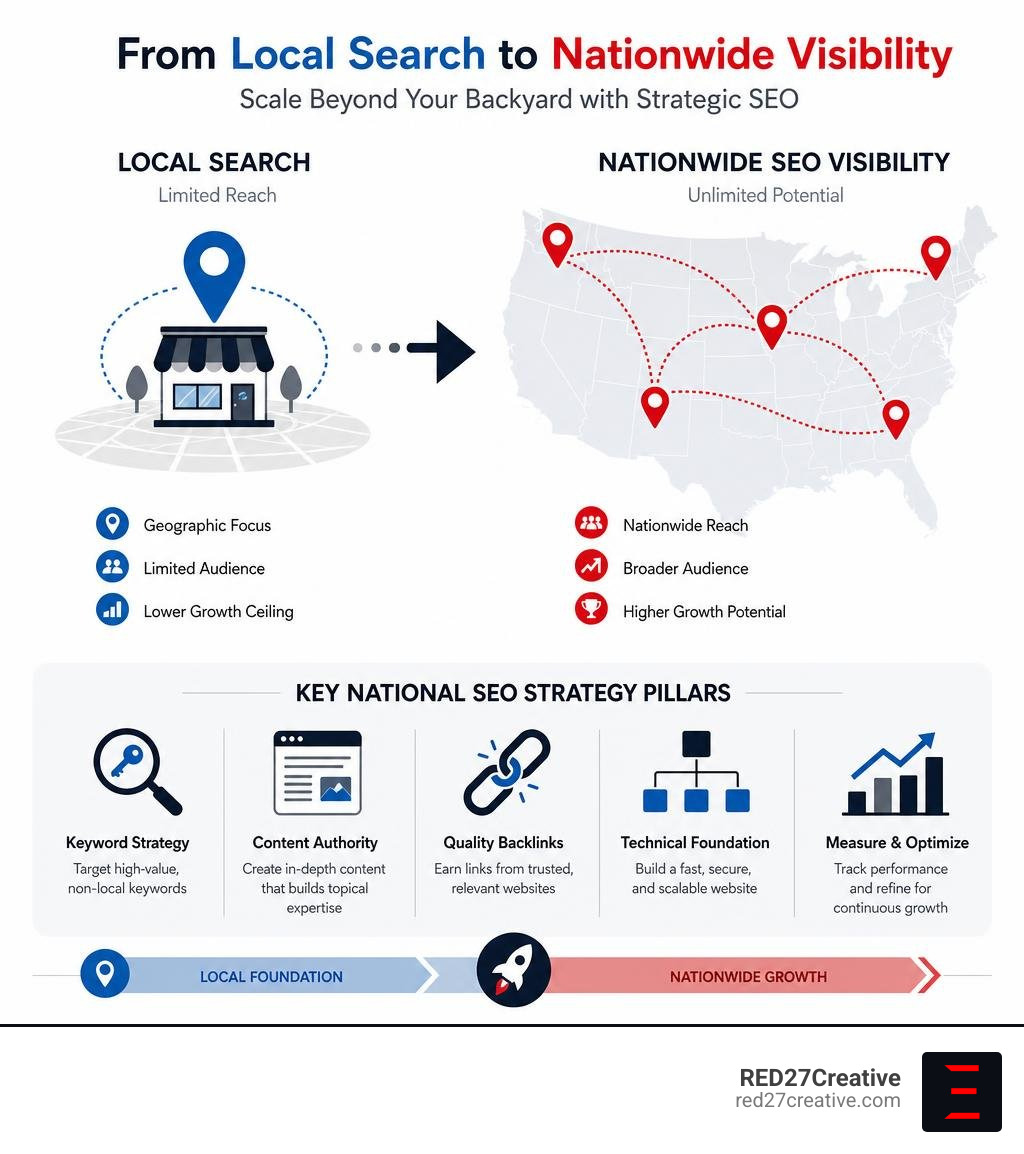
Most businesses start with local SEO — and for good reason. It works fast and it’s focused. But eventually, the local market has a ceiling. When your customers could be anywhere, and your competitors are ranking coast to coast, local tactics simply stop working at the scale you need.
The difference between local and national SEO isn’t just geography — it’s a fundamentally different game. National SEO replaces proximity signals with topical authority, deep content architecture, and high-quality backlinks from trusted sources. It rewards patience, strategy, and consistency over quick wins.
That’s also what makes it one of the highest-ROI marketing investments a growing business can make. Organic search drives 53.3% of all website traffic — and unlike paid ads, the results compound over time rather than stopping the moment you cut the budget.
I’m Kiel Tredrea, founder of RED27Creative, and over the past 20+ years I’ve helped businesses of all sizes build and execute national SEO strategies that drive real, measurable growth — from technical foundations to content authority and link acquisition. In this guide, I’ll walk you through everything you need to know to scale your visibility beyond your backyard.
National SEO strategies terms to learn:
National SEO vs. Local SEO: Understanding the Core Differences
The fundamental difference between local and national search engine optimization lies in search intent and geographic modifiers. Local SEO relies heavily on proximity, physical addresses, and “near me” queries. In contrast, national SEO focuses on building deep topical authority to rank for broad, non-geographically modified search terms.
To rank nationally, your website must demonstrate exceptional domain authority to search engines. This requires a shift from optimizing local directory listings to building a comprehensive, authoritative digital ecosystem. Understanding these differences is critical for proper resource allocation.
For local businesses operating in the Chicagoland area, proximity is the ultimate ranking lever. If a user searches for digital marketing in Geneva, Batavia, or Aurora, Google leverages the Map Pack and localized signals to serve nearby results. This is highly effective for capturing local intent, but it limits your reach. If your business is ready to scale nationwide, you need to transition from a proximity-first mindset to an authority-first mindset.
| Optimization Element | Local SEO | National SEO |
|---|---|---|
| Primary Target Audience | Local neighborhood or city | Entire country or multiple regions |
| Keyword Focus | Geo-modified (e.g., “SEO agency Chicago”) | Broad & informational (e.g., “National SEO strategies”) |
| Key Ranking Factors | Google Business Profile, proximity, local citations | Topical authority, entity trust, backlink profile |
| Competition Level | Low to moderate (local competitors) | Extremely high (enterprise brands & industry giants) |
To explore this comparison further, read Search Engine Land: Local SEO vs National SEO or look at how local strategies differ through resources like Local SEO vs. National SEO: Which Strategy Is Right for Your … . If you are ready to make the transition, check out our guide on From Local to National Scaling Your Digital Marketing Efforts.
Keyword Strategy and Content Depth in National SEO
A successful national campaign requires targeting high-value long-tail keywords that capture users at various stages of the buying journey. While high-volume head terms are attractive, long-tail variations often yield higher conversion rates. These specific queries allow us to address precise user pain points.
The average word count for a #1 ranking on Google in 2026 is 1,500-2,200 words. This means a thin, 500-word blog post will not cut it when competing at a national level. We must create extensive, high-quality resources that thoroughly cover a topic.
To organize this content effectively, we build comprehensive topic clusters around central pillar pages. This structure signals to search engines that our site possesses the necessary content depth to satisfy complex user queries. Discover how our specialized SEO Services can help you design and execute these advanced content frameworks.
Link Building and Authority Signals Beyond Proximity
In national search, proximity signals are replaced by entity recognition and brand mentions across authoritative platforms. High-quality backlink acquisition is the primary driver of domain authority at a national scale. The top spot in Google typically has 3.8x more backlinks than spots 2-10, making a structured link acquisition plan non-negotiable.
We must earn links from reputable, high-traffic websites within our industry. Unlike local SEO, where a link from a local Chamber of Commerce in Batavia or St. Charles carries significant weight, national SEO requires links from national publications, industry journals, and educational institutions.
Executing a modern digital PR strategy is one of the most effective ways to secure these high-authority links. By publishing original research and securing editorial features, we build the trust signals that search engines demand. For more technical guidance on authority signals, review the Google Search Central: Advanced SEO Guidelines.
Who Should Invest in National SEO Strategies?
National SEO strategies are ideal for businesses that are not restricted by physical, local service boundaries. E-commerce brands, software-as-a-service (SaaS) companies, and B2B service providers stand to gain the most from national visibility. These business models can seamlessly deliver value to customers regardless of their physical location.
For example, B2B SaaS businesses in 2026 earn an average of $8.75 for every $1 invested in SEO, illustrating the massive compounding potential of a national footprint.
Investing in national search is also a powerful tool for market diversification. If your business has hit a growth ceiling in its local market, expanding your digital reach is the logical next step. Learn more about how we tailor these campaigns by visiting our page on SEO for National Brands.
When to Scale from Local to National SEO
Recognizing the right scaling triggers is essential to avoid overextending your marketing budget. A key indicator is a steady rise in non-local Search Console impressions for your informational content. If users in California, Texas, and New York are finding your blog posts, it proves that search engines are already beginning to view your site as a trusted national resource.
Another trigger is when you have successfully dominated your local markets—such as Geneva, Batavia, St. Charles, and the wider Chicago area—and have reached a natural revenue ceiling.
Before launching a national campaign, ensure your business has the operational capacity to handle increased demand. Scaling too quickly without adequate resources can damage your brand reputation. If you need help evaluating your readiness, explore our SEO Strategy Consulting services.
How Local and National SEO Work Together
Transitioning to a national strategy does not mean you have to abandon your local roots. A hybrid model allows us to maintain our Google Business Profile for local trust while targeting national terms. This dual approach captures high-intent local buyers while simultaneously building broad brand authority.
For instance, we can target high-intent local searches in specific Illinois hubs using targeted location pages, while simultaneously publishing comprehensive, non-geographic guides for a national audience. This hybrid approach ensures you don’t lose valuable regional leads while scaling your brand nationwide.
Using localized landing pages for key regional hubs helps bridge the gap between local and national search. This ensures you capture regional search volume without diluting your overall national authority. For a complete breakdown of this integrated approach, read our Strategic SEO Services Complete Guide.
The Core Components of a Successful National SEO Strategy
A robust technical infrastructure is the foundation of any successful national campaign. Your website must be optimized for crawlability, indexability, and lightning-fast page speeds. Search engines will not rank a site nationally if it suffers from underlying technical debt.
Consider this: 53% of users will abandon a site if it takes more than 3 seconds to load. With 92.3% of searches happening on mobile devices, mobile responsiveness and site speed are critical ranking signals.
Implementing advanced schema markup is critical for helping search engines understand your site’s entity authority. Additionally, meeting strict Core Web Vitals standards ensures a seamless user experience across all devices. To optimize your technical foundation, consider our National Enterprise SEO Services.
Semantic Node Architecture and AI Search Visibility
As search engines evolve in 2026, optimizing for AI Overviews and ChatGPT indexing is crucial. This requires building a semantic node architecture that clearly defines the relationships between different topics on your site. Your content must provide high “information gain” by offering unique insights not found elsewhere.
To satisfy AI search models, we write with intent. We structure our content to include concise, factual summaries of 40–60 words at the beginning of key sections. This makes it easy for LLMs and voice assistants to extract and display our content as the definitive answer.
Using structured data, such as the knowsAbout schema, helps search engines map your brand to specific industries. This structured approach ensures your content is easily parsed and cited by AI search engines. By aligning your site with semantic search principles, you secure long-term visibility in an AI-driven landscape.
Building Entity Authority and E-E-A-T in 2026
To rank for competitive national terms, your site must demonstrate high levels of Experience, Expertise, Authoritativeness, and Trustworthiness (E-E-A-T). Search engines actively look for verified author profiles, editorial standards, and real-world credentials.
One of the most effective ways to build E-E-A-T is through original data. SaaS sites with original research see 29.7% higher organic growth than those without. By publishing first-party surveys and data reports, you establish your brand as a primary source, earning natural backlinks and citations across the web.
Getting your brand integrated into the Google Knowledge Graph is a major milestone for national authority. This is achieved by publishing original research, securing high-quality brand mentions, and maintaining consistent entity data across the web. Discover how our Advanced SEO Services can elevate your brand’s digital authority.
Timelines, Budgets, and Measuring ROI for National Campaigns
Measuring the success of a national campaign requires tracking a variety of key performance indicators (KPIs). While organic traffic growth is important, we must also monitor conversion rates, branded search volume, and organic revenue. Establishing a consistent reporting cadence keeps our team aligned and accountable.
The median ROI for organic search for B2B service businesses is 782%. To capture this growth, we must track macro-conversions like qualified leads and sales, rather than just vanity metrics like keyword rankings.
To accurately measure these metrics, you need a sophisticated analytics setup that attributes conversions correctly. This data allows us to refine our strategy and maximize our return on investment. Learn more about our measurement frameworks by visiting Enterprise SEO Analytics.
Realistic Timelines for National SEO Strategies
National campaigns require strategic patience, as search engines take time to re-evaluate your site’s authority. Unlike local SEO, which can show results in 3-6 months, national SEO campaigns typically see a 7-month break-even point. We typically implement a three-phase rollout over twelve months to ensure sustainable growth:
- Phase 1 (Months 1–3): Technical optimization, resolving technical debt, site architecture refinement, and initial keyword clustering.
- Phase 2 (Months 4–6): Content cluster deployment, digital PR launch, and initial long-tail keyword rankings.
- Phase 3 (Months 7–12): High-authority link acquisition, conversion rate optimization, and competitive head-term rankings.
As you cross the break-even point, the compounding returns of organic search will far outperform paid advertising channels, which are subject to an ever-increasing “ad tax.”
Budget Ranges and Pricing Tiers for National SEO Strategies
National campaigns require a larger financial investment than local campaigns due to the intense competition. Budgets must cover extensive content creation, technical development, and high-end digital PR campaigns.
Generally, businesses should expect the following national SEO pricing tiers in 2026:
- Growth/Startup Tier: $5,000 – $10,000/month. Ideal for businesses targeting specific national niches.
- Mid-Market Tier: $10,000 – $25,000/month. Designed for competitive national verticals and e-commerce brands.
- Enterprise Tier: $25,000 – $100,000+/month. For large-scale sites competing with household names.
Choosing between building an in-house team or partnering with an agency depends on your internal capabilities and growth goals. For detailed information on investment levels, review our Enterprise SEO Pricing guide.
Common Mistakes to Avoid in National SEO Campaigns
One common mistake in national campaigns is keyword cannibalization, where multiple pages target the same search intent, diluting your ranking power. Prevent this by maintaining a clean keyword registry and distinct topic clusters.
Another pitfall is treating national SEO like “local SEO everywhere” by duplicating location pages with thin content. Instead, focus on high-value comparison pages, which convert 3.2x higher than standard feature pages.
Finally, neglecting technical debt and Core Web Vitals will stall organic growth regardless of content quality. If you plan to expand further, read how Global SEO Services Boost Your Worldwide Visibility.
Frequently Asked Questions about National SEO
What is the main difference between local SEO and national SEO?
Local SEO optimizes your online presence to attract customers within a specific geographic area, relying heavily on proximity and Google Business Profile signals. National SEO targets broad, non-location-specific keywords to reach audiences across the entire country, requiring massive topical authority, high-quality backlinks, and deep content clusters.
How long does it take to see results from a national SEO campaign?
A national SEO campaign typically takes six to twelve months to show significant traction. While technical fixes and long-tail keyword wins can appear within the first three months, building the necessary domain authority and entity trust to rank for highly competitive national terms requires sustained, long-term investment.
Can a small business compete with national brands using national SEO?
Yes, small businesses can compete by targeting highly specific, long-tail keywords and building deep topical authority within a specialized niche. By out-engineering larger competitors with superior content depth, structured schema markup, and original data, smaller sites can secure top rankings and AI search citations without matching enterprise budgets.
Conclusion
Scaling your digital presence beyond your local market requires a sophisticated, data-driven approach. By implementing advanced national SEO strategies, you build a powerful digital marketing engine that drives sustainable, long-term growth.
At RED27Creative, led by founder Kiel Tredrea, we bring over 20 years of experience to help brands transition from local players to national industry leaders. Based in Geneva, Illinois, we serve businesses across Batavia, Aurora, St. Charles, Plainfield, Oswego, Naperville, and Chicago, building data-driven systems that connect your website, SEO, and lead generation into one unified engine for growth.
We align your technical infrastructure, content strategy, and authority signals to create a unified growth engine that delivers real ROI. Ready to scale your visibility across the country? Partner with RED27Creative for National Growth today.

Kiel Tredrea
https://red27creative.comTop Marketing Agency • Web, SEO & Leads • RED27Creative