Launch Like a Pro: Setting Up Your First Effective PPC Campaign

Why PPC Campaign Setup Matters for Your Business Growth
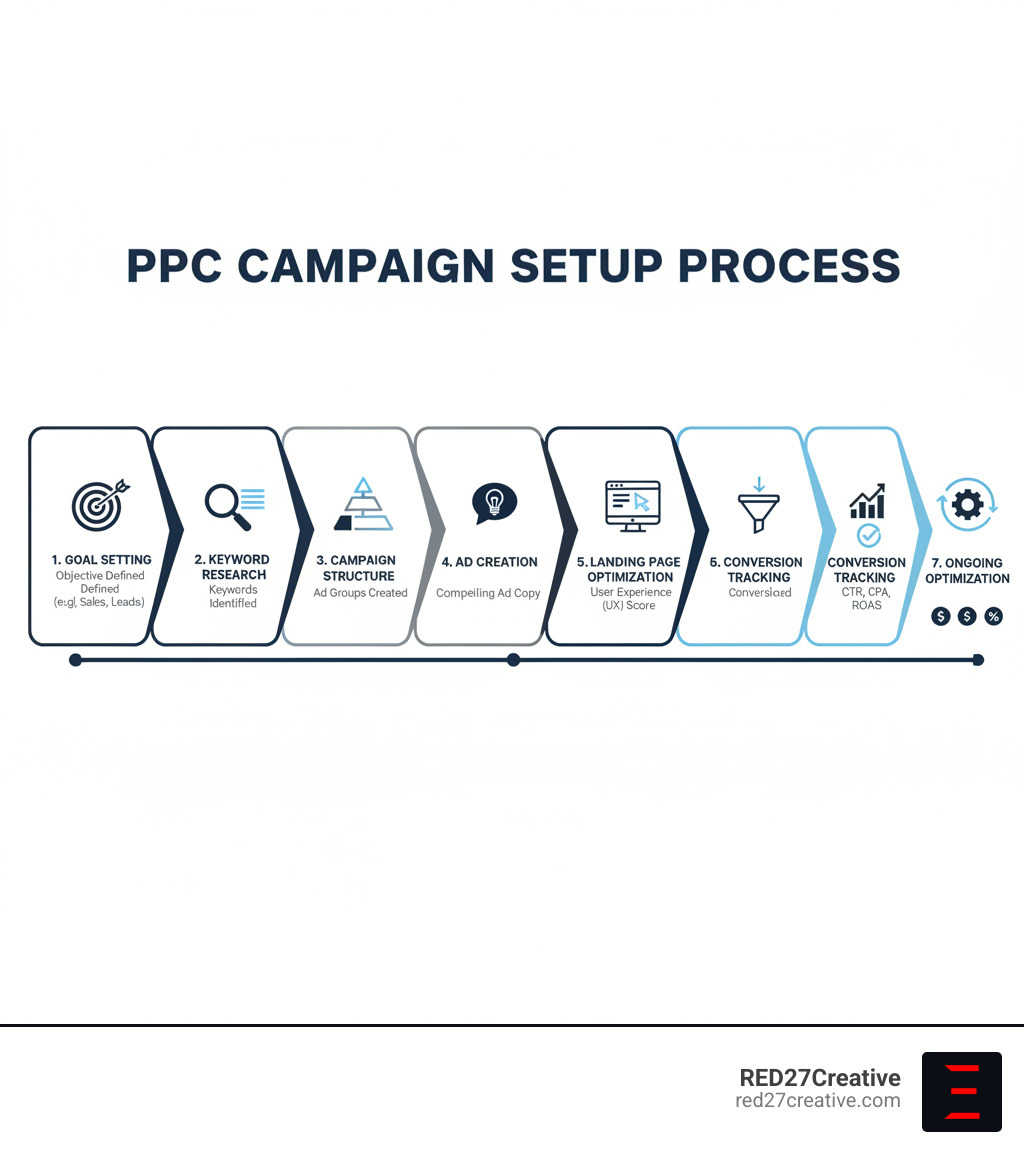
Proper PPC campaign setup is the foundation of any successful pay-per-click advertising strategy. When done right, targeted traffic can flow to your website within hours. However, most first-time campaigns waste money by skipping critical setup steps.
Quick Answer: Setting Up Your First PPC Campaign
- Choose your platform (e.g., Google Ads, Meta Ads)
- Define clear goals (sales, leads, traffic)
- Conduct keyword research (Google Keyword Planner)
- Set a test budget (start with $25-$50 daily)
- Create compelling ads with strong headlines and CTAs
- Build targeted ad groups around keyword themes
- Design optimized landing pages that match your ad
- Set up conversion tracking to measure results
- Launch and monitor key metrics like CTR
- Optimize continuously based on performance data
A correct setup is the difference between a profit engine and a budget drain. Industry data shows businesses earn an average of $2 for every $1 spent on Google Ads, and 79% of brands report PPC as a massive driver for their business. A well-structured campaign leads to lower costs, higher Quality Scores, and better ad positions from day one.
This guide walks you through the complete PPC campaign setup process, from platform selection to launch and optimization. I’m Kiel Tredrea, founder of RED27Creative. With over 20 years of experience managing millions in ad spend, I’ve refined this process to eliminate waste and maximize ROI. The strategies here are the same ones we use to deliver measurable results for our clients.
Understanding the PPC Landscape: Foundations for Success
PPC campaign setup is a strategic process where you pay only when someone clicks your ad, placing your business in front of customers at their exact moment of need. For example, a plumber in Geneva, IL, can appear instantly for a homeowner with a burst pipe.
Data proves its value: businesses average $2 in revenue for every $1 spent on PPC, and 79% of brands call it a massive growth driver. PPC offers total control over budget, keywords, and audience, targeting high-intent users actively searching for solutions.
Paid ads also boost brand awareness by up to 80% by building familiarity at the top of search results. Different campaign types serve different goals:
- Search ads: Capture existing demand with text ads on Google.
- Display ads: Build brand recognition with visual banners and remarketing.
- Social media ads: Reach specific demographics on platforms like Facebook and LinkedIn.
- Video ads: Engage users with storytelling on platforms like YouTube.
- Shopping campaigns: Showcase products with images and prices, ideal for e-commerce.
The Core PPC Platforms: Google Ads vs. Amazon PPC
Understanding Google Ads versus Amazon PPC is key to avoiding wasted spend. The difference is search intent versus buyer intent.
Google Ads captures users who are researching or comparing solutions. Its vast network reaches 90% of internet users with Search, Display, and Video campaigns, making it ideal for nurturing longer sales cycles, such as for B2B companies in Naperville. You can find more info about B2B PPC services on our site.
Amazon PPC targets users already in buying mode. This high buyer intent demands a strategy focused on conversion. Amazon’s main ad types include:
- Sponsored Products: Product-specific ads in search results for direct sales.
- Sponsored Brands: Ads with your logo and multiple products to build brand recognition.
- Sponsored Display: Retargeting ads on and off Amazon to recapture shoppers.
Your platform choice shapes your PPC campaign setup. Google requires broader strategies for awareness, while Amazon demands a tight focus on product keywords and conversion.
The Strategic Blueprint: Planning Your PPC Campaign
Before launching a campaign, a strategic blueprint is essential to save money, prevent mistakes, and ensure measurable success. This plan should define your core objectives, budget, and landing page strategy.
First, set clear campaign goals. Are you driving traffic, generating leads for your team in Aurora, IL, or boosting online sales? Your goal dictates every subsequent decision.
Next, determine your budget. We recommend starting with at least $50 daily for testing. This provides enough data to make smart decisions. The goal isn’t to spend the least but to allocate funds to campaigns with the best ROI. Start small, track results, and scale what works.
Finally, perfect your landing page. It’s where clicks become customers. Your page must match the ad’s message, load quickly, and have a clear call-to-action (CTA). Sending targeted traffic to a generic homepage is a common and costly error.
How to Conduct Effective PPC Keyword Research
Keyword research is about understanding user intent. Transactional keywords (e.g., “emergency plumber Oswego IL”) show buying intent and deliver higher ROI than informational keywords (e.g., “how to fix a leaky faucet”).
Use tools like the free Google Keyword Planner to find opportunities. Focus on long-tail keywords (e.g., “affordable family dentist in St. Charles IL”), which have lower volume but higher conversion rates.
Control your targeting with keyword match types:
- Broad Match: Widest reach; can attract irrelevant clicks.
- Phrase Match: Balances reach and relevance.
- Exact Match: Most control; highest conversion rates.
The Crucial Role of Landing Pages and Quality Score
Your ad gets the click, but the landing page secures the conversion. A dedicated page is essential. If your ad promises “HVAC repair St. Charles IL,” the page must focus on that service and location, load fast, and be mobile-friendly.
This directly impacts your Quality Score, Google’s 1-10 rating of your ad’s relevance. A higher score leads to better ad positions at lower costs. It’s based on:
- Ad relevance: How well your ad matches the search.
- Expected CTR: The likelihood your ad will be clicked.
- Landing page experience: The relevance and usability of your page.
A high Quality Score boosts your Ad Rank (QS x Max Bid), allowing you to outperform higher bidders with better quality. For more strategies, see our Google Ads Marketing Strategy guide.
Your Step-by-Step Google Ads PPC Campaign Setup Guide
This practical phase of your PPC campaign setup turns strategy into a live campaign. Here’s how to build the foundation for success in Google Ads.

First, create a Google Ads account at ads.google.com, making sure to switch from “Smart Mode” to Expert Mode for full control.
Inside your account, follow these initial steps:
- Choose a campaign objective: Select a goal like Sales, Leads, or Website traffic to guide Google’s optimization.
- Select a campaign type: Search campaigns are best for new advertisers as they target active searchers.
- Configure targeting settings: Use location targeting to focus on specific areas (e.g., Geneva, Naperville) and define audience segments.
- Set your budget and bidding strategy: Establish a daily budget. Automated strategies like Maximize Conversions work well for most, while Manual CPC offers more control.
Structuring Your Campaign: Ad Groups, Ads, and Keywords
A well-organized campaign costs less and performs better. The hierarchy is simple: Campaigns contain themed Ad Groups, which hold multiple Ad Variations. For example, an HVAC campaign might have ad groups for “Furnace Repair” and “AC Repair.” This alignment of keywords, ad copy, and landing pages boosts your Quality Score.
When writing compelling ad copy, use target keywords in headlines, state a clear value proposition, and include a strong call-to-action (CTA). Always use A/B testing to find the best-performing message. Our Google Ads Creation Ultimate Guide offers more detail.
Mastering Keywords for Your PPC Campaign Setup
Choose keywords highly relevant to each ad group. Keep themes narrow to improve ad relevance and Quality Score.
Your secret weapon is negative keywords—terms you tell Google not to show ads for. A plumber in Oswego, IL, would add negatives like “jobs” or “training” to avoid clicks from job seekers. Using negative keywords is one of the fastest ways to reduce wasted ad spend. Google provides detailed guidance on negative keywords.
Finalizing Your PPC Campaign Setup: Conversion Tracking
This is the most critical step. Without conversion tracking, you can’t measure if your ad spend is generating results. You must track valuable actions like phone calls, form submissions, or purchases.
Set this up using the Google Ads tag or by importing goals from Google Analytics 4. This data-driven approach is what transforms a basic campaign into a profit-generating system and is the foundation of effective Google Ads Account Management.
Beyond the Launch: Managing and Optimizing for ROI
Launching your campaign is just the start. A PPC campaign setup is not a “set it and forget it” channel; it requires continuous management and optimization to maximize ROI.

Continuous optimization is an ongoing process of monitoring data and making strategic adjustments. This is what separates a profitable campaign from a budget drain.
Key Metrics to Track for PPC Success
Focus on metrics that measure profitability:
- Click-Through Rate (CTR): Percentage of users who click your ad; indicates relevance.
- Cost Per Click (CPC): The cost for each click.
- Conversion Rate: Percentage of clicks that result in a lead or sale.
- Cost Per Acquisition (CPA): The total cost to acquire one customer; defines profitability.
- Return On Ad Spend (ROAS): Revenue generated per dollar of ad spend.
- Quality Score: Google’s 1-10 rating of ad relevance; a higher score lowers CPC.
- Impressions: The number of times your ad was shown.
Ongoing PPC Campaign Management Best Practices
Effective management involves several recurring tasks:
- Review search terms: Find new keyword opportunities and add irrelevant terms to your negative keyword list.
- Adjust bids: Increase bids on high-performing keywords and decrease them on underperformers. Use the Bid simulator to estimate impact.
- Pause underperforming keywords: Cut keywords that drain your budget without converting.
- Refine ad copy & landing pages: Continuously A/B test to improve CTR and conversion rates.
- Expand negative keyword lists: This is a constant process that reduces wasted spend.
- Leverage remarketing: Target users who have already visited your site for higher conversion rates.
An audit can often uncover quick wins. Our Google Ads Audit Complete Guide provides a comprehensive resource for evaluating your campaigns.
Frequently Asked Questions about PPC Campaign Setup
What is a good starting budget for a PPC campaign?
A good starting point for most businesses is a daily budget of $25 to $50 per campaign. This amount is typically sufficient to gather meaningful performance data without a major upfront investment. Think of it as an investment in learning what works, then scale your budget as you see positive returns.
How long does it take for a PPC campaign to become profitable?
While you will see traffic almost immediately, achieving profitability typically takes one to three months. This initial period is crucial for collecting data, testing ads, and optimizing keywords and bids. Profitability is an ongoing process of refinement, and patience during this learning phase pays off in long-term performance.
When should a business consider hiring a PPC agency?
You should consider hiring a PPC agency when you lack the time or expertise to manage your campaigns effectively. If your ads are underperforming, wasting budget, or you’re ready to scale, an agency provides the specialized knowledge and strategic oversight needed to maximize your return on investment and drive sustainable growth.
Conclusion: Your Partner in PPC Success
Getting your PPC campaign setup right is the difference between wasting money and building a system that grows your business. It requires strategic planning, meticulous execution, and a commitment to continuous optimization based on data.
When you define clear goals, conduct thorough keyword research, and optimize your ads and landing pages, you build a powerful marketing engine. However, most business owners don’t have the time or bandwidth to manage this process effectively. Staying on top of bid adjustments, search term reviews, and Quality Score optimization is a full-time job.
That’s where we come in. At RED27Creative, we build data-driven advertising systems that turn paid traffic into measurable growth. Based in Geneva, IL, we partner with businesses throughout the Chicago area who are serious about getting real results from their marketing investment.
If your campaigns aren’t performing or you’re ready to scale, we can help. We provide the strategic oversight and technical expertise to build a PPC system that works for your business.
Get expert Google Ads Management Services and let’s start building a more profitable campaign today.

Kiel Tredrea
https://red27creative.comTop Marketing Agency • Web, SEO & Leads • RED27Creative