Small Budget, Big Impact: PPC Strategies for Startups

Why PPC for Startups is Your Fastest Path to Customer Acquisition
PPC for startups is the fastest way to put your offer in front of people actively searching for solutions, often within 24 hours of launch. Unlike SEO, which takes months to build momentum, PPC delivers immediate visibility and measurable results while you’re still finding product-market fit.
Quick Answer: PPC for Startups Essentials
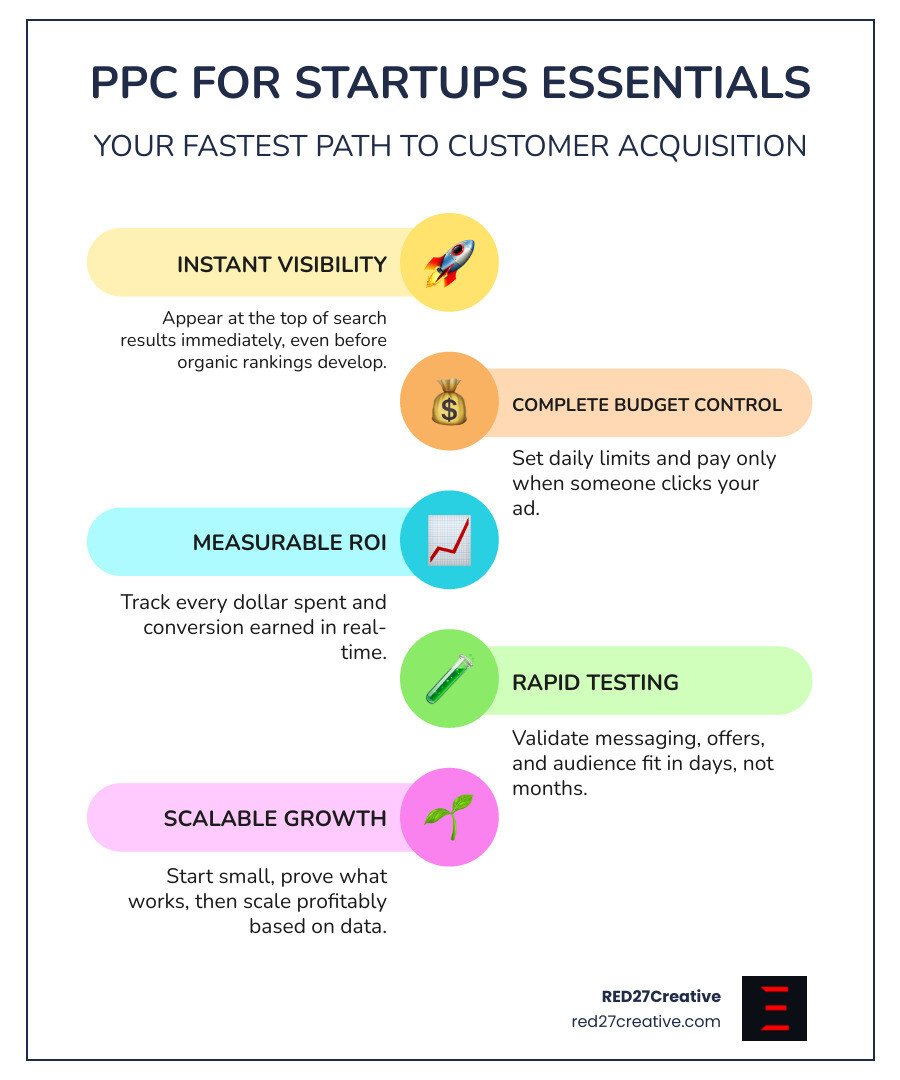
- Instant Visibility – Appear at the top of search results immediately.
- Complete Budget Control – Set daily limits and pay only when someone clicks.
- Measurable ROI – Track every dollar spent and conversion earned in real-time.
- Rapid Testing – Validate messaging, offers, and audience fit in days, not months.
- Scalable Growth – Start small, prove what works, then scale profitably.
Many startups waste money on poorly managed campaigns by skipping the fundamentals. Success comes from strategic keyword selection, relentless optimization, and treating PPC as a learning system—not just a traffic source.
With the right approach, even a modest budget can generate qualified leads, validate your market, and fuel rapid growth. PPC allows you to own key searches from day one, test messaging at scale, and out-learn competitors waiting for organic traffic.
I’m Kiel Tredrea, founder of RED27Creative. I’ve spent over 20 years helping businesses—including dozens of startups—build marketing systems that drive predictable growth. My experience with PPC for startups shows that success isn’t about big budgets; it’s about strategic execution and making every dollar count.
Basic PPC for startups glossary:
Why PPC is a Non-Negotiable Growth Engine for Startups
Launching a startup is intense, and waiting months for SEO to deliver results is a luxury most can’t afford. This is why PPC for startups is essential. It’s the difference between hoping customers find you and putting your solution directly in front of people actively searching for it right now.
PPC’s superpower is immediate visibility. While competitors wait for organic rankings, you can own the top spot on Google within 24 hours of launching a campaign, fast-tracking awareness when you need traction today.
The pay-per-click model offers complete budget control. You set daily spending limits and only pay when someone clicks your ad. For startups on tight margins, this means you can test the market without breaking the bank.
Where PPC truly shines is its measurable ROI and real-time data. Every click and conversion is tracked, so you’re not guessing if your messaging works—you’re seeing it in the numbers. We’ve helped businesses achieve a cost-per-acquisition of just $80-$95 using Google Ads, proving that strategic management delivers results even with modest budgets.
This data creates a powerful feedback loop. You can test messaging at scale, validate offers in days, and learn what works before competitors even finalize their strategy. Think of PPC as your startup’s learning engine, helping you out-learn competitors by testing and scaling what converts.
You don’t need a massive budget to start—you need a smart strategy and a commitment to optimization. That’s what lead generation services are designed for: turning modest ad spend into qualified opportunities that fuel growth. PPC for startups is about spending smarter, learning faster, and building momentum when it matters most.
The Foundational Blueprint: Setting Up Your First PPC for Startups Campaign
A strong foundation is the difference between a profitable PPC campaign and burning cash. For PPC for startups, getting the structure right from day one is critical. We align every campaign with a specific business goal, segment ad groups by keyword themes, and separate brand from non-brand campaigns to ensure control and clarity.

Define Clear Goals & Budget
Before spending a dollar, define success with SMART goals (Specific, Measurable, Achievable, Relevant, Time-bound) to clarify if you’re driving leads, sign-ups, or sales. Set a Target Cost Per Acquisition (CPA) and Target Return on Ad Spend (ROAS) based on your Customer Lifetime Value (CLV) to ensure profitability.
Start with a testing budget of $1,000 to $5,000 per month to gather data and prove ROI before scaling. The key is to start small, validate, and then scale what works. Careful Google Ads budget management makes every dollar count. For more on this, see this resource on planning PPC advertising budget.
Masterful Keyword Research on a Startup Budget
Focus on long-tail keywords—specific, less competitive queries that convert better and cost less. For example, target “cybersecurity SaaS for small businesses” instead of the broader “cybersecurity software.” Prioritize high-intent modifiers like “buy” or “pricing” to find users ready to act. Use tools like Google Keyword Planner, SEMrush, and Ahrefs for competitor analysis to find opportunities.
The Critical Role of Negative Keywords
Negative keywords are critical for avoiding the wrong clicks and saving your budget. This is a key tactic in PPC for startups. They tell platforms when not to show your ads. For example, a premium coffee seller would add “cheap” and “free” as negatives. Build lists to filter out job seekers, DIY users, and queries with no purchase intent to avoid wasting budget and improve PPC ROI optimization.
Choosing the Right Platforms & Bidding Strategy
Choosing the right platform is key. Google Ads is a powerhouse for most startups, while LinkedIn Ads offer precise targeting for B2B. Meta (Facebook and Instagram) works well for B2C, and Microsoft Ads often has lower competition.
For bidding, start with manual bidding or Improved CPC (ECPC) to maintain control while gathering data. After achieving 30-50 conversions per month, transition to automated strategies like Maximize Conversions or Target CPA. This progression is the smartest path. For our B2B PPC services, we find a blend of manual and automated strategies delivers the best results.
Crafting Campaigns That Convert: Ads, Landing Pages, and Targeting
Clicks don’t pay the bills—conversions do. For PPC for startups, a seamless journey from ad to landing page is essential. Aligning ad copy, landing pages, and targeting is what fuels growth.
Writing Compelling Ad Copy That Resonates
Great ad copy focuses on customer pain points and your solution. Instead of “We have the fastest software,” say “Stop wasting hours on manual data entry.” Use the AIDA framework (Attention, Interest, Desire, Action) for structure. A strong call-to-action (CTA), your Unique Selling Proposition (USP), and urgency are key. Testing ad variations reveals what resonates, a process detailed in our Google Ads Creation Ultimate Guide.
Optimizing Landing Pages for Maximum Conversions
A great ad is wasted on a poor landing page. Ensure strong message match between the ad and the page; if your ad promises a “Free 14-Day Trial,” the landing page headline must echo it. Landing pages need a single, focused CTA, no distracting navigation, and a mobile-first design. Pages must load in under two seconds, as speed is critical for conversions. Prominently display trust signals like testimonials and security badges. According to Unbounce), a high-converting page combines strong images, a benefit-focused headline, and a singular CTA.
Precision Targeting for Startups with Limited Budgets
With a limited budget, precision targeting is your superpower. Laser-focus on the most likely customers instead of advertising to everyone.
- Geo-targeting focuses ads on specific cities or zip codes. A local service in Geneva, IL, would only show ads in its service area.
- Audience segmentation uses in-market audiences (people actively researching products like yours) and remarketing to re-engage past visitors.
- Dayparting schedules ads for optimal times when your audience is most active.
- Device targeting lets us optimize bids based on whether mobile or desktop users convert better.
This precision ensures your budget is spent on the most relevant prospects. For our PPC for industrial companies services, this approach is essential.
Advanced Tactics and Continuous Optimization
Once your foundation is solid, continuous refinement is key. This means spending smarter, scaling what works, and cutting what doesn’t.
A/B Testing and Continuous Optimization in PPC for Startups
PPC for startups requires a continuous optimization mindset; it’s not a “set it and forget it” channel. A/B testing is crucial. Test one variable at a time across ad headlines, copy, CTAs, and landing page elements to improve conversions.
Conduct weekly data reviews to identify what drives profitable conversions. Scale winners by increasing budgets and pause underperformers to prevent waste. This iterative process is what transforms a campaign into a growth engine.
Key Metrics and Analytics to Drive PPC for Startups Decisions
Without proper conversion tracking, you’re flying blind. Set up comprehensive tracking from day one to measure every meaningful action, like form submissions or purchases. Use UTM parameters to track performance in Google Analytics for a complete view of the customer journey.
Focus on metrics that matter: Cost Per Acquisition (CPA), Return on Ad Spend (ROAS), and Customer Lifetime Value (CLV). A campaign with many clicks but no profitable conversions is a failure. Understanding CLV is crucial; if a customer is worth $5,000, spending $500 to acquire them can be highly profitable.
Integrating PPC with Your Overall Marketing Mix
Integrate PPC with your broader marketing strategy. PPC and SEO work well together, as PPC provides immediate traffic and keyword data that can inform your effective SEO strategy. Content remarketing is also powerful: show targeted ads to users who engaged with your content but didn’t convert to bring them back.
Insights from PPC can strengthen other channels. A successful ad’s value proposition can improve email, social, and website copy, making every marketing dollar work harder. This integration is exactly what we help clients achieve at RED27Creative—connecting every part of your marketing into one unified system that drives measurable results.
Common Pitfalls and How to Avoid Them
PPC for startups is powerful, but it’s also easy to get wrong. I’ve seen countless startups burn through their budgets by falling into common traps. The good news? These mistakes are avoidable.
- The “Set It and Forget It” Mentality: PPC campaigns need continuous attention—weekly reviews at a minimum. Don’t launch a campaign and check back a month later to find you’ve wasted thousands.
- Ignoring Mobile Optimization: Over half of all internet traffic is mobile. If your landing page is slow or hard to use on a phone, you’re throwing money away.
- Poor Conversion Tracking: Without accurate tracking, you’re flying blind. You can’t optimize if you don’t know which keywords, ads, or audiences are driving sales. Set up tracking from day one.
- Scaling Recklessly: Don’t double your budget overnight after a few conversions. Scale gradually—in 20-30% increments—based on proven performance to keep your Cost Per Acquisition under control.
- Focusing on Clicks Over Conversions: Clicks are a vanity metric if they don’t lead to business. Prioritize conversions and ROI over traffic volume.
- Ignoring Quality Score: Google’s Quality Score directly impacts your ad position and cost. A low score means you pay more for less visibility. Focus on ad relevance and landing page experience to keep costs down.
- Spreading Your Budget Too Thin: With limited funds, focus on your highest-performing keywords, platforms, and audiences first. It’s better to dominate a small niche than to be invisible everywhere.
Avoiding these pitfalls is key. Stay vigilant, keep optimizing, and remember that smart execution beats big budgets. When you need help, our PPC ROI optimization services can guide you toward profitable growth.
Frequently Asked Questions about PPC for Startups
Starting a PPC campaign can feel overwhelming, especially when you’re working with a tight budget and trying to make every dollar count. We’ve answered the most common questions we hear from startup founders to help you move forward with confidence.
How much should a startup spend on PPC?
The honest answer? It depends on your industry, goals, and what each customer is worth to your business over time (Customer Lifetime Value or CLV). That said, most startups find success starting with $1,000-$5,000 per month. This gives you enough budget to test different keywords, gather meaningful data, and prove ROI before scaling up. Think of it as your learning phase—small enough to minimize risk, but large enough to generate real insights. Once you identify what works, you can confidently increase your investment based on actual performance, not guesswork.
Which PPC platform is best for a B2B startup?
For B2B startups, LinkedIn Ads are often the most effective choice. The platform’s targeting capabilities are best when it comes to reaching decision-makers—you can filter by job title, company size, industry, and even seniority level. This precision makes it ideal for selling software, services, or solutions to other businesses. That said, Google Ads remains a powerhouse for capturing high-intent users who are actively searching for B2B solutions. Many successful startups use both platforms strategically: LinkedIn for building awareness and Google for capturing demand. If you’re looking for expert guidance custom to your business model, our B2B PPC services can help you choose the right mix.
How long does it take to see results from PPC?
One of the biggest advantages of PPC for startups is speed—you can start driving traffic within hours of launching your first campaign. However, seeing consistent, meaningful results like qualified leads or sales typically takes 1-3 months. This initial phase is critical for gathering data, testing messaging, and refining your targeting. PPC isn’t a “set it and forget it” channel; it’s a learning system that gets smarter over time. The faster you iterate and optimize, the faster you’ll see results that impact your bottom line. Patience during this testing phase pays off with campaigns that scale profitably.
Conclusion: Turn Your Vision into Measurable Growth
For startups, PPC for startups is more than an advertising channel. It’s an accelerator that compresses months of learning into weeks, a validation tool for your market assumptions, and a growth engine that scales with your ambitions.
While other marketing channels ask for patience, PPC delivers data-driven insights from day one. You learn what messaging resonates, which audiences convert, and your true customer acquisition cost—not in theory, but in practice.
Small budgets don’t mean small results; they demand smarter strategies. By focusing on precision targeting and continuous optimization, startups can compete effectively. The difference isn’t budget size—it’s the quality of execution.
At RED27Creative, we’ve spent over 20 years helping businesses in Geneva, Naperville, and Chicago build marketing systems that deliver predictable, profitable growth. We understand the pressures startups face and the need to prove ROI quickly.
We’re here to help you steer paid advertising, build campaigns that convert, and transform your vision into measurable success.
Ready to turn your startup’s potential into proven performance? Get expert Google Ads Management Services with RED27Creative and start building your growth engine today.

Kiel Tredrea
https://red27creative.comTop Marketing Agency • Web, SEO & Leads • RED27Creative