A Comprehensive Guide to Sales Funnel & Conversion Optimization
Why Sales Funnel & Conversion Optimization Is the Key to Measurable Growth
Sales Funnel & Conversion Optimization is the process of guiding potential customers through their buying journey, from awareness to purchase, while improving each step to maximize conversions.
Quick Overview:
- Sales Funnel = The path prospects take from learning about your brand to becoming customers
- Conversion Optimization = Testing and refining each step to reduce drop-offs and increase results
- Core Stages = Awareness -> Interest -> Desire -> Action (AIDA model)
- Key Benefits = Higher conversion rates, lower acquisition costs, better ROI, and predictable revenue growth
- Essential Tactics = Audience research, persuasive content, landing page optimization, A/B testing, analytics tracking, and retargeting
Many businesses drive traffic but fail to convert it. The issue isn’t visitor volume; it’s the post-arrival experience. An unoptimized funnel is like a leaky bucket—no matter how much you pour in, you won’t get the desired results.
Today’s buyers are informed and impatient. They research independently and expect instant answers. With buyers controlling most of their journey, sales teams get only about 17% of their time. Your digital touchpoints—website, content, and ads—must build trust and guide prospects toward a decision without direct interaction.
This is where Sales Funnel & Conversion Optimization is essential. It’s not about guesswork; it’s about understanding where prospects drop off and systematically removing friction. Proper optimization turns marketing into a predictable growth engine, converting visitors into leads, customers, and advocates.
Winning businesses don’t just have big budgets; they optimize every funnel stage to deliver value and build trust. They test, measure, and refine relentlessly, understanding that optimization isn’t a one-time project—it’s a continuous discipline that compounds over time.
I’m Kiel Tredrea, founder of RED27Creative. For over 20 years, I’ve helped businesses build integrated marketing systems connecting SEO, web design, and lead generation. My team uses advanced Sales Funnel & Conversion Optimization to help clients improve conversion rates and generate qualified leads for measurable growth.
Understanding the Funnel: Sales, Marketing, and Conversion
A sales funnel visualizes the customer journey, from initial awareness to the final purchase. It’s a framework for guiding potential customers, converting their interest into sales. Optimizing this funnel ensures every marketing dollar drives results, a strategy businesses of all sizes use to turn interest into revenue.
While the buyer’s journey covers every brand interaction, the conversion funnel focuses on the specific steps leading to a single goal, like a purchase or sign-up. It’s a targeted path designed for maximum efficiency.
The Classic Sales Funnel Stages
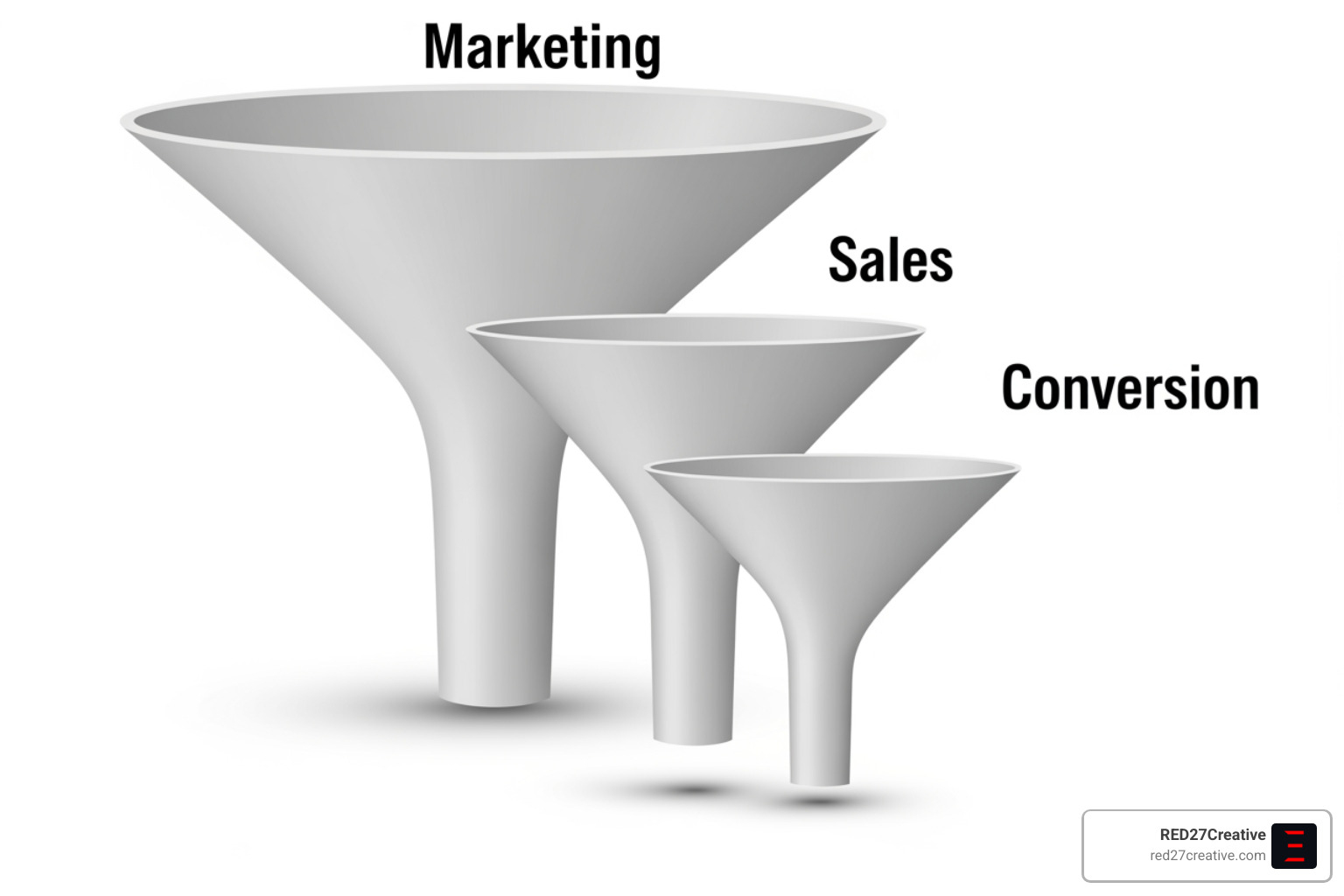
The traditional sales funnel, often mapped using the AIDA model (Awareness, Interest, Desire, Action), outlines how buyers move from initial contact to final purchase.
- Awareness (TOFU – Top of Funnel): Prospects first find your brand. The goal is to capture attention with broad-reaching content, like educational articles or videos, that introduces your solutions and sparks curiosity.
- Interest (MOFU – Middle of Funnel): Prospects research and compare solutions. The goal is to nurture their interest with in-depth content like guides, webinars, or case studies. Since nearly all buyers prefer self-service research, providing valuable resources is key.
- Desire (MOFU – Middle of Funnel): Prospects move from interest to want. They envision using your product. At this stage, we build trust and highlight unique benefits to differentiate our offerings and solidify their desire.
- Action (BOFU – Bottom of Funnel): The final step where leads become customers. The goal is to make conversion seamless by simplifying the purchase process and creating a clear, compelling call to action.
Throughout these stages, building trust with high-quality content is essential for nurturing leads. By creating urgency where appropriate, we help prospects overcome hesitation and move forward. Learn more about our lead generation approach.
Sales Funnel vs. Marketing Funnel vs. Conversion Funnel
While related, these terms have distinct meanings:
| Feature | Sales Funnel | Marketing Funnel | Conversion Funnel |
|---|---|---|---|
| Goal | Guide prospects to a purchase | Generate awareness, engage, and nurture leads | Guide users to complete any desired action (e.g., signup, download, purchase) |
| Scope | Focused on the sales process, from qualified lead to customer | Broad, encompassing the entire customer journey from first touch to post-purchase | Specific path users take toward a single, defined conversion event |
| Example Actions | Demo request, trial sign-up, sales call, purchase | Blog post views, social media engagement, email sign-ups, content downloads | Newsletter subscription, ebook download, free trial sign-up, contact form submission, purchase |
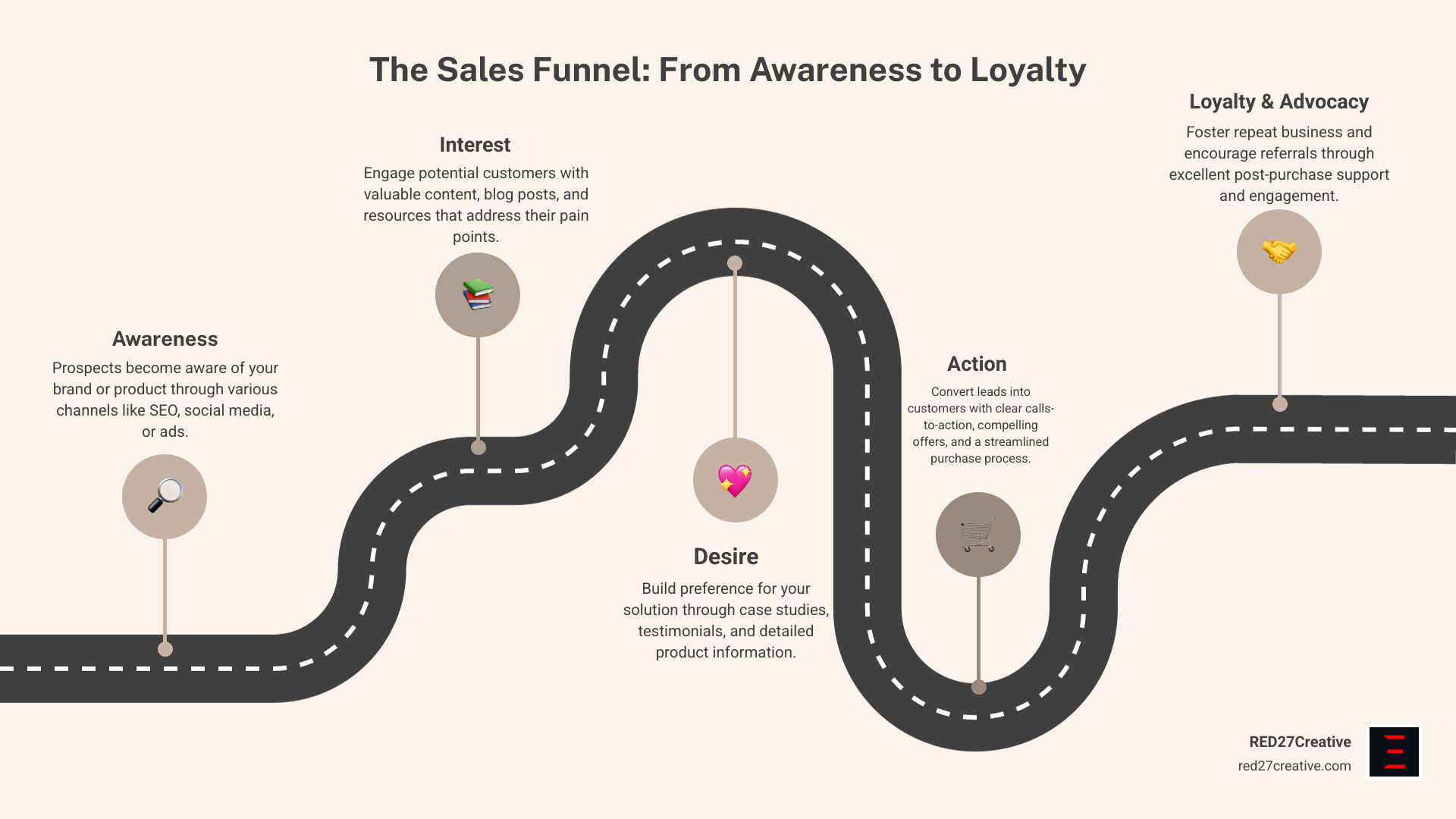
Think of these funnels like nesting dolls. The broad marketing funnel generates awareness and engagement. The sales funnel sits within it, guiding interested prospects to a purchase. A conversion funnel is even more specific, focusing on any single action, like a download or sign-up. A complete marketing strategy often incorporates both sales and conversion funnels.
Core Strategies for Sales Funnel & Conversion Optimization
Effective Sales Funnel & Conversion Optimization is about creating a seamless, holistic experience for your audience. At RED27Creative, we build these frictionless paths to drive measurable results for businesses in the Chicago area, including Geneva, St. Charles, and Naperville.
Defining Your Audience and Crafting Your Message
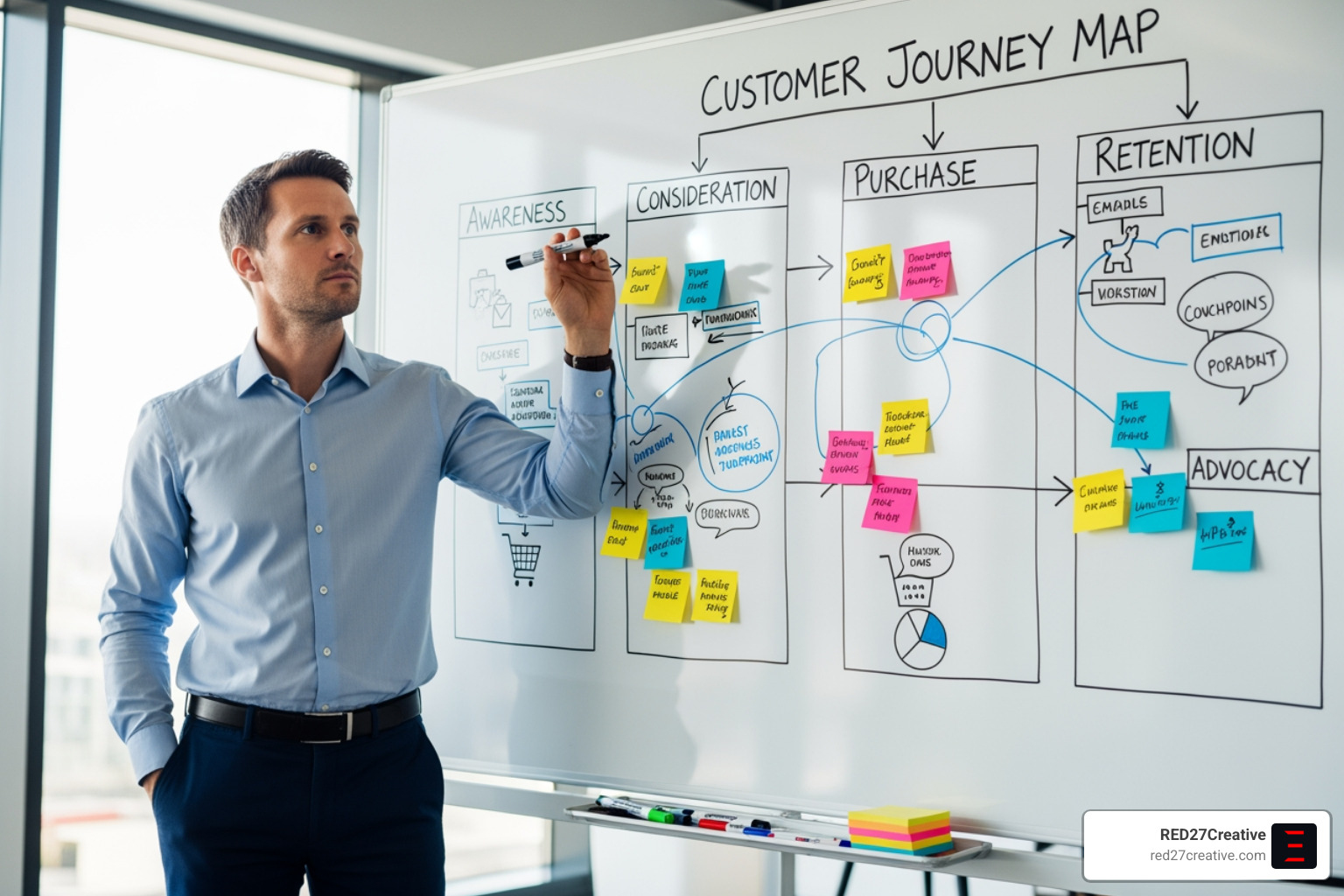
Success starts with defining your target audience through detailed buyer personas that outline their pain points and goals. Pouring unqualified leads into your funnel guarantees leaks. Once you know your audience, you can craft personalized, high-quality content that resonates. With 75% of buyers preferring personalized experiences, this step is non-negotiable. This strategic approach is central to Our B2B marketing strategies.
Building a High-Converting Path
Your landing page is a critical first touchpoint. It must have a clear value proposition, an appealing design, and zero distractions to keep users focused on the goal. A clear, compelling call to action (CTA) then guides users to the next step. We test CTA wording, design, and placement to maximize clicks and conversions.
A complex sales process causes frustration and abandonment. Simplifying everything from sign-up forms to checkout removes friction and dramatically improves conversion rates. With more B2B buyers researching on their phones, a mobile-first design is essential. If your site is not optimized for mobile, you are losing leads. The experience must be seamless on every device, which is why a great website matters for conversion.
Building Trust and Re-engaging Leads
Trust is critical for conversions. Social proof like testimonials, reviews, and case studies is powerful, as are trust seals like a Better Business Bureau logo or a VeriSign security badge. These signals reassure customers that their purchase is safe and wise.
Most leads don’t convert on their first visit; in fact, 80% of sales require at least five follow-ups. Retargeting and remarketing campaigns re-engage interested prospects, keeping your brand top-of-mind and bringing them back to the funnel.
Automated lead scoring and nurturing optimize efficiency. Scoring prioritizes high-potential leads so sales teams can focus their efforts. Automated email sequences then deliver relevant content at the right time, guiding prospects through the funnel without manual intervention. This is truly the game-changer in B2B lead generation.
The Science of Improvement: Analytics, Testing, and Refinement
Sales Funnel & Conversion Optimization is a science, not guesswork. It relies on data-driven decisions, continuous testing, and refinement to adapt to changing market dynamics. Funnels are not static; what works today may not work tomorrow.
Our approach at RED27Creative is built on data. We believe in the competitive edge of data-driven marketing, using insights to inform every decision we make for our clients.
Measuring What Matters: Funnel Analytics and Key Metrics
Analytics platforms provide a clear view of the customer journey, helping you map your funnel and see where users drop off. Key metrics to track include:
- Conversion Rate: The percentage of visitors who complete a desired action. This fundamental metric measures the effectiveness of your funnel.
- Cost Per Acquisition (CPA): The total cost to acquire a new customer. This helps measure marketing spend efficiency.
- Customer Lifetime Value (LTV): The total revenue a customer generates over their lifetime. A healthy LTV to CPA ratio is typically 3:1 or higher.
- Click-Through Rate (CTR): The percentage of people who click a link, such as in an email or ad, indicating interest.
- Engagement Rate: How users interact with your content. High engagement indicates strong interest and a well-functioning funnel.
- Average Order Value (AOV): The average amount spent per order. This metric helps identify opportunities for upselling and cross-selling.
- Bounce Rate: The percentage of visitors who leave after viewing only one page. A high bounce rate can indicate a mismatch between user expectation and page content.
- Exit Rate: The percentage of visitors who leave your site from a particular page. This helps identify weak pages in your funnel.
To track these effectively, your first step is to set up a goal in Google Analytics. The data you collect will reveal where users are abandoning your conversion funnel.
A Deep Dive into Conversion Funnel Analysis
Conversion funnel analysis pinpoints where users drop off. By mapping the customer journey and tracking conversion events, we identify these leaks. Tools like Hotjar and Microsoft Clarity provide heatmaps and session recordings to show how users interact with your site. We then segment users by criteria like traffic source or behavior to understand different paths. This data is visualized to turn insights into actionable improvements.
The Power of Testing for Sales Funnel & Conversion Optimization
A/B testing is essential for data-driven optimization. It involves comparing two versions of a page element—like a headline or CTA—to see which performs better. When you A/B test, you are trying to improve how a page encourages customers to take action.
For deeper insights, we combine A/B testing with usability testing, where we observe real users interacting with your site. This qualitative feedback helps us understand why users struggle, informing our A/B test hypotheses. Continuous testing is crucial, as optimization is an ongoing process, not a one-time project.
Advanced Tactics for a Modern Buyer’s Journey
Today’s buyers control their journey. They conduct their own research and expect self-service tools and instant answers. In fact, responding to a lead in the first minute can boost conversions by nearly 400%. This new reality demands advanced tactics focused on speed, personalization, and interactive experiences, which we implement for clients across the Chicago area. Learn how we help Improve Sales Demos: Strategies for Success.
Optimizing Key Touchpoints for Maximum Conversion
Landing page messaging must match the ad or link that brought the user there. This “message match” aligns user expectations with your content. Headlines, copy, and visuals should be consistent. While detailed, longer pages often convert better, clarity and relevance are paramount.
Simplify sign-up forms to reduce friction. While fewer fields can increase initial sign-ups, sometimes collecting more information can improve lead quality. We test to find the right balance for your goals.
Trust elements are vital for conversion. Guarantees, customer reviews, and security seals like VeriSign reassure users that their information is safe. A lack of these signals can significantly harm conversion rates.
In email marketing, subject lines are critical. We A/B test subject lines, copy, CTAs, and formatting to optimize performance. Beyond open rates, we track click-through and conversion rates to measure true impact.
Enhancing the Buyer’s Journey with Interactive Content
Modern buyers want to experience a product, not just hear about it. Interactive demos and product tours allow them to explore solutions at their own pace. This self-service approach is crucial, as sales reps only get about 17% of a buyer’s time.
By letting prospects experience your product’s value firsthand, they become product-qualified leads who are far more likely to convert. This builds buyer confidence, reduces perceived risk, and accelerates the journey through the desire and action stages of the funnel.
Frequently Asked Questions about Sales Funnel & Conversion Optimization
What is the main difference between a sales funnel and a marketing funnel?
A marketing funnel has a broad scope, covering the entire customer journey from initial awareness to post-purchase loyalty. A sales funnel is more focused, specifically guiding prospects who have shown interest toward making a purchase. The sales funnel is often considered a subset of the larger marketing funnel.
What is the most important stage to optimize in a sales funnel?
While every stage is important, the “Interest” and “Desire” stages (Middle of the Funnel) often offer the greatest optimization opportunities. This is where you build trust, educate prospects, and differentiate your solution. Improving engagement here directly impacts the number of qualified leads that reach the final purchase decision.
How do I know where my funnel is leaking?
You can identify leaks by using analytics tools like Google Analytics to visualize your conversion path. High drop-off rates between specific stages are clear indicators of a leak. User behavior tools like heatmaps and session recordings can then show you why users are leaving at that point.
Conclusion: Build a Funnel That Drives Real Growth
Sales Funnel & Conversion Optimization is an ongoing process of understanding, testing, and refining. A strong funnel helps you educate buyers, qualify leads, and close deals faster, turning traffic into measurable revenue. By focusing on the buyer’s journey and making data-driven decisions, you build a system for sustainable growth.
At RED27Creative, we specialize in creating these integrated marketing systems for businesses in Geneva, St. Charles, Naperville, and the greater Chicago area. Our experienced team builds data-driven strategies that connect your website, SEO, and lead generation into a unified growth engine.
Ready to turn your marketing into a predictable source of revenue? Develop your marketing strategy with us.

Kiel Tredrea
https://red27creative.comTop Marketing Agency • Web, SEO & Leads • RED27Creative