How to Master SEO for Your Food Manufacturing Company

What is SEO for Food Manufacturing Companies? (Quick Answer)
SEO for food manufacturing companies is the process of improving your website’s visibility in Google so that your products, services, and brand appear when potential B2B and B2C buyers search online. It delivers qualified leads, boosts brand authority, and increases sales by making sure your company is found first.
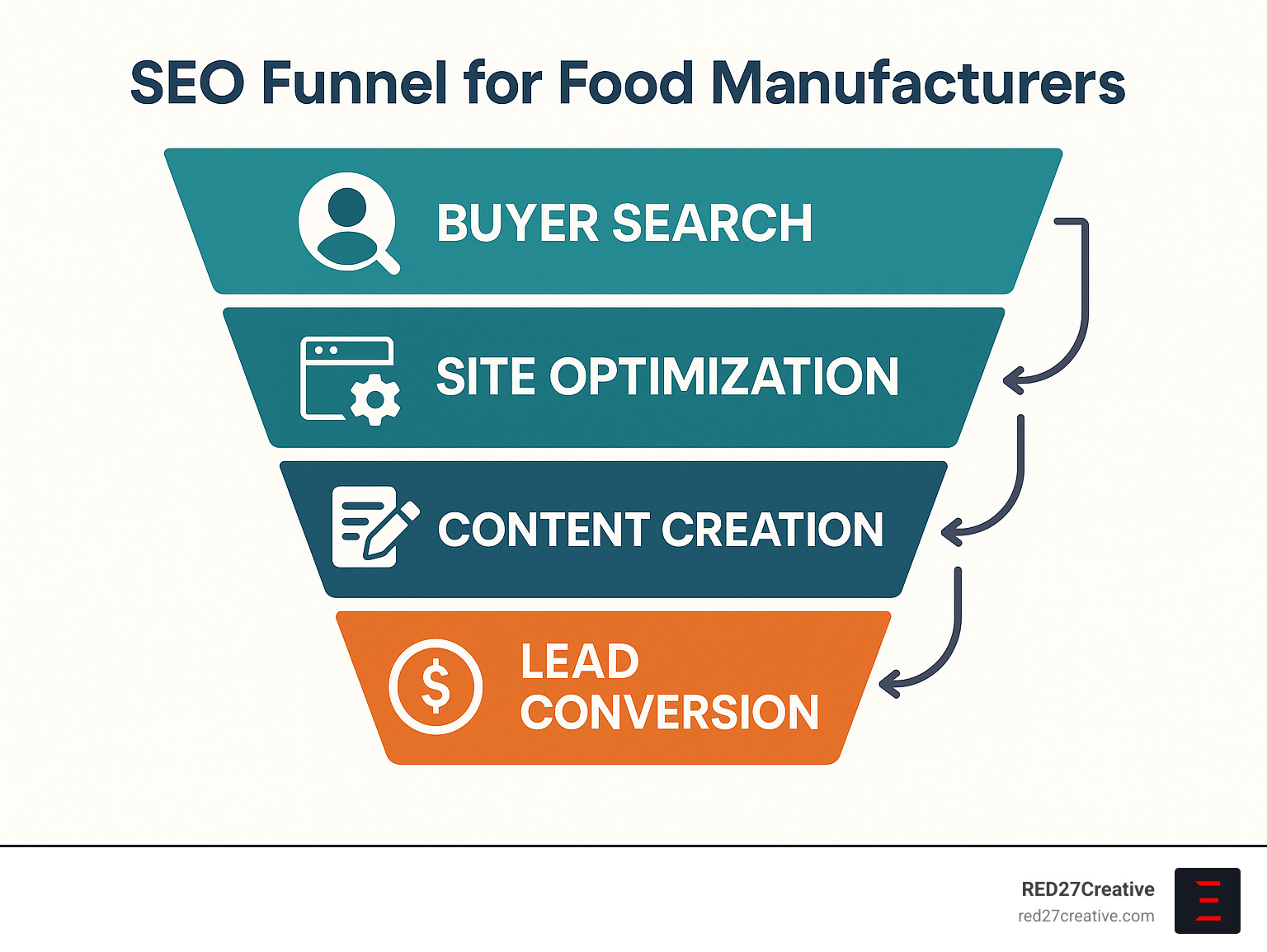
Here’s what mastering SEO for food manufacturing companies involves:
| Step | What It Means | Quick Win |
|---|---|---|
| 1. Keyword Research | Find exactly what your target buyers are searching for | Rank for industry, product, and local terms |
| 2. Technical SEO | Fix site speed, mobile use, and structured data | Faster site = higher rankings |
| 3. Content Marketing | Create valuable resources and product guides | Attract and nurture leads |
| 4. Local/Global SEO | Optimize for Google Maps and export markets | Dominate local + international results |
| 5. Authority Building | Get reviews and links from industry sources | Build trust and top search positions |
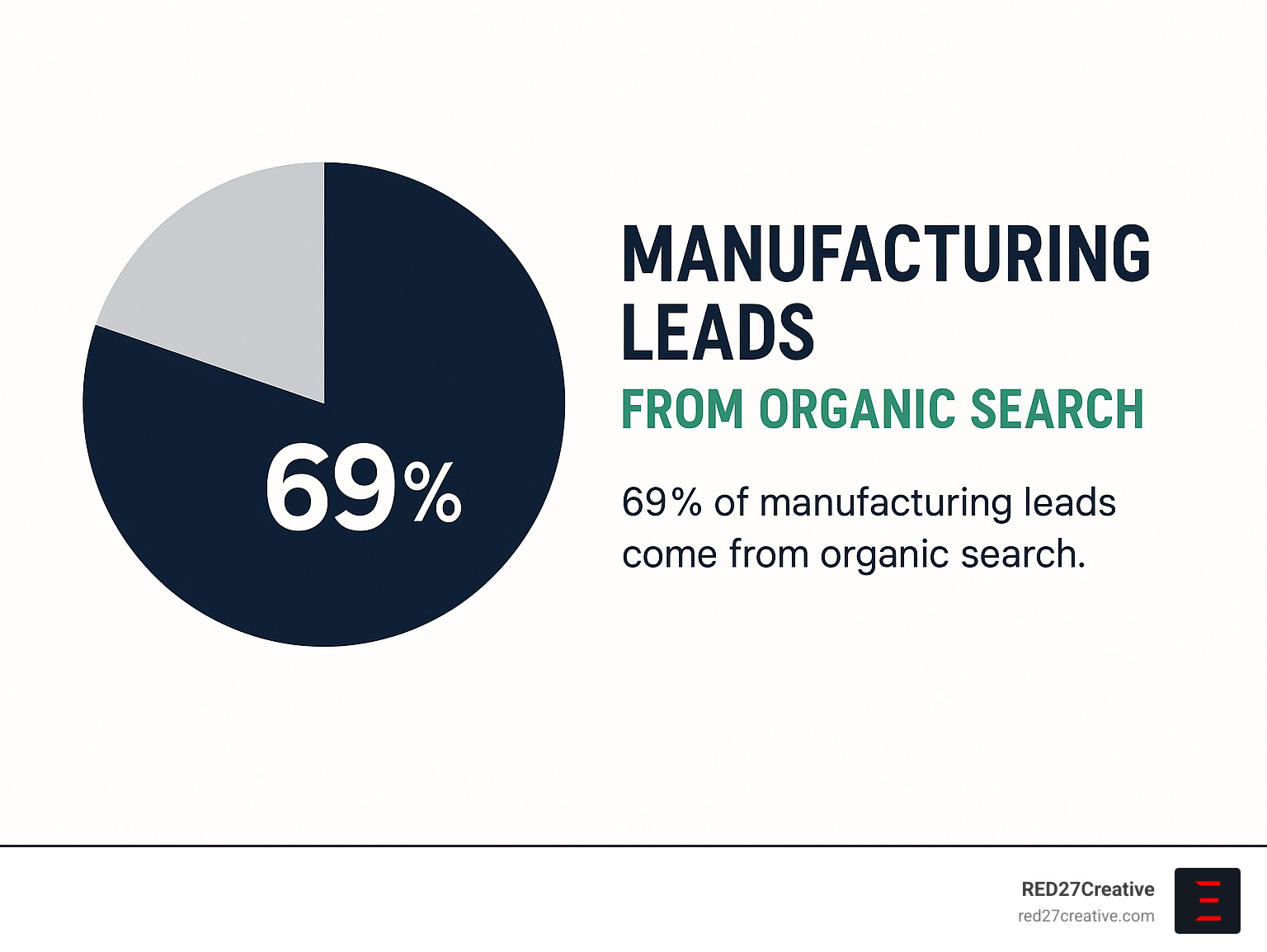
Why does this matter? Organic search now delivers about 69% of all leads for manufacturers, and 75% of buyers never look beyond page 1 of Google. If you aren’t visible, your competitors are winning your customers.
If you’re looking to learn seo for food manufacturing companies so you can drive more leads, boost online visibility, and grow your business, you’re in the right place. This article will give you a step-by-step roadmap for practical SEO—no jargon, just clear guidance grounded in proven results.
“Search engine optimization (SEO) is a great way to draw in valuable traffic and new leads for your food products company.”
— WebFX
My name is Kiel Tredrea. With over 20 years’ experience in SEO, web strategy, and digital marketing for B2B and food manufacturing brands, I’ve helped companies just like yours turn their sites into lead engines and authority builders using data-driven, industry-specific SEO for food manufacturing companies.
Seo for food manufacturing companies terms simplified:
– advantages of search engine optimization
– aftermarket manufacturer seo
– manufacturing seo agency
What You’ll Learn
Ready to transform your food manufacturing company’s online presence? You’re about to start on a journey that will revolutionize how your potential customers find you. This comprehensive guide to seo for food manufacturing companies isn’t just theory—it’s a practical roadmap built from years of real-world success.
Here’s what we’ll cover together:
First, we’ll explore why SEO isn’t just another marketing buzzword but a genuine game-changer for food manufacturers looking to grow their customer base and revenue. The numbers don’t lie, and you’ll see exactly how powerful organic search can be for your business.
Next, we’ll tackle those unique challenges that keep food manufacturing marketers up at night—regulatory compliance, seasonal products, allergen claims, and the balancing act between B2B and B2C audiences. These aren’t just obstacles; they’re opportunities to outshine your competition.
The heart of our guide is a proven, 5-step SEO playbook that delivers both quick wins (think ranking improvements in weeks) and sustainable growth that builds your brand authority for years to come. We’ve refined this approach working with food manufacturers just like yours.
Throughout, you’ll find real-world case studies and concrete examples that show these strategies in action—no vague promises, just practical applications you can implement starting today.
And because every food manufacturer has unique questions, we’ll wrap up with answers to the most common SEO concerns we hear from production floor to C-suite.
Whether your production facilities are humming away in Geneva, Batavia, Aurora, St. Charles, Plainfield, Oswego, Naperville, Chicago, or beyond Illinois’s borders, this guide is custom to help manufacturers like you connect with the customers actively searching for your products right now.
Let’s roll up our sleeves and get cooking with seo for food manufacturing companies that actually delivers results.
Why SEO Matters for Food Manufacturing
The food manufacturing world is changing fast, and your online presence needs to keep up. But why exactly should you invest in SEO for food manufacturing companies when you’re already juggling production schedules, compliance, and supply chain challenges?
SEO Delivers Leads, Revenue, and Brand Authority
Let’s talk real numbers that matter to your bottom line. 69% of leads for manufacturers now come from organic search—not paid ads, not trade shows, and not cold calls. That’s a massive shift in how business happens in our industry.
What’s even more telling is that 57% of B2B marketers report that SEO brings in more qualified leads than any other marketing approach they’ve tried. For food and beverage manufacturers specifically, a well-executed SEO strategy can generate an average of $1M in new net revenue per year. That’s not just impressive—it’s transformative for your business.
“81% of B2B buyers start their purchase process with a web search.”
— Industry Study
The Buyer Journey Has Moved Online
Think about your most valuable potential partners and customers. They’re all searching online before they ever contact you:
Distributors are researching potential private label manufacturing partners while sitting at their desks. Retailers are comparing product lines and ingredients before trade shows even begin. Food service operators are vetting suppliers based on online reviews and website information. Even end-consumers are digging deeper into where their food comes from before making purchasing decisions.
The hard truth? 75% of users never click past the first page of Google results. If your competitors are showing up there and you’re not, those valuable leads are walking straight through their door instead of yours.
This shift isn’t temporary—it’s the new normal in how business decisions are made. Scientific research on buyer search confirms that both B2B and B2C purchasing journeys now begin online, with search engines serving as the primary gateway to findy.
For food manufacturers, this means your digital visibility directly impacts your revenue potential. Whether you’re producing ingredients for other manufacturers, private label products for retailers, or branded goods for consumers, being findable online is no longer optional—your continued growth and success.
At RED27Creative, we’ve seen how food manufacturers who accept SEO for food manufacturing companies consistently outperform those who rely solely on traditional marketing channels. The digital landscape offers unprecedented opportunities to connect with exactly the right buyers at precisely the moment they’re looking for what you offer.
Overcoming Industry-Specific SEO Challenges
Let’s face it – food manufacturing isn’t your typical industry when it comes to SEO. While other businesses might worry about basic keyword placement, you’re juggling regulations, seasonal products, and multiple audience types simultaneously.
Food manufacturers face unique challenges that require specialized SEO approaches. Having worked with dozens of food producers, we’ve seen these obstacles and developed strategies to overcome them.
Regulatory compliance is perhaps your biggest headache. Every word on your website needs to adhere to FDA guidelines, allergen warnings, and nutritional claim regulations. One misstep could mean legal trouble, yet your content still needs to be engaging and SEO-friendly.
Multiple SKUs create another layer of complexity. When you’re manufacturing dozens or even hundreds of product variants, you’re at risk of creating what Google sees as duplicate content. One client came to us after realizing their site had 40+ pages with nearly identical text for different pack sizes. Their rankings had plummeted as a result. By consolidating pages and implementing proper structured data, we helped them recover their visibility within weeks.
Shelf life and seasonality affect both your business operations and your search traffic patterns. Holiday-specific products might see massive search spikes followed by months of quiet. A smart SEO strategy accounts for these fluctuations and capitalizes on peak periods while maintaining baseline visibility year-round.
Allergen and health claims require extreme precision. Your website must be transparent about ingredients while highlighting benefits in a compliant way. This balance between marketing appeal and regulatory accuracy is delicate but essential.
Factory locations matter more than you might think. Today’s buyers often search with geographic intent, looking for manufacturers in specific regions or states. Without proper local SEO, you’ll miss these opportunities.
Perhaps most challenging is balancing B2B vs. B2C audiences. The same keyword can have entirely different intent depending on who’s searching. “Organic tomato sauce” might mean bulk purchasing for a restaurant chain or a single jar for a home cook.
And don’t forget about voice search, which continues to grow in popularity. Questions like “Who supplies gluten-free pizza dough near me?” require different optimization strategies than traditional text searches.
| Challenge | B2B Pain Points | B2C Pain Points |
|---|---|---|
| Regulatory compliance | Product specs, labeling, certifications | Health claims, nutrition info |
| Multiple SKUs | Product data management | Shopping experience |
| Duplicate content | Similar product lines, variations | Category pages |
| Shelf life/seasonality | Demand planning, logistics | Holiday promotions |
| Location targeting | Distribution hubs, export markets | “Near me” searches |
| Audience intent | Bulk pricing, distributor info | Recipes, single purchase |
The good news? These challenges also create opportunities to differentiate your brand. When you properly address these industry-specific obstacles, you create distance between yourself and competitors who are still using generic SEO approaches.
At RED27Creative, we’ve developed specialized seo for food manufacturing companies that turns these challenges into competitive advantages. By understanding the unique landscape of food manufacturing, we help our clients create SEO strategies that speak to both compliance requirements and customer needs simultaneously.
Mastering SEO for Food Manufacturing Companies: 5-Step Playbook
Ready for the good stuff? Here’s our proven process for seo for food manufacturing companies—the same one that’s helped our clients see up to a 136% increase in online sales. Think of this as your roadmap to digital visibility that actually delivers results.
Step 1: Keyword Research for SEO for Food Manufacturing Companies
“Which keyword is better: ‘organic strawberries’ or ‘organic strawberries in Harrisburg, PA’? The latter, because it targets a select market with clearer purchase intent.”
— Industry Case Example
Getting your keyword strategy right is like finding the perfect recipe—it needs the right ingredients to work. Start by thinking like your buyers. Are they searching for bulk organic spices, private label snack manufacturer, or maybe vegan protein powder Chicago?
The magic often happens with long-tail keywords—those longer, more specific phrases that might have less search volume but bring in visitors who know exactly what they want. For example, “wholesale gluten-free bread supplier Illinois” might only get 30 searches a month, but those 30 people are likely serious buyers, not just browsers.
Don’t forget to include both B2B and B2C intent in your strategy. A school district purchasing manager searches differently (“case of nut-free cookies for schools”) than a parent (“nut-free cookies delivery”). Tools like keywordtool.io can help you spot what your competitors might be missing, including export and regulatory-focused queries.

Quick Win:
Identify 5–10 high-intent, low-competition keywords for each product line and use them to structure your product pages, category descriptions, and blog posts. This simple step can boost your visibility within weeks.
For more insights on content strategy, check out our guide to Content Marketing for Manufacturers.
Step 2: Technical SEO Essentials
Technical SEO is like the foundation of your factory: If it’s weak, nothing else matters. You can have the most delicious products in the world, but if your website loads like molasses or confuses Google, customers won’t find you.
Let’s start with site speed—82% of B2B sites load in under 5 seconds, and there’s a good reason for that. Every second of delay can reduce conversions by 7%. Test how your site measures up with Page Speed Insights.
Your site also needs to shine on mobile devices. With mobile-first indexing, Google now ranks your site based primarily on how it performs on phones, not desktops. This isn’t optional anymore—it’s essential.
Another game-changer is structured data and schema markup. This special code helps search engines understand your content better, potentially giving you those eye-catching rich results in search—think star ratings, price information, and nutritional facts right in the search results.
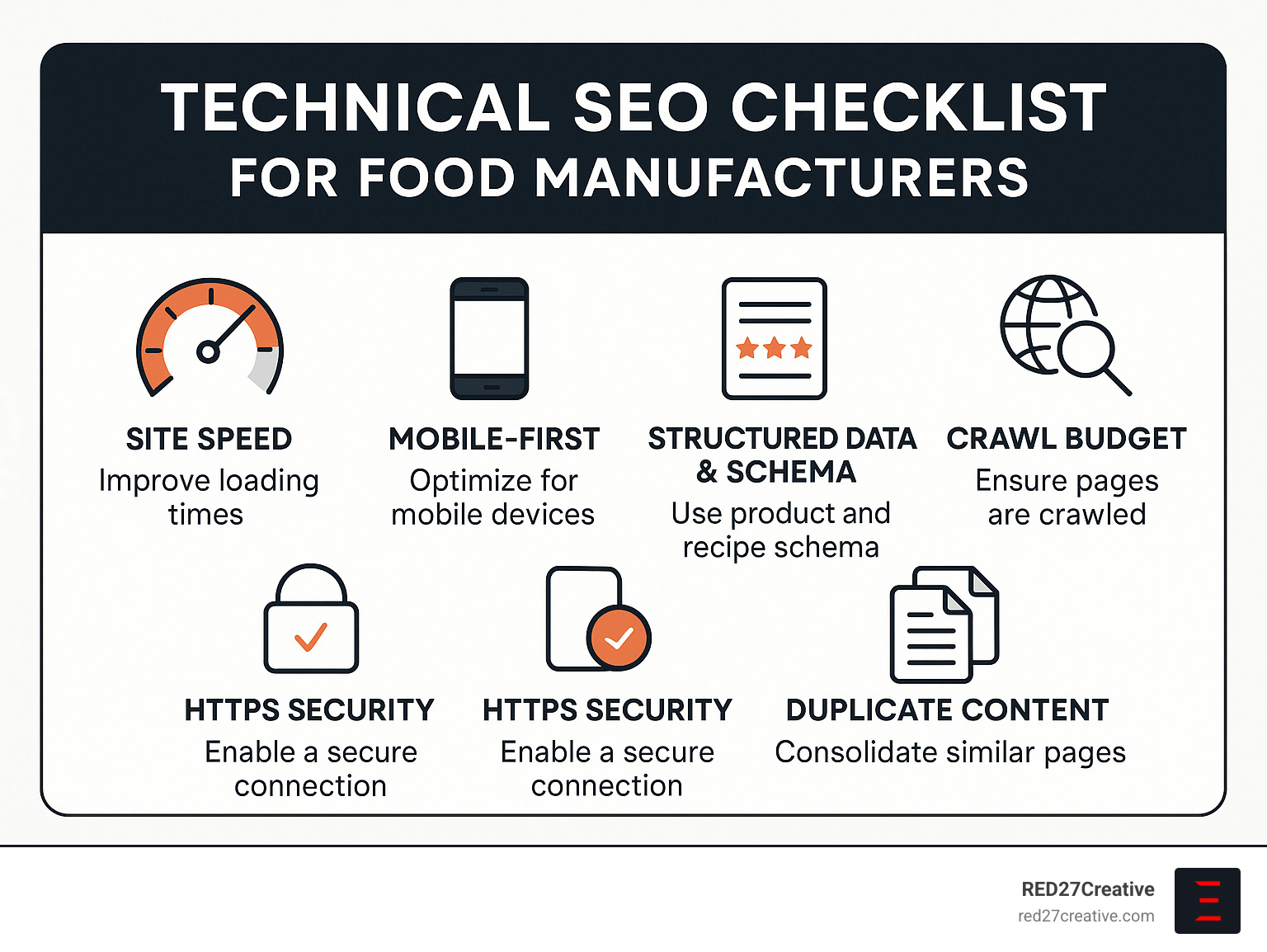
Don’t overlook your crawl budget—making sure search engines can easily access all your important pages. And remember that HTTPS security isn’t just about protection; secure sites rank higher and build trust with visitors.
Finally, tackle that duplicate content issue that plagues so many food manufacturers with multiple product variations. Consolidate similar pages, use canonical tags, and ensure each SKU has unique, valuable content.
Pro Tip:
One of our manufacturing clients who prioritized site speed and mobile design saw a 59% boost in engagement and a 136% increase in e-commerce sales within a year. Sometimes the technical stuff really does move the needle!
Step 3: Content Marketing That Powers SEO for Food Manufacturing Companies
Content is the heart and soul of effective seo for food manufacturing companies. It’s what connects you with your audience and proves to Google that you’re an authority worth ranking.
For food manufacturers, creating the right content means understanding both your B2B and B2C buyers. Recipes and usage blogs like “10 Ways to Use Our Plant-Based Sausage” serve double duty—they help home cooks while also giving foodservice professionals ideas.
Compliance whitepapers might sound boring, but they’re gold for B2B buyers who need to verify your certifications, traceability, and safety standards. Similarly, case studies that show real results (like how a school district switched to your allergen-free snacks and saw fewer sick days) build trust like nothing else.

Don’t underestimate the power of video demos either. A behind-the-scenes tour of your facility or a “how it’s made” series can be incredibly engaging. One of our clients saw their time-on-site double after adding production videos—people are fascinated by food manufacturing!
For maximum impact, organize your content in a “hub and spoke” model. Your hubs are comprehensive pillar pages (like “Wholesale Organic Ingredients Guide”), while your spokes are related blogs, recipes, and FAQs that link back to the hub. This structure tells Google your site has depth and authority on specific topics.
Remember to use internal linking strategically—connect your blogs to relevant product pages and vice versa. This keeps users on your site longer (the industry average for food sites is 2:41) and signals authority to search engines.
Want to generate more qualified leads? Explore our guide to Lead Generation for Manufacturing Companies.
Step 4: Local & International SEO
Whether your company delivers to restaurants within a 50-mile radius or ships containers to distributors worldwide, location-based SEO matters enormously.
For local visibility, your Google Business Profile is absolutely critical. Claim it, optimize it, add high-quality photos of your facility and products, and make sure your business hours are accurate. This simple step can put you on the map—literally—when local buyers search.
NAP consistency might sound like technical jargon, but it’s just making sure your Name, Address, and Phone number are identical across all online directories. This consistency builds trust with search engines and helps your local rankings.
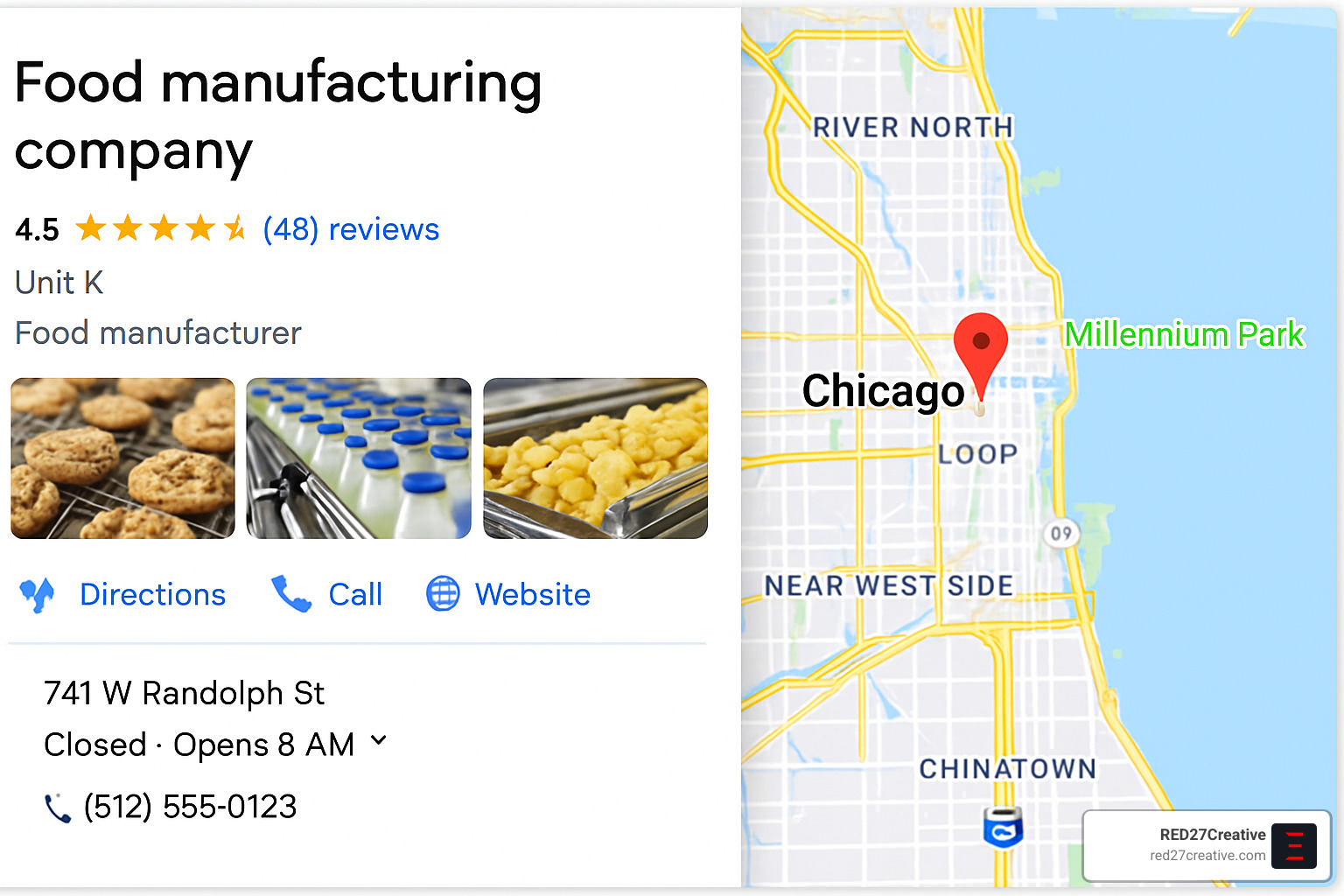
If you’re selling internationally, consider creating multilingual pages for your target markets. Even translating just your core product pages can make a huge difference. Include terms like “export,” “bulk,” or “international shipping” to attract the right buyers, and create specific pages targeting major logistics locations.
Don’t forget about online reviews—they influence both rankings and conversions. Make it a habit to respond thoughtfully to both positive and negative reviews. This shows potential customers that you’re engaged and care about their experience.
One of our Chicago-based clients saw a 43% increase in local search traffic within just 3 months after optimizing their Google Business Profile and adding a store locator map to their website. Sometimes the simplest changes yield the biggest results!
Step 5: Link Building, Reviews & Performance Measurement
In SEO, authority is earned, not bought. Google rewards food manufacturers who are trusted by others in their industry and by customers.
Building this authority starts with digital PR—getting your company mentioned in industry news, partnering with food bloggers, or supplying products to influencer chefs who can create content featuring your ingredients. Each mention that includes a link back to your site is a vote of confidence in Google’s eyes.
Don’t overlook your existing business relationships as link sources. Ask your suppliers, distributors, and partners to link to your site from their “Our Suppliers” or “Preferred Vendors” pages. These relevant industry links carry significant weight.
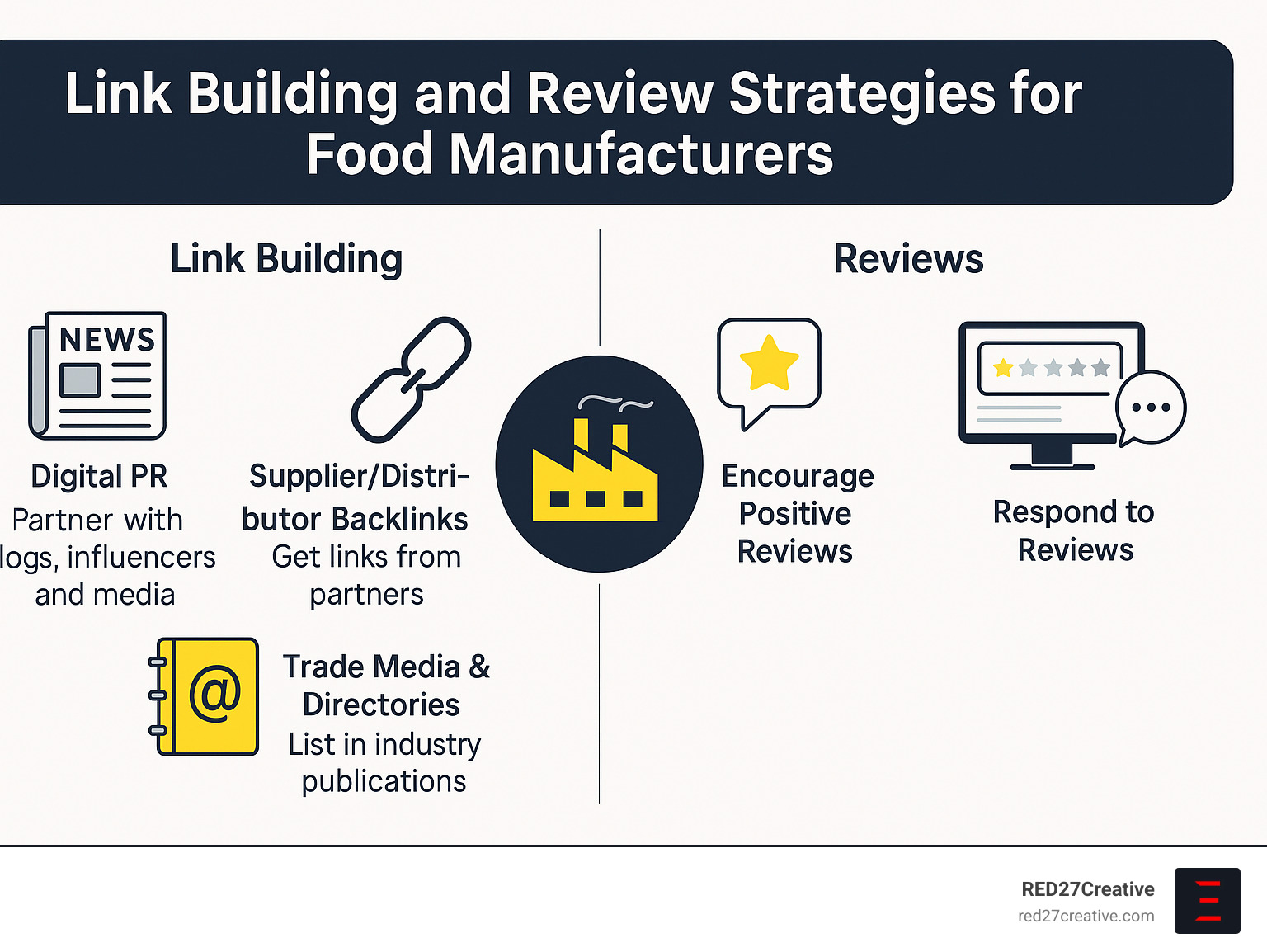
Online reviews deserve special attention. They not only influence your rankings but also directly impact whether a potential customer decides to contact you. Make it a regular practice to request reviews from satisfied clients, and consider implementing a simple follow-up system to make this happen consistently.
Of course, all this work needs to be measured. Use GA4 dashboards to track your organic traffic, keyword rankings, lead form submissions, and user engagement. Without measurement, you’re just guessing at what works.
Most food manufacturers see early SEO impact within 1–2 months (usually more impressions and clicks in Search Console), with full results developing over 4–12 months depending on your competition and site history. SEO is a marathon, not a sprint—but the sustainable results are worth the patience.
For inspiration, check out the success story of Maine Lobster Now. They combined strategic content, technical SEO improvements, and consistent link-building to achieve industry-leading rankings and impressive sales growth.
Frequently Asked Questions about Food Manufacturing SEO
How long before SEO delivers results?
The million-dollar question! Most food manufacturers start seeing the first signs of SEO success within just 1-2 months – those early indicators like improved rankings and increasing traffic numbers. But the really meaningful results – the leads that turn into sales – typically take 4-12 months to fully materialize.
Think of SEO like planting an orchard. You’ll see sprouts fairly quickly, but harvesting the fruit takes patience. Your timeline depends on three main factors: where your site stands today, how fierce your competition is, and how thoroughly you implement the strategies we’ve covered.
One of our clients in the specialty ingredients space saw their organic traffic climb 23% within just six weeks after implementing technical fixes – but their lead conversion rate took about five months to double. Every manufacturer’s journey is unique.
How do we balance FDA compliance with persuasive copy?
This is where so many food manufacturers get stuck! The secret is to make compliance part of your value proposition, not a roadblock to good marketing.
Always lead with accuracy and transparency. Your regulatory requirements can actually become powerful trust signals when presented the right way. Integrate your certifications, allergen statements, and nutritional information naturally into your product pages, using plain, accessible language that both Google and humans appreciate.
The key is collaboration – your regulatory and marketing teams should work together from the start, not in separate silos. One effective approach is to create templates for product descriptions that satisfy both teams’ needs, allowing for consistency and compliance while still maintaining that persuasive edge.
Transparency sells in today’s market. Modern consumers and B2B buyers alike value honesty about ingredients, sourcing, and manufacturing processes – so turn your compliance into a competitive advantage.
What KPIs prove ROI for a food manufacturer?
Let’s cut through the metrics maze and focus on what really matters for your bottom line. Track these six KPIs to demonstrate real ROI from your SEO for food manufacturing companies efforts:
- Qualified leads: Count those form submissions and quote requests – these are your potential new customers
- Organic traffic growth: Watch the steady climb of non-paid visitors to your site
- Keyword rankings: Monitor positions for your most valuable product terms
- Engagement metrics: Time-on-site and bounce rate tell you if visitors find your content valuable
- Conversion rate: The industry average for food manufacturing is around 1.3% – how do you compare?
- Revenue attribution: The ultimate metric – how much new business came directly from organic search? (For reference, our successful clients average about $1M in new annual revenue)
One midwest food ingredients manufacturer we worked with initially struggled to prove SEO value to their leadership. By implementing proper tracking, they finded that 43% of their highest-value contracts in 2023 originated from organic search – completely changing how their executive team viewed digital marketing investments.
The goal isn’t just traffic – it’s qualified traffic that converts to real business opportunities. When you focus on these meaningful metrics, the ROI becomes crystal clear.
Conclusion
Let’s face it – SEO for food manufacturing companies isn’t a one-and-done project. It’s more like tending a garden that continuously yields fresh leads and opportunities. When you follow the playbook we’ve outlined, your food manufacturing business can achieve remarkable growth that compounds over time.
Think about what this means for your company: more qualified leads finding you organically, stronger brand authority in your specific niche, and the satisfaction of watching your competitors fade in the rearview mirror of search rankings – both locally and on the global stage.
I’ve seen how manufacturers transform their digital presence from an afterthought into their primary lead generator. The beauty of a well-executed SEO strategy is that it works for you 24/7, bringing in prospects while you focus on what you do best – creating exceptional food products.
“SEO is the most cost-effective, sustainable way to generate inbound leads, build brand awareness, and increase both B2B and B2C sales for food and beverage companies.”
— Industry Expert
At RED27Creative, we understand the unique challenges facing food manufacturers in Geneva, Batavia, Aurora, St. Charles, Plainfield, Oswego, Naperville, Chicago, and beyond. We’ve designed our approach to combine SEO for food manufacturing companies with lead generation and compelling visual media – creating a cohesive strategy that delivers measurable results.
The digital landscape is competitive, but with the right partner, your manufacturing business can carve out a dominant position. Whether you’re looking to reach local distributors or international buyers, the fundamentals remain the same: visibility, authority, and conversion.
Ready to see what’s possible? Take your first step today:
– Learn more about our SEO Marketing Services
– Contact us for a free consultation
Let’s grow your food manufacturing business together through the power of strategic, results-driven SEO.
Quick Reference FAQ (Optimized for Voice Search & Featured Snippets)
What is SEO for food manufacturing companies?
SEO for food manufacturing companies is the process of fine-tuning your website and online presence to appear prominently in Google search results when potential buyers are looking for your products or services. It’s about making your digital storefront visible to the right people at the right time, ultimately driving more qualified leads and boosting your bottom line.
How long does SEO take to work for food companies?
Most food manufacturers see the first signs of improvement within 1–2 months—think better visibility and more clicks. The real impact on leads and revenue typically kicks in between 4–12 months. Your timeline depends on your competition, how aggressive your strategy is, and your starting point. SEO is a marathon, not a sprint, but the sustained results are worth the patience.
What are the top SEO strategies for food manufacturers?
The winning formula starts with thorough keyword research to understand what your buyers are searching for. Then, tackle technical SEO essentials like site speed, mobile-friendliness, and product schema markup. Create compelling content that educates and converts—think recipe collections, compliance guides, and case studies. Don’t forget to optimize for both local searchers and international prospects. Finally, build your authority through quality backlinks and genuine customer reviews.
How can food manufacturers optimize for local search?
Local visibility starts with a well-optimized Google Business Profile—complete with mouth-watering photos of your facility or products. Ensure your name, address, and phone number (NAP) are identical across all online directories. Create targeted landing pages for each manufacturing location or distribution center. And perhaps most importantly, actively encourage and respond to customer reviews—they’re pure gold for both rankings and trust-building.
How do you measure SEO success in food manufacturing?
Track what matters: organic traffic growth shows your visibility is improving, keyword rankings tell you if you’re winning the right searches, and lead form submissions indicate real business impact. Keep an eye on engagement metrics like time-on-site (industry average: 2:41) and your conversion rate (food industry average: 1.3%). The most important metric is revenue attributable to organic search—many manufacturers see around $1M in new annual revenue from effective SEO.
How do you balance regulatory compliance with SEO content?
Always put accuracy first. Your content should reflect the same commitment to compliance that your products do. Work closely with your regulatory team to ensure all product claims, ingredient lists, and certification mentions meet FDA and industry standards. The good news? Transparency builds trust with both Google and your customers. Use plain, straightforward language about allergens, nutrition, and certifications while still keeping your content engaging and readable.
Ready to grow your food manufacturing business with SEO?
Let’s start building your digital authority—reach out to RED27Creative today.
[This article is optimized for Google, ChatGPT, Alexa, and AI-driven search. For more resources, visit RED27Creative’s guides on Content Marketing for Manufacturers and Lead Generation for Manufacturing Companies.]

Kiel Tredrea
https://red27creative.comTop Marketing Agency • Web, SEO & Leads • RED27Creative