The Big Picture: Optimizing SEO for Enterprise Websites

Why SEO for Large Businesses Demands a Different Approach
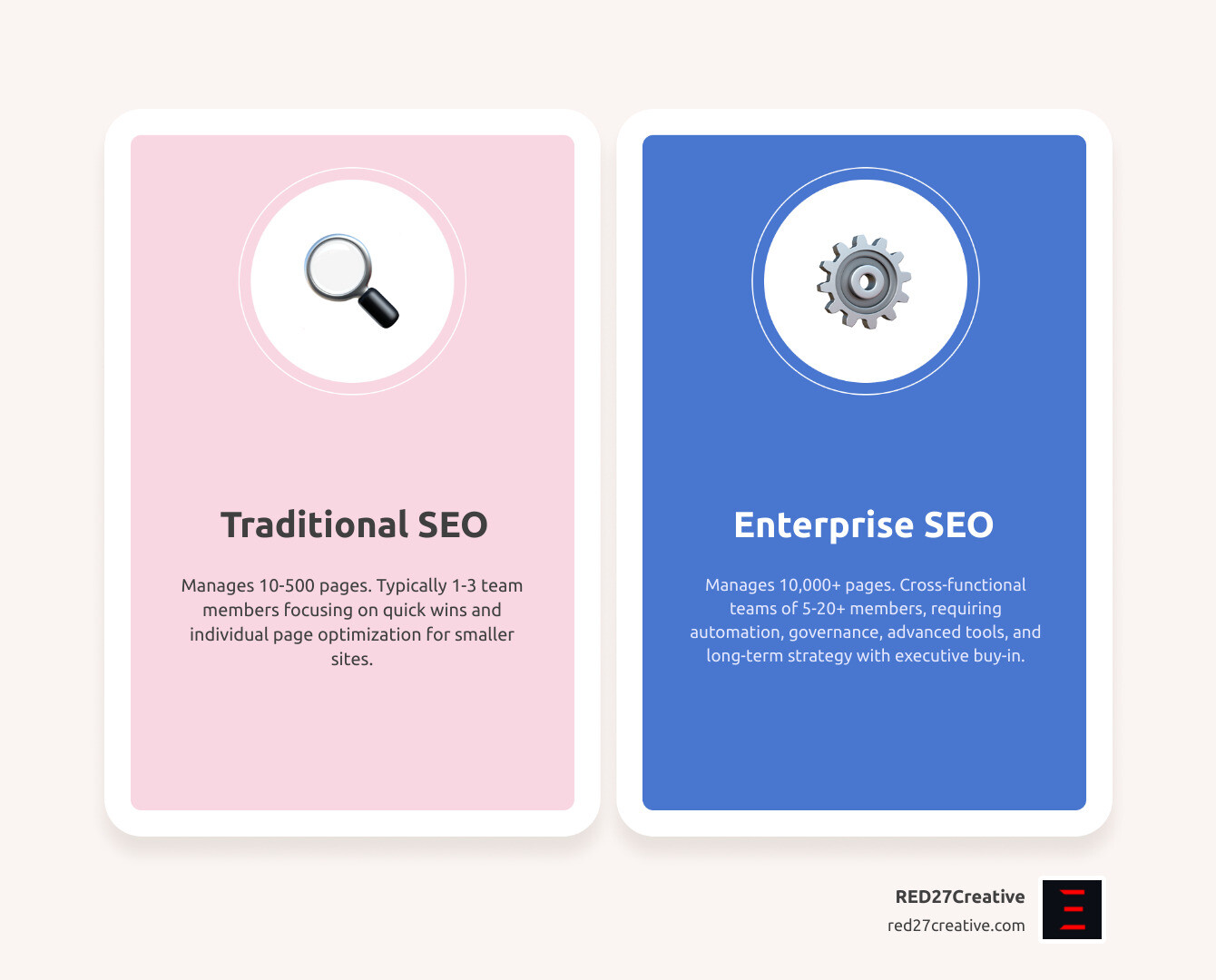
SEO for large businesses is not simply traditional SEO at a bigger scale—it’s a fundamentally different discipline that requires specialized strategies, advanced tools, and cross-functional coordination to succeed.
What makes Enterprise SEO different:
- Scale: Managing thousands or millions of pages instead of dozens
- Complexity: Coordinating across multiple departments, stakeholders, and often international markets
- Technical demands: Addressing crawl budget optimization, site architecture, and indexation at massive scale
- Resource coordination: Aligning content teams, developers, legal, and marketing under unified SEO standards
- Measurement: Tracking performance across numerous segments, products, and geographic regions
According to industry research, 90% of surveyed enterprise organizations say SEO is a must-have, yet fewer than 20% of Senior SEOs hold their positions beyond two years—largely due to the operational and organizational challenges that come with implementing SEO at this level. The stakes are high: enterprise sites can see as much as 120% growth in traffic within a year with the right platform and strategy, but without proper structure, even well-known brands lose millions in potential revenue to better-optimized competitors.
Unlike small business SEO, where a single practitioner can manage the entire strategy, enterprise SEO requires automation, governance models, and systems that can handle everything from managing duplicate content across hundreds of subdomains to coordinating SEO changes through legal, IT, and content teams. It’s less about optimizing individual pages and more about building scalable frameworks that maintain performance across your entire digital ecosystem.
The biggest difference? Enterprise SEO success depends on your ability to break down internal silos and create a culture where SEO is integrated into every department that touches the website—from product development and UX design to customer service and PR.
I’m Kiel Tredrea, founder of RED27Creative, and over the past 20+ years, I’ve helped hundreds of businesses—including national B2B brands and multi-location enterprises—build SEO strategies that drive measurable, long-term growth. My experience with SEO for large businesses has taught me that success at scale requires not just technical expertise, but the ability to align strategy, systems, and stakeholders into one unified approach.
In this guide, you’ll learn the essential components of a winning enterprise SEO strategy, how to overcome the unique organizational and technical challenges large businesses face, and how to measure and prove the ROI of your SEO investments—so you can turn your website into a predictable engine for growth.
The Core Components of a Winning Enterprise SEO Strategy
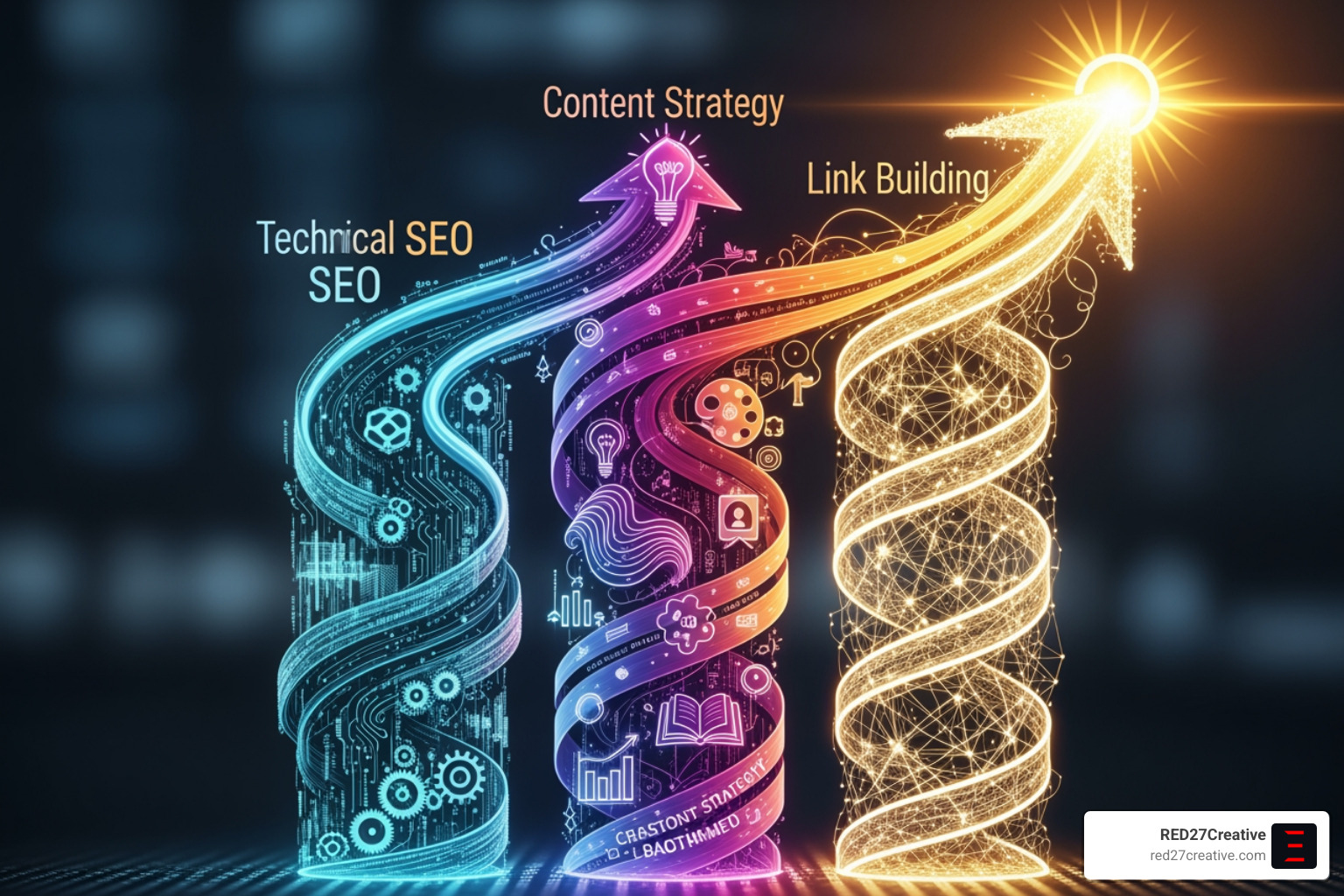
Managing SEO for large businesses means orchestrating an entire digital ecosystem, not just optimizing a website. Success requires a holistic approach combining technical precision, content excellence, and strategic authority building. Everything must work in harmony, scaled for millions of pages, automated where possible, and guided by data. The goal is to build a sustainable growth engine that integrates with business objectives and generates qualified opportunities. Our Advanced SEO Services are built for this complexity.
Technical SEO: The Bedrock of Your Digital Presence
A solid technical foundation is essential for SEO for large businesses; without it, even the best content will fail. Technical SEO ensures search engines can find, understand, and rank your content. On massive sites, challenges multiply: logical site architecture is needed for users and crawlers to navigate millions of pages efficiently. Crawl budget optimization becomes critical to guide search engines to valuable pages. Page speed and mobile-friendliness are not optional—they directly impact rankings and user experience at scale.
Indexation management is also crucial. With thousands of pages, you need systems to manage duplicate content and ensure the right pages are indexed. Schema markup helps search engines interpret content, leading to richer search results. We regularly audit these elements using tools like Ahrefs’ site audit to identify and prioritize technical SEO issues before they impact performance. Our Chicago Technical SEO Consultant Guide dives deeper into these practices.
Content Strategy at Scale: Creating for SEO for Large Businesses
Content at enterprise scale is about building comprehensive topical authority, not just producing more. HubSpot, with over 100,000 pages, ranks for 3.5 million keywords. Salesforce, with nearly 59,000 pages, dominates for over 73,000 keywords, driving a million+ annual visits.
The key is to address user intent across the entire buyer journey. This starts with content audits to find performance gaps and consolidation opportunities. Page templates are essential for maintaining quality and consistency across thousands of pages. E-E-A-T (Experience, Expertise, Authoritativeness, Trustworthiness) is critical for topics where credibility matters.
Understanding user intent and conducting content gap analysis reveals opportunities your competitors miss. Programmatic SEO can efficiently generate unique content for large product catalogs or location pages. The impact is substantial: Intuit refreshed 2,000 blog posts and saw a 20% traffic surge and a 72% increase in sign-ups. Our Professional Content Writing Services help create scalable content for diverse audiences.

Advanced Link Building and Authority
Link building for SEO for large businesses focuses on building authority and trust at scale, not just hunting for individual links. While links don’t hold as much weight as they used to, they still matter, and the focus must be on quality. Large enterprises have a natural advantage: brand mentions. Many established brands get over 500 unlinked mentions monthly, which can be converted into valuable backlinks through simple outreach.
Digital PR is another powerful tool. Creating data-driven content that journalists want to reference naturally attracts high-quality, earned links that signal authority. Internal linking also deserves equal attention. On a massive site, strategically distributing page authority and reinforcing topical relevance with smart internal links can significantly boost important content. The goal is to build topical authority and become a recognized expert through excellent content and strategic partnerships that naturally attract links.
Overcoming the Unique Challenges of Enterprise SEO

The biggest obstacles in SEO for large businesses are often human, not technical. Even the best strategy will fail if IT, content, and legal teams aren’t aligned, causing initiatives to stall.
Departmental silos are a primary challenge. Marketing, IT, content, and legal often have conflicting goals and timelines. As McKinsey reported, cultural and behavioral challenges like silos significantly impact digital priorities, delaying even simple SEO changes for months.
Resource allocation is another hurdle. SEO projects compete with numerous other urgent initiatives for developer time and budget. Securing resources requires a compelling business case that speaks the language of revenue, not just rankings.
Technical debt from legacy systems and outdated architecture adds further complexity, requiring significant investment and coordination to fix.
Perhaps the trickiest challenge is gaining stakeholder buy-in. Executives need to see clear ROI projections and understand the business risks of inaction. Many initiatives fail not from a lack of expertise, but from the inability to translate SEO value into business language. You must show how technical fixes increase conversions, content captures market share, and authority building supports brand reputation.
Our SEO Project Management approach is designed for these complexities. We build cross-functional alignment, create clear roadmaps, and translate technical recommendations into business outcomes that resonate with executives.
Ultimately, SEO for large businesses requires as much change management as technical skill. Success comes from orchestrating collaboration across the organization. When the organizational piece is right, the technical and content work becomes far easier to execute.
Essential Tools and Technologies for SEO for Large Businesses
For SEO for large businesses, standard tools are insufficient. Enterprise-grade platforms are essential for managing millions of pages, offering superior capability and scale. Unlike standard tools, enterprise systems are built to handle massive sites like GitHub (78M+ indexed pages). They provide unified reporting, track millions of keywords, and offer centralized workflow management for team collaboration.
The real power lies in automation and API integrations. These platforms automatically audit technical issues, update meta tags at scale, and integrate with your MarTech stack. This is crucial for coordinating efforts across departments and international markets.
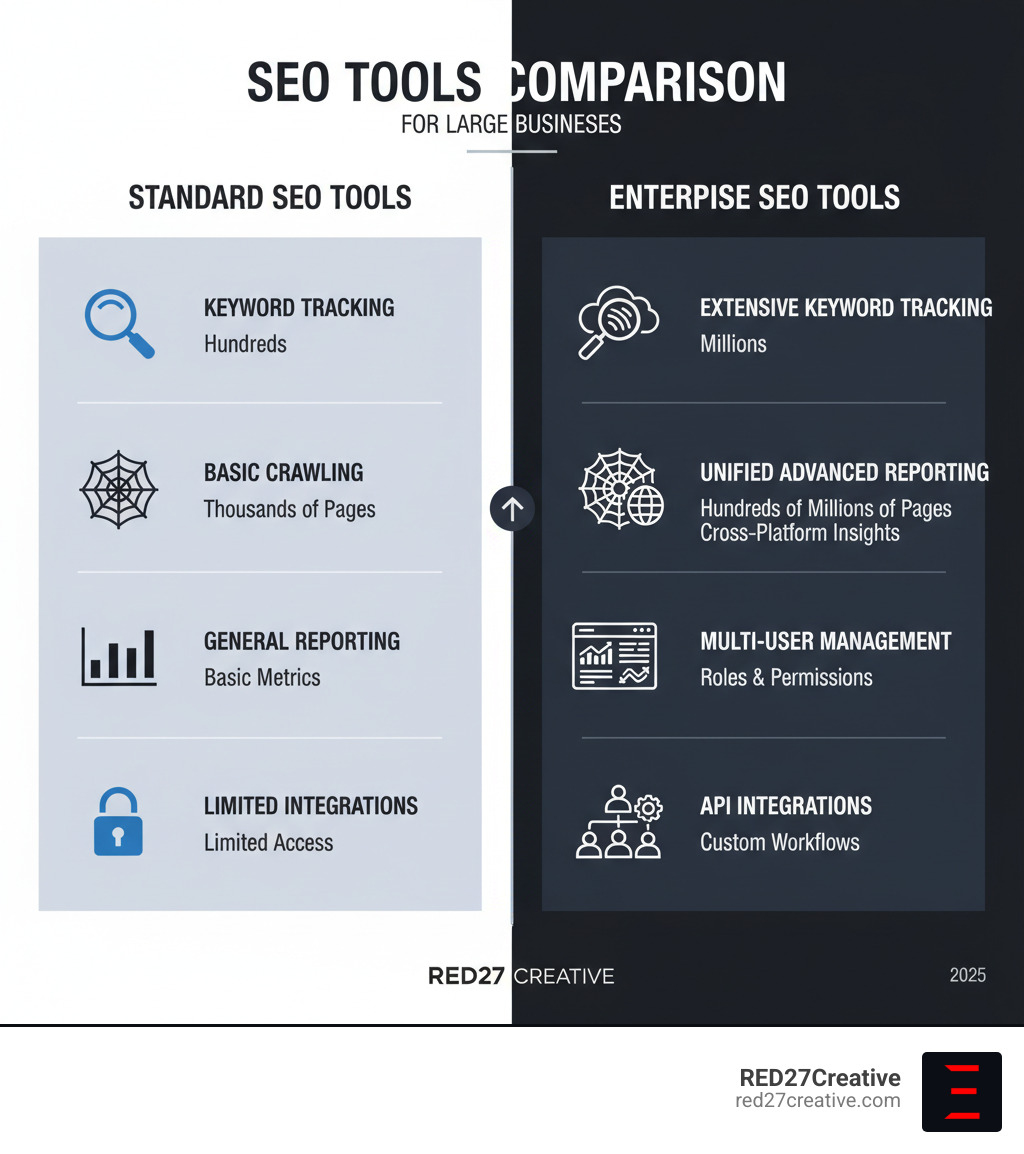
Enterprise platforms include advanced crawlers (e.g., Lumar) for deep technical analysis and sophisticated analytics that surpass basic tools with custom dashboards and predictive insights. AI and machine learning are also transforming these platforms, enabling predictive analytics and large-scale content optimization. Learn how AI in Marketing Transforms Business Growth and enhances enterprise SEO.
The key difference is capacity: standard tools track hundreds of keywords and crawl thousands of pages, while enterprise platforms handle millions of each. They offer multi-user management, granular permissions, and advanced reporting designed for teams. Investing in the right enterprise technology is not optional; it’s the foundation that makes scalable SEO possible.
Measuring Success and Proving ROI in Enterprise SEO
For SEO for large businesses, proving ROI is paramount; tracking rankings alone is not enough. Success means turning organic search into a measurable revenue driver.

Focus on key performance indicators (KPIs) that reflect business outcomes. Beyond organic traffic growth, track organic traffic value (its paid equivalent), conversion rates, and lead generation to measure revenue contribution. For example, Salesforce’s enterprise SEO strategy led to one million monthly visits—a flood of potential customers without ad spend.
Another critical metric is Share of Voice (SOV), which measures your visibility against competitors for key search terms. Increasing SOV means cost-effectively capturing market share.
A compelling statistic for executives: SEO leads close at a 14.6% rate, versus 1.7% for outbound leads. This means a well-executed SEO strategy can deliver nearly nine times more customers for a fraction of the cost.
Beyond direct ROI, enterprise SEO builds invaluable brand credibility and trust. Consistently ranking on Google’s first page positions you as an industry leader, shortening sales cycles and increasing customer lifetime value.
We provide transparent, data-driven reporting that connects SEO activities to business outcomes. We translate technical improvements into financial impact, showing how site speed affects conversions or content authority captures valuable search terms. This approach reveals The Secret of Marketing ROI and turns SEO into a predictable growth engine.
Frequently Asked Questions about Enterprise SEO
If you’re considering SEO for large businesses, you probably have questions. These are the ones we hear most often from enterprise clients, along with straightforward answers based on our two decades of experience helping large organizations grow through search.
What is the main difference between regular and enterprise SEO?
The primary difference is scale—but it’s scale that changes everything. Enterprise SEO manages websites with thousands or millions of pages, which means you can’t just optimize one page at a time. You need advanced automation, cross-departmental collaboration, and scalable frameworks that work across your entire digital ecosystem. While regular SEO focuses on individual page optimization, enterprise SEO addresses the site’s performance as a whole, tackling complex technical issues like crawl budget management, multi-domain tracking, and large-scale content governance that simply don’t exist at smaller scales.
How long does enterprise SEO take to show results?
Due to the size and complexity of large websites, SEO for large businesses is a long-term strategy—and that’s actually a good thing. While some technical fixes can yield quick improvements in crawlability or page speed, significant results like increased organic traffic and revenue typically take six to twelve months to materialize. The timeline depends on your site’s current condition, how quickly your organization can implement changes across departments, and the competitive landscape you’re operating in. The good news? Once that momentum builds, the results compound and become increasingly predictable over time.
What are the first steps in creating an SEO strategy for large businesses?
The first steps involve a comprehensive technical audit to identify foundational issues that might be blocking search engines from properly crawling and indexing your site. From there, we conduct in-depth keyword and competitor analysis to uncover high-value opportunities. But here’s what many organizations miss: it’s equally crucial to define clear business goals, establish KPIs, and secure buy-in from key stakeholders across different departments early in the process. Without alignment between marketing, IT, content, legal, and leadership, even the best technical recommendations can languish in approval queues for months. A successful enterprise SEO strategy requires both technical excellence and organizational coordination from day one.
Conclusion: Building a Future-Proof SEO Foundation
When you commit to SEO for large businesses, you’re not just chasing better rankings—you’re building something far more valuable. You’re creating a digital infrastructure that can support your organization’s growth for years to come, adapt to changing search landscapes, and deliver consistent, measurable results that impact your bottom line.
The journey we’ve covered in this guide—from technical foundations and content at scale to overcoming organizational silos and proving ROI—represents what’s possible when you approach enterprise SEO with the right strategy, tools, and mindset. A successful enterprise SEO strategy transforms your website into a powerful, predictable engine for growth, ensuring your brand dominates the search landscape for years to come.
But here’s the truth: the digital world doesn’t stand still. AI-driven search is changing how people find information. Voice optimization is becoming standard, not optional. User expectations around page speed, mobile experience, and content quality continue to rise. That’s why building a future-proof SEO foundation isn’t just smart—it’s essential for staying competitive.
The good news? When you get the fundamentals right—when you prioritize technical excellence, create genuinely valuable content, build real authority, and align your teams around shared goals—you create something resilient. You build a system that can adapt to algorithm updates, accept new technologies, and continue delivering results even as the search landscape evolves.
We’ve spent more than 20 years helping businesses steer these exact challenges. We partner with companies in Geneva, Batavia, Aurora, St. Charles, Plainfield, Oswego, Naperville, and Chicago, Illinois—and nationally—who are ready to grow and achieve measurable success through strategic, sustainable SEO.
Ready to transform your enterprise’s online presence into a true growth engine? Discover our National Enterprise SEO Services and let’s build an SEO strategy that delivers real, lasting results for your business.

Kiel Tredrea
https://red27creative.comTop Marketing Agency • Web, SEO & Leads • RED27Creative