The Data-Backed Guide to Improving Your Marketing ROI

Why So Many Businesses Are Losing Money on Marketing Right Now
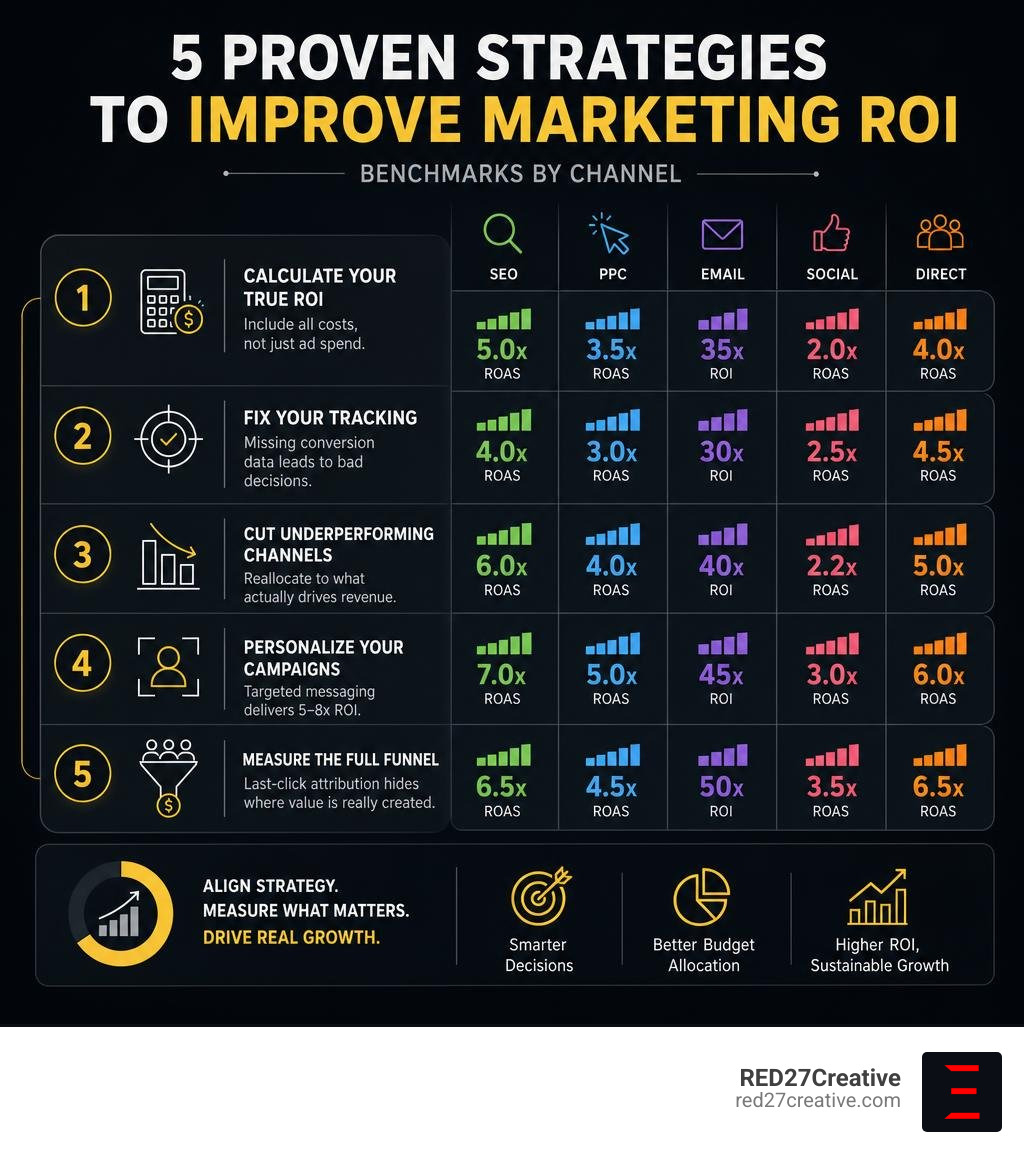
To improve marketing ROI, focus on these five core actions:
- Calculate your true ROI — include all costs, not just ad spend
- Fix your tracking — missing conversion data leads to bad decisions
- Cut underperforming channels — reallocate to what actually drives revenue
- Personalize your campaigns — targeted messaging delivers 5–8x ROI
- Measure the full funnel — last-click attribution hides where value is really created
Here is a number worth sitting with: McKinsey estimates that 15 to 20 percent of global marketing spend — up to $200 billion annually — could be freed up simply by measuring and allocating budgets more effectively.
Yet 76% of marketing leaders still struggle to demonstrate the financial impact of their campaigns. And 70% of organizations are miscalculating their true ROI right now due to poor data and flawed methodologies.
That gap between what marketing costs and what it returns is not a budget problem. It is a measurement and systems problem.
Think of it like tuning an engine while the car is still moving. Push too hard on scale and efficiency drops. Focus too narrowly on efficiency and growth stalls. Getting it right requires seeing the whole machine — not just one part.
This guide breaks down exactly how to close that gap. You will learn how to calculate real ROI, fix the tracking failures quietly inflating your costs, and build a smarter strategy across every channel.
I’m Kiel Tredrea, founder and president of RED27Creative, and over the past 20+ years I’ve helped hundreds of businesses — from local service companies to national B2B brands — improve marketing ROI through integrated systems that connect SEO, web performance, and lead generation into one measurable growth engine. The strategies in this guide are drawn directly from that work, and from the data patterns we see across clients every day.
Improve marketing ROI vocab to learn:
Defining Marketing ROI and Why It Matters in 2026
In the current landscape of July 2026, modern businesses face unprecedented pressure to justify every single dollar spent. Economic shifts have forced brands to stop treating marketing as an experimental playground and start treating it as a predictable revenue center. If you cannot prove the direct financial impact of your campaigns, your budget is always on the chopping block.
Understanding The Secret of Marketing ROI starts with shifting your focus from activity to outcomes. Many teams celebrate vanity metrics like impressions, clicks, or follower counts. But your finance department cannot deposit “likes” into the bank. True return on investment is about cash flow, customer lifetime value, and business growth.
To survive and thrive today, you must build a framework that connects your high-level business goals directly to your daily marketing actions. When you align your strategic goals with active performance measurement, you can easily discover how to improve marketing ROI. In fact, organizations that align their benefits management with their strategic goals enjoy an average of 25% higher returns on investment over three years.

The Math Behind the Money: Calculating True ROI
Most businesses fail to measure their true marketing return because they use incomplete math. They look at their dashboard, see a high Return on Ad Spend (ROAS), and assume they are highly profitable.
But ROAS is a misleading metric. It only compares direct revenue against direct ad spend, completely ignoring your operational overhead. To see if you are actually making money, you must transition to a fully-loaded calculation.
Use this formula to calculate your true Marketing ROI:
$$\text{Marketing ROI} = \frac{\text{Revenue Attributable to Marketing} – \text{Total Marketing Costs}}{\text{Total Marketing Costs}} \times 100$$
Your “Total Marketing Costs” must go far beyond media spend. To calculate this accurately, you need to use a fully-loaded Customer Acquisition Cost (CAC) model.
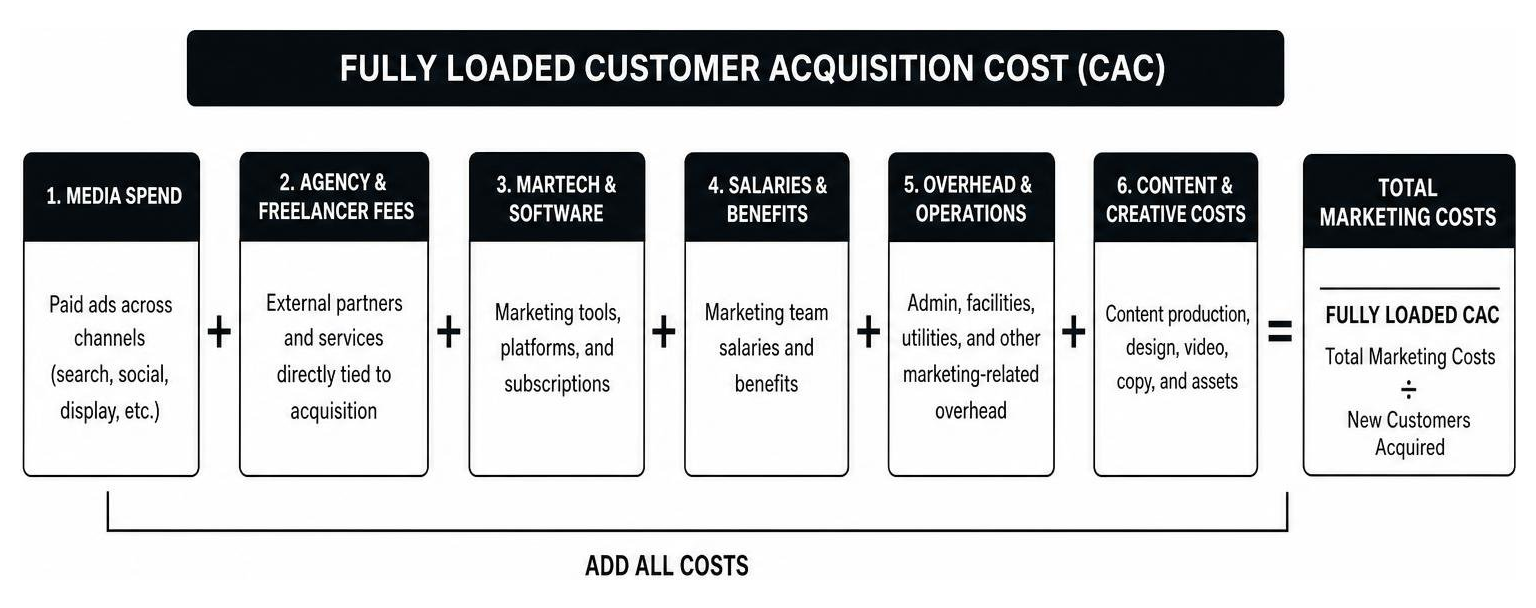
The ROAS vs. Marketing ROI Showdown
| Metric | What It Measures | What It Includes | What It Ignores |
|---|---|---|---|
| ROAS | Direct campaign efficiency | Ad spend only | Agency fees, software, salaries, product margins |
| Marketing ROI | True business profitability | Ad spend, agency fees, software, content, salaries | None (when calculated correctly) |
When you ignore these operational expenses, you risk running campaigns that look profitable on a dashboard but are actually draining your cash flow. If you want to dive deeper into this mathematical reality, check out How to Achieve ROI in Advertising: The Practitioner Framework.
Additionally, you must calculate your payback period. This is the number of months required to recover your fully-loaded CAC from a customer’s gross margin. If your payback period is longer than your average customer lifespan, your business model is quietly bleeding out. For a comprehensive look at tracking these numbers over time, read Marketing ROI: How to Measure It From Individual Campaigns All the Way to Revenue Impact – Martech Pulse.
Proven Strategies to Improve Marketing ROI
Once you have an accurate measurement system in place, you can begin optimizing the engine. You do not always need a larger budget to get better results. Often, you simply need to build a stronger conversion path and eliminate wasted spend.
The cleanest way to improve marketing ROI is to focus on Website Conversion Rate Optimization. If your website is driving substantial traffic but converting at a low rate, you have a conversion problem, not a traffic problem. By turning more of your existing visitors into leads, you instantly lower your acquisition costs across every single channel.

For B2B companies, focusing on the user experience is even more critical. Implementing The Ultimate Guide to B2B Conversion Rate Optimization allows you to map out high-intent actions. You can also partner with a local digital marketing agency to align your local presence with high-converting landing pages.
To maximize your returns, you must understand the historical benchmarks of different channels:
- Email Marketing: Delivers an average ROI of 3,600% ($36 for every $1 spent).
- SEO Marketing: Delivers an average return of 2,200% (and an average of 748% specifically for B2B companies).
- PPC Advertising: Delivers an average ROI of 200%.
- Webinars: Generate an average ROI of 430%.
To make these channels work together, you must bridge the gap From Clicks to Customers: Unlocking Conversions with Smart Web Design. A website built with conversion-focused design elements naturally guides visitors toward your primary call to action.
Leveraging Data-Driven Analytics to Improve Marketing ROI
Running marketing campaigns on gut feel is an incredibly expensive mistake. In 2026, the most successful brands are those that rely on hard data to guide their budget allocation.
Organizations implementing comprehensive data-driven marketing strategies achieve a 23.5% higher ROI than those relying on intuition. By unlocking The Competitive Edge of Data-Driven Marketing, you can identify exactly which touchpoints are driving value and which are wasting your budget.
This level of insight requires a commitment to tracking the true incrementality of your campaigns. You must prove that your marketing is actually causing new sales, rather than simply taking credit for customers who would have bought from you anyway. To build this foundation, you can learn from The Impact of Data-Driven Marketing Strategies.
If you are using modern tools, you also need to understand how to measure their efficiency. We recommend reviewing the Measuring AI Marketing ROI: Complete Framework Guide to calculate both direct revenue lift and operational savings. If you need help setting up these complex tracking systems, consider partnering with specialists in Stop Guessing and Start Growing with Analytics Strategy Consulting.
Technical Tracking Upgrades that Improve Marketing ROI
Traditional browser-based tracking is failing. Privacy-focused browser updates, ad blockers, and cookie restrictions mean that standard tracking pixels are losing 15% to 30% of their conversion data. This data loss artificially deflates your reported ROI and starves ad platform algorithms of the information they need to optimize your campaigns.
The solution is implementing server-side tracking and Conversions APIs (like Meta CAPI or Google Tag Manager Server-Side). By sending conversion data directly from your server to the ad platform, you bypass browser-based restrictions entirely.
The real-world results of this upgrade are massive:
- Switching to server-side tracking can increase reported conversions by 30% and lower your cost per purchase by up to 58%.
- Implementing Meta Conversions API can result in tracking 30.7% more conversions while dropping your cost per purchase by nearly 59%.
- Server-side tracking allows you to extend first-party cookie lifespans from a restricted 7 days up to 180 days, maintaining accurate long-term attribution.
Optimizing Paid Media and Creator Partnerships
To maximize your paid media returns, you must move away from fragmented campaigns and embrace audience consolidation. Post-iOS, search and social algorithms perform best when they have large pools of data to analyze. Consolidating your ad sets allows platforms to exit the learning phase faster, typically improving your CAC by 15% to 30% within 60 days.
If you want to master your paid channels, you must learn how to Master Your ROI with Google Ads Ad Manager. Combining Smart Bidding with high-quality, server-side audience signals allows Google’s system to bid aggressively on your highest-value prospects.
For a complete approach to paid media, we recommend focusing on continuous PPC ROI Optimization. This involves running rapid creative testing, refining your landing page offers, and systematically Scoring Traffic Sources for Better ROI to double down on the channels that convert.
Additionally, creator marketing has evolved into a highly structured performance channel. More than half of brands have doubled down on creator ROI measurement amid economic pressure, with nearly two-thirds of increased creator investment coming directly from traditional paid and digital budgets. To drive ROI here, select creators based on high-intent behavioral signals (like saves and shares) rather than raw follower counts.
Personalization and Customer Journey Mapping
The modern customer journey is highly non-linear. In 2026, the average customer journey has grown to over 11 touchpoints before a final purchase. A prospect might discover your brand through an organic search, read a blog post, subscribe to your newsletter, receive a personalized email, and finally convert after clicking a retargeting ad.
To guide prospects through this complex path, you must leverage personalization and journey mapping:
- Personalized marketing campaigns deliver a 5–8x ROI on marketing spend.
- Personalization increases engagement rates by 3x and purchase likelihood by 2.5x.
- Multichannel marketing strategies deliver 72% higher customer retention rates and 33% higher average order values.
Implementing these strategies at scale requires automation. You can learn how Marketing Automation Simplifies Your Efforts by delivering the right message to the right person at the exact right moment. To build these automated pathways, follow The Marketing Automation Funnel Guide to nurture cold traffic into loyal brand advocates.
Common Pitfalls That Erase Your Marketing Returns
Even the most creative marketing campaigns will fail to deliver a positive return if you fall into common strategic traps. The most dangerous pitfall is focusing on vanity metrics instead of business outcomes. Traffic without conversions is just an expensive hobby.
Another major issue is failing to audit your existing systems. If you do not know where your money is currently going, you cannot optimize it. We recommend you Unlock Your Potential with a Marketing Audit to identify hidden leaks in your funnel.
To protect your investments, you must go Beyond the Surface: Mastering Your Digital Marketing Audit for Peak Performance. This deep technical review helps you uncover broken tracking links, slow landing pages, and misaligned targeting.
For local businesses throughout the Chicago suburbs, these issues are often amplified by poor regional targeting. Working with a specialized local digital marketing agency can help you eliminate wasted ad spend outside your actual service areas.
Finally, remember to look at your website’s conversion infrastructure. You should understand Why Your Website Needs a Conversion Audit and How It Works to ensure that your hard-earned traffic isn’t bouncing away due to a confusing user interface or a slow loading speed.
Frequently Asked Questions About Marketing ROI
What is a good marketing ROI to aim for?
A 5-to-1 (500%) ROI ratio is generally considered the industry benchmark for a strong, profitable marketing program. This ratio ensures you comfortably cover your direct media costs, operational overhead, and production margins while leaving a healthy net profit for business growth.
How does server-side tracking improve marketing ROI?
Server-side tracking sends conversion data directly from your web server to ad platforms, bypassing browser ad blockers and cookie restrictions. This improves data accuracy by 15% to 30%, giving ad algorithms the complete data they need to lower your cost per purchase and optimize your bidding.
Why does traditional last-click attribution fail?
Last-click attribution awards 100% of conversion credit to the final touchpoint, completely ignoring the early-stage channels that built demand. This bias leads businesses to prematurely cut budget from top-of-funnel channels like SEO and brand awareness, ultimately causing their bottom-funnel performance to collapse.
Conclusion
Improving your marketing ROI is not about finding a single magic channel. It is about building a unified, data-driven system where your tracking, website design, SEO, and paid campaigns work together to turn traffic into measurable revenue.
At RED27Creative, we build modern marketing engines designed for real growth. From our headquarters in Geneva, Illinois, we help businesses across Batavia, Aurora, St. Charles, Plainfield, Oswego, Naperville, and Chicago establish high-performing digital foundations that drive consistent, qualified leads.
If you are ready to stop guessing and start growing, Partner with RED27Creative for Strategic Consulting. Our team is ready to help you audit your current campaigns, deploy advanced server-side tracking, and optimize your entire conversion funnel for maximum financial return.
Explore our core strategy and performance solutions:
- Build a comprehensive roadmap with our Marketing Strategy Review Complete Guide.
- Transition to data-backed growth by From Strategy to Success: Partnering with a Performance-Focused Agency.
- Uncover hidden opportunities with our specialized Reveal Revenue Service.
- Drive consistent sales opportunities through our Unlock Growth: Discover Leading Pay Per Lead Providers.
- Partner with a regional leader to dominate your local market and establish a high-performing digital foundation.

Kiel Tredrea
https://red27creative.comTop Marketing Agency • Web, SEO & Leads • RED27Creative