The Marketing Automation Funnel Guide
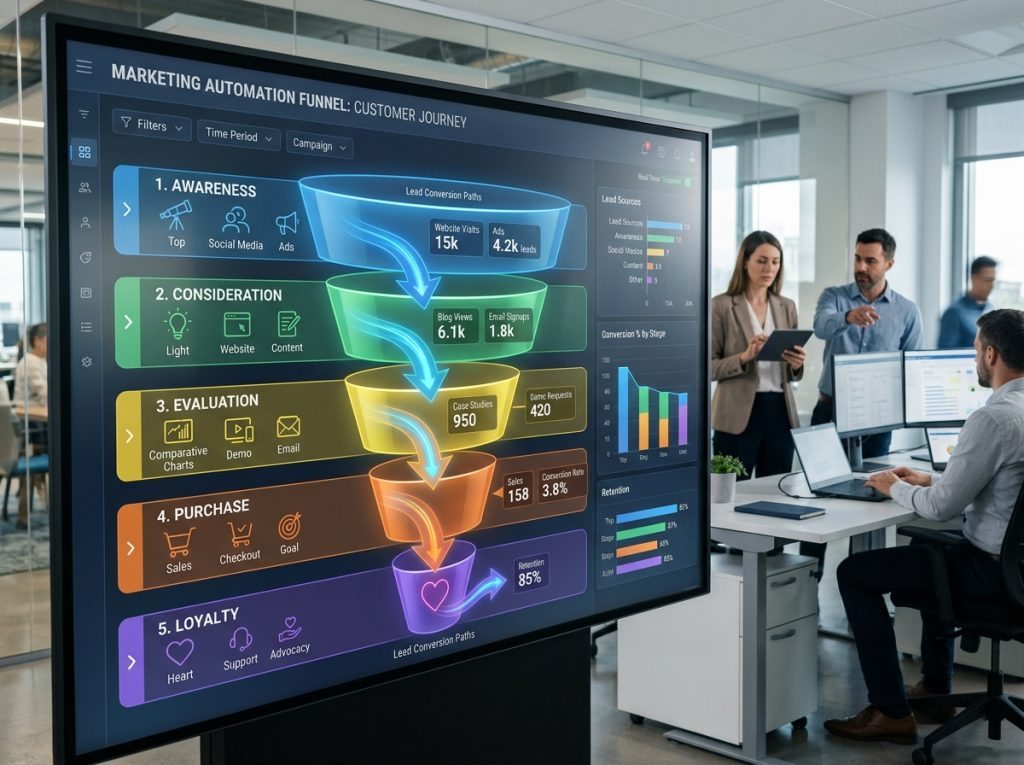
The Core Components of a Marketing Automation Funnel
A marketing automation funnel is a system that uses software to move potential customers from first contact to final sale — automatically, at scale, and with minimal manual effort.
Here is a quick breakdown of how it works:
| Funnel Stage | Goal | Automation Example |
|---|---|---|
| TOFU (Awareness) | Attract new leads | Triggered social ads, SEO content, lead capture forms |
| MOFU (Consideration) | Nurture and educate | Automated email drip sequences, lead scoring |
| BOFU (Decision) | Convert and close | CRM alerts, personalized offers, sales handoffs |
The core idea is simple: instead of following up with every lead by hand, you build workflows that do it for you — sending the right message, to the right person, at the right time.
The business case is just as clear. Marketing automation boosts sales productivity by 14.5% and reduces marketing overhead by 12.2%. Consumers are 80% more likely to buy from brands that personalize their experience. And the market for these tools is expected to hit $9.5 billion by 2027.
Yet only 19% of companies currently use marketing automation tools. That gap is a real competitive opportunity — and this guide will show you exactly how to close it.
I’m Kiel Tredrea, founder of RED27Creative and a marketing strategist with over 20 years of experience building data-driven systems that generate qualified leads and measurable growth. Designing and optimizing the marketing automation funnel is one of the core frameworks I use to help businesses scale without scaling their workload. Let’s break down exactly how to build one that works.

Important Marketing automation funnel terms:
- Sales Funnel & Conversion Optimization
- Website conversion rate optimization
- Conversion audit services
Building a marketing automation funnel isn’t just about buying a piece of software and “setting it and forgetting it.” It is about creating a strategic architecture that handles your lead management with surgical precision. When we talk about core components, we are looking at how technology bridges the gap between a stranger seeing your brand and a loyal customer signing a contract.
Research shows that marketing automation boosts sales productivity by 14.5%. This happens because your team is no longer bogged down by repetitive data entry or manual follow-ups. Instead, they focus on high-value strategy and closing deals. At RED27Creative, we’ve seen how marketing automation simplifies your efforts by providing a scalable foundation. Whether you are a local business in Geneva, IL, or a growing enterprise in Chicago, the ability to make data-driven decisions based on real-time performance is what separates the winners from the rest.
The marketing automation market is expected to grow to $9.5B by 2027, signaling that businesses across every industry are waking up to the power of operational efficiency. By automating the “busy work,” you reduce human error and ensure that every prospect receives a consistent, high-quality experience.
Defining the Automated Journey
To build a successful funnel, we must first map the customer lifecycle. This involves identifying every touchpoint a prospect has with your brand—from their first Google search to their final invoice payment.
A “workflow trigger” is the heart of this journey. For example, if a visitor downloads a guide on your site, that action triggers a specific sequence of events. We use a complete digital marketing funnels guide approach to ensure these triggers are logical and helpful, rather than intrusive. The goal is to guide the user naturally through the stages of awareness, interest, and intent.
Why Automation Is Essential for Modern Growth
In today’s market, speed is a currency. If a lead fills out a form in Naperville, IL, and doesn’t hear back for 24 hours, they’ve likely already moved on to a competitor. Automation allows for real-time engagement, sending an immediate response that keeps the conversation alive.
Beyond speed, there is the massive benefit of overhead reduction. Implementing these systems can lead to a 12.2% reduction in marketing overhead. By replacing manual tasks with automated workflows, you gain a significant competitive advantage, allowing you to do more with a smaller, more focused team.
Key Stages of the Automated Funnel: TOFU, MOFU, and BOFU
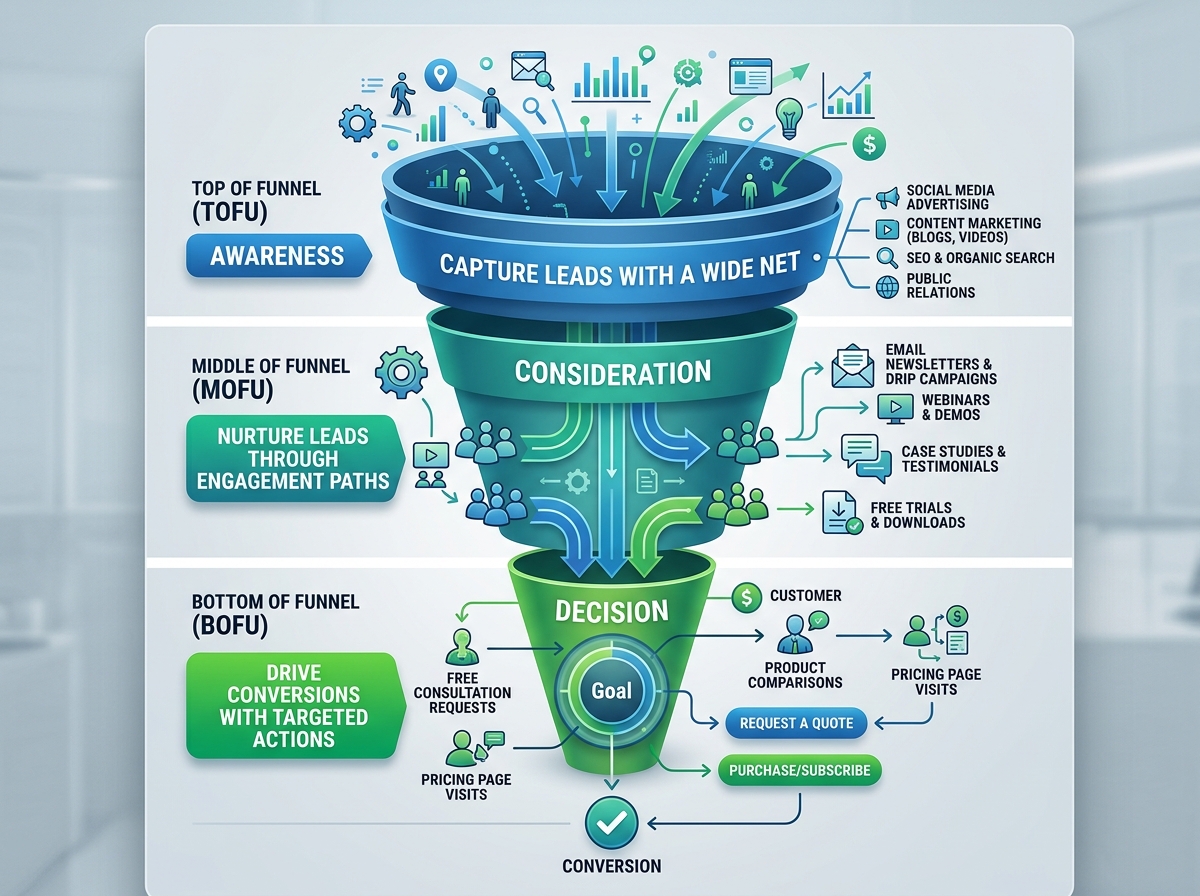
A high-performing marketing automation funnel is traditionally divided into three main sections: Top-of-Funnel (TOFU), Middle-of-Funnel (MOFU), and Bottom-of-Funnel (BOFU). Each stage requires a different type of content and a unique automation strategy. Understanding these differences is the first step in a lead generation strategy complete guide.
Automating the Top-of-Funnel (TOFU)
The TOFU stage is all about awareness. You are casting a wide net to attract potential customers who may not even know they have a problem your business can solve. Automation here focuses on lead capture and content distribution.
Since 80% of consumers prefer personalized experiences, we use automation to segment leads the moment they arrive. By integrating SEO efforts with social media triggers, we can ensure that when someone interacts with a specific topic on your blog, they are automatically tagged and entered into a relevant nurturing sequence. This ensures the “awareness” stage feels tailored to their specific needs from day one.
Nurturing Leads in the Middle-of-Funnel (MOFU)
The MOFU stage is where the “magic” of automation really happens. This is the consideration phase, where prospects are evaluating their options. Here, we use lead scoring and behavioral tracking to determine how “hot” a lead is.
| Feature | B2B Automation Needs | B2C Automation Needs |
|---|---|---|
| Cycle Length | Long (months/years) | Short (minutes/days) |
| Decision Maker | Multiple (Buying Committee) | Individual/Household |
| Content Type | Whitepapers, Webinars, Case Studies | Promo codes, Reviews, Social Proof |
| Automation Focus | B2B lead generation | Abandoned cart, Instant discounts |
Educational drip campaigns are essential here. If a prospect in St. Charles, IL, watches a webinar but doesn’t book a consultation, our system automatically sends them a follow-up email with a relevant case study. This keeps your brand top-of-mind without a salesperson having to lift a finger.
Closing the Deal at the Bottom-of-Funnel (BOFU)
At the BOFU stage, the lead is ready to make a decision. Automation shifts from “education” to “conversion.” This often involves automated notifications sent directly to your sales team when a lead visits a high-intent page, like your pricing or contact page.
By ensuring CRM synchronization, your sales reps have the full history of the lead’s interactions at their fingertips. This ultimate B2B lead generation solution allows for personalized offers or “limited-time” triggers that provide the final nudge needed to close the deal.
How to Build an Effective Marketing Automation Funnel
Building an effective marketing automation funnel requires a blend of strategy and technical setup. You can’t just turn on a tool and expect results; you need to define your goals and understand your audience segments first.
Start by connecting your content to the buying process. This means identifying which blog posts, videos, or guides move a person from one stage of the funnel to the next. Once you have the strategy, you move into tool integration. Whether you are using HubSpot, Marketo, or ActiveCampaign, your tools must “talk” to each other via API connectivity to maintain data hygiene and prevent leads from falling through the cracks.
Step-by-Step: Building Your Marketing Automation Funnel
- Define Your Stages: Clearly outline what constitutes a TOFU, MOFU, and BOFU lead for your specific business.
- Capture Leads: Use optimized landing pages and forms to gather data.
- Segment Your Data: Group leads by industry, behavior, or location (e.g., Batavia vs. Plainfield).
- Create Sequences: Write and schedule automated email and SMS drips that provide value.
- Test and Refine: Use A/B testing to see which subject lines and CTAs perform best.
We’ve implemented these steps for various sectors, including marketing automation for manufacturing, where long sales cycles make automation a lifesaver for staying connected with prospects.
Optimizing Your Marketing Automation Funnel for Maximum ROI
Optimization is an ongoing process. With an average email marketing ROI of $42 for every $1 spent, there is a massive incentive to get this right. We focus on performance analytics to identify “leaks” in the funnel—places where people are dropping off.
Retargeting strategies are also a powerful optimization tool. If someone visits your site in Oswego, IL, but doesn’t convert, automation can trigger a targeted ad on Facebook or Google to bring them back into the funnel. This multi-channel approach significantly boosts conversion rate optimization (CRO).
Measuring Success and Overcoming Implementation Challenges
You cannot manage what you do not measure. To understand if your marketing automation funnel is working, you need to track specific KPIs.
Key metrics include:
- Conversion Rates: The percentage of people moving from one stage to the next.
- Cost Per Acquisition (CPA): How much it costs to gain a new customer through the automated system.
- Customer Lifetime Value (LTV): The total revenue a customer generates over time.
- Close Rate: The percentage of qualified leads that ultimately become paying clients.
Sharing data visualizations for team review is a great way to keep everyone aligned. When your marketing and sales teams can see the same dashboard, they can collaborate on how to improve the funnel’s performance.
Common Pitfalls in Funnel Automation
Implementation isn’t always smooth sailing. According to the Future of Martech 2024 report, 34% of companies face significant technical hurdles during setup. Common issues include data silos (where information is stuck in one app and can’t be used by another) and a lack of a cohesive strategy.
To overcome these, start simple. Don’t try to automate your entire business in one day. Focus on one high-impact area—like lead follow-up—and expand from there.
Aligning Marketing and Sales Teams
One of the biggest benefits of a marketing automation funnel is its ability to align your teams. By using customer behavior analysis, you can create a shared definition of a “qualified lead.”
When a lead reaches a certain score, the system triggers an automated handoff to the sales team. This ensures that sales reps are only spending time on leads that are actually ready to talk, reducing friction and improving the overall culture of the company.
The Future of Funnel Automation: AI and Predictive Analytics
The landscape of marketing is shifting rapidly thanks to artificial intelligence. We are moving beyond simple “if/then” logic into generative AI in sales and messaging.
Future trends include:
- Predictive Lead Scoring: Using machine learning to predict which leads are most likely to buy before they even take a major action.
- Hyper-Personalization: AI that can write unique, one-to-one emails for thousands of leads simultaneously.
- Conversational Marketing: AI-powered chatbots that can qualify leads and book appointments 24/7.
These emerging martech trends are making funnels smarter and more efficient than ever before, allowing businesses in the Fox Valley area and beyond to compete on a national scale.
Frequently Asked Questions about Marketing Automation Funnels
What is a marketing automation funnel?
A marketing automation funnel is a strategic framework that uses software to guide potential customers through the buying journey—from awareness to purchase—without manual intervention. By automating repetitive tasks like email follow-ups, lead scoring, and segmentation, businesses can deliver personalized content at scale, ensuring no lead is forgotten while increasing overall conversion rates.
How does automation improve lead nurturing?
Automation improves lead nurturing by delivering the right message at the perfect time based on user behavior. Instead of generic blasts, automated systems trigger specific content sequences when a lead interacts with your site or emails. This relevance builds trust and keeps your brand top-of-mind, significantly increasing the likelihood of a final purchase.
What are the key metrics for funnel success?
The most critical metrics include conversion rates at each stage, Cost Per Acquisition (CPA), and Customer Lifetime Value (LTV). Additionally, tracking the “close rate” and “time-to-conversion” helps identify bottlenecks. Monitoring these data points allows marketing teams to refine their automated workflows, reduce waste, and maximize the return on their advertising spend.
Conclusion
At RED27Creative, we believe that a marketing automation funnel is the engine of modern business growth. It isn’t just about software; it’s about building a data-driven system that respects the customer’s journey while maximizing your team’s efficiency.
Whether you are looking to establish a strong online foundation or turn your current visibility into consistent opportunities, we are here to help. Our team of experts specializes in building unified growth engines that connect SEO, web design, and lead generation into one powerful system.
Ready to stop chasing leads and start attracting them? Contact us for lead generation services today, and let’s build a funnel that works for you.

Kiel Tredrea
https://red27creative.comTop Marketing Agency • Web, SEO & Leads • RED27Creative