The No-Nonsense Guide to Social Media Branding

Why Your Social Media Brand Is Either Building Trust or Losing It
Branding social media is one of the most powerful — and most misunderstood — growth levers available to businesses today.
Here’s a quick answer if you need it fast:
What is social media branding?
- It is the strategic process of expressing your brand’s identity, values, and personality across social platforms
- It shapes how your audience perceives your business — not just what you sell, but who you are
- It includes your visual identity (colors, logos, fonts), your brand voice, your content pillars, and how consistently you show up
Why does it matter?
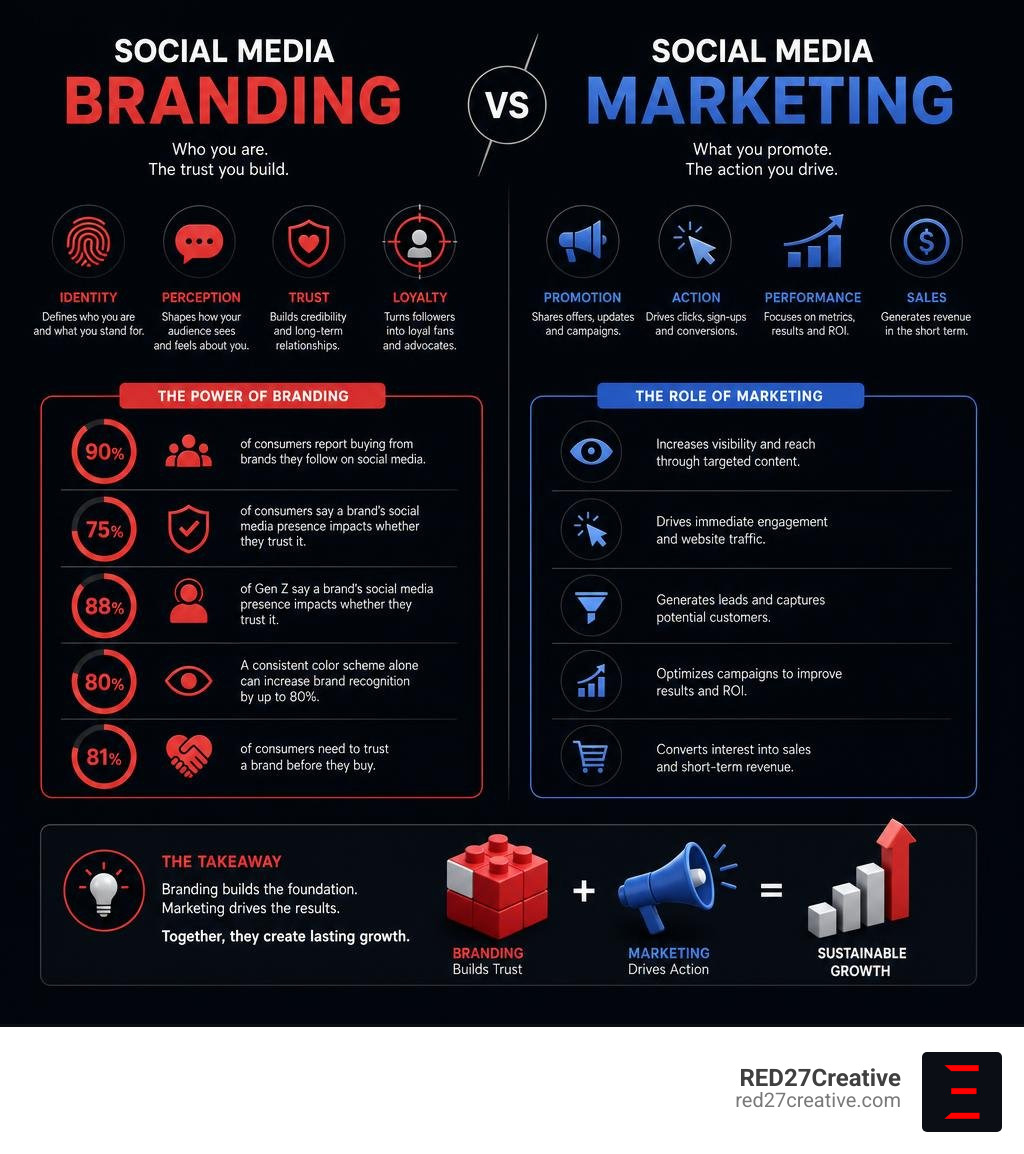
- 90% of consumers report buying from brands they follow on social media
- Over 75% of consumers say a brand’s social media presence impacts whether they trust it — that number jumps to 88% among Gen Z
- A consistent color scheme alone can increase brand recognition by up to 80%
- 81% of consumers need to trust a brand before they buy
The stakes are real. Your potential customers are scrolling past hundreds of posts every day. Most of it blurs together. The brands that cut through are the ones that show up with intention — a clear look, a consistent voice, and a message that resonates.
This is not about posting more. It is about posting right.
I’m Kiel Tredrea, founder of RED27Creative, and over the past 20+ years I’ve helped hundreds of businesses — from local service companies to national B2B brands — build social media branding systems that drive real, measurable growth. In this guide, I’ll walk you through exactly how to build a brand on social media that earns trust, drives recognition, and turns followers into customers.
Easy branding social media word list:
What is Branding Social Media and Why Does It Matter?
At its core, branding social media is about defining and maintaining your digital reputation by shaping how your target audience perceives your profiles. In June 2026’s noisy digital landscape, filled with automated content and AI-generated imagery, genuine brand perception is the ultimate differentiator.
Building a strong brand means creating a digital persona that communicates reliability, authority, and purpose. Transforming random posts into a cohesive identity requires a strategic approach. For a deeper dive into this ecosystem, read The Complete Guide to Social Media Branding | Vista Social.
Fostering an emotional connection separates forgettable accounts from household names; 62% of consumers feel emotionally connected to brands they buy from frequently. Intentional branding builds a community around shared values rather than just products.
The Difference Between Social Media Marketing and Branding Social Media
While social media marketing is promotional, transactional, and campaign-focused to drive immediate actions, branding social media focuses on long-term perception and relationship building. Marketing asks for the sale today; branding builds the trust that makes future sales effortless.
Balancing both makes marketing campaigns far more effective—brand recognition can improve ad conversion rates three to five times over. To see how custom assets play a role, check out our guide on Custom Social Media Content.
Why Consistency is Your Ultimate Trust Accelerator
Consistency is the foundation of digital trust. A chaotic feed makes a business look disorganized and unreliable. Psychology shows people judge products within 90 seconds, with 62% to 90% of that assessment based on color alone. A unified color scheme can increase brand recognition by up to 80%.
Furthermore, consumers typically need five to seven exposures in a fast-scrolling environment to remember a brand. To understand why many companies struggle with this visual standard, explore Why Most Social Media Brand Kits Fail (And How to Fix Yours) | Forge by Printlogik.
The Core Elements of a Strong Social Media Brand Identity
To construct a brand that leaves a lasting impression, you must define its core identity elements. This identity acts as a template for every visual asset, caption, and reply your team publishes.

A complete social media brand identity relies on four pillars:
- Visual Identity: Your logos, color palettes, and typography.
- Brand Voice: Your personality, tone, and language rules.
- Brand Values: Your core mission, ethics, and beliefs.
- Content Pillars: The core topics you write about to establish authority.
Visual Assets: Logos, Colors, and Typography
Your visual assets are the first things a user notices when scrolling. Because recognition windows on modern feeds have shrunk to under one second, your visuals must do the heavy lifting instantly.
To keep your visual identity clean and recognizable, we recommend focusing on these core assets:
- A Primary Logo and Sub-marks: Optimized for circular profile pictures.
- A Fixed Color Palette: One primary color, two supporting colors, and one accent color with exact HEX codes.
- Consistent Typography: One or two typefaces used across all graphic overlays.
- Graphic Templates: Pre-designed layouts for quotes, statistics, and announcements.
Using official platform assets correctly is also essential for maintaining a professional look. If you need high-quality, approved vector files for your profiles, check out Every Social Media Logo You May Want [Free Resource].
Defining Your Brand Voice and Content Pillars
Your brand voice is how your business speaks to its audience. It should sound like the exact same person is writing your captions, responding to comments, and sending direct messages across every network. Whether your voice is warm and professional, playful and sarcastic, or authoritative and educational, you must document these rules in a style guide.
Alongside your voice, you need to establish three to five content pillars. These pillars are the specific themes your business will cover. For example, a local professional services firm in Naperville or Geneva might focus on three pillars: industry education, local community highlights, and behind-the-scenes culture.
By sticking to these boundaries, you avoid confusing your audience with irrelevant topics. For actionable strategies on creating structured, highly engaging posts, explore our resources on Branded Social Media Content and Creative Social Media Content.
Step-by-Step: How to Build Your Branding Social Media Strategy
Building a successful presence does not happen by accident. It requires a documented Social Media Strategy that aligns your business goals with your audience’s needs.
Step 1: Audit Your Current Presence and Define Your Audience
Before looking forward, you must look at where you stand today. Start by auditing your existing social media profiles. Are your profile pictures consistent? Is your bio copy up to date? Do your recent posts accurately reflect your current business values?
Next, define your target audience with detailed buyer personas. You cannot build a brand that appeals to everyone. Ask yourself:
- Where does our ideal customer spend their time online?
- What challenges do they face that we can help solve?
- What tone of voice resonates most with them?
If you are a business operating in the Chicago suburbs, such as Batavia, IL, Aurora, IL, or St. Charles, IL, your audience will have distinct local interests. Tailor your positioning to address these regional dynamics while identifying gaps left by your direct competitors.
Step 2: Create a Social Media Style Guide and Templates
Once your audience is defined, it is time to build your operational toolkit. A standard social media style guide should be a simple, accessible document that your entire team can refer to daily.
Your style guide must include:
- Approved logo variations and clear space rules.
- Color palette HEX codes and font hierarchies.
- Voice guidelines (e.g., “We are professional but never stuffy”).
- Rules for customer communication and comment moderation.
- Ready-to-use content templates.
Using templates does not limit your creativity; instead, it focuses your energy on what you are saying rather than how to design it from scratch every day. To ensure your team is set up for long-term consistency, follow our Social Media Content Plan Best Practices.
Platform-Specific Branding Social Media Tactics for 2026
Every social platform has its own unique culture, format rules, and user expectations. A visual asset that performs beautifully on Instagram might feel completely out of place on LinkedIn. To build a cohesive brand, you must adapt your expression to fit each platform’s norms.

Tailoring Your Identity for Instagram, TikTok, and YouTube
Instagram, TikTok, and YouTube are highly visual networks driven by vertical video formats. On these channels, highly produced, corporate imagery often fails to capture attention. Instead, audiences seek authenticity, behind-the-scenes transparency, and high-energy storytelling.
To succeed on these platforms:
- Prioritize Video Identity: Ensure your video transitions, caption styles, and music choices align with your brand’s overall mood.
- Maintain Grid Aesthetics: On Instagram, your profile grid displays nine to twelve posts at a time. Keep this space clean by using a consistent color palette.
- Keep Production Realistic: On TikTok, raw, organic video content often outperforms heavily edited corporate commercials.
If you want to master the art of video storytelling across these platforms, read our Social Media Video Creation Ultimate Guide.
Professional Branding Social Media on LinkedIn
LinkedIn is the premier network for professional services, B2B branding, and employer advocacy. The audience here expects cleaner, more structured designs, thought leadership, and industry insights.
To build an authoritative brand on LinkedIn:
- Share Original Perspectives: Publish long-form articles, industry breakdowns, and real-world case studies.
- Leverage Employee Advocacy: Encourage your team members to share company updates and professional insights from their personal profiles.
- Maintain a Polished Look: Use professional banner images (1584 x 396 px) and high-quality headshots.
For local businesses seeking to build referral networks in communities like Naperville, IL, Oswego, IL, or Plainfield, IL, LinkedIn is an invaluable tool. If you need help managing this professional presence, check out our Business Social Media Help resource or read our comprehensive Social Media Management Naperville Guide.
Trending Strategies and Common Mistakes to Avoid
The digital landscape evolves rapidly. To keep your brand relevant, you must stay ahead of emerging trends while avoiding the structural mistakes that can erode public trust.
Top Social Branding Trends for 2025-2026
As we navigate 2026, several key trends have redefined how brands connect with their audiences:
- Hyper-Personalization: Audiences are moving away from massive, generic broadcast feeds and gravitating toward micro-communities, private groups, and broadcast channels.
- Social SEO: Optimizing your post captions with relevant keywords is now just as important as traditional search engine optimization. Users are increasingly using social platforms as search engines.
- Values-Driven Branding: Consumers, particularly Gen Z, prefer to buy from brands that take a clear stand on social and environmental issues. In fact, 76% of Gen Z consumers prefer values-aligned brands.
- Employee-First Storytelling: Audiences trust real people more than corporate logos. Featuring your team’s day-to-day work builds unmatched credibility.
Critical Mistakes That Can Destroy Your Brand Trust
Even the most beautiful visual identity can be undermined by operational mistakes. Here are the most common pitfalls we see businesses make:
- Inconsistent Posting Cadence: Going silent for weeks at a time signals to your audience (and the algorithms) that your business is inactive or unreliable.
- Ignoring Community Engagement: Social media is a two-way conversation. Failing to respond to comments and direct messages makes your brand feel cold and unapproachable.
- Copying Competitors Verbatim: While it is useful to monitor competitor gaps, imitating their style directly dilutes your own unique value proposition.
- Neglecting Visual and Formatting Standards: Using low-quality images, stretched logos, or incorrect platform dimensions immediately makes your business look unprofessional.
Frequently Asked Questions About Branding Social Media
What is the difference between social media branding and marketing?
Social media branding is the long-term process of shaping public perception, establishing trust, and building an emotional connection through consistent visuals, voice, and values. Social media marketing focuses on short-term promotional tactics, direct lead generation, and driving immediate conversions.
Do I need a large budget to build a brand on social media?
No. While paid ads can accelerate your reach, organic brand building relies on consistency, clear messaging, and genuine community engagement. By using high-quality content templates, defining your pillars, and encouraging employee advocacy, you can build a powerful brand on a limited budget.
How do I measure the ROI of my social media branding efforts?
While branding returns compound over time, you can track success by monitoring brand awareness metrics (such as profile visits and reach), engagement rates, customer sentiment, and the volume of direct brand searches on search engines.
Conclusion
Building a strong system for branding social media is not a luxury; it is a fundamental requirement for business growth in 2026. When you show up consistently with a clear visual identity, a defined voice, and genuine values, you build the trust that turns casual scrollers into lifelong customers.
At RED27Creative, based in Geneva, Illinois, we specialize in building data-driven digital marketing engines that connect your website, SEO, local presence, and social branding into one unified system for growth. Led by founder Kiel Tredrea, we partner with businesses throughout Chicago, Naperville, Batavia, Aurora, St. Charles, Plainfield, and Oswego to deliver measurable results that last.
Ready to transform your social media presence into a strategic driver of brand equity? Contact RED27Creative for expert branding help today, and let’s build something great together.

Kiel Tredrea
https://red27creative.comTop Marketing Agency • Web, SEO & Leads • RED27Creative