The Science of Data Driven Lead Generation

Why Data Driven Lead Generation Is the New Standard for B2B Growth
Data driven lead generation is the practice of using real, measurable information — about your prospects, their behavior, and their buying intent — to find, attract, and convert the right customers instead of guessing.
Here’s a quick breakdown of what it involves:
| Component | What It Means |
|---|---|
| Ideal Customer Profile (ICP) | Define exactly who you’re targeting using firmographic and behavioral data |
| Intent Data | Identify prospects actively researching solutions like yours |
| Lead Scoring | Rank leads by fit and readiness so sales focuses on the best opportunities |
| Multi-Channel Outreach | Reach prospects where they are, with messages that match their stage |
| Attribution & KPIs | Track which efforts actually drive pipeline and revenue |
The gap between companies that grow predictably and those that struggle often comes down to one thing: how they find and qualify leads.
Traditional approaches — cold lists, spray-and-pray email blasts, gut-feel targeting — are becoming less effective and more expensive. Meanwhile, 78% of businesses report that data-driven marketing directly improves client acquisition and lead conversion. Yet 61% of B2B marketers still name lead quality as their single biggest challenge.
That tension is exactly what this guide addresses.
You don’t have a lead volume problem. You have a lead quality problem. And quality starts with data.
I’m Kiel Tredrea, founder of RED27Creative and a marketing strategist with over 20 years of experience building lead generation systems that combine data, strategy, and execution for B2B and service-based businesses. Throughout my career, I’ve helped companies across industries implement data driven lead generation frameworks that replace guesswork with measurable, repeatable growth. In the sections ahead, I’ll walk you through exactly how to build one.
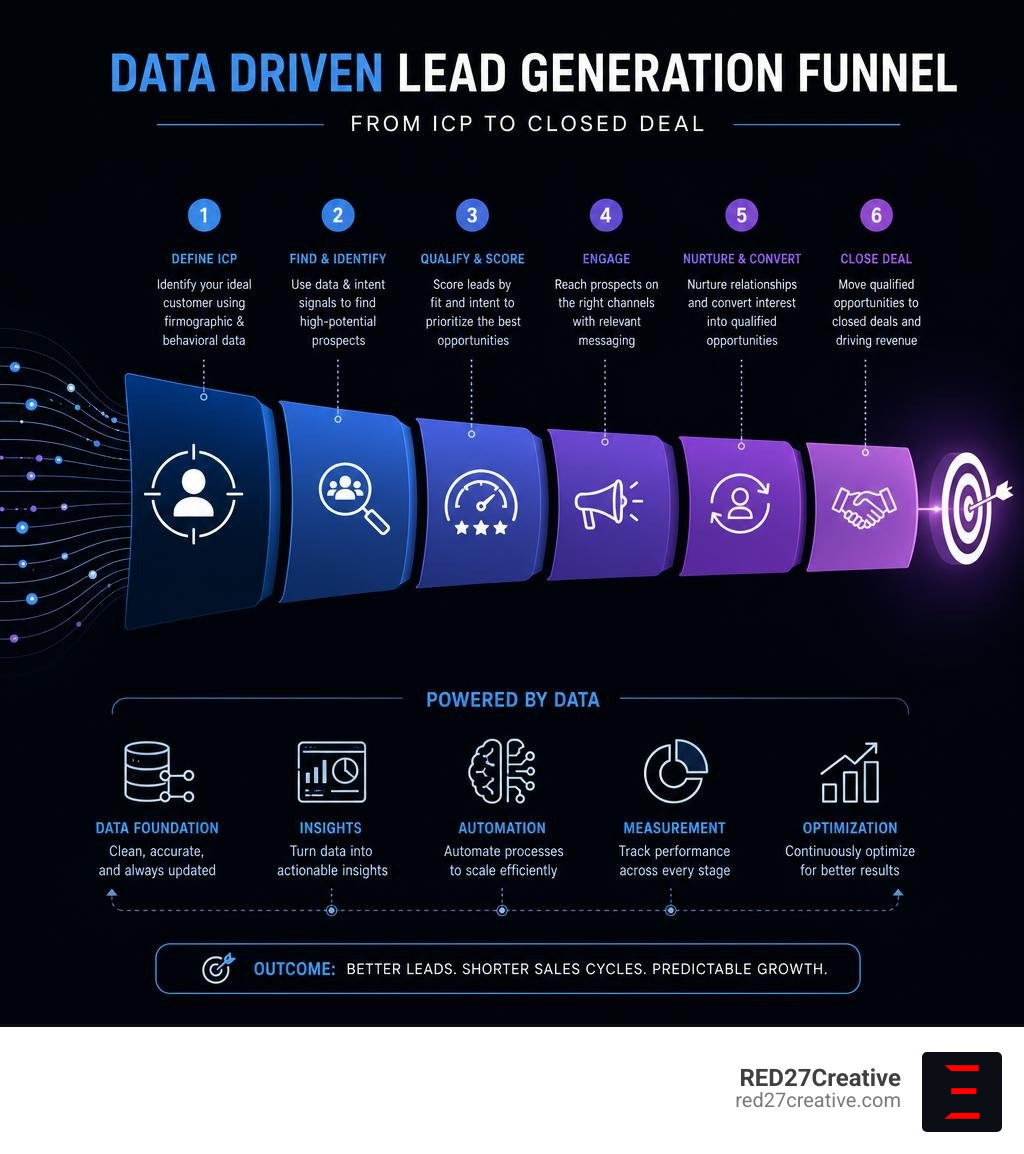
Data driven lead generation terms simplified:
What is a Data Driven Lead Generation Strategy?

A data driven lead generation strategy is a systematic approach to identifying, attracting, and converting potential customers using quantitative and qualitative data. Instead of relying on gut feelings or purchasing outdated, static email directories, we analyze real-time behaviors, firmographic characteristics, and intent signals to find high-value prospects.
Traditional approaches often treat every prospect the same, pushing generic marketing messages across broad demographics. This “spray-and-pray” method results in high acquisition costs, poor conversion rates, and frustrated sales teams. In contrast, modern, data-backed strategies rely on continuous feedback loops. By monitoring how prospects interact with our digital assets, we can adjust campaigns in real-time to match their exact needs.
By partnering with professional B2B lead generation services, we can transition from static marketing to dynamic pipeline building. This transition optimizes our resource allocation, ensuring that marketing spend and sales hours are focused only on the accounts most likely to close.
Utilizing data-backed strategies is about driving ROI improvement. When we base our outreach on concrete indicators rather than assumptions, we dramatically reduce waste, shorten our sales cycles, and build a more predictable revenue engine.
Key Benefits of Data Driven Lead Generation
Transitioning to a data-backed model offers immediate improvements in client acquisition and lead conversion rates. When we target accounts based on hard data, our sales and marketing teams no longer waste time on low-fit prospects.
To illustrate the differences, let’s look at how traditional and data-driven methods compare:
| Feature | Traditional Lead Generation | Data-Driven Lead Generation |
|---|---|---|
| Targeting Method | Broad demographics and purchased static lists | Dynamic Ideal Customer Profiles (ICPs) and intent signals |
| Messaging | Generic, one-size-fits-all templates | Highly personalized content tailored to specific pain points |
| Sales Alignment | Marketing hands over raw contacts without scoring | Marketing passes verified, highly scored SQLs |
| Resource Allocation | High spend on low-yield, untracked channels | Budget optimized toward high-conversion traffic sources |
| Pipeline Velocity | Slow; sales spends weeks qualifying cold leads | Fast; sales engages warm prospects already in-market |
By focusing our resource allocation on verified data, we achieve higher pipeline velocity. Prospects move through our funnel faster because we address their specific pain points at exactly the right moment in their buying journey.
Building Accurate Ideal Customer Profiles (ICPs) with Data
An Ideal Customer Profile (ICP) is not a fictional persona based on assumptions. An accurate, data-driven ICP is built by analyzing our top 20% of existing customers to identify their shared characteristics.
To build a high-performing ICP, we must collect and analyze three distinct layers of data:
- Firmographic Data: This includes company size, annual revenue, industry vertical, geographic location, and employee count.
- Technographic Data: This maps the prospect’s current technology stack, including their CRM, hosting providers, marketing automation software, and specialized tools.
- Behavioral Indicators: This tracks how they interact with our website, the content they download, and their overall search behavior across the web.
Evaluating these layers allows us to design comprehensive B2B lead generation solutions that target accounts with surgical precision.
An equally important step is identifying negative attributes. Negative attributes are characteristics of businesses that we should deliberately exclude from our targeting, such as companies using a competitor’s locked-in contract, businesses below a certain revenue threshold, or specific industries that our service model cannot support. Defining these negative attributes prevents wasted outreach budget.
Defining our target market with this level of detail allows us to build lists of high-value targets that match our most successful real-world accounts.
Sourcing High-Value Data Types
To build a complete, 360-degree view of our prospects, we must source and combine multiple data types:
- First-Party Data: The information we collect directly from our audience through our website analytics, CRM, surveys, and customer interviews. This is our most valuable asset because it represents direct, verified interactions with our brand.
- Third-Party Data: Enriched intelligence sourced from external databases that provides broader context about market trends, firmographics, and contact details.
- Contact Data: Up-to-date mobile phone numbers, direct dials, and validated email addresses. In a hybrid work environment, verified mobile numbers are far more valuable than standard office direct lines.
- Demographic Data: Job titles, seniority levels, decision-making authority, and professional backgrounds of target stakeholders.
Leveraging modern AI-powered prospecting tools allows us to synthesize these data types automatically. Instead of manually building lists, we can use conversational natural language searches to instantly generate highly accurate prospect pools that are refreshed in real-time.
Leveraging Buyer Intent Data and Lead Scoring
Buyer intent data acts as an early-warning system, identifying prospects who are actively researching solutions like ours before they ever fill out a form on our website. This data is captured through search query patterns, content consumption across third-party websites, and on-site behavior like visiting pricing pages or reading technical case studies.
By understanding these signals, we can master our B2B lead generation funnel and transition from reactive marketing to predictive sales engagement.
We also monitor sales trigger events, such as executive leadership changes, funding rounds, corporate expansions, or a prospect starting or stopping specific technologies. These events create immediate windows of opportunity.
Aligning our outreach with these triggers dramatically reduces our time to engagement. In fact, research shows that companies leveraging intent data and direct dials can achieve a full ROI in as little as 8 weeks, even within traditional 6-to-8-month B2B sales cycles.
Implementing Advanced Lead Scoring in Data Driven Lead Generation
Lead scoring is the process of assigning numerical values to prospects based on their fit and behavior. This system ensures that our sales team only spends time on prospects who are genuinely ready to buy, creating a highly efficient MQL-to-SQL handoff.
A modern lead scoring model combines two distinct scoring dimensions:
- Fit Scoring (Explicit Data): Points awarded based on how well the prospect matches our ICP (e.g., job title, industry, company revenue).
- Behavioral Scoring (Implicit Data): Points awarded based on digital actions (e.g., downloading a whitepaper, attending a webinar, visiting a pricing page).
To keep this process transparent, we can implement open-source Explainable AI lead scoring systems. Unlike traditional “black-box” scoring tools, an explainable model provides clear, written explanations for every score (such as “+25 points for strong revenue fit” or “-30 points for enterprise lock-in risk”). This absolute clarity builds trust between marketing and sales, ensuring both teams are aligned on lead prioritization.
Executing Multi-Channel Outreach and Automation

Once we have identified and scored our high-value prospects, we must engage them across multiple touchpoints. A successful multi-channel outreach strategy coordinates email automation, social media engagement, direct mail, and phone calls into a single, seamless sequence.
To make this outreach effective, we must focus on attracting ideal buyers with content that addresses their specific, real-world challenges. Rather than sending generic, automated sales pitches, we use data insights to tailor our messaging to the prospect’s industry, role, and current technology stack.
Conversational AI and advanced automation tools allow us to achieve personalization at scale. By using automated systems to handle repetitive tasks—like booking meetings, updating CRM records, and sending timely follow-ups—our sales reps can focus 100% of their energy on holding high-value conversations with interested prospects.
Ensuring Data Quality and Compliance
Data-driven outreach is only as good as the underlying data. Working with inaccurate, outdated, or unverified information wastes resources, damages your brand, and can lead to severe legal penalties.
To maintain a healthy, compliant system, we must adhere to several strict guidelines:
- GDPR and CCPA Compliance: Ensure that all prospective data is sourced, stored, and processed in strict accordance with global privacy laws. We must maintain clear consent records, offer easy opt-out options, and only use compliant, verified data partners.
- Data Hygiene: Regularly audit and clean our databases. Outdated contact records should be enriched or purged to protect our sender reputation and prevent high bounce rates.
- Lead Validation: Implement systematic verification processes to filter out spam, customer service inquiries, and job applications. Research indicates that roughly 50% of raw online inquiries are not actual sales leads. Validating this data ensures we only optimize campaigns based on real business opportunities.
Using professional signal-driven prospecting solutions helps us maintain data integrity. These platforms constantly verify contact details, track executive movements, and monitor compliance status, giving our sales reps clean, accurate, and actionable lists.
Measuring Success: KPIs and Attribution Models
To prove the ROI of our data driven lead generation efforts, we must move beyond simple vanity metrics like click-through rates or raw lead volume. Instead, we focus on deep financial and pipeline metrics that show exactly how our marketing spend translates into closed revenue.
First, we must track pipeline velocity—the speed at which a prospect moves from initial contact to a closed-won deal. Measuring this velocity allows us to identify bottlenecks in our sales cycle and optimize our resource allocation. We also measure customer lifetime value (LTV) against our customer acquisition cost (CAC) to ensure our lead generation efforts are driving profitable, long-term business growth.
To understand which marketing channels are actually driving these results, we must implement multi-touch attribution models. Rather than relying on simple first-touch or last-touch models, we often utilize a W-shaped attribution model.
The W-shaped model distributes credit across the key milestones of the buyer’s journey: 30% to the first touch, 30% to the lead creation touch, and 30% to the opportunity creation touch, with the remaining 10% spread across intermediate touchpoints.
Using this model gives us a complete, accurate view of how our campaigns work together to generate qualified leads and close enterprise-level deals.
Frequently Asked Questions about Data Driven Lead Generation
What is a data-driven lead generation strategy?
A data-driven lead generation strategy is a systematic process that uses quantitative behavioral data, firmographics, and buying intent signals to identify, target, and nurture high-value prospects. Unlike traditional broad marketing, it relies on continuous data analysis to optimize campaigns, improve conversion rates, and maximize marketing ROI.
How does buyer intent data improve lead quality?
Buyer intent data improves lead quality by identifying prospects who are actively researching industry-specific topics, pain points, or competitor solutions. Engaging prospects who already display active buying signals allows sales teams to prioritize high-intent accounts, dramatically reducing the time to engagement and shortening the overall sales cycle.
How do you ensure GDPR and CCPA compliance in lead generation?
Compliance is maintained by sourcing data only from verified, legally compliant data providers, implementing rigorous consent management systems, and maintaining clean databases. It also requires giving prospects clear, accessible opt-out options, practicing data minimization, and ensuring all automated outreach respects regional privacy regulations and sender guidelines.
Conclusion
Building a modern, predictable business requires moving away from guesswork and embracing the science of data. By combining accurate ICPs, real-time intent signals, advanced lead scoring, and multi-channel automation, you can build a highly efficient revenue engine that consistently attracts and converts your ideal buyers.
At RED27Creative, based in Geneva, Illinois, we specialize in helping businesses across our local communities—including Batavia, Aurora, St. Charles, Plainfield, Oswego, Naperville, and Chicago—as well as national brands, build these high-performing marketing systems. With over 20 years of experience, we build unified engines that connect your website, advanced SEO, local listings, and lead generation into a single source of growth.
Ready to transform your marketing into a predictable, data-backed revenue engine? Partner with RED27Creative for lead generation services today, and let’s build a strategy designed to deliver lasting ROI.

Kiel Tredrea
https://red27creative.comTop Marketing Agency • Web, SEO & Leads • RED27Creative