Crafting Compelling Narratives: The Art of the Visual Story

The Power of Visual Communication in Today’s Digital World
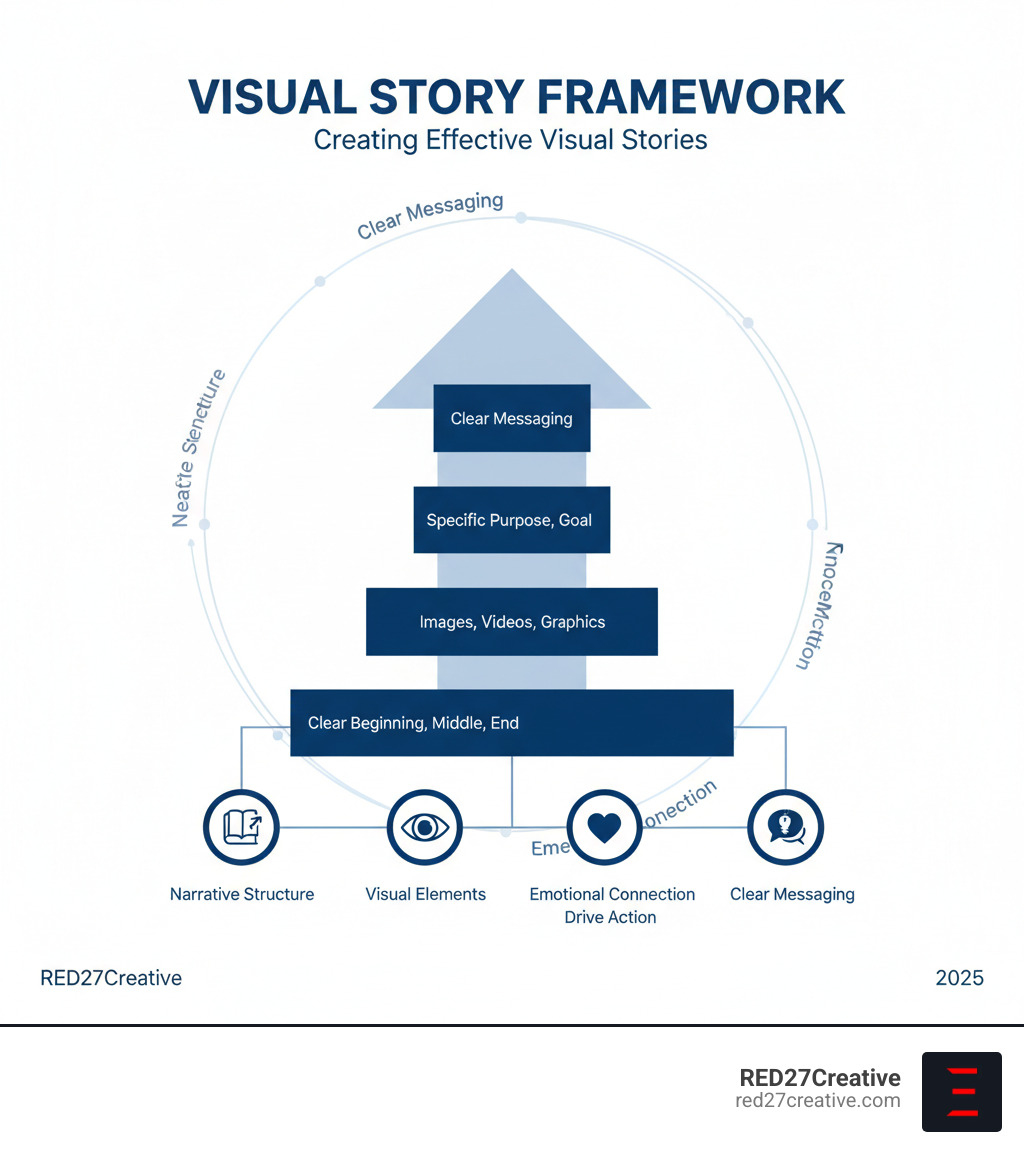
A visual story uses compelling imagery, video, or graphics with a narrative structure to communicate messages more effectively than text alone. It’s a narrative told through visuals.
Here’s what defines a visual story:
Key Components:
- Narrative Structure: A clear beginning, middle, and end.
- Visual Elements: Images, videos, graphics, or animations.
- Emotional Connection: Evokes feelings and drives action.
- Clear Message: Communicates a specific purpose or goal.
The human brain processes visual information 60,000 times faster than text. This is cognitive science at work. After three days, people remember only 10% of text-based information, but when combined with visuals, retention jumps to 65%.
With 90% of information transmitted to our brain being visual, storytelling through images has become essential. Visuals help audiences understand, retain, and share information more effectively.
The challenge for marketers isn’t whether to use visual storytelling, but how to do it authentically. As attention spans shrink, brands that master the art of visual narrative gain a significant competitive advantage.
I’m Kiel Tredrea, founder of RED27Creative. Over the past 20 years, I’ve helped businesses transform their marketing through strategic visual story development. My experience shows that companies using well-crafted visual stories consistently outperform competitors in engagement, retention, and revenue.
What is a Visual Story and Why Does It Matter?
Imagine explaining a sunset with only words. You can describe the colors and the feeling, but a photograph makes someone instantly feel it. That’s the magic of a visual story.
A visual story is a narrative that speaks through images, videos, or graphics rather than relying on text. It can be a single powerful photo, a series of illustrations, or a short video that takes viewers on an emotional journey. The key is to show, not just tell.
Think about your social media feed. What stops your scroll? It’s rarely a wall of text. Our brains are drawn to visuals because they communicate instantly and universally, crossing cultural and language barriers.
Researchers studying Visual Narrative Structure have found that combining narrative with visual media creates uniquely powerful communication tools. This isn’t just a marketing trend—it’s backed by cognitive science.
At RED27Creative, we’ve seen businesses transform customer connections with visual storytelling. Our Marketing Video Production services and integrated visual campaigns deliver measurable results.
The Science Behind the Sight
Your brain can process an image in just 13 milliseconds—faster than you can blink. MIT researchers found this incredible processing speed, which explains why a visual story grabs attention almost instantaneously.

The numbers tell a powerful story. We process visuals 60,000 times faster than text, and about 90% of all information reaching our brain is visual.
Most importantly, while people remember only 10% of text after three days, adding visuals boosts retention to 65%. This makes your message more memorable and impactful.
Visual information flows directly to our brain’s emotional centers, creating stronger, more lasting connections. For visual learners, who make up 65% of the population, this difference is even more pronounced.
A well-crafted visual story doesn’t just inform; it resonates on a deeper emotional level. This builds trust and understanding in ways that text alone struggles to achieve.
How a Visual Story Differs from Text
Reading requires work. Your brain decodes symbols and builds mental images sequentially. A visual story, on the other hand, delivers the complete picture in an instant.
This immediacy creates emotional resonance. Nielsen research shows that ads with above-average emotional responses lead to 23% higher sales. People remember 80% of what they see compared to just 20% of what they read.
Visuals also tap into our subconscious, shaping perceptions and decisions before we even realize it. A photo of a smiling customer communicates trust more powerfully than a dozen written testimonials.
While language creates barriers, visuals transcend them. A visual story about overcoming challenges resonates globally, which is invaluable in our connected world.
At RED27Creative, our Content Writing and Editing Services blend compelling visuals with strategic messaging. We ensure every element works together to create maximum impact.
The shift from telling to showing is a strategic necessity. When you have only seconds to capture interest, a visual story gives you the best chance to succeed.
The Core Elements of an Unforgettable Visual Narrative
Creating a memorable visual story is more than just combining attractive images. It’s about crafting an intentional narrative where every element works together to deliver your message with impact.

Think of your visual story like a house. The foundation is your narrative arc—a clear beginning, a developing middle, and an end that inspires action. Without this structure, even stunning visuals feel confusing.
Authenticity forms the walls. Your audience can spot fake emotions and staged scenarios easily. Real people and genuine situations build the trust that turns viewers into customers and makes your story stick.
Cohesion is the roof that ties it all together. Every visual element, color choice, and design decision should feel like part of the same family. When your brand identity is consistent, your audience begins to recognize your style instantly. This is where professional Graphic Design St Charles Il services can make a difference.
Key Ingredients for an Effective Visual Story
Every powerful visual story needs five essential ingredients. First, a clear message—one focused takeaway. If you try to say everything, you’ll end up saying nothing.
Your story also needs compelling characters or subjects. Whether it’s a person, a product, or an abstract concept, give your audience something to connect with. People relate to people.
A defined plot is crucial. Even simple narratives benefit from a beginning that sets up a situation, a middle that builds interest, and an end that provides resolution or a call to action.
The emotional core determines if your story is memorable. Visuals excel at triggering feelings like happiness, curiosity, or empathy. The strategic use of colours plays a huge role here, as different colors can instantly shift the emotional tone.
Finally, strong visual hierarchy acts as a roadmap for the audience’s eyes. Use size, contrast, and placement to highlight what matters most, ensuring people see your key message first.
Common Media and Formats
Visual storytelling offers many creative tools. Photography remains one of the most powerful, from photo essays to authentic portraits. A single photo can convey what might take paragraphs to explain.
Videography adds motion and sound for immersive experiences. Whether it’s a behind-the-scenes look, customer testimonials, or an animated explainer, Digital Marketing Videography brings stories to life.
Infographics and data visualization transform boring numbers into engaging narratives. Complex information becomes digestible, helping your audience understand insights at a glance.
Illustrations and animation offer unlimited creative freedom. These formats work well for abstract concepts or for creating a unique brand aesthetic that photos alone cannot achieve.
Interactive content like quizzes and polls invites your audience to participate in your story. This engagement creates a deeper, more memorable connection than passive viewing.
Don’t overlook user-generated content. Authentic photos and videos from real customers often outperform polished content, building community and providing powerful social proof.
Our Social Media Content Creation services help you combine these formats to create rich narratives that capture attention and drive results.
Leveraging Visual Storytelling in Your Marketing Strategy
In today’s market, visual storytelling is the backbone of successful marketing. When was the last time you scrolled past a compelling video to read a text-heavy post? Your answer shows where marketing is headed.
Statistics show that seventy-five percent of customers buy from businesses they trust. A well-crafted visual story builds that recognition and trust faster than any other approach.
Digital platforms like Instagram, TikTok, and LinkedIn have made visual content essential. AI and machine learning are taking this further, allowing brands to create personalized visual experiences that adapt to user preferences in real-time.
Our research on B2B Marketing Trends shows that companies using strategic visual content see higher engagement and conversion rates. Visuals simply cut through the noise more effectively.
When you combine compelling visuals with a solid technical foundation through professional Website Design Services, you create a marketing ecosystem that builds your brand around the clock.
Essential Steps to Create Your Visual Story
Creating a compelling visual story is a strategic process. Here’s how we approach it with our clients:

1. Define your goals and KPIs. What should your visual story accomplish? Are you aiming for brand awareness, lead generation, or sales? Clear objectives are crucial for crafting content that moves the needle.
2. Know your audience. Go beyond demographics. What are their pain points? What content formats do they prefer? The better you understand their world, the more your story will resonate.
3. Develop your core concept. This is the heart of your narrative—the central idea or emotion. It should align with your brand values and address something your audience genuinely cares about.
4. Storyboard the narrative. This roadmap for your visual journey outlines key scenes, visual elements, and calls-to-action. It ensures your story flows logically and keeps viewers engaged.
5. Create and curate visuals. Whether shooting new content or using existing assets, maintain consistent quality that aligns with your brand aesthetic. Professionalism here is key.
6. Edit and refine. Optimize your content for different platforms and devices. This includes adjusting aspect ratios for social media and ensuring everything looks great on mobile.
7. Distribute and promote. Distribute your visual story strategically. Different platforms require different approaches, so adapt your content format while maintaining the core message.
Inspiring Examples Across Industries
Visual storytelling works in every industry, but the approach varies. Here are some standout examples.
In journalism, The New York Times uses visual storytelling to make complex information accessible. Their interactive data maps transform statistics into compelling narratives about major events.
Non-profit organizations have found that emotional visual stories drive action. WaterAid’s impactful fundraising videos combine personal stories with broader issues, creating shareable and supportive content.
Technology companies use animated explainer videos to simplify complex products. These videos turn abstract concepts into relatable stories that potential customers can understand.
E-commerce businesses leverage user-generated content to build trust. Authentic photos and videos from customers create powerful social proof that traditional advertising can’t match.
For our clients in manufacturing, we create Manufacturing Case Studies that use industrial photography and videography to showcase complex processes. These visual stories transform technical specs into compelling narratives about innovation and precision.
Measuring Success and Avoiding Common Pitfalls
Creating a compelling visual story is only half the battle. To succeed, you must understand how your audience responds and learn from the data.
Measuring your visual story success isn’t about vanity metrics. It’s about understanding if your investment is driving real business results like brand awareness, lead generation, or conversions.
Our approach at RED27Creative centers on The Competitive Edge of Data-Driven Marketing. We use analytics and A/B testing to continuously refine your visual storytelling efforts.
How to Measure the Impact of Your Campaign
To know if your visual story is working, start with the basics. Engagement metrics (likes, shares, comments) tell you if people care about your content. High engagement means your story resonates emotionally.
Next, look at website traffic. Does your visual content drive people to learn more about your business? Compelling visual narratives should make people curious enough to click through.
Conversion rates are where the rubber meets the road. A beautiful visual story that doesn’t inspire action is just expensive art. Track sign-ups, downloads, or purchases to see if your visuals are doing their job.
Lead generation metrics are vital for B2B companies. Research shows that 50% of customers from paid ads are more likely to purchase than those from organic search, but only if your visual content captures their information effectively.
Don’t overlook brand sentiment. Social listening tools can reveal how people feel about your brand after seeing your visual stories. A campaign can improve public perception, which pays dividends long-term.
Our SEO Project Management services ensure your visual content is findable and optimized for the metrics that matter most.
Pitfalls to Avoid in Visual Storytelling

Many businesses fall into predictable traps. The biggest mistake is prioritizing style over substance. If your visuals don’t support a clear message, they’re just eye candy.
Inauthenticity kills visual stories. Audiences can spot forced narratives and mismatched stock photos. The most powerful stories feel genuine because they are.
Another pitfall is creating beautiful content that ignores the target audience. Your visual story must speak to your customers’ interests and values to drive results.
Poor quality visuals undermine your credibility. Blurry photos or amateur graphics make your business look unprofessional, regardless of your product quality.
A lack of clear messaging is also critical. If your audience can’t quickly understand your point, they’ll move on. Simplicity beats complexity every time.
Finally, failing to optimize for mobile is a major error. With over 52% of internet traffic on mobile, your visual story must work on smartphones. Google’s “Mobilegeddon” update penalizes sites that aren’t mobile-friendly.
That’s why our Responsive Website Development ensures your visual narratives look stunning and function perfectly on every device.
Frequently Asked Questions about Visual Storytelling
As I work with clients at RED27Creative, these questions about visual storytelling come up frequently. Understanding the answers helps businesses make smarter marketing investments.
What is the main goal of a visual story?
The main goal is to create an emotional connection. A visual story communicates a message more powerfully than words alone by making the audience feel something. This simplifies complex information, makes the message memorable, and drives specific actions like a purchase or a share.
Can I create a visual story without a big budget?
Absolutely. High-quality smartphone cameras and accessible editing tools have made visual storytelling affordable. What matters most is not your budget, but your concept and authenticity. A genuine story told with creativity will always outperform an expensive production that lacks a clear, compelling narrative.
What is the single most important element of a visual story?
The story itself is the most important element. While high-quality visuals are the vehicle, the narrative is the engine. A compelling, authentic, and well-structured story is what drives engagement and makes your content memorable. The visuals should always serve the story, not the other way around.
Conclusion: Tell Your Story, Visually
This guide reveals a powerful truth: visual storytelling isn’t just a marketing buzzword. It’s how humans are naturally wired to connect and understand the world.
Your brain is built to prioritize visuals. This biological fact is what makes visual storytelling so effective. It’s a direct line to how your audience receives and retains information.
An effective visual story transcends language barriers, simplifies complex ideas, and forges authentic emotional connections in milliseconds. You’re speaking the language your audience’s brain is designed to understand.
After 20 years in this industry, I’ve learned that the most successful visual stories are built on authenticity and strategy. They start with understanding your audience and crafting a clear message that matters to them.
The future of storytelling is visual. As platforms like TikTok and Instagram Reels dominate content consumption, brands that master visual narrative will stay relevant.
At RED27Creative, we’ve seen how the right visual story can transform a business. Whether you’re in Geneva IL, Batavia IL, St. Charles IL, or Chicago IL, we know every brand has a unique story worth telling.
Our approach combines strategic marketing, SEO expertise, and compelling visual media to help you tell your story in a way that drives real growth. Our Photo and Videography services capture the essence of your brand and translate it into content that connects and converts.
Your story matters. The question isn’t whether you should tell it visually—it’s how quickly you can start. When attention is the most valuable currency, visual storytelling is your competitive advantage.

Kiel Tredrea
https://red27creative.comTop Marketing Agency • Web, SEO & Leads • RED27Creative