From Browsers to Buyers: Mastering Website Conversion Rate Optimization

Why Your Website Traffic Isn’t Turning Into Revenue
Website conversion rate optimization is the practice of increasing the percentage of visitors who complete a desired action on your site—whether that’s making a purchase, filling out a contact form, or requesting a quote.
Quick Answer: What You Need to Know About Website Conversion Rate Optimization
- What it is: The systematic process of improving your website to convert more visitors into leads or customers
- Why it matters: Even small improvements (1-2%) can dramatically increase revenue without spending more on traffic
- How to calculate it: (Total Conversions ÷ Total Visitors) × 100 = Conversion Rate %
- Average benchmark: Most websites convert between 2-4% of visitors
- Key focus areas: Landing pages, forms, checkout process, calls-to-action, and mobile experience
- Primary methods: A/B testing, user behavior analysis, data-driven improvements
If you’re getting traffic but not seeing results, you’re not alone. Most business websites convert only 2-3% of visitors into customers. That means 97 out of every 100 people leave without taking action.
The frustration is real. You invest in SEO, run ads, create content—and watch qualified prospects slip away. Your analytics show thousands of visitors, but your phone isn’t ringing and your contact form sits empty.
Here’s the reality: driving traffic is only half the equation. The other half is conversion optimization—the strategic process of turning browsers into buyers.
Website conversion rate optimization isn’t about tricks or hacks. It’s about understanding what your visitors need, removing barriers that stop them from converting, and making it easy for them to take the next step. Small, strategic changes to your website can double or triple your lead flow without spending another dollar on traffic.
The difference between a 2% and a 4% conversion rate isn’t just numbers—it’s the difference between struggling to hit revenue goals and having more qualified leads than your sales team can handle.
I’m Kiel Tredrea, founder of RED27Creative, and over the past 20 years I’ve helped hundreds of businesses transform underperforming websites into lead-generation engines through strategic website conversion rate optimization. My team and I combine data analysis, user behavior insights, and proven testing methods to create measurable improvements that compound over time.
What is Website Conversion Rate Optimization and Why Does It Matter?
Website conversion rate optimization (CRO) is the practice of increasing the percentage of users who complete a desired action on your website. These actions, known as “conversions,” can range from making a purchase (macro-conversion) to subscribing to a newsletter (micro-conversion). By understanding user behavior, identifying obstacles, and making strategic improvements, you can drive significant business growth.
CRO is crucial because it directly impacts your bottom line. Bringing visitors to your website is only half the battle; you need to turn those visitors into leads, customers, and fans. It’s about getting more value from your existing traffic, making your marketing efforts more efficient, and ultimately lowering your customer acquisition costs.
How to Calculate Your Conversion Rate
Calculating your conversion rate is straightforward and provides a clear benchmark for your optimization efforts. It helps you understand how effectively your website is performing.
- Conversion Rate Formula: (Total Conversions / Total Visitors) x 100
- Example: If your website has 10,000 visitors per month that generate 100 leads, your website visitor-to-lead conversion rate would be 1%. If you had 500 newsletter sign-ups from 20,000 visitors last quarter, your conversion rate would be 2.5%.
- Tools: We find that marketing analytics tools equipped with conversion tracking capabilities make this process straightforward. These tools allow us to define custom conversion events and monitor them over time.
What is a Good Conversion Rate?
The average conversion rate is often cited as anywhere between 1% and 4%. However, this figure can be misleading because every website, page, and audience is different. According to WordStream’s industry benchmark data, conversion rates vary significantly across industries, while some high-performing landing pages can convert far higher.
Instead of chasing a universal benchmark, we believe it’s more productive to focus on improving your own baseline. A high conversion rate means your website is well-designed, formatted effectively, and appealing to your target audience.
Even a small increase, like from 1% to 2%, can double your leads and customers, significantly boosting your marketing ROI. We aim to understand your specific goals and optimize for your unique audience, turning your browsers into buyers right here in Geneva, Batavia, Aurora, St. Charles, Plainfield, Oswego, Naperville, and Chicago.
The Core Website Conversion Rate Optimization Process
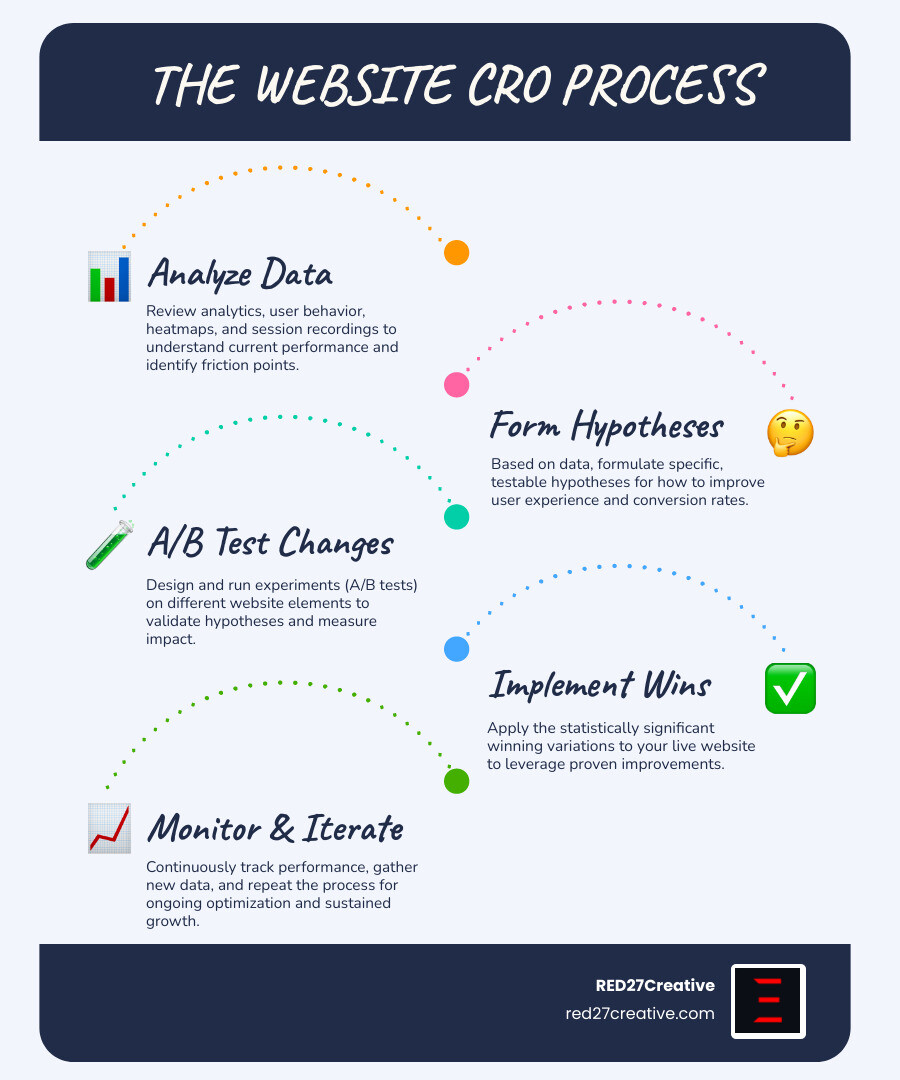
Effective CRO is a structured, data-driven process, not guesswork. It involves analyzing user behavior, forming hypotheses, testing changes, and iterating based on results to ensure every change has a measurable impact.

Our process begins with a deep dive into your website’s performance, using funnel analysis and user journey mapping to find where visitors drop off. We then use prioritization frameworks like ICE (Impact, Confidence, Ease) to focus on changes that will yield the greatest return. This data-driven approach is truly the competitive edge of data-driven marketing.
Gathering Qualitative and Quantitative Data
To truly understand your visitors, we combine quantitative data (the “what”) with qualitative insights (the “why”).
- Quantitative Data: We use analytics to track metrics like traffic sources and bounce rates. Tools like heatmaps and session replays show us what users are doing—where they click, scroll, and get stuck.
- Qualitative Data: We use surveys, polls, and user interviews to understand why they do it, uncovering their motivations and pain points. For businesses in Geneva, Naperville, or Chicago, understanding local customer behavior is key.
- We also help you start identifying anonymous website visitors to enrich your understanding of your audience.
The Role of Testing in Website Conversion Rate Optimization
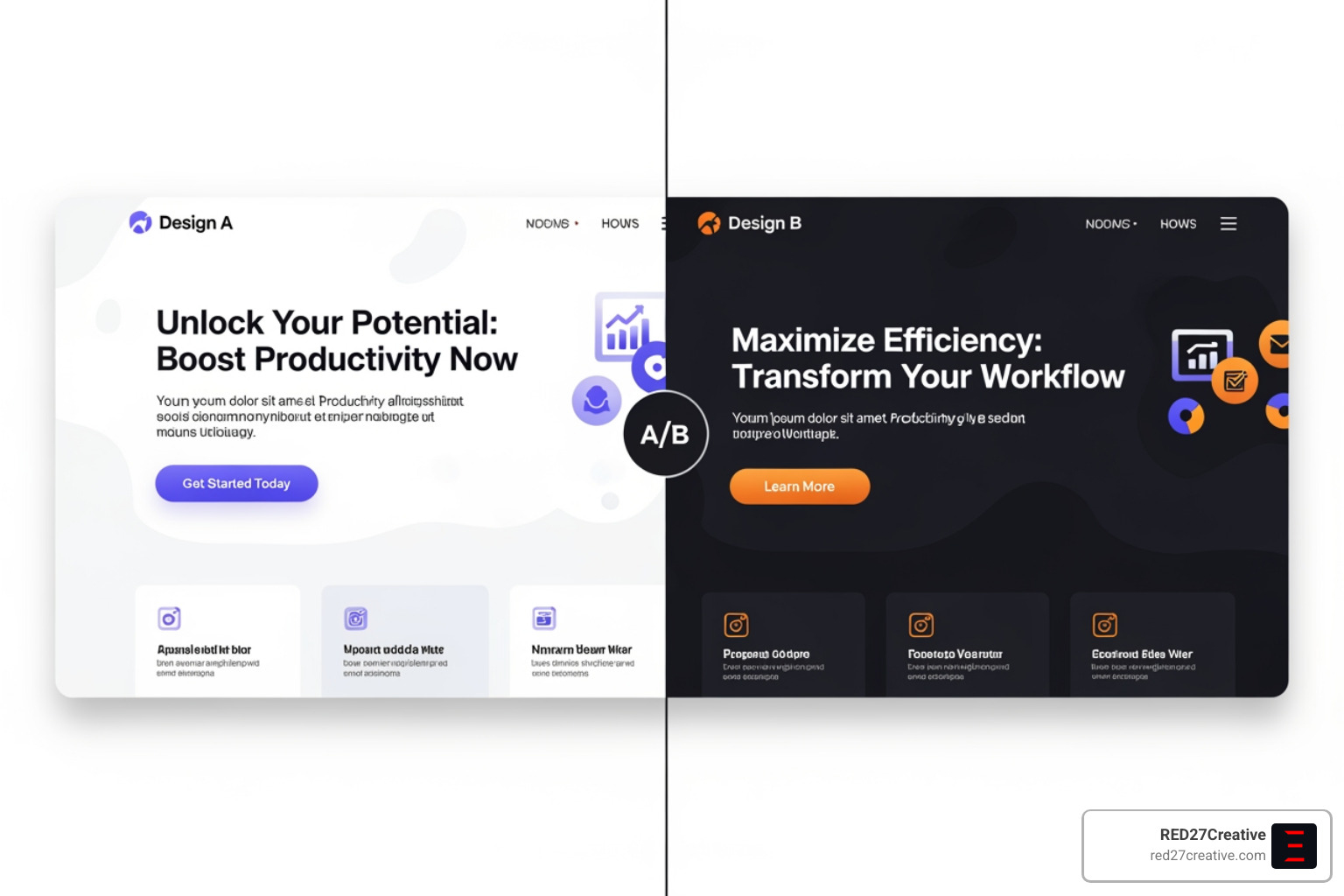
Testing is the engine of CRO. By comparing different versions of a web page (a “control” vs. a “variation”), you can determine which changes drive better results. This scientific approach ensures decisions are based on real user behavior, not assumptions. Since research from Optimizely shows only 12% of experiments produce a winning result, the goal is continuous learning, not just finding winners.
- Statistical Significance: We analyze results to ensure that any observed differences are statistically significant, meaning they are not due to random chance.
- Testing Elements: We systematically test various elements, including headlines, calls-to-action (CTAs), images, and page layouts.
- Multivariate Testing: For more complex changes, we use multivariate testing to test multiple elements simultaneously and find the optimal combination.
- Learn more about effective website testing strategies that are custom to your business goals.
Actionable Strategies to Boost Website Conversions
With a solid process in place, we can implement proven tactics to overcome common conversion barriers, build trust, and motivate action. These strategies are refined through continuous testing and adapted to your specific audience in Aurora, St. Charles, Plainfield, or wherever your customers are.
- Value Proposition Clarity: Your unique selling point should be immediately clear. Summarize your value proposition in 10 words or less and feature it prominently so visitors quickly understand “what’s in it for me.”
- Headline Optimization: A compelling headline can significantly increase engagement. We regularly test different headlines to find the combinations that perform best.
- Call-to-Action (CTA) Design: Your CTAs should be prominent, visually distinct, and use clear, action-oriented language like “Get Your Free Quote Now!” instead of a generic “Submit.”
- Social Proof: Reviews, Testimonials & Case Studies: People trust other people. According to BrightLocal’s consumer review survey, 87% of users rely on reviews. Displaying testimonials, reviews, and case studies builds credibility and reduces perceived risk. See how testimonials drive results for businesses like yours.
- Trust Signals: Security Badges, Clear Return Policies: Clearly communicate security measures (SSL certificates, site seals) and make policies easily accessible, as many buyers abandon orders due to unclear or unfavorable return policies.
Optimizing High-Impact Pages and Elements
To achieve the most significant gains, we focus on pages and elements with the highest impact on your conversion goals.
- Homepage and Landing Pages: The homepage is your first impression, while landing pages are built for a single action. We optimize both with clear headlines, concise copy, minimal distractions, and prominent CTAs.
- Product Pages: For e-commerce, these are critical. We ensure high-quality product photography, clear descriptions, and prominently displayed customer reviews.
- Checkout and Forms: According to the Baymard Institute, a complex checkout is a major cause of cart abandonment. We simplify the process by reducing form fields to only the essentials and offering guest checkout to reduce friction.
Improving User Experience for Website Conversion Rate Optimization
A seamless user experience (UX) is essential for conversions. If your site is slow, confusing, or not mobile-friendly, visitors will leave.
- Site Speed (aim for under four seconds): Slow site speed kills conversions. Research shows page load times under four seconds significantly outperform slower sites, so we use tools like PageSpeed Insights to improve loading times.
- Mobile-First Design: With over half of global web traffic coming from smartphones, mobile optimization is non-negotiable. This means responsive design, larger buttons, and simplified navigation. Streamlined payment options also dramatically improve mobile checkout performance. Discover our responsive website development services that ensure your site performs flawlessly on any device, anywhere from Oswego to Chicago.
- Simple, Intuitive Navigation: Users should easily find what they’re looking for. Clear, logical navigation and smart search bars with predictive results are vital to help customers move quickly from browsing to buying.
Frequently Asked Questions about Website Conversion Rate Optimization
What is a simple definition of CRO?
Conversion Rate Optimization (CRO) is the systematic process of increasing the percentage of website visitors who take a desired action, such as making a purchase or filling out a form. It’s about making your website more effective at turning visitors into customers or leads.
How does CRO differ from SEO?
SEO focuses on attracting more visitors to your website from search engines, while CRO focuses on converting those visitors into customers. SEO brings people in; CRO encourages them to take action. Both work best when used together to maximize online success.
How long does it take to see results from CRO?
Results from CRO can appear within a few weeks after implementing changes or running tests, depending on your website traffic. However, CRO is an ongoing process of continuous improvement, aiming for sustained growth over time. It’s an iterative journey, not a one-time fix.
Turn Your Website into a Growth Engine
Mastering website conversion rate optimization is not a one-time project—it’s a mindset shift. By understanding your customers, testing improvements, and committing to ongoing optimization, you can transform your website into a powerful engine for leads and revenue.
At RED27Creative, we build data-driven systems that connect every part of your marketing for unified growth. From our base in Geneva, Illinois, we serve businesses across Batavia, Aurora, St. Charles, Plainfield, Oswego, Naperville, and Chicago, helping them establish a strong online foundation and turn visibility into consistent, qualified opportunities. If you’re ready to turn more website visitors into measurable success, we’re here to help.

Kiel Tredrea
https://red27creative.comTop Marketing Agency • Web, SEO & Leads • RED27Creative