What is a Lead Generation Specialist and Why Your Business Needs One

Why Every B2B Business Needs a Sales Lead Generation Specialist
A Sales lead generation specialist is a professional who identifies, engages, and qualifies potential customers to build a consistent pipeline of sales opportunities for your business. If you’re struggling to generate enough qualified leads or your sales team is spending too much time prospecting instead of closing deals, a specialist can transform your revenue growth by focusing exclusively on filling your pipeline with high-quality prospects.
What a Sales Lead Generation Specialist Does:
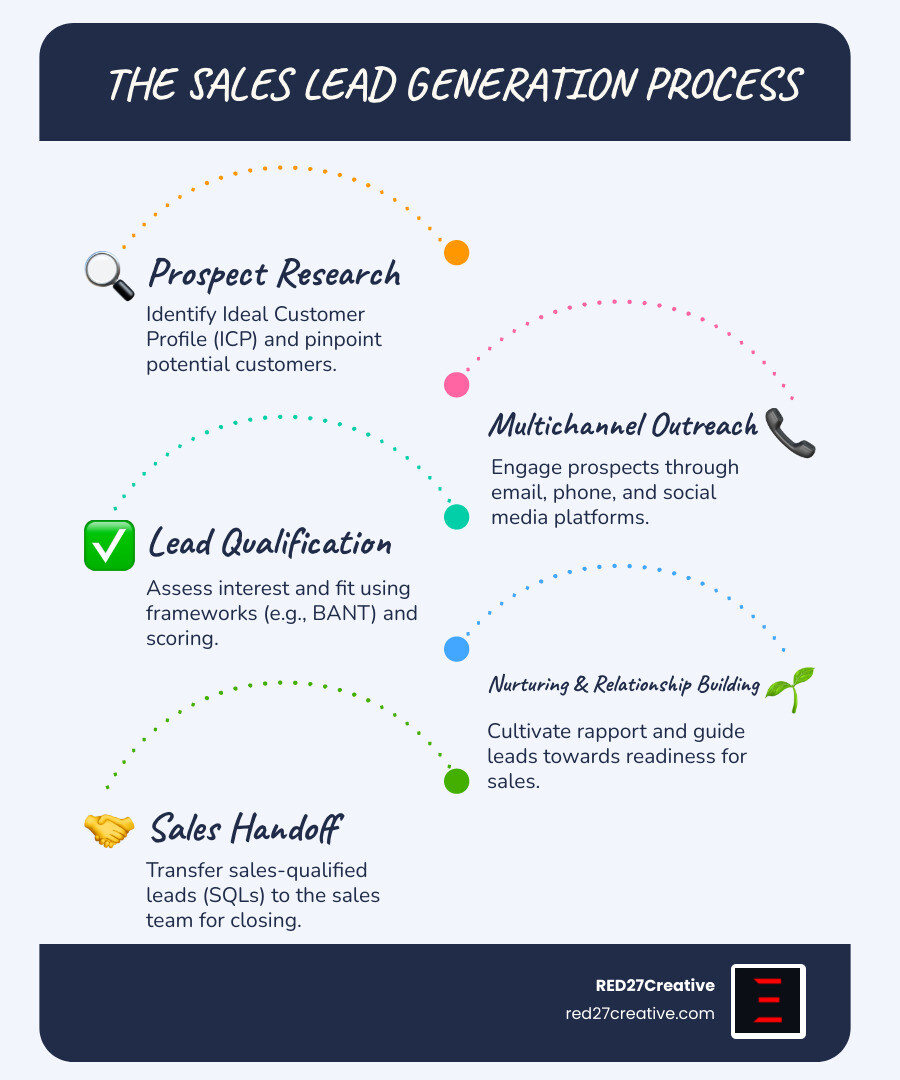
- Researches and identifies potential customers who match your ideal customer profile
- Reaches out through email, phone, LinkedIn, and other channels to engage prospects
- Qualifies leads by determining their level of interest and fit for your product or service
- Nurtures relationships until prospects are ready to talk to your sales team
- Manages data in your CRM and continuously improves the lead generation process
- Reports on performance using metrics like cost per lead, conversion rates, and pipeline value
The numbers tell a clear story: 68% of companies struggle with lead generation, and 91% of marketers say it’s their most important goal—yet 37% can’t convert those leads into customers. This gap is where a dedicated specialist makes the difference. They solve the challenge of getting the right leads at a sustainable cost, preventing wasted marketing budgets and sales team burnout. By building a systematic approach to finding and qualifying prospects, a specialist ensures your sales team focuses on closing deals, which shortens the sales cycle and drives predictable revenue.
I’m Kiel Tredrea, founder of RED27Creative. With over 20 years of experience building scalable lead generation systems for B2B companies, I know what separates high-performing *Sales lead generation specialists from the rest.*
The Core Role and Responsibilities of a Sales Lead Generation Specialist
A Sales lead generation specialist is the engine of your sales pipeline. Their primary role is to deliver a steady flow of high-quality prospects, freeing the sales team to focus on closing deals. This specialized focus shortens the sales cycle and increases revenue.
In competitive markets like Geneva IL, Batavia IL, Aurora IL, St. Charles IL, Plainfield IL, Oswego IL, Naperville IL, and Chicago IL, a dedicated specialist can transform a struggling sales pipeline. Their daily tasks blend strategic thinking, meticulous research, and proactive communication.
Prospect Research and List Building
Before any outreach begins, a Sales lead generation specialist dedicates significant time to understanding the “right” customer by developing an Ideal Customer Profile (ICP). This profile considers industry, company size, geography, and specific decision-maker roles.
They conduct thorough market research and competitor analysis to identify untapped opportunities and client pain points. Using tools like LinkedIn, they research contacts, identify sales points, and build targeted, accurate contact lists. A lead generation specialist is responsible for creating leads and nurturing them until they are ready to buy from the company. They use a variety of channels to identify and connect with potential customers, including email, LinkedIn, and phone calls. Experienced specialists rely on a multichannel approach.
Outreach and Engagement
Once potential leads are identified, the specialist initiates contact using a personalized, multichannel approach that resonates with the prospect’s specific needs and pain points. Tactics include:
- Cold Calling: Engaging prospects directly to gauge interest and gather information.
- Personalized Email Outreach: Crafting custom emails that highlight relevant solutions. We’ve found that even a small personal touch can make a big difference in email response rates.
- Social Selling: Utilizing platforms like LinkedIn to build rapport and share valuable insights.
- Content Distribution: Sharing relevant blog posts, case studies, or whitepapers that address prospect challenges.
These efforts are part of a broader, integrated marketing strategy. To learn more about how we can help you craft effective outreach strategies, explore our marketing strategy services.
Lead Qualification and Nurturing
After identifying a lead, the specialist qualifies them by evaluating their interest, budget, authority, need, and timeline (often using frameworks like BANT). This process distinguishes between a Marketing Qualified Lead (MQL), who has shown interest, and a Sales Qualified Lead (SQL), who is ready for a sales conversation.
They then nurture these leads, building relationships and providing valuable information until they are ready to engage with the sales team. This involves addressing objections, answering questions, and maintaining consistent communication. This careful nurturing ensures that when a lead is passed to sales, they are genuinely interested and well-informed, increasing the likelihood of a successful conversion.
Data Management and Process Improvement

A key aspect of the specialist’s role is meticulous data management within a Customer Relationship Management (CRM) system to log interactions, track lead status, and manage data. This ensures no lead falls through the cracks and that the sales team has a complete history of engagement.
Beyond record-keeping, specialists analyze performance data to refine the buyer’s journey and improve workflows. By finding what works best, their data-driven approach ensures lead generation efforts become increasingly efficient and effective over time.
Essential Skills and Strategies for Success
The evolving B2B landscape requires Sales lead generation specialists to be adaptable and skilled in both inbound and outbound strategies. A cyclical process of research, outreach, qualification, and analysis, guided by data-driven decisions, is key to ensuring continuous optimization and maximum impact.
Key Skills and Qualifications for a Sales Lead Generation Specialist
To excel in this dynamic role, a Sales lead generation specialist needs a diverse skill set:
- Communication Skills: Essential for engaging prospects, building rapport, and collaborating with sales and marketing teams.
- Problem-Solving: The ability to troubleshoot issues, overcome objections, and create more compelling campaigns.
- Research and Analysis: Adept at digging out data, understanding market trends, and identifying ideal prospects.
- Tech-Savviness: Proficiency with CRM software (like Salesforce or HubSpot), marketing automation tools, and data analysis platforms.
- Time Management: Given that 63% of a lead generation specialist’s time is often spent on activities that don’t generate revenue, structured time management is critical for efficiency.
While not a strict prerequisite, a college degree can provide a strong foundation; a majority (60.6%) of specialists have a bachelor’s degree. Many successful specialists also build expertise through practical, on-the-job experience, developing invaluable critical-thinking and fact-finding skills.
Channels and Strategies Used to Generate Leads
Sales lead generation specialists employ a wide array of channels and strategies to identify and contact prospects. The goal is to reach the right person at the right time with the right message. Here are some of the most effective:
- Email Marketing: Crafting personalized and targeted email campaigns.
- Cold Calling: Direct phone outreach to initiate conversations and qualify interest.
- Social Selling: Leveraging platforms like LinkedIn for networking, sharing insights, and direct messaging.
- Content Marketing: Creating valuable content (blogs, videos, whitepapers) that attracts and educates potential leads, drawing them into the sales funnel.
- Search Engine Optimization (SEO): Optimizing web content to rank higher in search results, capturing inbound leads actively searching for solutions. Learn more about our SEO services.
- Account-Based Marketing (ABM): Focusing resources on a specific set of high-value target accounts, treating each as a market of one.
The choice of channels often depends on the target audience and industry, with B2B companies frequently relying on outbound strategies due to their direct and targeted nature.
How Specialists Qualify Leads and Measure Performance
Qualifying leads is paramount to ensuring the sales team spends its valuable time on prospects most likely to convert. Sales lead generation specialists use various frameworks to assess a lead’s potential:
- BANT (Budget, Authority, Need, Timeline): A classic framework to determine if a prospect has the financial capacity, decision-making power, a genuine need for the product, and a realistic timeframe for purchase.
- MEDDIC (Metrics, Economic Buyer, Decision Criteria, Decision Process, Identify Pain, Champion): A more advanced framework often used in complex B2B sales to deeply understand the prospect’s situation and internal buying process.
Measuring the success of these efforts is equally important. Specialists track Key Performance Indicators (KPIs) to evaluate and optimize their strategies:
- Lead Volume and Quality: The number of leads generated and how well they fit the ICP.
- Conversion Rates: How many leads move from one stage of the funnel to the next.
- Cost per Lead (CPL): The total cost of acquiring a lead, which helps assess efficiency.
- Qualified Opportunity Rate: The percentage of leads that become qualified sales opportunities.
Building Your Lead Generation Team: Key Roles and Hiring Options
Building an effective lead generation team requires strategic alignment between sales and marketing. Key hiring decisions—whether in-house or outsourced—are critical for sustained growth, especially for businesses in competitive areas like Oswego IL, Plainfield IL, and St. Charles IL.
Sales Lead Generation Specialist vs. Sales Development Representative (SDR)
While often used interchangeably, the roles of a Sales lead generation specialist and a Sales Development Representative (SDR) are distinct, though complementary. Understanding this difference is key to optimizing your sales strategy.
| Feature | Sales Lead Generation Specialist | Sales Development Representative (SDR) |
|---|---|---|
| Primary Focus | Identifying, attracting, and qualifying potential customers. | Engaging qualified leads, nurturing them, and booking meetings. |
| Core Task | Research, list building, initial outreach, basic qualification. | Deeper qualification, relationship building, discovery calls, scheduling. |
| Goal | Fill the top of the funnel with MQLs. | Convert MQLs into SQLs and scheduled sales appointments. |
| Key Metrics | Lead volume, lead quality, cost per lead, conversion rate to MQL. | Qualified meeting rate, SQL conversion rate, pipeline generated. |
| Handoff Point | Hands off MQLs or warm leads to an SDR or Account Executive. | Hands off SQLs/booked meetings to an Account Executive. |
Think of the specialist as a scout who finds promising targets, and the SDR as a hunter who guides them toward a sale. Both roles are vital for a healthy pipeline.
In-House vs. Outsourced Lead Generation Specialists
Deciding whether to hire an in-house Sales lead generation specialist or outsource the function is a strategic choice with significant implications. The benefits of outsourcing are often compelling for businesses looking for efficiency and expertise.
Benefits of Outsourcing:
- Cost Savings: Hiring an in-house sales executive costs an average of $162,750 annually (factoring in training, labor, and overhead). By partnering with a lead generation specialist, businesses typically save up to 65% on labor and overhead expenses.
- Access to Expertise: Outsourced specialists bring years of experience and a broader range of skills, tools, and best practices from working with diverse clients.
- Scalability: External teams can quickly scale efforts up or down based on your business needs, without the overhead of hiring and training new staff.
- Reduced Overhead: You avoid costs associated with salaries, benefits, office space, and software licenses.
- Focus on Core Business: Outsourcing lead generation frees your internal teams to focus on core competencies, such as product development or closing deals.
Much like outsourcing web design services, outsourcing lead generation provides specialized skills without the cost and burden of an in-house team.
Career Path and Growth Opportunities

The role of a Sales lead generation specialist offers a robust and rewarding career path within the sales and marketing ecosystem. It’s a foundational role that builds critical skills in communication, sales acumen, and data analysis.
From an entry-level position, opportunities for progression are plentiful:
- Senior Lead Generation Specialist: Taking on more complex accounts or leading small teams.
- SDR Manager: Overseeing a team of Sales Development Representatives.
- Account Executive: Moving into a direct sales role, managing client relationships and closing deals.
- Marketing Strategist: Leveraging their deep understanding of lead flow to inform broader marketing campaigns.
- Sales Operations: Focusing on optimizing sales processes and technology.
Compensation reflects the value of this role. According to Comparably, the average lead generation specialist in the US makes $71,463 a year, though this varies by experience, location, and industry. For example, a lead generation manager might earn a base salary of $64,149 plus significant bonuses, highlighting the growth potential in this field.
Frequently Asked Questions about Sales Lead Generation Specialists
What’s the difference between a lead generation specialist and an SDR?
A lead generation specialist focuses on top-of-funnel activities like identifying and attracting potential leads. An SDR takes those qualified leads and nurtures them further, aiming to book a sales meeting.
Do I need a degree to become a lead generation specialist?
No, a degree is not strictly required. Many successful specialists build their careers on strong sales experience, excellent communication skills, and a deep understanding of CRM tools. While a degree in marketing or business can be helpful, practical skills are paramount for this role.
Can lead generation be automated?
Parts of lead generation, like data entry and email sequences, can be automated to improve efficiency. However, the most critical tasks—strategic research, personalized outreach, and building genuine relationships—still require a human touch to be truly effective and drive high-quality results.
Conclusion: Boost Your Growth with a Specialist
The journey from a curious prospect to a loyal customer is complex, but a dedicated Sales lead generation specialist simplifies it. They are the unsung heroes who ensure your sales pipeline is not just full, but full of qualified opportunities. By skillfully identifying, engaging, and nurturing potential clients, they provide the consistent growth engine every business needs to thrive.
At RED27Creative, we partner with businesses in Geneva IL, Batavia IL, Aurora IL, St. Charles IL, Plainfield IL, Oswego IL, Naperville IL, Chicago IL, and beyond to build robust lead generation systems. We turn marketing investment into predictable revenue, allowing you to focus on what you do best.
Ready to build a consistent lead generation engine? Explore our expert lead generation services.

Kiel Tredrea
https://red27creative.comTop Marketing Agency • Web, SEO & Leads • RED27Creative