Why Your Website Needs a Conversion Audit (and How It Works)

Why Your Website is Losing Money Right Now
Conversion audit services are professional evaluations of your website designed to identify why visitors aren’t taking action—and how to fix it. Here’s what you need to know:
- What it is: A data-driven analysis of your entire customer journey to uncover friction points preventing sales, leads, or signups
- What you get: A prioritized report with specific recommendations to improve conversion rates, backed by analytics, user behavior data, and industry best practices
- Why it matters: The average e-commerce conversion rate is only 2.14%, meaning most businesses lose 98 out of 100 visitors without converting them
- Expected ROI: For every $1 spent on conversion optimization, businesses typically see up to $10 in return
- Timeline: Most audits take 2-6 weeks and deliver immediate quick wins plus a long-term testing roadmap
The core problem is simple: Your website is probably working harder to confuse visitors than convert them. Hidden friction points—slow load times, unclear CTAs, confusing navigation, or poorly structured checkout flows—are silently killing your revenue every single day.
You’re spending money to drive traffic through SEO, paid ads, and content marketing. But if your website can’t convert those visitors, you’re pouring water into a leaky bucket. A conversion audit finds the leaks and tells you exactly how to plug them.
Most business owners assume their website is “fine” because it looks professional. But looking good and performing well are two different things. Even minor improvements to page speed, form fields, or button placement can increase conversion rates by 10-15% or more. For a business doing $2M annually, that’s $200,000+ in additional revenue from the same traffic.
The research is clear: optimizing your website can increase conversion rates by up to 200%. Mobile optimization alone can boost conversions by 69%. Reducing cart abandonment by just 10% can increase revenue by 25%. These aren’t theoretical gains—they’re measurable, repeatable outcomes that happen when you understand what’s actually stopping people from buying.
I’m Kiel Tredrea, founder of RED27Creative, and I’ve spent over 20 years helping businesses turn underperforming websites into revenue-generating systems through strategic conversion audit services and data-driven optimization. Whether you’re a B2B service company frustrated by low lead volume or an e-commerce store watching visitors abandon carts, a professional audit gives you the clarity and roadmap to fix what’s broken and capitalize on what’s working.
What is a Conversion Audit and Why is It Crucial?
A conversion audit is a comprehensive, data-driven analysis of your website’s performance, user experience (UX), and conversion funnels. It identifies barriers preventing visitors from completing desired actions (like purchases or sign-ups), acting as a detective mission to find out why your site isn’t converting effectively.
This evaluation is crucial because it transforms guesswork into strategy. Instead of wondering why users leave, an audit provides data-backed answers, enabling informed decisions that streamline the customer journey.
In today’s competitive landscape, converting traffic is where the real revenue lies. With average e-commerce conversion rates around 2.14%, most businesses leave significant revenue on the table. A conversion audit captures this lost opportunity, ensuring marketing efforts generate income, not just traffic.
Finally, an audit provides a roadmap for continuous optimization. This ensures your website, a dynamic asset, is always working to achieve your business goals. For more insights into maximizing your website’s potential, explore our guide on Website Conversion Rate Optimization.
The Key Benefits of a Conversion Audit
Investing in conversion audit services offers a multitude of benefits that extend far beyond simply increasing sales. These advantages contribute to a stronger, more profitable, and more sustainable business model:
- Increased Revenue and Sales: This is the most direct benefit. By identifying and fixing friction points, you turn more visitors into paying customers. Statistics show that optimizing your website can increase conversion rates by up to 200%, directly impacting your bottom line.
- Higher Quality Leads: CRO-focused businesses are 50% more likely to get higher quality leads, meaning customers who are more likely to be loyal.
- Reduced Cart Abandonment: An audit pinpoints why customers abandon carts (e.g., complex checkouts), allowing you to fix issues. Reducing abandonment by 10% can increase revenue by 25%.
- Improved User Experience (UX): By highlighting usability problems, an audit leads to a more intuitive and enjoyable user experience, which boosts engagement and conversions.
- Improved Customer Lifetime Value (CLV): A better UX and smoother conversion path create happier, returning customers, increasing their lifetime value (CLV).
- Lower Customer Acquisition Costs: Converting more existing traffic lowers the cost of acquiring each new customer, making your marketing spend more efficient.
- Better SEO Signals: A fast, user-friendly website sends positive signals to search engines like Google, which can indirectly improve your search rankings and bring more traffic.
- Competitive Advantage: By investing in CRO when many competitors don’t, you gain a significant edge in the market.
- Sustainable Growth: An audit provides the framework for ongoing optimization, leading to steady, long-term growth rather than a one-time fix.
- Data-Driven Decision Making: Audit recommendations are rooted in data, eliminating guesswork and ensuring every change is strategic and impactful. Learn more about how this works in The Competitive Edge of Data-Driven Marketing.
The Anatomy of a Conversion Audit: A Step-by-Step Process
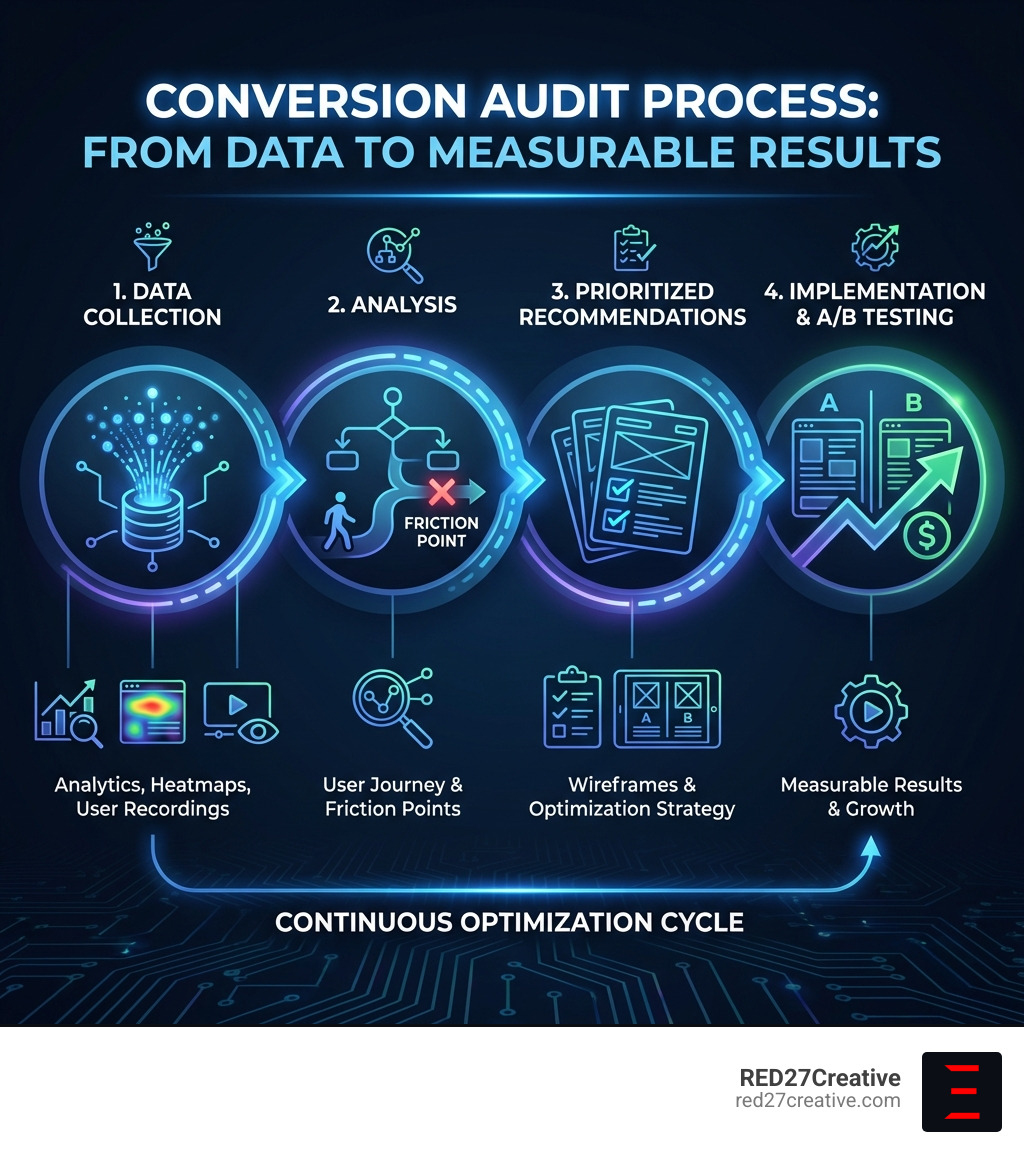
A conversion audit follows a structured, scientific process to uncover opportunities and provide actionable solutions. Our methodology ensures a thorough examination of your digital assets, culminating in a clear roadmap for improvement. The process involves four key steps: data collection, analysis, hypothesis formulation, and recommendations for A/B testing.

Step 1: Data Collection and Goal Setting
An effective audit is built on robust data. We gather quantitative and qualitative insights to understand site performance and user behavior.
- Quantitative Data: We use tools like Google Analytics to track user flow and drop-off points, while heatmaps and session recordings show how users interact with your site.
- Qualitative Data: To understand the “why,” we use surveys, customer feedback, on-site polls, and interviews to uncover pain points.
This step also involves defining your objectives and business goals. Establishing baseline metrics is crucial for measuring the impact of changes. This approach is fundamental to Data Driven Web Design.
Step 2: Analysis and Identifying Friction Points
With comprehensive data collected, we analyze it to pinpoint friction points and missed opportunities in your conversion funnels.
We conduct a user journey analysis to map visitor paths and identify where they get stuck, confused, or lost. We look for:
- Funnel Drop-off Points: Where are users abandoning the process (e.g., checkout, lead form)?
- Usability Issues: Are there elements of the site that are difficult to use, confusing, or broken? This can include navigation, form fields, or interactive elements.
- Messaging Clarity: Is your value proposition clear? Is the copy persuasive? Does it resonate with your target audience?
- Technical Glitches: Are there any technical errors or slow loading elements hindering the user experience?
Identifying these bottlenecks explains why your site isn’t converting effectively. Understanding the user journey is vital for optimization, as detailed in our Complete Digital Marketing Funnels Guide.
Step 3: Hypothesis, Prioritization, and Recommendations
Once friction points are identified, we formulate and prioritize hypotheses—educated guesses on changes that will improve conversions—based on potential impact and effort.
- Creating Testable Ideas: We turn problems into testable solutions. For example: “Reducing form fields by 30% will increase completions by 15%.”
- Prioritizing Fixes by Impact: We prioritize recommendations based on the biggest impact for reasonable effort, ensuring quick wins alongside long-term optimizations.
- Actionable Report and Roadmap: Our conversion audit services deliver a detailed report with clear, actionable recommendations, often including wireframes or mockups. This report is your strategic roadmap for optimization.
We provide comprehensive documentation with visuals, and our expertise in Marketing Strategy and Consulting Services ensures recommendations align with your business objectives.
The Core Components of Professional Conversion Audit Services
Our conversion audit services examine every website element through the lens of conversion. This holistic approach ensures we optimize your digital performance thoroughly.
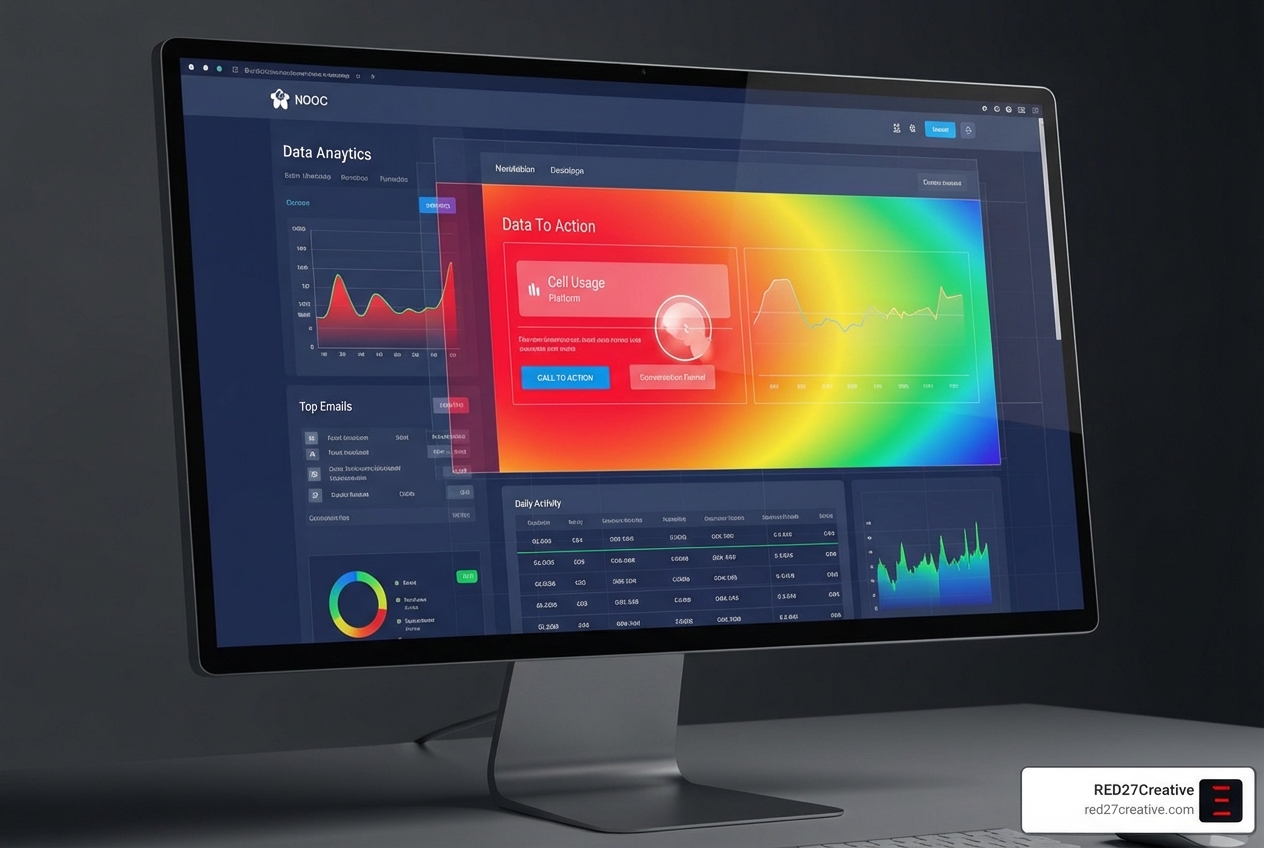
Key areas of examination include:
- Website Design and Navigation: Is it intuitive? Does it guide users effectively towards conversion goals?
- Page Speed: Does your site load quickly, especially on mobile devices?
- Mobile Optimization: Is your website fully responsive and user-friendly on all screen sizes?
- Calls-to-Action (CTAs): Are they clear, compelling, and strategically placed?
- Copywriting: Is your messaging persuasive, clear, and does it address user anxieties?
- Checkout Process: Is it streamlined, simple, and secure?
Technical and Performance Analysis
Technical issues can silently sabotage conversions. Our audit examines your site’s technical backbone to ensure it’s not hindering the user experience.
- Page Load Time: A 1-second delay can reduce conversions by 7%. We use tools like GTmetrix to analyze speed and identify slowdowns.
- Mobile Responsiveness: Your site must offer a perfect mobile experience. Mobile optimization can boost conversions by up to 69%.
- Browser Compatibility: We ensure your site works flawlessly on all browsers and devices to prevent user frustration.
- SSL Certificate: A secure (HTTPS) site is non-negotiable for building trust and driving conversions.
These technical foundations are crucial for UX and SEO. Learn more about SEO Website Design.
User Experience (UX) and Funnel Analysis
Beyond technicals, a deep dive into user experience is paramount. We analyze how users interact with content and move through conversion funnels.
- Homepage: Does it make a strong first impression with a clear value proposition that guides visitors effectively?
- Category and Product Pages: Are products well-organized with clear filters and compelling descriptions? Baymard Institute notes 46% of top e-commerce sites have poor product list content.
- On-Site Search: Is your search function prominent and effective at helping users find what they need?
- Checkout Flow and Form Fields: Simplifying the average 5.2-step, 11.8-field checkout can drastically reduce abandonment. 18% of users abandon orders due to a complex process, and a “Guest Checkout” option is critical.
Our analysis creates a seamless journey, turning your site into a conversion machine. This focus is central to building Conversion-Focused Websites.
Differentiating a Conversion Audit from Other Analyses
It’s easy to confuse a conversion audit with other types of website analysis, but their focus and outcomes differ significantly. Understanding these distinctions helps you appreciate the unique value of conversion audit services.
| Feature | Conversion Audit | SEO Audit | UX Review |
|---|---|---|---|
| Primary Focus | Maximizing the percentage of visitors who complete a desired action (e.g., purchase, lead) | Improving search engine rankings and organic traffic | Enhancing overall user satisfaction and ease of use |
| Main Goal | Increase revenue, leads, and sales from existing traffic | Increase visibility in search results, drive more qualified traffic | Make the website more intuitive, efficient, and enjoyable for users |
| Key Metrics | Conversion rates, revenue, average order value, lead quality, cart abandonment | Organic traffic, keyword rankings, domain authority, crawlability | User satisfaction scores, task completion rates, error rates, time on task |
| Methodology | Data analysis (analytics, heatmaps, recordings), user research, hypothesis testing, A/B testing | Technical SEO, content analysis, backlink profile, keyword research, competitor analysis | Usability testing, heuristic evaluation, user interviews, wireframing |
| Outcome | Prioritized list of actionable changes to boost conversions, A/B test roadmap | Recommendations for improving search engine visibility and organic traffic | Insights into user behavior and pain points, design recommendations |
While there’s overlap (good UX and SEO help conversions), a conversion audit is uniquely focused on generating revenue from existing traffic. It’s an action-oriented process to fix leaks in your sales funnel. For more on SEO, explore our Advanced SEO Services.
The Business Case: ROI, Timelines, and Who Should Invest
Investing in conversion audit services comes down to the business case: ROI, timeline, and fit. We’re here to provide clarity. A conversion audit is a strategic investment in your bottom line. It fixes issues causing lost sales, making your site an effective selling machine and increasing the value of your marketing spend.
How Can a Conversion Audit Help Identify and Fix Issues Leading to Lost Sales or Leads?
The audit is a diagnostic tool. By analyzing data and user behavior, we pinpoint where customers face obstacles, from confusing descriptions to cumbersome checkouts. For example, if a landing page has a high bounce rate, the audit investigates why—is the message unclear, the design poor, or are there distractions? We then provide precise, data-driven recommendations (e.g., simplifying the headline, improving page speed) to solve real problems costing you sales.
What are the Potential ROI and Long-Term Benefits of Implementing Recommendations from a Conversion Audit?
The ROI from a conversion audit is compelling, with businesses seeing up to a $10 return for every $1 spent. This return comes from optimizing your existing website to better convert the traffic you already have.
The long-term benefits are equally significant:
- Compounding Growth: Small improvements compound over time, leading to substantial revenue gains.
- Sustainable Business Model: An optimized site is less reliant on increasing traffic, making your business more resilient.
- Deeper Customer Understanding: Audit insights into customer behavior are invaluable for future marketing and product development.
- Improved Marketing Efficiency: A better-converting website improves paid ad effectiveness, reducing your PPC ROI Optimization.
How Long Does an Audit Take and What is the Outcome?
The duration of our conversion audit services varies by site complexity but generally takes 2 to 6 weeks. This allows for thorough data collection, analysis, and recommendations. Larger audits may take 6-8 weeks.
The expected outcome is always a clear, actionable roadmap for improvement:
- Detailed Report: A comprehensive document with all findings, supported by data.
- Prioritized Action Plan: A list of recommended changes, ordered by impact and effort for quick wins and long-term gains.
- A/B Testing Roadmap: Specific hypotheses and suggestions for A/B tests to ensure continuous optimization.
- Expected Deliverables: Includes mockups, revised copy, and technical specifications.
This methodical approach provides a practical guide to enhancing site performance. Learn more at our Website Design and Development Process page.
Who Should Consider Investing in Conversion Audit Services?
While any online business can benefit, conversion audit services are especially impactful for:
- E-commerce Stores: Struggling with cart abandonment or low average order value.
- B2B Companies: Focused on generating higher quality leads through optimized landing pages and forms. Learn more about our B2B Lead Generation Service Provider.
- SaaS Businesses: Optimizing free trial sign-ups, demo requests, and user onboarding.
- Service-Based Businesses: Local or national firms needing to convert visitors into inquiries and bookings.
- Websites with Traffic But Low Conversions: If you have traffic but visitors aren’t taking action, an audit explains why.
- Businesses Running Paid Ad Campaigns: Ensure landing pages are optimized to convert before spending more on ads.
- Businesses Launching a Redesign: An audit before a redesign ensures the new site is built for conversion.
If your website is underperforming, it’s time for a professional conversion audit.
Frequently Asked Questions About Conversion Audits
What is a conversion audit?
A conversion audit is a systematic review of your website to identify opportunities for increasing the percentage of visitors who complete a desired action, like making a purchase or filling out a form. It uses data analysis and user behavior insights to find and fix “leaks” in your sales funnel.
How does a conversion audit differ from a standard website analysis?
While a standard analysis might look at traffic or technical SEO, a conversion audit focuses specifically on the user journey and psychological triggers that lead to a conversion. It’s less about getting more visitors and more about getting more value from the visitors you already have.
What is the typical ROI from a conversion audit?
The ROI can be significant, as improvements directly impact revenue. While results vary, it’s common for businesses to see returns far exceeding the initial investment. Industry data suggests an average ROI of 10:1, as you are making your existing marketing efforts more effective.
How long does a conversion audit typically take?
The duration of a conversion audit varies based on website complexity, but most comprehensive audits are completed within 2 to 6 weeks. This period allows for thorough data collection, in-depth analysis, and the development of actionable recommendations.
What tools are used in a conversion audit?
Common tools include Google Analytics for quantitative data, heatmaps and session recordings for visual user behavior insights, and surveys or user interviews for qualitative feedback. A/B testing platforms are also crucial for validating hypotheses.
Who performs a conversion audit?
Conversion audits are typically performed by experienced CRO specialists or agencies like RED27Creative. These experts combine analytical skills with an understanding of user psychology, web design, and digital marketing to provide comprehensive insights.
Conclusion: Take the First Step Towards Higher Conversions
In the digital world, your website is your hardest-working employee. But if it’s not optimized for conversions, it’s like having a talented team member who’s constantly distracted or missing key opportunities. Stop guessing why your website isn’t performing and start making data-driven decisions that generate real results.
Conversion audit services provide the clarity you need to transform your website from a passive online presence into a proactive revenue-generating machine. We help you uncover the hidden potential, fix the invisible leaks, and open up significant growth for your business. The first step to fixing conversion issues is identifying them, and a professional audit provides the roadmap to turn your website into a powerful engine for growth and profitability.
Ready to transform your website’s performance and start seeing the conversions you deserve? Contact us today to schedule a consultation and learn how our conversion audit services can benefit your business in Geneva, Batavia, Aurora, St. Charles, Plainfield, Oswego, Naperville, Chicago, and beyond.

Kiel Tredrea
https://red27creative.comTop Marketing Agency • Web, SEO & Leads • RED27Creative