Industrial Digital Marketing: Strategies for Success
The Evolution of Industrial Digital Marketing
Industrial digital marketing refers to the strategic use of digital channels and technologies to promote industrial products, services, and brands to businesses and technical buyers.
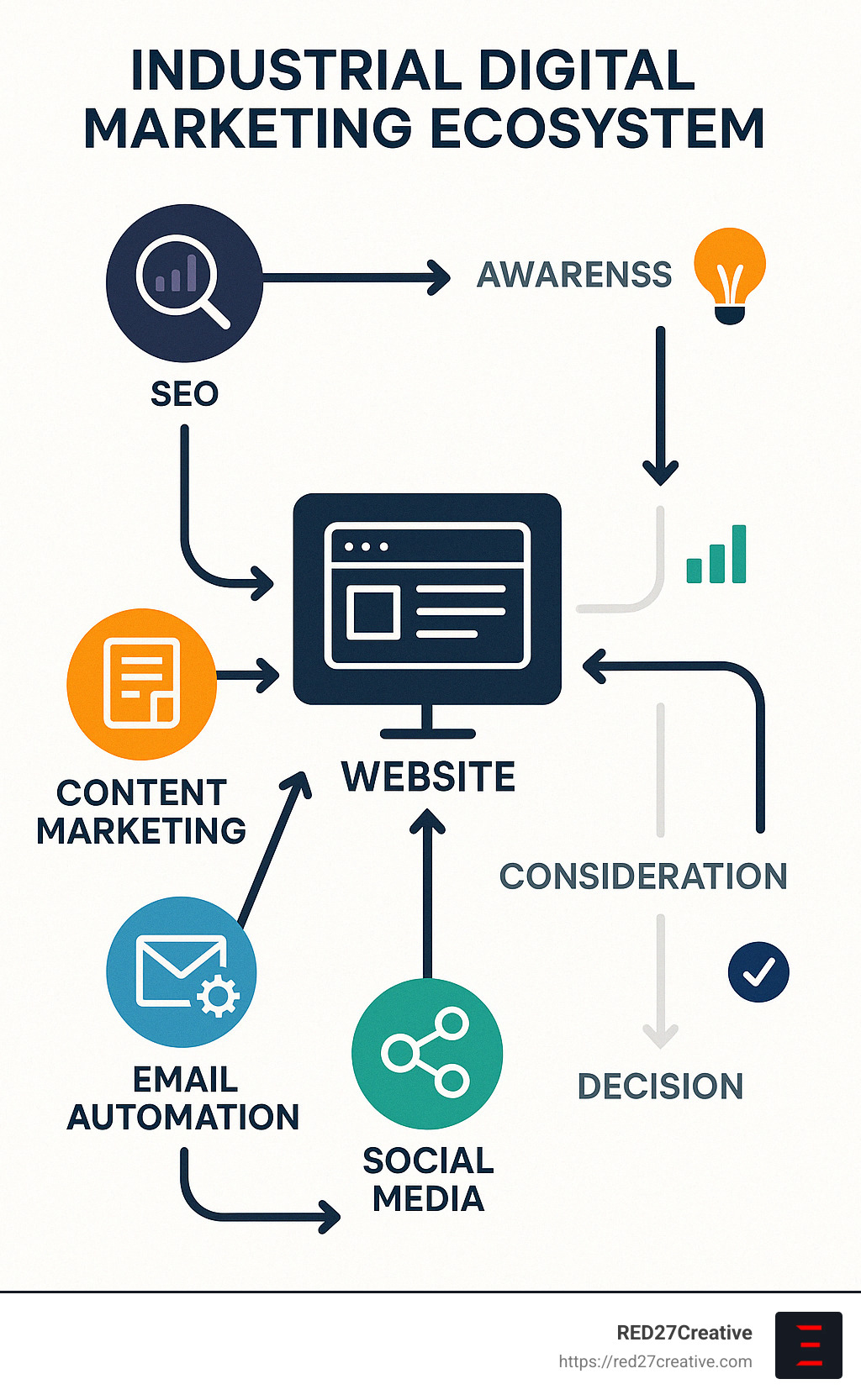
Core elements of industrial digital marketing include:
| Component | Purpose | Key Focus Areas |
|---|---|---|
| Website Optimization | Central hub for technical information | User experience, mobile responsiveness, technical specifications |
| SEO | Visibility in search results | Industry-specific keywords, technical content optimization |
| Content Marketing | Establish authority | Whitepapers, case studies, technical blogs |
| Email Marketing | Nurture leads | Personalized communication, lead scoring |
| PPC Advertising | Targeted visibility | High-intent keywords, specific audience targeting |
| Social Media | Brand awareness | LinkedIn focus, industry engagement |
| Video Marketing | Product demonstrations | Complex concept explanation, technical walkthroughs |
The manufacturing and industrial sectors have traditionally relied on trade shows, word-of-mouth, and direct sales approaches. However, research shows that nearly 70% of the industrial buyer’s journey now happens online before contacting sales. With B2B buyers performing an average of 12 searches before visiting a website, a strong digital presence has become essential.
As the digital landscape evolves, industrial companies must adapt their marketing strategies to remain competitive. According to the Marketing in Manufacturing Survey Report 2025, 73% of manufacturers measure marketing success based on new sales leads, highlighting the critical role of digital lead generation.
I’m Kiel Tredrea, a strategic marketing leader with over 20 years of experience helping industrial companies develop and implement high-impact industrial digital marketing strategies that drive growth, increase brand authority, and generate measurable revenue.
Important industrial digital marketing terms:
- PPC for industrial companies
- lead generation for manufacturing companies
- manufacturing digital marketing services
Understanding Industrial Digital Marketing
Industrial digital marketing isn’t just another buzzword—it’s a transformative approach custom specifically for B2B landscapes. Unlike your typical consumer-focused marketing, it addresses the unique and often complex challenges faced by the industrial sector.
In this arena, marketers deal with intricate products and technical specifications, along with sales cycles that can stretch over months or even years. It’s not a one-person decision either; purchasing involves multiple stakeholders, from engineers to executives, each with their own set of priorities and information needs.
As Chuck LaBounty, Vice President at a manufacturing company, puts it, “The relationship we have with our marketing team is very close and personal. We need partners who truly understand our business and are always looking at our growth opportunities and market trends.”
Industrial digital marketing is distinct because it demands technical depth and an educational focus. Content here isn’t about flashy ads; it’s about demonstrating expertise and answering specific technical questions. The goal is to help buyers understand complex solutions rather than pushing for immediate sales.
Targeting is more strategic too, as it involves multiple stakeholders in the buying process. This means creating content that speaks to different roles, from engineers to the C-suite. Given the long nurturing cycles, it’s about supporting a prolonged period of research and decision-making.
Importantly, the focus is on high-value transactions. It’s not about casting a wide net and hoping for a catch; it’s about reeling in quality leads that matter.
Research highlights that B2B industrial buyers are turning to digital channels more than ever throughout their purchasing journey. The traditional sales-driven approach is being complemented—and oftentimes, replaced—by robust digital strategies. These strategies engage potential buyers early, right when they’re beginning their research process.
For more insights, explore RED27Creative’s services that cater to this evolving domain, ensuring your brand remains competitive and credible in the digital age.
The Importance of Industrial Digital Marketing

The shift toward industrial digital marketing isn’t just a fleeting trend—it’s a seismic change in how industrial buyers research and make purchasing decisions. Let’s explore why this matters so much today.
Changing Buyer Behavior
The journey of a B2B buyer begins long before they ever reach out. On average, they perform 12 searches before even visiting a website. This means your potential customers are actively researching solutions online, and if your business isn’t visible during these crucial early stages, you’re missing out on valuable opportunities.
A wise professional once noted, “Most of the industrial buyer’s journey is done prior to talking to sales (nearly 70%), and most prospective buyers are looking at your website as a part of their research process.” This highlights the vital role a well-optimized online presence plays in the buying cycle.
Competitive Advantage
As 77% of companies pivot to digital methods to improve their online footprint, those who lag behind risk being left in the dust. Yet, many industrial manufacturers still lean heavily on traditional marketing approaches, opening the door for forward-thinking companies to seize a competitive edge. For example, a manufacturing company that accepted a comprehensive digital marketing strategy reported an astonishing 401% increase in organic search traffic within just a year. They excitedly shared, “Our bottom line has greatly increased! The impact has been dollars—we’re busier than we’ve ever been. And out-of-state sales are high.”
Building Trust and Credibility
Industrial purchases aren’t just transactions—they’re significant investments involving long-term commitments. Buyers need confidence in your company’s ability to deliver. A robust digital presence builds this trust by offering detailed product information, case studies of successful implementations, and technical content that underscores your expertise. Transparent communication about both capabilities and limitations further solidifies credibility.
Measurable Results
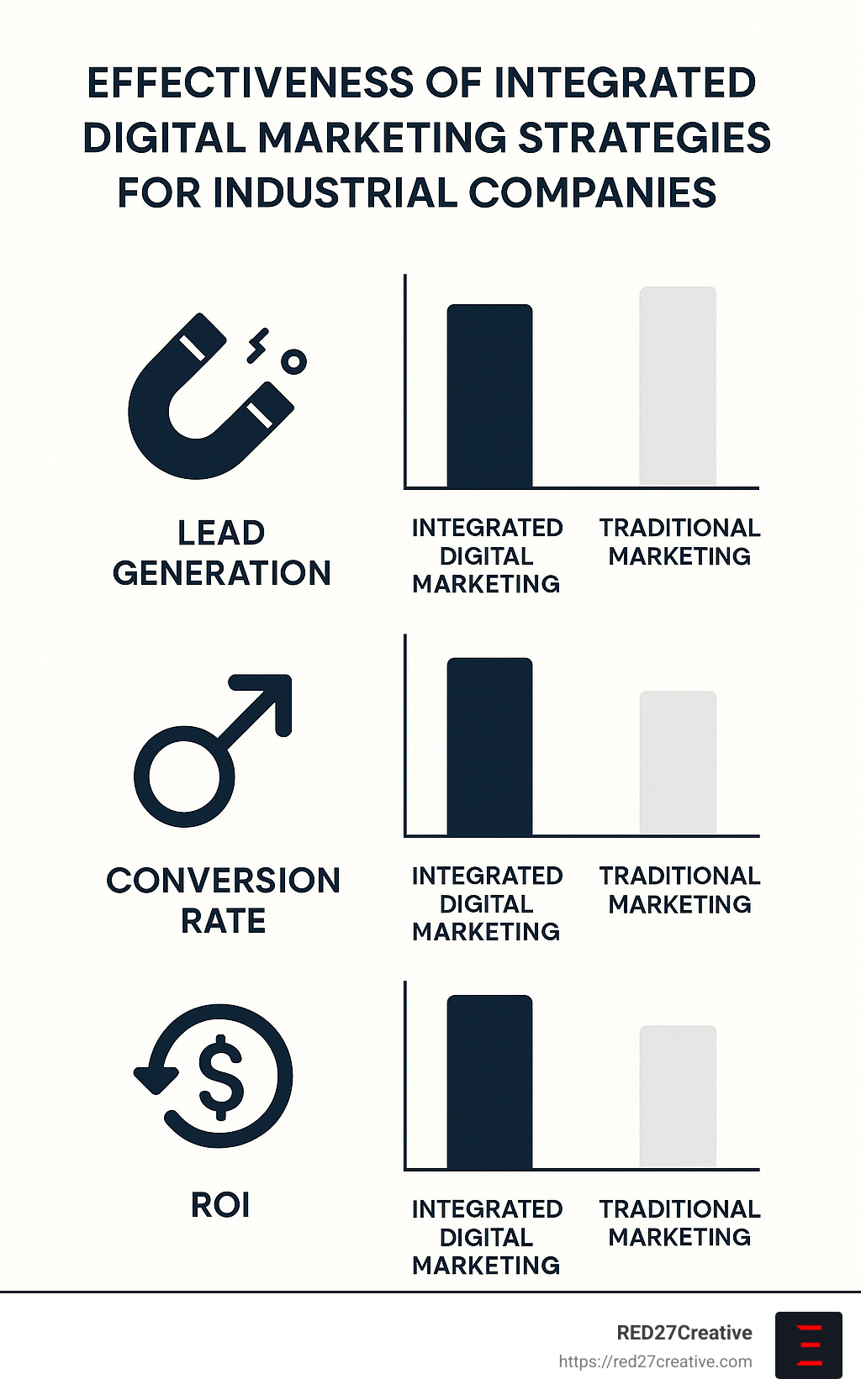
Unlike the somewhat elusive nature of traditional marketing methods, industrial digital marketing offers tangible data to gauge effectiveness. This paves the way for continuous optimization and a better return on investment. According to Salesforce, 92% of B2B marketers have jumped on the Account-Based Marketing (ABM) bandwagon, and 68% use automation to track and improve their results. One industrial company shared their success, stating, “With our digital marketing partner running our lead generation efforts and marketing, our sales increased by 60% in just one year. They maximized our company exposure, drove a record number of qualified leads, and helped us turn these opportunities directly into sales dollars.”
In the changing landscape of digital marketing, embracing change isn’t optional—it’s essential for staying competitive and driving growth.
For more insights, explore the latest research on B2B buyer behavior.
Key Components of an Effective Industrial Digital Marketing Strategy
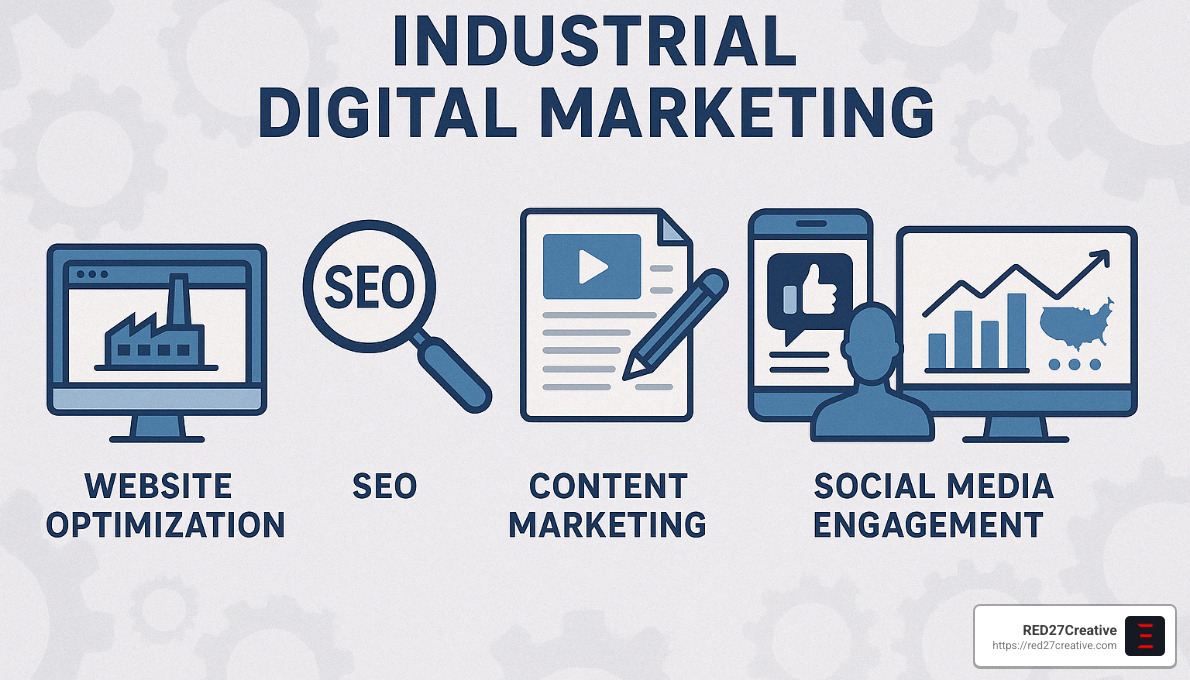
Creating a successful industrial digital marketing strategy is like orchestrating a symphony where each instrument plays a crucial role. Every element complements the others, crafting a seamless experience to attract, engage, and convert industrial buyers.
Website Optimization
Consider your website the heart of your digital marketing strategy—it never sleeps and is always ready to welcome visitors. For industrial companies, website optimization is more than just pretty pictures. It’s about delivering the right information effectively. Your site should be easy to steer, allowing visitors to find technical details swiftly. And let’s not forget speed—pages should load quickly because nobody has time to wait. Plus, with more folks using mobile devices, your site must dance gracefully across all screens. Finally, ensure ADA compliance to make sure everyone can engage with your content.
Search Engine Optimization (SEO)
Imagine SEO as your digital megaphone. It’s how the right people find you in the vast world of search results. For industrial companies, SEO isn’t just about keywords. It’s about finding those magical phrases your potential customers use when they’re looking for solutions. Dive into technical SEO to ensure your site speaks to search engines in their language. Local SEO can also give you a boost if you’re targeting specific regions. Want more details? Check out our SEO marketing services.
Content Marketing
In the industrial world, knowledge truly is power. Content marketing is your chance to shine as an authority. Whether it’s technical blogs that solve industry puzzles or white papers that dig into the nitty-gritty, content is king. Video demonstrations can show your products in action, while case studies can highlight how you’ve made a difference. The trick is to create content that informs and engages. For more on tapping into the power of content, explore our Content Marketing for Manufacturers.
Email Marketing
Email marketing is like having a friendly conversation over a virtual cup of coffee. It’s your chance to build and nurture relationships. By segmenting your audience, you can tailor messages to speak directly to each recipient’s needs. Automation can keep the conversation going without you lifting a finger. And remember, personalization goes a long way. Instead of just selling, offer value with technical insights and updates.
Pay-Per-Click Advertising (PPC)
PPC is your shortcut to immediate visibility. Imagine a spotlight that shines directly on your target audience. With highly targeted keywords, you reach those eager to buy. Craft campaigns with dedicated landing pages to seal the deal. And don’t forget remarketing to re-engage those who left without saying goodbye. This approach ensures your investment leads to tangible results. Want to dive deeper into PPC? Find more about PPC for industrial companies.
Social Media Marketing
Social media is all about joining the right conversations. While not every platform suits industrial companies, LinkedIn is a goldmine for B2B interactions. Share industry-specific content, engage in professional groups, and position your team as thought leaders. Encourage employee advocacy and use targeted ads to expand your reach. As you do, social media is more about connection than perfection.
Video Marketing
In the age of visuals, video marketing lets you tell your story in a compelling way. Whether you’re showcasing products or offering technical tutorials, video can simplify complex concepts. It’s like taking your audience on a virtual tour of your capabilities. Videos can be shared across platforms, enhancing engagement and understanding.
Conversion Rate Optimization (CRO)
CRO is about turning interest into action. By refining your site, you can boost the percentage of visitors who become leads. Implement A/B testing to see what resonates best. Simplify forms, emphasize your value propositions, and use trust signals like testimonials. Strategic call-to-action placement can guide visitors to the next step, making the journey seamless and rewarding.
In industrial digital marketing, each component is a vital piece of the puzzle. By weaving together these strategies, you can create a digital presence that resonates with potential buyers and drives real results.
Developing Your Industrial Digital Marketing Strategy
Creating a powerful industrial digital marketing strategy is like building a robust machine—it requires precise planning and a well-structured approach. At RED27Creative, we’ve honed a six-step process to craft strategies that resonate with our industrial clients.
Step 1: Analyze Your Current Growth Strategy
The first step is to take a magnifying glass to your current digital footprint. Start by examining your website performance, checking metrics like traffic and user behavior. Get a grip on your SEO status by evaluating your current rankings and spotting potential opportunities. Dive into a content assessment—how effective is your existing material, and where are the gaps? Don’t forget a competitor analysis to understand what’s working for others. Finally, evaluate your lead generation efforts to measure both the volume and quality of your leads. At RED27Creative, we use tools like Google Analytics to guide industrial companies in Naperville and beyond, establishing baseline metrics that pave the way for informed decisions.
Step 2: Define Your Target Audience
Knowing your audience is crucial in industrial marketing. Develop detailed buyer personas to zero in on the right decision-makers. Consider job roles like engineers and procurement specialists, and identify the industry sectors you serve. Pinpoint company sizes that match your ideal customer. Understand their technical challenges and what information they need. Lastly, uncover their decision criteria. One of our clients learned through this process that engineers were their main users, but procurement managers held the decision-making power. By tailoring content for both, they saw an uptick in engagement.
Step 3: Integrate Marketing with Sales
In industrial sectors, integrating marketing with sales is like adding the perfect lubricant to your gears—it reduces friction and boosts efficiency. Start by implementing a CRM system to track leads from start to finish. Develop a lead scoring system to qualify these leads based on engagement. Establish Service Level Agreements (SLAs) to ensure smooth lead handoff. Keep both teams aligned with shared metrics and foster collaboration through regular communication. Megan Sherwood emphasizes the power of having marketers who drive strategy and execution. Our clients in Plainfield and Oswego have benefited from systems that improve lead quality and shorten sales cycles.
Step 4: Leverage Marketing Technology
Let’s turbocharge your strategy with the right tech tools. Use marketing automation platforms to streamline tasks and nurture leads. Employ CRM systems to manage relationships and track sales. Tap into analytics tools for performance insights, and wield SEO software for ranking boosts. A content management system can simplify updates and publishing. With 76% of companies using digital marketing automation, it’s a game-changer, especially for those with tight-knit marketing teams. At RED27Creative, we assist clients in selecting and implementing tech solutions that mesh seamlessly with existing systems, ensuring smooth data flow and maximum efficiency.
Step 5: Establish Metrics and Goals
Set your sights on clear, measurable objectives. Lead generation metrics like qualified leads and cost per lead are key indicators. Track your website performance—keep an eye on traffic and engagement. Monitor conversion rates and SEO results to ensure you’re on the right path. Stay attuned to content engagement metrics like downloads and views. Most importantly, measure your ROI to track your marketing investment. Setting SMART goals helps maintain focus. One manufacturing client aimed to boost their qualified leads by 35% in six months—and with our strategy, they exceeded it.
Step 6: Continuous Improvement through A/B Testing
Think of digital marketing as a never-ending journey of optimization. A/B testing allows you to tweak and refine your approach continuously. Experiment with website design elements like layout and colors. Test various call-to-action placements and email content to find what resonates. Explore different ad copy to find impactful messages. Adjust your landing pages for maximum conversion. For instance, an equipment manufacturer in Batavia boosted their form submissions by 36% by experimenting with form lengths and call-to-action positioning. This methodical approach ensures ongoing improvements and compound results over time.
Advanced Industrial Digital Marketing Strategies
As your digital marketing matures, consider implementing these advanced strategies to further improve your results:
Account-Based Marketing (ABM)
ABM focuses resources on targeting and converting specific high-value accounts rather than casting a wide net. This approach is particularly effective for industrial companies with clearly defined target markets.
According to Salesforce, 92% of B2B marketers now have an ABM program. Key elements include:
- Target account identification: Selecting specific companies that match your ideal customer profile
- Personalized content creation: Developing materials custom to each target account
- Multi-channel coordination: Ensuring consistent messaging across all touchpoints
- Sales and marketing alignment: Working together to engage key stakeholders
- Detailed tracking and measurement: Monitoring engagement at the account level
One industrial manufacturer we worked with implemented an ABM strategy targeting 50 high-value prospects. Within six months, they had engaged with decision-makers at 35 of these companies and converted 12 into customers—representing more revenue than their previous 100 general leads combined.
Emerging Trends
Staying ahead of digital trends can provide competitive advantages. Key emerging technologies for industrial digital marketing include:
- Artificial Intelligence (AI): Using machine learning to personalize content and predict buyer behavior
- Virtual Reality (VR): Creating immersive product demonstrations and facility tours
- Internet of Things (IoT): Leveraging connected devices for data collection and customer insights
- Sustainability messaging: Highlighting environmental benefits and corporate responsibility
- Voice search optimization: Adapting content for voice-based queries
As one industrial marketing expert notes: “Digital marketing isn’t just about having a website or launching trendy social media campaigns—it requires a strategic, integrated approach that evolves with technology.”
At RED27Creative, we help industrial companies in Chicago and throughout Illinois evaluate and implement emerging technologies that align with their business objectives and customer expectations.
Challenges in Industrial Digital Marketing
While industrial digital marketing offers tremendous opportunities, it also presents unique challenges:
Complex Products and Services
Industrial products often involve complex specifications and applications that can be difficult to communicate effectively online. Addressing this challenge requires:
- Breaking down technical information into digestible content
- Using visual elements like diagrams, videos, and 3D models
- Creating content for different technical levels
- Providing detailed specifications while highlighting key benefits
Long Sales Cycles
Industrial purchases typically involve extended decision-making processes. Digital marketing must support these longer cycles through:
- Developing content for each stage of the buying journey
- Implementing nurturing campaigns that maintain engagement over time
- Setting appropriate timeframes for measuring marketing effectiveness
- Extending remarketing durations (90+ days) to match sales cycles
Finding the Right Target Audience
The industrial market is often highly specialized, making precise targeting essential. Strategies include:
- Using very specific, high transactional intent keywords
- Narrowing audience targeting geographically and by industry
- Leveraging industry directories and publications
- Implementing account-based marketing for key prospects
Tracking ROI
Connecting marketing activities to revenue can be challenging when sales cycles extend over months. Solutions include:
- Implementing robust attribution models
- Setting intermediate conversion points (downloads, demo requests)
- Establishing clear lead scoring systems
- Creating dashboards that track the entire customer journey
Integrating Traditional and Digital Methods
Many industrial companies have established traditional marketing programs that must be integrated with new digital initiatives. Successful integration involves:
- Ensuring consistent messaging across all channels
- Using digital tools to improve trade show and event effectiveness
- Creating digital follow-up systems for traditional touchpoints
- Gradually shifting budget allocation based on measured results
As one manufacturing VP noted: “The relationship we have with our digital marketing team has been very close and personal. They understand our traditional business and help us evolve while respecting our established methods.”
At RED27Creative, we specialize in helping industrial companies in Aurora, Geneva, and throughout Illinois steer these challenges and develop effective industrial digital marketing strategies that drive measurable growth.
Frequently Asked Questions about Industrial Digital Marketing
What is Industrial Digital Marketing?
Industrial digital marketing refers to the use of online strategies to promote industrial products and services, targeting B2B customers through channels like SEO, content marketing, and PPC. It differs from consumer marketing by focusing on technical specifications, longer sales cycles, and multiple decision-makers in the buying process. Effective industrial marketing blends technical expertise with digital best practices to generate qualified leads and support complex sales processes.
How does digital marketing complement the industrial manufacturing buying cycle?
Digital marketing supports the industrial buying cycle by providing valuable information online, nurturing leads over long sales cycles, and helping buyers make informed decisions with engaging content. Since nearly 70% of the industrial buyer’s journey happens before contacting sales, digital marketing ensures your company is visible during the research phase. It also helps maintain engagement throughout extended decision-making processes, often involving 6-10 stakeholders, each requiring different types of information.
How can manufacturers measure the success of their digital marketing efforts?
Manufacturers can measure success through analytics tools by tracking KPIs such as website traffic, conversion rates, lead generation, and ROI from various digital campaigns. Specific metrics to monitor include:
- Lead quantity and quality (including cost per lead)
- Website engagement (time on site, pages per session)
- Conversion rates at different funnel stages
- Search engine rankings for target keywords
- Content engagement metrics (downloads, video views)
- Email performance (open rates, click-through rates)
- Social media engagement and growth
- Overall marketing ROI and customer acquisition cost
For industrial companies with longer sales cycles, it’s important to track both leading indicators (engagement metrics) and lagging indicators (actual sales and revenue).
What digital marketing services do industrial companies need most?
Industrial companies typically benefit most from a comprehensive approach that includes:
- A technically-focused, user-friendly website
- SEO targeting industry-specific keywords
- Content marketing that demonstrates expertise
- Email marketing for lead nurturing
- PPC advertising for immediate visibility
- LinkedIn-focused social media strategies
- Video marketing for product demonstrations
- Marketing automation to support long sales cycles
The specific mix depends on your company’s goals, target audience, and competitive landscape. At RED27Creative, we customize digital marketing strategies for each industrial client based on their unique needs and objectives.
How much should manufacturers spend on digital marketing?
Digital marketing budgets for manufacturers typically range from 2-10% of revenue, depending on growth goals and competitive factors. For most industrial companies, a starting budget of 3-5% of revenue is appropriate, with allocation adjusted based on performance data. Marketing budgets can be broken down into Lean (1–2% of revenue), Target (3–4%), or Stretch (5%+) plans. Real-world agency retainers for comprehensive services typically range from $5,000 to $15,000 per month.
Conclusion
Industrial digital marketing has evolved from being a nice-to-have to a must-have for manufacturers and industrial companies. With a whopping 77% of companies using digital methods and B2B buyers doing deep dives online before they even think about talking to sales, having a robust digital presence is no longer just a feather in your cap—it’s essential for survival and growth.
One savvy industrial marketing expert summed it up perfectly: “Digital marketing is indispensable for industrial brands to remain competitive and grow online.”
The most successful industrial companies are those embracing comprehensive digital strategies. They’re integrating website optimization, SEO, content marketing, email nurturing, PPC advertising, and even dipping their toes into emerging technologies. It’s about aligning these digital efforts seamlessly with sales processes and measuring results to keep raising the bar.
At RED27Creative, we specialize in helping industrial companies across Chicago, Geneva, Aurora, St. Charles, Plainfield, Oswego, Naperville, and Batavia craft and implement digital marketing strategies that truly deliver. We get the unique problems of industrial marketing and bring both technical know-how and digital savvy to every partnership.
Embracing industrial digital marketing strategies is key for achieving lasting growth and carving out a competitive edge in today’s digital arena. By implementing these strategies, manufacturers can boost their online presence and drive results that really hit home.
Want to boost your industrial company’s digital footprint? Reach out to RED27Creative to see how our SEO Marketing Services and extensive digital marketing solutions can propel you toward your growth targets.

Kiel Tredrea
https://red27creative.comTop Marketing Agency • Web, SEO & Leads • RED27Creative